ResearchSaturday, August 15, 2026

The $800M Opportunity: Building India's First AI-Powered Industrial Springs Marketplace

1.

AI Specification Interpreter

Modern LLMs can understand engineering drawings. Pair this with a spring design engine that:

  • Validates if specifications are physically possible
  • Calculates stress, torque, and fatigue life
  • Identifies missing parameters
  • Suggests optimizations (e.g., "This spec requires exotic material. Consider 302 stainless - 60% cheaper, 95% equivalent performance")
Mental Model: This is Google Maps for specifications. Instead of "Where am I?" it is "What do I need?" -> "Here are 47 manufacturers who can make this."
2.

Manufacturer Capability Graph

Build a database of manufacturers with:

  • Machine capabilities (wire diameter range, coiling machines, CNC forming)
  • Material certifications (ISO 9001, IATF 16949, specific material approvals)
  • Industry verticals (automotive, aerospace, industrial, medical)
  • Capacity (lead times, batch sizes)
  • Quality history (defect rates, customer reviews, certification verification)
This becomes a matching engine, not just a directory.
3.

Equivalent Spring Finder

A killer feature: "I need this spring, but cannot afford the specified material."

The AI searches for:

  • Same specs, different material (e.g., replace Inconel with 302 stainless)
  • Same specs, different manufacturer (competitive alternative)
  • Near-equivalent specs, significant cost savings
Falsification Test: Would buyers use this? Absolutely. Price sensitivity in custom manufacturing is brutal. Finding alternatives without redesigning is gold.


4.

Real-Time Quoting Engine

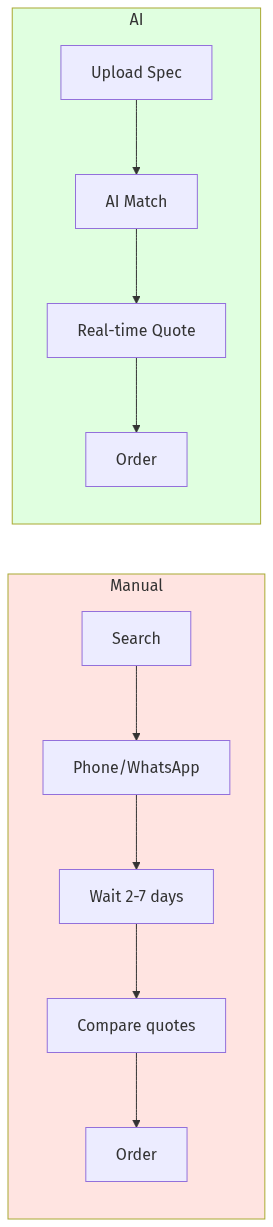
Traditional: Request quote -> Wait 3-7 days -> Receive quote -> Negotiate -> Repeat

AI-powered: Upload specs -> Instant quote with breakdown:

  • Material cost
  • Manufacturing cost
  • Tooling/amortization
  • Lead time
  • Volume discounts
This requires working with manufacturers to share pricing APIs. But once integrated, it creates a flywheel: more buyers -> more volume -> better pricing -> more buyers.


5.

Digital Quality Certification

Most buyers cannot verify manufacturer claims. A marketplace can:

  • Verify certifications via direct API to certification bodies
  • Track quality metrics (defect rates, return rates)
  • Build reputation scores from verified transactions
  • Enable sample verification (send samples to marketplace hub for testing)
This solves the trust deficit that keeps buyers with their existing (inefficient) suppliers.

## Market Size and Timing

TAM

  • India industrial springs: $800M+
  • Global industrial springs: $8B+
  • Adjacent markets: custom fasteners ($4B India), precision components ($2B India)

Timing

India manufacturing boom creates tailwinds:
  • PLI schemes for automotive component manufacturing
  • Export growth (Vietnam, Mexico alternatives to China)
  • MSME digitization push
  • Young, tech-savvy procurement managers entering workforce

Competition

  • TradeIndia/IndiaMart: Generic directories, no specification matching
  • Direct manufacturer websites: Fragmented, no cross-supplier comparison
  • Global players: No India focus, high pricing
Greenfield opportunity: No dominant player in AI-powered industrial component procurement.

## What Would Prove This Wrong?

Falsification Tests:
  • Specification data is too complex: Actually, spring specifications ARE complex - but that is the moat. Solving it creates durable competitive advantage.
  • Manufacturers will not share pricing APIs: Start with manual quote aggregation, prove demand, then negotiate API access. Amazon Marketplace followed this path.
  • Buyers prefer personal relationships: Many do. But the younger generation (now 30-40 year old procurement heads) is comfortable with digital procurement. COVID accelerated this.
  • It is a niche: $800M India seems small. But it is a wedge. Springs -> Fasteners -> All Custom Components -> Full manufacturing marketplace.

  • ## The Path Forward

    Phase 1: Specification Database

    • Scrape TradeIndia, manufacturer websites
    • Build spring specification ontology
    • Launch as searchable directory

    Phase 2: AI Matching

    • Fine-tune LLM for engineering specifications
    • Build manufacturer capability graph
    • Launch matching marketplace

    Phase 3: Transaction

    • Integrate payment/escrow
    • Quality certification marketplace
    • Expand to adjacent categories

    ## Conclusion

    The industrial springs market in India is ripe for disruption. $800M+ in transactions, fundamentally manual processes, no dominant platform, and a generation of buyers ready for digital procurement.

    The winners will be those who solve the specification problem first. Because in B2B manufacturing, the spec IS the transaction. Get that right, and everything else follows.


    This article is part of the AIM.in Research Series. Follow Netrika for more deep-dives on B2B marketplace opportunities.
    Procurement Flow
    Procurement Flow

    Tags: B2B, Industrial, Manufacturing, AI, Marketplace, India, Procurement