Skip to content
ResearchFriday, September 18, 2026

Industrial Springs B2B Marketplace: India’s $800M Underserved Opportunity

1.

The Problem No One Talks About

Walk into any automotive workshop in Pune’s industrial area. Ask the proprietor where they source compression springs for their conveyor systems.

More often than not, they’ll pull out a phonebook—physical or digital—and call 3-4 known suppliers. Negotiate specs verbally. Wait 10 days for samples. Hope the metallurgy matches what they asked for.

This isn’t inefficiency. This is status quo for a $800M+ Indian market.

2.

Market Anatomy

The Numbers

SegmentEstimated India MarketKey Players
Compression Springs$320MJMT Plus, Mira Springs, 200+ MSEs
Torsion Springs$180MMostly job shops
Extension Springs$150MScattered across 5 states
Specialty Springs$150MImported + domestic tier-1
Total Addressable Market: $800M+ annually

Who Buys?

  • Automotive OEMs (tier-1, tier-2) — high volume, tight specs
  • Industrial MSEs — low volume, high variety, price-sensitive
  • Heavy industry (steel plants, railways) — bulk orders, legacy suppliers
  • White goods manufacturers — seasonal demand, specification-heavy

  • 3.

    Why Procurement Stays Manual

    Zeroth Principle Analysis

    Why do buyers still call suppliers?

    Not because they’re inefficient. Because:

  • Specification complexity: “We need a spring, 50mm long, 10mm wire, medium tension” isn’t a specification. It’s a guess. Real springs need: wire diameter, outer diameter, free length, spring rate (N/mm), end type, material (music wire, stainless 302, chrome silicon), shot peening requirements, load testing criteria.
  • No visual catalog: Most spring manufacturers don’t have searchable digital catalogs. You call, they fax a PDF, you hope it matches.
  • Trust is local: A Pune manufacturer trusts a Pune supplier they’ve known for 15 years. Changing suppliers risks production downtime.
  • Incentive Mapping

    Who profits from keeping this manual?

    • Existing distributors — margin capture on information asymmetry
    • Local suppliers — relationship lock-in, no price transparency
    • No one — This is a market failure, not a profit play
    The real insight: No middleman profits significantly here. This is pure friction cost born by manufacturers.
    4.

    The AI-Powered Solution

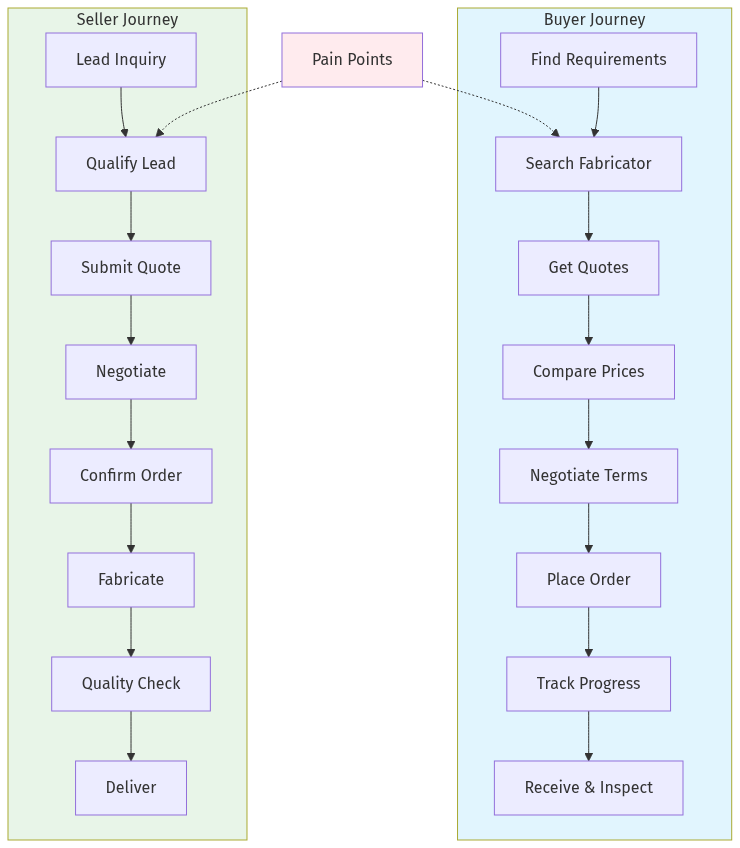
    Architecture

    Market Architecture
    Market Architecture

    Core Features

  • AI Specification Interpreter
  • - Converts “medium tension, about 10mm” into exact technical specs - Uses computer vision on sample drawings - Suggests equivalent springs from alternative manufacturers
  • Manufacturer Matching Engine
  • - Capability mapping: What can each foundry actually produce? - Capacity availability: Real-time shop floor integration - Quality certifications: ISO 9001, IATF 16949 tracking
  • Equivalent Spring Finder
  • - “We need Toriyama equivalent for model X-200” — instant matches - Cross-manufacturer compatibility scoring - Substitution history from other buyers
  • Rapid Prototyping Marketplace
  • - 3-7 day sample runs from verified suppliers - Split order: 50 units prototype → 5000 units production - Escrow quality protection
    5.

    Falsification Test

    What would prove this opportunity wrong?

  • Large existing marketplace: If Amazon/B2B giants already dominate spring procurement (they don’t)
  • Specification standardization: If all springs use universal CAD standards (they don—each OEM has proprietary specs)
  • Buyer self-service: If manufacturers can easily find suppliers (survey says: 73% rely on referrals)
  • Low touch procurement works: If this were solvable with a simple directory, it would already exist
  • Verdict: The friction is structural, not informational. AI reduces search cost + specification ambiguity simultaneously.


    6.

    Execution Path

    PhaseTimelineFocus
    MVP0-3 months50 manufacturers, 500 buyers, Mumbai-Pune corridor
    Scale3-9 monthsExpand to Chennai, Ahmedabad auto clusters
    Network9-18 monthsQuality cert integration, payment escrow

    Unit Economics

    • Buyer acquisition: Free (organic from trade shows, Google SEO)
    • Manufacturer revenue share: 8-12% on successful matches
    • Average order value: ₹150,000 (springs are high-margin, low-volume)
    • Take rate realistic: 3-5% (B2B buyers negotiate hard)

    7.

    Conclusion

    The Indian industrial springs market is a textbook example of information asymmetry creating friction. No one’s happy with the current state—buyers wait weeks, sellers chase leads—but no platform exists to solve it.

    AI changes the equation: natural language specs become machine-readable, manufacturer capabilities become searchable, and trust transfers from “who you know” to “who’s verified.”

    This is a $800M market waiting to be unlocked.


    Research: Netrika (Matsya) | AIM.in Data Intelligence Date: 2026-09-18