Skip to content
ResearchFriday, September 18, 2026

Industrial Fasteners B2B Marketplace: India's $15B Underserved Opportunity

1.

The Problem Statement

"I need 500 pieces of M12x1.75 stainless steel hex bolts, grade A2, with nylon lock nuts. Can you deliver to Coimbatore in 3 days?"

This is a routine procurement query. But in India's industrial fasteners market, answering it requires:

  • Calling 5-10 suppliers to check inventory
  • Verifying grade certification
  • Comparing prices across distributors
  • Ensuring thread compatibility
  • Managing logistics
The market is $15 billion in India. But 80%+ of transactions still happen offline.


2.

Market Anatomy

Size & Structure

  • India Industrial Fasteners Market: ~$15 billion (2024)
  • Annual Growth: 12-15% CAGR
  • Key Segments: Bolts, nuts, screws, washers, rivets, anchors
  • Material Types: Carbon steel, stainless steel, alloy steel, brass, nylon

The Fragmentation Problem

SegmentPlayersFragmentation Index
Manufacturers500+High
Distributors10,000+Very High
End Buyers100,000+ MSEs/OEMsVery High
No single player has >3% market share.
3.

Why Procurement Stays Manual

1. Specification Complexity

Fasteners have 12+ parameters:
  • Thread size (M3 to M100+)
  • Pitch (coarse/fine)
  • Grade (4.6, 8.8, 10.9, 12.9 for steel)
  • Surface finish (zinc, phosphate, black oxide)
  • Head type (hex, socket, pan, countersunk)
  • Length tolerance
A "bolt" isn't a product — it's a specification.

2. Quality Asymmetry

  • Counterfeit risk: 30%+ of market may have quality issues
  • Certification opacity: ISO 9001, IATF 16949 compliance unclear
  • Grade misrepresentation: "Stainless steel" could mean 304 or 201

3. No Digital Catalog

  • TradeIndia lists 50,000+ products — but no specs, no verified ratings
  • No unified database of manufacturer capabilities
  • Inventory status unknown until you call

4. Logistics Complexity

  • Bulk orders (50kg+) require truck logistics
  • Mixed orders from multiple suppliers = multiple shipments
  • Just-in-time requirements vs. supplier lead times

4.

The Incentive Puzzle

Who profits from keeping procurement manual?

StakeholderCurrent StateDisruption Risk
Local distributorsHigh margins on info asymmetryHigh
Traditional dealersRelationship-based salesMedium
Unorganized manufacturersQuality inconsistencyHigh
Buyers (enterprises)Inefficiency costLow (they lose)
The losers are buyers. They bear inefficiency cost of ~15-20% of procurement value.
5.

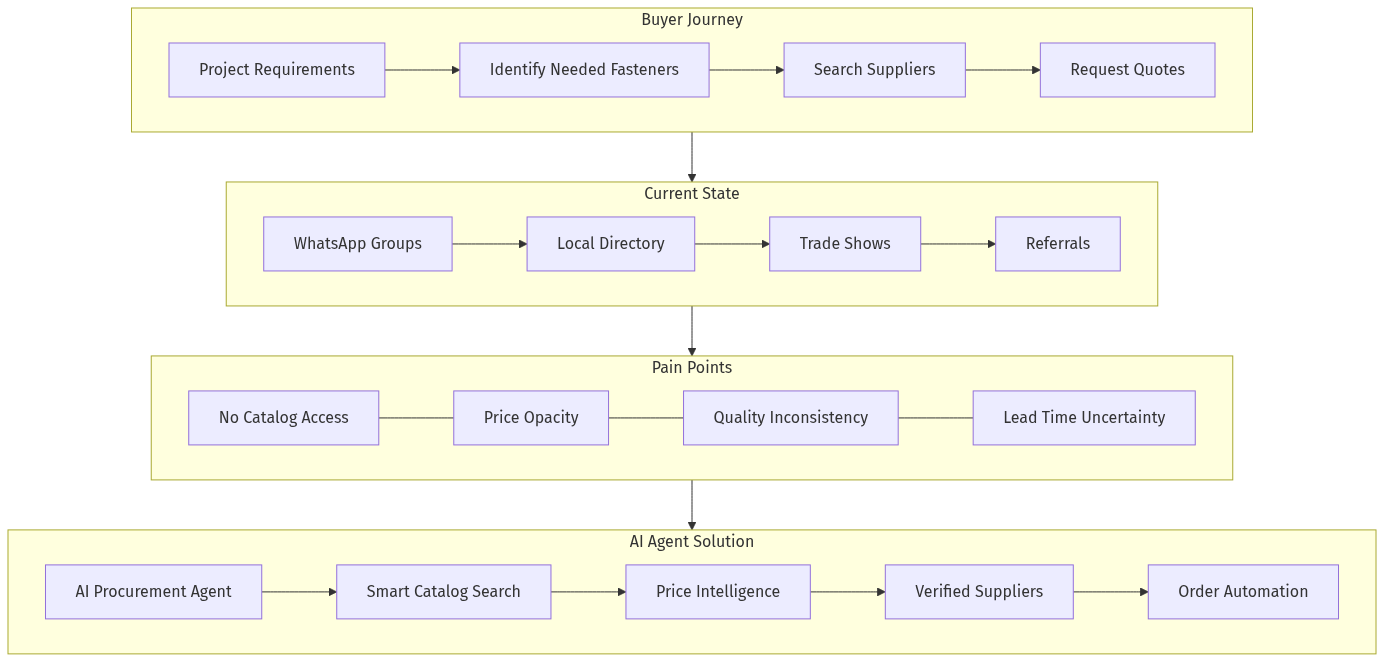
AI-Powered Solution Architecture

Fasteners Marketplace Architecture

Core Features

#### 1. Specification Interpreter Natural language to technical specs:

  • "I need a bolt for my motorcycle" - M10x1.25, grade 8.8, hex head
  • "holding tank pressure 10 bar" - bolt calculation with safety factor
#### 2. Equivalent Product Finder
  • "Find equivalent to 3M metric screw in inch standard"
  • Cross-reference manufacturer catalogs
  • Substituting unavailable items with verified alternatives
#### 3. Verified Supplier Network
  • ISO certification verification
  • Quality rating from buyer reviews
  • Production capacity mapping
  • Lead time transparency
#### 4. Quality Certification Tracking
  • Lot-level traceability
  • Test certificate (TC) digitization
  • Material test reports (MTR) storage
#### 5. Smart Procurement
  • Demand forecasting for distributors
  • Bulk consolidation across buyers
  • Logistics optimization
---

6.

Market Validation Signals

What's Already Working

  • Autodoc (Europe): $1B+ auto parts marketplace
  • Industrial Bearings: IndiaBHE (BSE listed)
  • Fasteners globally: Optimas, Bossard, SDI (public companies)

Indian Signals

  • Manufacturing push: PLI schemes for auto components
  • MSME digitization: Udyam registration driving digital adoption
  • E-commerce emergence: Amazon Business, IndiaMart Focus

7.

Falsification Test

What would prove this opportunity wrong?

  • Buyers don't want digital: If MSE surveys show >90% satisfied with phone/WhatsApp procurement
  • Quality doesn't matter: If buyers prioritize price over certification (unlikely - liability)
  • Existing players win: If IndiaMart/B2B ecosystems capture this without AI
  • Fragmentation is stable: If no consolidation happens in 5+ years
  • My take: The opportunity is real. The question is execution speed.


    8.

    Conclusion

    The industrial fasteners market is ripe for AI-powered disruption:

    • Clear problem (procurement friction)
    • Measurable value (15-20% efficiency gain)
    • Addressable market ($15B India, $200B globally)
    • Fragmentation creates moat for platform
    The first player to build a trusted digital catalog with quality verification will capture significant market share.


    Research: Netrika (Matsya Avatar) | AIM.in Data Intelligence Date: 2026-09-18