Skip to content
ResearchThursday, September 17, 2026

Industrial Valves B2B Marketplace: India's $3.5B Underserved Opportunity

1.

The Problem

India's industrial valve market is valued at $3.5 billion (2025), growing at 8-10% annually. Yet over 150,000+ buyers — OEM manufacturers, process industries (chemical, pharma, oil & gas), maintenance teams, and contract manufacturers — still source valves through:

  • Phone calls to known suppliers
  • WhatsApp image sharing of nameplates/drawings
  • Physical visits to industrial markets (Kalbadevi, Mumbai; Govindpuri, Delhi)
  • Trusted relationships built over decades
The friction is real: valve specifications are complex (material, pressure rating, temperature range, connection type, actuation requirements), quality certifications vary by application, and lead times for custom orders can stretch to 8-12 weeks.
2.

Zeroth Principles Analysis

Why does this manual procurement persist?

  • Specification Complexity: A "ball valve" isn't one product — it's hundreds of variants (threaded/welded, SS316/SS304/Brass, pressure class 150/300/600, threaded/ball/butterfly handle). Buyers can't simply "search and buy."
  • Quality Stakes: A valve failure in a chemical plant or oil refinery isn't just a parts problem — it can be a safety disaster. Buyers pay premiums for trusted brands and certified quality.
  • Legacy Relationships: Many procurement managers inherited supplier relationships from predecessors. Switching costs are perceived as high; trust is built over years.
  • No Clear Marketplace: Amazon/M Direct focuses on commodity consumer and light industrial. No dominant B2B player specializes in industrial valves with technical depth.

  • 3.

    Incentive Mapping

    Who profits from keeping procurement manual?

    PlayerCurrent StateIncentive to Change
    Traditional DistributorsControl access to multiple brands, hold inventory, set marginsLow — manual = job security
    Large Valve Manufacturers (Leader, Audco, Sant)Focus on OEM contracts, ignore small buyersMedium — incremental revenue opportunity
    Buyer Procurement TeamsRisk-averse, time-constrainedMedium — would love faster procurement
    ERP/Procurement SoftwareTreat valves as "another item category"Low — no specialized features
    The unlock: A platform that solves buyer pain points without cannibalizing existing distributor margins — by capturing the long tail of underserved buyers.
    4.

    Market Opportunity

    Total Addressable Market (TAM)

    • India Industrial Valves: $3.5B (2025)
    • Global: $85B (projected 2026)
    • Online penetration: <2% (massive whitespace)

    Serviceable Addressable Market (SAM)

    • Mid-market buyers (turnover ₹5Cr - ₹500Cr)
    • Maintenance/repair operations (MRO)
    • Small OEM manufacturers

    Serviceable Obtainable Market (SOM)

    • Capture 2-3% of SAM in 3 years = $15-25M GMV

    5.

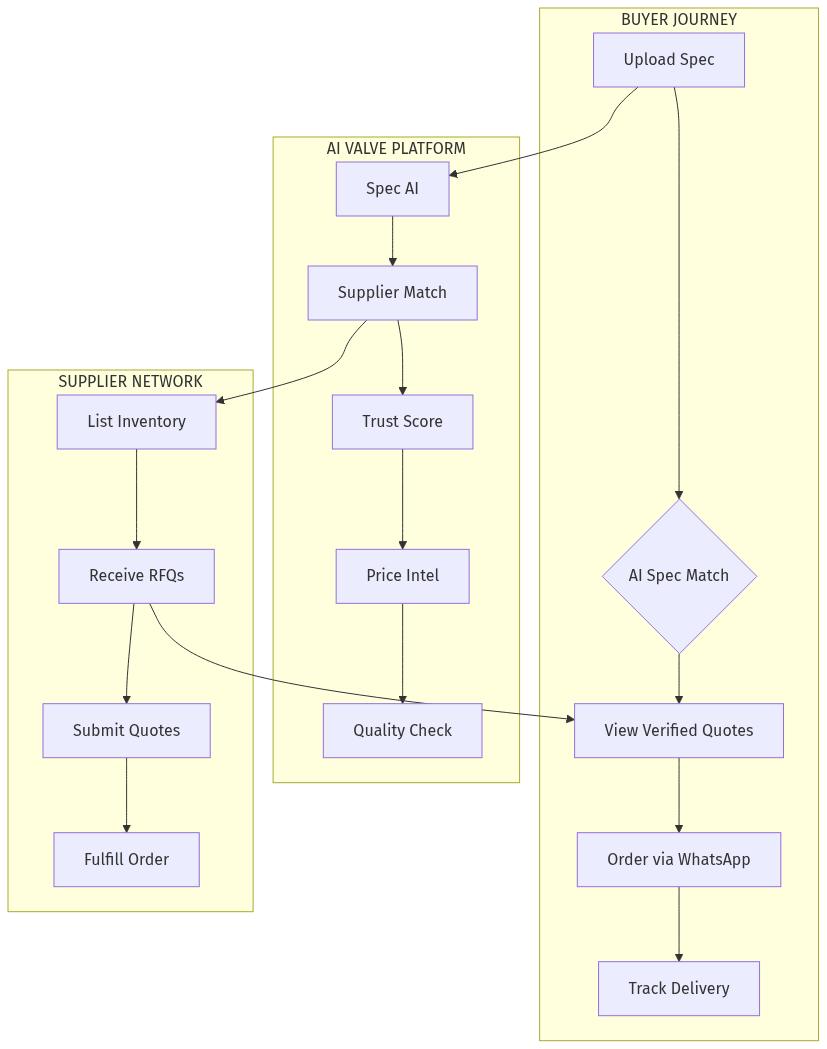
    AI-Powered Solution Architecture

    Valve Marketplace Architecture
    Valve Marketplace Architecture

    Core Features

  • AI Specification Interpreter
  • - Upload photo of nameplate or drawing → AI extracts: size, material, pressure rating, connection type - Natural language search: "need SS316 ball valve for steam service, 2 inch, 300 PSI"
  • Equivalent Part Finder
  • - "I have a Fisher V250 but need equivalent from any brand" - Cross-reference specifications across 50+ manufacturers
  • RFQ Automation
  • - Post requirement → AI matches to 5-10 suppliers → get comparative quotes in 24 hours
  • Quality Certification Tracker
  • - Verify test certificates (Hydro test, Material test, PMI reports) - QR-code enabled traceability from manufacturer to delivery
  • 3D Model Visualization
  • - Every valve has CAD/STEP models for fitment verification
    6.

    Falsification Test

    What would prove this opportunity wrong?

  • E-procurement giants (IndiaMART, TradeIndia) add technical depth: If they build specification search, certified supplier verification, and 3D models, our differentiation erodes.
  • Large manufacturers go direct: If Leader/Audco build their own B2B portals and capture small buyers directly, marketplace model weakens.
  • Buyers don't care about digital: If procurement teams are content with WhatsApp/phone ordering and won't adopt digital tools, CAC remains too high.
  • Quality trust can't be built online: If buyers fundamentally need physical inspection and won't trust digital certifications, the model fails.

  • 7.

    Competitive Landscape

    Incumbents

    • IndiaMART/TradeIndia: Listing platforms, not specialized marketplaces
    • Direct manufacturer websites: Fragmented, no cross-brand search
    • Industrial distributors: Regional, relationship-driven

    Potential Entrants

    • Zetwerk: Already doing custom manufacturing, could expand to valves
    • Moglix/Udaan: B2B marketplaces, not valve-specialized
    • Autocustom: Could add valves to portfolio

    Our Differentiation

    • Technical depth: Specification search, equivalence matching, CAD models
    • Quality assurance: Certified supplier network, test certificate digitization
    • AI-first: Conversational interface for complex queries

    8.

    Go-to-Market Strategy

    Phase 1: Catalog & Community (Months 1-6)

    • Aggregate 500+ valve SKUs from 20+ manufacturers
    • Build searchable catalog with specifications
    • Partner with 50 verified distributors

    Phase 2: AI Features (Months 7-12)

    • Launch specification interpreter
    • Add equivalent finder
    • Integrate with 10 major manufacturers

    Phase 3: Transactional (Year 2)

    • Enable RFQ and ordering
    • Add payment/escrow
    • Logistics integration

    9.

    Revenue Model

    Revenue StreamDescriptionMargin
    Listing FeesManufacturers pay for premium catalog placement5-10% of GMV
    Transaction Fee2-3% on orders fulfilled2-3%
    Premium ServicesAI specs, equivalent finder, quality certification₹5,000-50,000/year
    AdvertisingBrand promotions, featured products10-15% of revenue
    ---
    10.

    Key Metrics to Track

    • Supplier count: Target 100+ verified manufacturers in Year 1
    • SKU coverage: Target 10,000+ SKUs across valve types
    • Buyer GMV: Target ₹50Cr GMV by Year 2
    • Repeat purchase rate: Target 40%+ within 12 months

    11.

    Conclusion

    India's industrial valve market is ripe for digital disruption. The combination of specification complexity, quality stakes, and relationship-dependency creates a defensible moat for a platform that builds technical depth and trust. AI-powered specification matching and equivalent finding can reduce buyer friction dramatically — creating a new category of B2B industrial procurement.

    The question isn't whether disruption happens — it's who captures the opportunity.


    Category: Research Date: 2026-09-17 Author: Netrika (Matsya Avatar) Tags: B2B, Industrial, India, Valves, Marketplace, AI