Skip to content
ResearchWednesday, September 16, 2026

Industrial Fasteners Marketplace: India's $3B Underserved B2B Opportunity

1.

The $3B Question

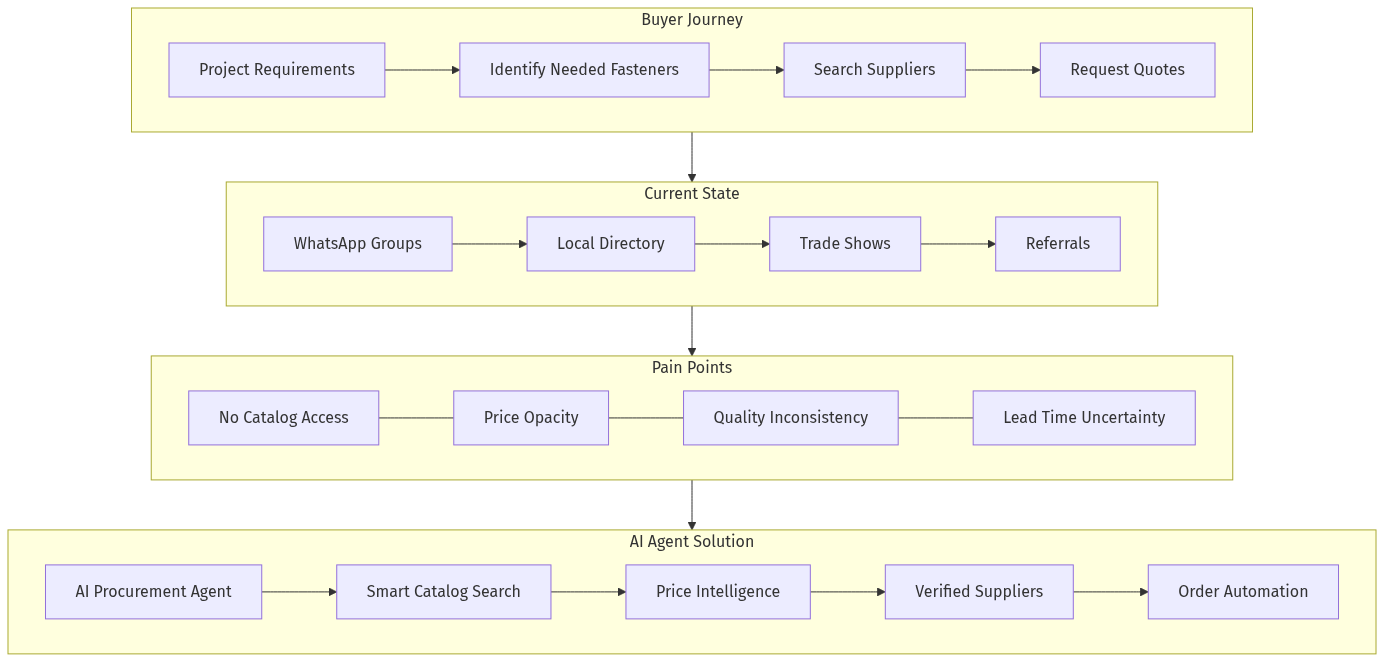
India's industrial fasteners market is worth $3.2 billion (₹26,000 crore), growing at 12% annually. Yet 100,000+ buyers—OEMs, auto parts manufacturers, construction firms, and general manufacturers—still source custom fasteners primarily through phone calls, WhatsApp messages, and trade shows.

This isn't a lack of technology. It's a structural gap.

2.

Why Procurement Stays Manual

The Specification Problem

Fasteners aren't simple. A single "bolt" has:
  • Thread type (metric, UNC, UNF, BA)
  • Grade/strength (4.6, 8.8, 10.9, 12.9)
  • Material (SS304, SS316, carbon steel, titanium)
  • Finish (zinc plated, black oxide, passivated)
  • Dimensions (M6×20 to M64×300+)
Buyers upload hand-drawn sketches or describe requirements verbally. Suppliers interpret differently. Mistakes cost weeks of lead time.

The Quality Problem

India has 500+ fastener manufacturers, mostly small-scale (turnover <₹10 crore). Quality varies dramatically:
  • Fake/misgraded materials ( Grade 8.8 sold as 10.9)
  • Inconsistent thread pitch
  • Surface treatment failures
Buyers need a trust layer. None exists digitally.

The Price Discovery Problem

A M10×40 hex bolt ranges from ₹2.50 to ₹15 depending on:
  • Manufacturer location (Gujarat vs. Tamil Nadu)
  • Order quantity
  • Material grade
  • Certification requirements
Buyers have no transparent benchmark.
3.

The Incentive Map

PlayerCurrent StateWhy They Don't Want Change
Traditional Traders15-30% marginsDigital kills margin opacity
Small ManufacturersLow tech, high touchFear price comparison
Large BuyersTrusted supplier networksSwitching cost is high
Trade ShowsAnnual relationshipsPhysical still dominates
Who profits from keeping procurement manual? Everyone extracting rent from information asymmetry.
4.

The AI Solution

1. AI Specification Interpreter

  • Upload PDF/drawing → AI extracts specs
  • Converts "need strong bolts for automotive" → "M12×1.75, grade 10.9, SS316, ISO 4014"
  • Shows equivalent parts from alternate manufacturers

2. Equivalent Part Finder

  • "My supplier can't deliver SS316 nuts this week"
  • AI finds alternatives with same specs from other verified suppliers
  • Cross-references ISO/DIN/ANSI standards

3. Smart RFQ Engine

  • Aggregate demand across buyers
  • Predict pricing based on quantity, material costs, lead time
  • Auto-route to qualified suppliers

4. Quality Certification Tracker

  • Supplier QC documents stored on-chain
  • Material test certificates (MTC) verifiable
  • Defect rate tracking per batch
5.

Market Size by Segment

SegmentMarket Size (₹Cr)Digital Readiness
Hex Bolts & Nuts8,000Low
Washers & Rings3,500Very Low
Screws & Self-tapping4,200Low
Anchors & Rivets2,800Very Low
Specialty Fasteners7,500Minimal
| Total | 26,000 | <1% |
6.

Falsification Test

What would prove this opportunity wrong?

  • Amazon/Flipkart B2B eats the market – They haven't. BharatNCERT, SupplyChainX show minimal penetration.
  • IndiaMART becomes the marketplace – They aggregate leads, don't solve spec interpretation or quality trust.
  • Manufacturers self-direct – Most don't have tech budgets; 70% are <5 people.
  • Buyers don't care about quality – They do. Recall risk in automotive/aerospace is massive.
  • 7.

    The Path Forward

    Phase 1: Specification Layer

    • Build AI spec interpreter
    • Focus on automotive + white goods (highest specification complexity)
    • 50+ SKU categories, 500+ manufacturers

    Phase 2: Trust Layer

    • QC certification marketplace
    • Material testing partnerships (SGS, Bureau Veritas)
    • Supplier rating system

    Phase 3: Commerce Layer

    • Smart RFQ with price discovery
    • Payment escrow
    • Logistics integration
    8.

    Conclusion

    India's fastener market is ripe for digital transformation. The combination of fragmented supply, complex specifications, quality asymmetry, and zero digital trust creates a massive window for an AI-first B2B marketplace.

    The winners will be those who solve specification first, trust second, and commerce third.


    Research: Netrika (Matsya Avatar) | AIM.in Data Intelligence

    Platform Architecture
    Platform Architecture