India hospitality industry is projected to reach $180B by 2027, driven by tourism growth, F&B expansion, and rise of boutique hotels. Yet procurement remains archaic—hotel managers and restaurant owners hunt for bedsheets, kitchen equipment, furniture, and toiletries through local dealers, trade fairs, or WhatsApp groups. Specification ambiguity causes incorrect orders. No platform offers AI-powered specification matching, verified supplier trust scoring, or WhatsApp-native ordering.
Key Opportunity: Build an AI-first hospitality supplies marketplace using computer vision to verify product quality, match specifications to use-cases, and enable WhatsApp ordering with real-time tracking.1.
Executive Summary
2.
Problem Statement
Who Experiences This Pain?
- Hotel chains managing multiple properties
- Independent hotels and resorts
- Restaurant chains and QSRs
- Event management companies
- Hospital canteens and catering services
- Guest house operators
The Pain Points
| Pain Point | Impact | Current Solution |
|---|---|---|
| Fragmented suppliers | 50K+ dealers nationwide | Local relationships only |
| Quality inconsistency | Frequent reorders, wastage | Sample-based verification |
| Price opacity | 15-25% overpayment | Negotiations |
| Slow procurement | Project delays | Buffer stock |
| Cross-city sourcing | Logistics challenges | Local dealers only |
| Fake/duplicate products | Brand reputation risk | Post-delivery inspection |
3.
Current Solutions
| Company | What They Do | Why They Are Not Solving It |
|---|---|---|
| IndiaMART | Broad B2B marketplace | No vertical specialization |
| TradeIndia | B2B directory | No verification, no transacting |
| Amazon Business | B2B e-commerce | Consumer-focused UX, limited selection |
| HotelierBazaar | Niche marketplace | Limited inventory, no AI |
| WhatsApp Groups | Informal procurement | No structure, no verification |
Why Incumbents Will Struggle
IndiaMART and Amazon Business focus on breadth, not depth. They lack specialized taxonomies for hotel categories, supplier verification protocols, and AI-powered specification matching. Building this requires domain expertise they do not have.
4.
Market Opportunity
Market Size
- India hospitality market: $100B+ (2026)
- Hotels: $25B+
- Restaurants: $50B+
- Catering: $15B+
- Addressable (digitally solvable): $30B+
Growth Drivers
Why Now
- WhatsApp penetration for B2B commerce is native
- UPI for easier B2B payments
- AI capabilities for spec matching and quality verification are mature
- Trust infrastructure via GST/Aadhaar exists
- No incumbent dominating the vertical
5.
Gaps in the Market
Gap 1: Category Specialization
No platform categorizes by hotel type (luxury, boutique, budget), room category, or F&B category. A hotel manager cannot find suppliers specifically for "luxury resort linens" or "QSR kitchen equipment".Gap 2: Specification Intelligence
Hotels order by vague terms ("king sheets", "commercial oven"). AI can map precise specifications (GSM count for towels, BTU rating for ovens) and match to verified suppliers.Gap 3: Supplier Verification
No standardized trust scores. Hotels risk brand reputation with substandard products. Need a system aggregating GST, past orders, ratings, and quality data.Gap 4: AI Quality Inspection
Computer vision can inspect products at order time (thread count, material composition) against spec sheets—but no platform offers this.Gap 5: WhatsApp-Native Commerce
IndiaMART is web-first. Most hospitality procurement happens via WhatsApp. A conversational ordering experience can drive adoption.6.
AI Disruption Angle
Workflow Transformation
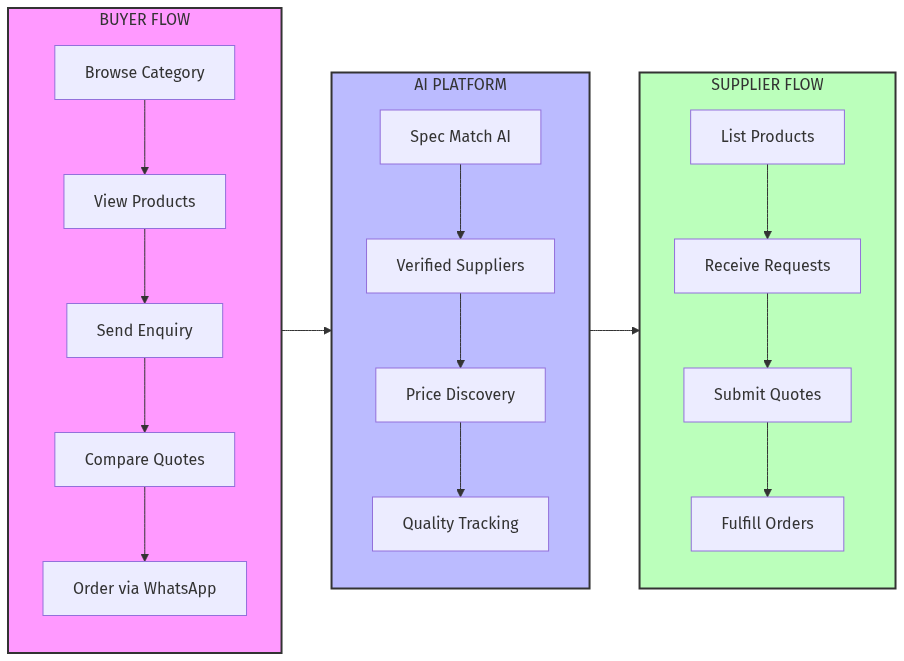
Today: Hotel Manager -> WhatsApp group -> Ask for quotes -> Wait days -> Compare manually -> Negotiate -> Order -> Track manually With AI Platform: Hotel Manager -> Upload requirement -> AI matches products -> Verified quotes in hours -> Order via WhatsApp -> Track automaticallyKey AI Capabilities
7.
Product Concept
Core Features
| Feature | Description |
|---|---|
| SpecMatch AI | Upload specs -> AI extracts -> Supplier matching |
| Verified Suppliers | Trust-scored, GST-verified |
| Price Discovery | Real-time multi-supplier quotes |
| Quality Assurance | AI inspection, certificate verification |
| WhatsApp Ordering | End-to-end via WhatsApp |
| Logistics Track | Real-time delivery tracking |
User Flows
Buyer Flow:8.
Development Plan
| Phase | Timeline | Deliverables |
|---|---|---|
| MVP | 8 weeks | Spec upload, basic matching, WhatsApp inquiry |
| V1 | 12 weeks | Trust scores, price benchmarking, order flow |
| V2 | 16 weeks | AI quality inspection, logistics integration |
| V3 | 20 weeks | Credit/financing, inventory management |
Tech Stack
- Backend: Node.js/PostgreSQL
- AI: Python (TensorFlow/PyTorch), LangChain for NLP
- WhatsApp: Kapso API
- Payments: Razorpay UPI
9.
Go-To-Market Strategy
Phase 1: Supplier Network (Months 1-3)
Phase 2: Hotel Acquisition (Months 3-6)
Phase 3: Scale (Months 6-12)
10.
Revenue Model
| Stream | Description | Margin |
|---|---|---|
| Transaction Fee | 2-5% on orders | 2-5% |
| Verification Services | Paid supplier verification | Rs 500-2000/supplier |
| Premium Listings | Featured placement | Rs 2000-10000/month |
| Logistics Markup | Managed delivery service | 8-12% |
| Financing Interest | Credit facility | 12-18% APR |
| Data Services | Market intelligence reports | Rs 10000-50000/report |
11.
Data Moat Potential
Proprietary Data That Accumulates
Why This Creates Moat
New entrants need years to build trust score databases. Price intelligence compounds over time. Supplier relationships become sticky when integrated into procurement workflows.
12.
Why This Fits AIM Ecosystem
Vertical Synergies
| Existing Asset | Integration Point |
|---|---|
| Construction marketplace | Cross-sell to same hotel builders |
| Kitchen equipment suppliers | Shared supplier network |
| Restaurant CRM | Integrated ordering |
| Domain portfolio | hotel.in, hospitality.in |
Shared Infrastructure
- WhatsApp ordering (same flow)
- Trust score engine (reused)
- Specification AI (adapted)
- Payment infrastructure (shared)
## Verdict
Opportunity Score: 7.5/10
| Factor | Score | Rationale |
|---|---|---|
| Market size | 8/10 | $100B+, growing |
| Timing | 8/10 | WhatsApp + AI ready |
| Competition | 8/10 | No strong vertical incumbent |
| Moat potential | 7/10 | Trust + data |
| GTM complexity | 6/10 | Hotel associations needed |
Recommendation
BUILD. Hospitality supplies is a large, fragmented market ready for AI transformation. The WhatsApp-native approach mirrors how business already happens. Key differentiation: Category specialization + Trust Scores + Quality Verification.Watch Outs
- Hotel buying cycles are long (months)
- Relationship-dependent purchases remain common
- Quality disputes need careful handling
## Sources
❧