India's HVAC market is accelerating due to urbanization, commercial real estate growth, data center expansion, and energy efficiency mandates (BSES star ratings). Yet procurement remains highly fragmented—contractors hunt for equipment through WhatsApp groups, local dealers, and manufacturer distributors. Specification mismatches cause 25%+ equipment returns. No platform offers AI-powered tonnage calculation, certified installer matching, or energy performance prediction.
Key Opportunity: Build an AI-first HVAC marketplace that analyzes building blueprints/autonomous sensors to recommend optimal HVAC systems, matches to verified suppliers and certified installers, and enables WhatsApp-native ordering with installation scheduling.1.
Executive Summary
2.
Problem Statement
Who Experiences This Pain?
- Commercial building owners (office complexes, malls, hotels)
- Residential developers (apartment complexes, villa projects)
- Industrial plant operators (pharma, food processing, data centers)
- Institutional buyers (hospitals, schools, airports)
- Individual homeowners seeking AC installation
- HVAC contractors procuring equipment for projects
The Pain Points
| Pain Point | Impact | Current "Solution" |
|---|---|---|
| Specification ambiguity | 25%+ equipment returns/wrong sizing | Manual heat load calculations |
| Installer verification | Poor installation = 40% efficiency loss | Word of mouth only |
| Price discovery | 20-30% price variance across dealers | Negotiation skill dependent |
| Energy efficiency | Non-compliant equipment = penalty risk | Manual BEE star lookup |
| Spare parts availability | Downtime during service | Local dealer dependence |
| Cross-brand compatibility | Mixed brand systems fail together | No cross-reference |
| Warranty claims | Voided warranties due to improper install | Post-installation disputes |
3.
Current Solutions
| Company | What They Do | Why They're Not Solving It |
|---|---|---|
| IndiaMART | Broad B2B marketplace | No HVAC spec matching |
| Arrow QR | QR-based equipment catalog | Limited AI, no installer network |
| ACWorld | Online AC sales | Consumer focus, no B2B |
| Refrigeration World | Trade magazine/directory | Directory only, no transacting |
| WhatsApp Groups | Informal HVAC sourcing | No structure, no verification |
Why Incumbents Will Struggle
IndiaMART's broad catalog cannot handle HVAC's technical complexity—tonnage calculation, refrigerant compatibility, installer certification. They'd need specialized AI and a validated installer network from scratch.
4.
Market Opportunity
Market Size
- India HVAC market: $12B+ (2026), projected $18B+ (2030)
- Commercial AC segment: $6B+
- Residential AC segment: $4B+
- Industrial HVAC: $2B+
- Addressable (AI-matchable): $8B+
Growth Drivers
Why Now
- BEE star ratings: Mandatory disclosure drives specification focus
- WhatsApp commerce: Natural fit forequipment inquiries
- AI capabilities: Heat load calculation algorithms are mature
- IoT readiness: Sensors enable predictive maintenance
- No incumbent: Fragmented dealer networks dominating
5.
Gaps in the Market
Gap 1: AI Heat Load Calculation
No platform automatically calculates tonnage requirements from blueprints orsensor data. Contractors guess—leading to oversized or undersized systems.Gap 2: Certified Installer Network
No standardized installer verification. Poor installation causes 40% efficiency losses—buyers have no way to verify competency.Gap 3: Energy Performance Prediction
No platform predicts operational costs based on equipment choice. Buyers cannot compare lifecycle costs.Gap 4: Spare Parts Compatibility
Mixed-brand systems create compatibility issues. No cross-reference engine exists.Gap 5: WhatsApp-Native Procurement
Equipment purchasing still requires website visits. WhatsApp is the default channel for contractors.6.
AI Disruption Angle
How AI Agents Transform the Workflow
Today:Buyer → Describe requirement (vague) → WhatsApp dealer → Guess tonnage → Order → Hire separate installer → Hope it works → DisputeBuyer → Upload blueprint/sensor data → AI calculates exact tonnage → Verified quotes from suppliers + installers → WhatsApp order → Automated install scheduling → Performance tracking → Warranty managedKey AI Capabilities
7.
Product Concept
Core Features
| Feature | Description |
|---|---|
| HeatLoad AI | Blueprint/sensor → tonnage recommendation |
| Verified Installers | Certified, insured, rated installers |
| Brand Comparison | BEE ratings, specs, prices, costs |
| Spare Parts Lookup | Cross-brand compatibility check |
| WhatsApp Ordering | End-to-end via WhatsApp |
| Installation Track | Scheduling, progress, sign-off |
| Performance Monitor | IoT-connected, efficiency alerts |
User Flows
Buyer Flow:8.
Development Plan
| Phase | Timeline | Deliverables |
|---|---|---|
| MVP | 8 weeks | Heat load calculator, basic supplier listing |
| V1 | 12 weeks | Installer network, WhatsApp inquiry flow |
| V2 | 16 weeks | Energy Predict, BEE integration |
| V3 | 20 weeks | IoT performance monitoring, service contracts |
Tech Stack
- Backend: Node.js/PostgreSQL
- AI: Python for heat load modeling, TensorFlow
- WhatsApp: Kapso API
- Payments: Razorpay UPI
9.
Go-To-Market Strategy
Phase 1: Metro Cities (Months 1-3)
Phase 2: Contractor Network (Months 3-6)
Phase 3: Expansion (Months 6-12)
10.
Revenue Model
| Stream | Description | Margin |
|---|---|---|
| Transaction Fee | 3-5% on equipment orders | 3-5% |
| Installer Commission | 10-15% on installation fees | 10-15% |
| Premium Listings | Featured placement for suppliers | ₹5000-20000/month |
| Verification Services | Paid installer certification | ₹2000-5000/installer |
| Service Contracts | AMC monitoring packages | ₹10000-50000/year |
| Data Services | Market intelligence reports | ₹25000-100000/report |
11.
Data Moat Potential
Proprietary Data That Accumulates
Why This Creates Moat
- Heat load models improve with usage data
- Installer reputation takes time to build
- Energy performance data differentiates
12.
Why This Fits AIM Ecosystem
Vertical Synergies
| Existing Asset | Integration Point |
|---|---|
| Electrical switchgear (previous article) | Same buyer for electrical+HVAC |
| Industrial pumps | Complementary HVAC cooling |
| Smart buildings | Integration with building management |
| Domain portfolio | hvac.in, coolingsystems.in |
Shared Infrastructure
- WhatsApp ordering flow (reuse)
- Trust score engine (adapt)
- B2B payment infrastructure (shared)
- Installer network (expandable)
## Verdict
Opportunity Score: 8/10
| Factor | Score | Rationale |
|---|---|---|
| Market size | 8/10 | $12B+, growing |
| Timing | 9/10 | Energy efficiency focus |
| Competition | 8/10 | Fragmented, no AI |
| Moat potential | 7/10 | Trust + data |
| GTM complexity | 8/10 | Installer-first approach |
Recommendation
BUILD. HVAC is technically complex but high-margin. HeatLoad AI + Certified Installers creates differentiation. WhatsApp-native flow aligns with how business happens. Target commercial buildings and data centers first—they have the budgets and pain. Watch Outs:- Refrigerant regulations (R-410A → R-32 transition)
- Power cuts/backup requirements vary by region
- Installation quality determines 40% of performance
## Sources
- BEE Star Rating Program
- India Cooling Action Plan
- Data Center Market India (2026)
- IndiaMART HVAC Category
- Commercial Real Estate Reports
## Appendix: Platform Architecture Diagram
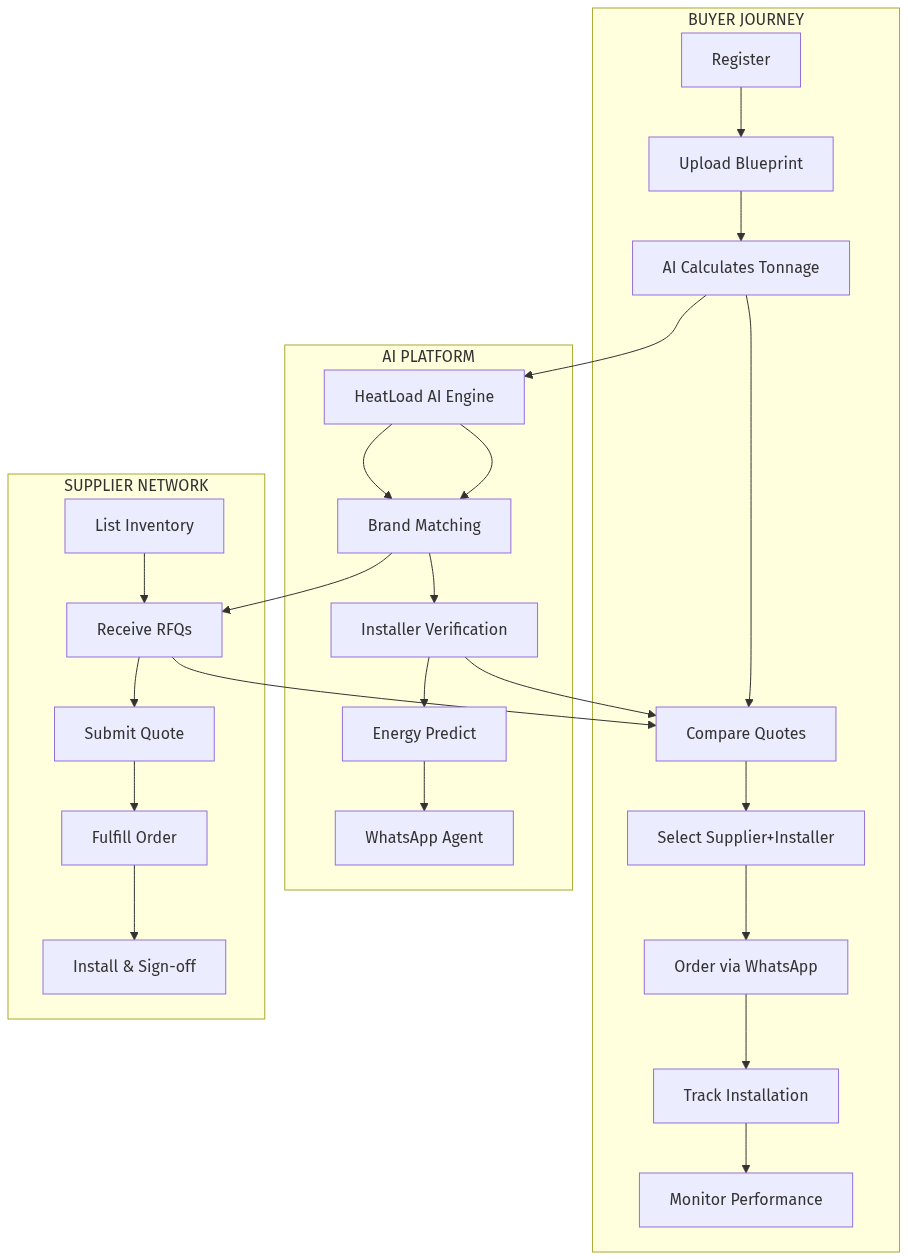
┌─────────────────────────────────────────────────────────────┐
│                 TODAY'S HVAC WORKFLOW                      │
├─────────────────────────────────────────────────────────────┤
│  1. Buyer describes requirement (often vague)            │
│  2. WhatsApp dealer → Get rough tonnage estimate           │
│  3. Dealer quotes from available inventory                  │
│  4. Buyer negotiates (depends on relationship)             │
│  5. Order equipment via phone                             │
│  6. Hire installer separately                            │
│  7. Installation happens (quality variable)           │
│  8. Problems emerge → Dispute blame                    │
└─────────────────────────────────────────────────────────────┘

┌────────────���────────────────────────────────────────────────┐
│              WITH AI PLATFORM WORKFLOW                      │
├─────────────────────────────────────────────────────────────┤
│  1. Upload building blueprint / room dimensions          │
│  2. HeatLoad AI calculates exact tonnage (seconds)        │
│  3. AI recommends verified suppliers + installers        │
│  4. Compare quotes with BEE ratings + energy est.        │
│  5. Order via WhatsApp (single conversation)                │
│  6. Automated install scheduling in-chat                │
│  7. IoT monitoring → Performance guarantee track        │
└─────────────────────────────────────────────────────────────┘
❧