ResearchMonday, May 25, 2026

AI-Powered Medical Devices & Hospital Equipment Marketplace for India

India's healthcare infrastructure is undergoing a massive transformation with $30B+ in hospital expansions. Yet medical device procurement remains highly fragmented—hundreds of import distributors, opaque pricing, and WhatsApp-dependent supply chains. No AI-first vertical platform exists for hospital equipment specification matching, certification verification, or automated procurement.

1.

Executive Summary

India's hospital and healthcare equipment market is valued at $18B+, growing at 15%+ annually due to Ayushman Bharat, hospital expansions, and diagnostics growth. Yet procurement remains archaic—hospitals depend on dealer relationships, face opaque pricing (30-50% variance), and struggle with equipment installation and maintenance. No vertical platform offers AI-powered specification matching, CDSCO/ISI certification verification, or WhatsApp-native ordering for consumables and devices.

Key Opportunity: Build an AI-powered medical devices marketplace that uses equipment specification intelligence to match requirements to certified suppliers, verifies regulatory compliance (CDSCO registration, ISI marking), and enables WhatsApp-native ordering with installation and calibration support.
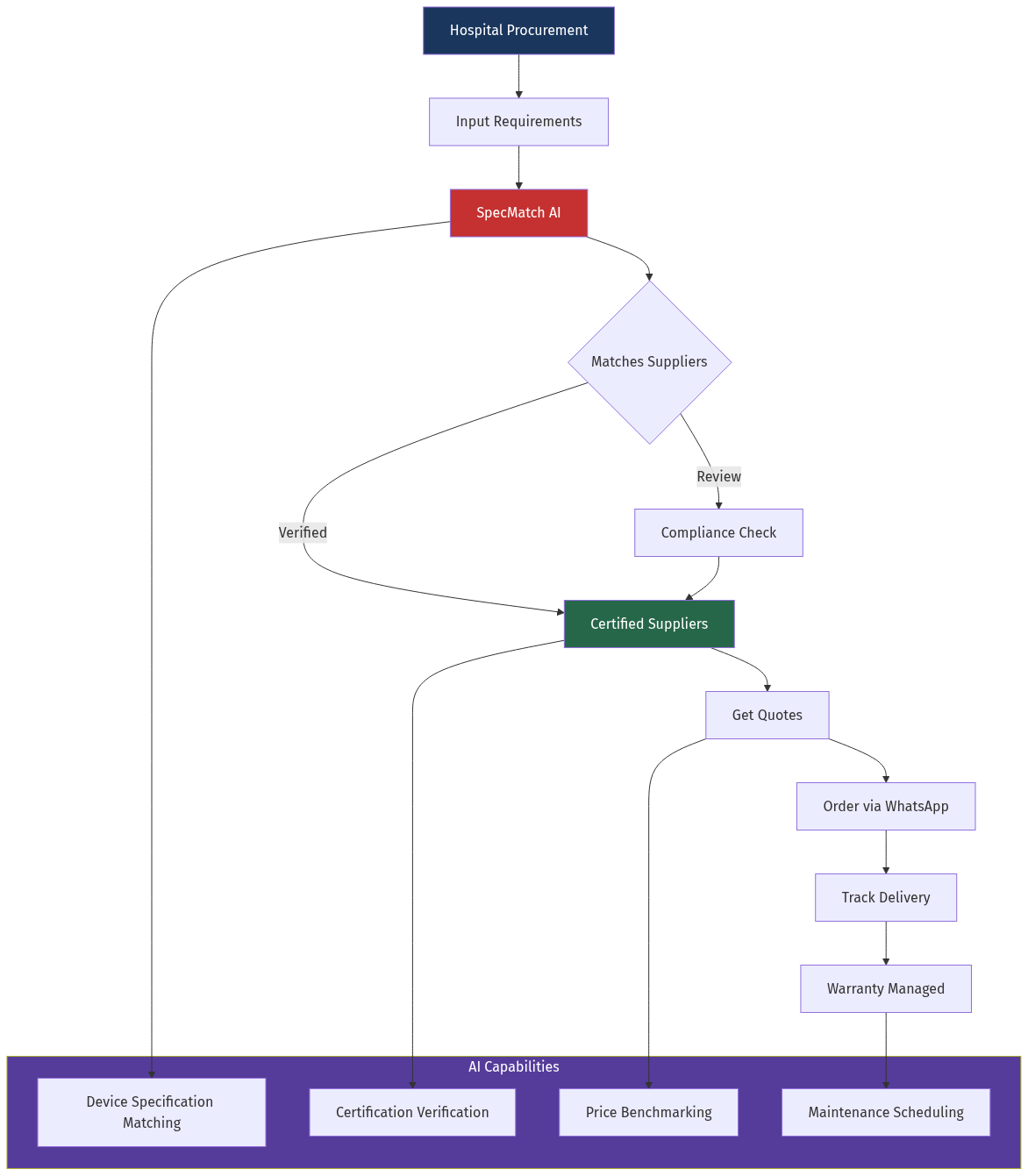
Medical Devices Market Architecture

2.

Problem Statement

Who Experiences This Pain?

  • Corporate hospital chains (Apollo, Fortis, Max) procuring at scale
  • Single-specialty hospitals (eye, cardiac, ortho) needing focused equipment
  • Diagnostic labs (Dr. Lal Path, SRL) expanding networks
  • Government district hospitals under PPP programs
  • Tier 2/3 city nursing homes upgrading infrastructure
  • Ayushman Bharat empaneled hospitals meeting quality standards

Pain Points

Pain PointImpactCurrent "Solution"
Specification ambiguityWrong equipment = patient safety riskDealer recommendation
Regulatory complianceCDSCO violation = license revocationManual verification
Price opacity30-50% overpaymentRelationship negotiation
Installation complexityEquipment malfunctionThird-party technicians
Consumables repeatStockouts affecting careManual inventory
Warranty managementClaim disputesLegal intervention
Maintenance schedulingDowntime affects patientsReactive servicing
---
3.

Current Solutions

CompanyWhat They DoWhy They're Not Solving It
MediBureauMedical equipment listingsNo certification verification
IndiaMART HealthGeneric B2B health suppliesNo equipment specs, no compliance
DoctorCMedical devices e-commerceConsumer-focused, limited B2B
Bajaj Finserv HealthHealthcare financingEquipment sourcing indirect
Local distributorsTraditional salesNo AI, opaque pricing
WhatsApp groupsInformal procurementNo structure, no verification

Why Incumbents Will Struggle

IndiaMART's strength (broad catalog) is its weakness for medical devices—strict regulatory requirements need CDSCO verification, no generic marketplace can handle. Specialized players lack AI capabilities.


4.

Market Opportunity

Market Size

  • India healthcare equipment: $18B+ (2026)
  • Medical devices: $12B+
  • Hospital furniture: $2B+
  • Diagnostic equipment: $1.5B+
  • Consumables: $2.5B+
  • Addressable (AI-matchable): $6B+

Growth Drivers

  • Ayushman Bharat: 50K+ empaneled hospitals, quality upgrades needed
  • Hospital expansions: 100+ new hospitals annually in Tier 1/2
  • Diagnostics growth: Preventive health checkups increasing 20% YoY
  • Insurance penetration: 50Cr+ persons covered by health insurance
  • Medical tourism: $9B+ target by 2026
  • PPP programs: District hospital upgrades
  • Why Now

    • CDSCO digitization: Registration certificates online verifiable
    • WhatsApp for B2B: Hospitals already order via WhatsApp groups
    • UPI for recurring payments: Simplifies consumables repeat orders
    • No vertical incumbent: IndiaMART is generic, not med-tech specialized
    • Make in India: Medical device PLI scheme promoting domestic manufacturing

    5.

    Gaps in the Market

    Gap 1: Equipment Specification Intelligence

    No platform reads hospital requirements (patient capacity, specialty focus, budget) and matches equipment. Hospitals depend on dealer recommendations—who push high-margin products.

    Gap 2: Regulatory Verification

    No platform verifies CDSCO registration status, ISI marking, or USFDA/CE certifications. Purchased equipment can be non-compliant—risking hospital license.

    Gap 3: Price Transparency

    Medical device pricing is extremely opaque (30-50% variance across suppliers). No platform provides real-time benchmarking.

    Gap 4: Installation & Calibration Network

    Critical equipment (ventilators, analyzers) requires professional installation—dealers don't provide, no centralized network exists.

    Gap 5: Consumables Repeat Automation

    Tests/procedures require recurring consumables—no platform auto-reorders based on usage patterns.

    Gap 6: WhatsApp-Native Procurement

    Still phone-call and email based. Healthcare professionals need conversational ordering during emergencies.
    6.

    AI Disruption Angle

    How AI Transforms Workflow

    Today:
    Hospital → Consult supplier → Request quotes → Negotiate (days) → Order → Wait for delivery → Arrange installation → Calibrate → Train staff
    With AI Platform:
    Hospital → Input requirements → AI matches certified suppliers → Verified quotes in 1 hour → Order via WhatsApp → Installation scheduled → Calibration verified → Staff training auto-scheduled

    Key AI Capabilities

  • SpecMatch AI
  • - Input hospital parameters (beds, specialty, existing equipment) - AI matches device specifications, compatibility - Suggests alternatives (budget, brand preference)
  • RegVerify AI
  • - CDSCO registration verification in real-time - ISI/USFDA/CE certificate validation - Expiry date alerting for licenses
  • PriceBench AI
  • - Real-time price benchmarking across suppliers - Historical price trend analysis - Bulk discount optimization
  • InstallMatch AI
  • - Geolocation-based technician network - Manufacturer certification verification - Installation quality tracking
  • Consumables AI
  • - Usage-based reorder suggestions - Stock level monitoring - Expiry date management
  • WhatsApp Care Agent
  • - Conversational ordering via WhatsApp - Emergency ordering (priority queue) - Order status and delivery tracking
    7.

    Product Concept

    Core Features

    FeatureDescription
    SpecMatch AIHospital params → certified device matching
    RegVerifyCDSCO, ISI, USFDA verification
    PriceBenchReal-time pricing across suppliers
    Installation NetworkCertified technicians by region
    Consumables Auto-RepeatUsage-based reordering
    WhatsApp OrderingEnd-to-end via WhatsApp
    Maintenance SchedulingPreventive maintenance alerts

    User Flows

    Buyer Flow:
  • Register (hospital license, GST)
  • Enter equipment requirements
  • AI suggests compliant alternatives
  • Request quotes from verified suppliers
  • Compare pricing on dashboard
  • Order via WhatsApp
  • Installation scheduled automatically
  • Supplier Flow:
  • Register (CDSCO certificates, product docs)
  • List products with specifications
  • Receive quote requests matching specialty
  • Submit competitive quotes
  • Fulfill orders with installation coordination

  • 8.

    Development Plan

    PhaseTimelineDeliverables
    MVP8 weeksRequirement input, device catalog, WhatsApp inquiry
    V112 weeksCDSCO verification, pricing benchmarks, order flow
    V216 weeksInstallation network, consumables automation
    V320 weeksMaintenance contracts, financing options

    Tech Stack

    • Backend: Node.js/PostgreSQL
    • AI: Python (spec matching, NLP)
    • WhatsApp: Kapso API
    • Payments: Razorpay UPI

    9.

    Go-To-Market Strategy

    Phase 1: Diagnostic Labs (Months 1-3)

  • Target metro cities: Delhi, Mumbai, Bangalore, Chennai
  • Focus equipment: Pathology analyzers, imaging (ultrasound, X-ray)
  • **Onboard 50 verified suppliers
  • Free listing + verified badge
  • Phase 2: Nursing Homes & Small Hospitals (Months 3-6)

  • Partner with IMA (Indian Medical Association)
  • Target Tier 2 city hospitals
  • Equipment bundles (OT, ICU, Radiology)
  • Referral program: Credits for first order
  • Phase 3: Hospital Chains (Months 6-12)

  • Enterprise sales team
  • PPP program partnerships
  • Government tender participation
  • PAN India expansion

  • 10.

    Revenue Model

    StreamDescriptionMargin
    Transaction Fee2-5% on device orders2-5%
    Verification ServicesPaid CDSCO verification₹1000-5000/device
    Premium ListingsFeatured supplier placement₹5000-25000/month
    Installation ServicesCommission on bookings12-18%
    Consumables MarketplaceRepeat orders8-12%
    Maintenance ContractsAnnual service agreements15-20%
    ---
    11.

    Data Moat Potential

    Proprietary Data That Accumulates

  • Device Specifications Database — Equipment-to-application mappings
  • Pricing Indices — Real-time hospital equipment pricing
  • Supplier Compliance History — CDSCO verification records
  • Installation Performance — Technician success rates
  • Consumption Patterns — Usage analytics by hospital type
  • Why This Creates Moat

    • Regulatory data takes years to compile
    • Hospital buyer relationships are sticky
    • Consumables create recurring revenue

    12.

    Why This FITS AIM Ecosystem

    Vertical Synergies

    Existing AssetIntegration Point
    Healthcare CRMSame buyer segment
    Hospital furnishingCross-sell opportunity
    Cold chain equipmentLab refrigeration needs
    Domain portfoliomeddevices.in, hospitalequipment.in

    Shared Infrastructure

    • WhatsApp ordering (same flow)
    • RegVerify AI (adapted from existing)
    • Trust score engine (reused)
    • Payment infrastructure (shared)

    ## Verdict

    Opportunity Score: 8.5/10

    FactorScoreRationale
    Market size9/10$6B+ addressable
    Timing9/10Ayushman + hospital expansion
    Competition8/10No strong vertical incumbent
    Moat potential9/10Regulatory + compliance data
    GTM complexity7/10Hospital-first approach

    Recommendation

    BUILD. Medical devices is a regulated, fragmented market ready for AI transformation. CDSCO verification is the key barrier most players can't clear. Key differentiation: RegVerify AI + Certified Suppliers + Installation Network. Watch Outs:
    • Regulatory changes need constant monitoring
    • Hospital procurement cycles are long (6-12 months)
    • Equipment installation requires certified technicians

    ## Sources


    ## Appendix: Workflow Comparison

    ┌─────────────────────────────────────────────────────────────┐
    │                 TODAY'S WORKFLOW                           │
    ├─────────────────────────────────────────────────────────────┤
    │ 1. Hospital identifies equipment need                    │
    │ 2. Consult existing dealer relationships                 │
    │ 3. Request quotes from multiple suppliers (weeks)         │
    │ 4. Negotiate price (opaque, relationship-dependent)     │
    │ 5. Verify certifications manually                      │
    │ 6. Order via phone/email                                │
    │ 7. Arrange installation separately                     │
    │ 8. Schedule training for staff                         │
    │ 9. Warranty claims handled manually                     │
    │ 10. Consumables reordered manually                     │
    └─────────────────────────────────────────────────────────────┘
    
    ┌─────────────────────────────────────────────────────────────┐
    │             WITH AI PLATFORM WORKFLOW                        │
    ├─────────────────────────────────────────────────────────────┤
    │ 1. Enter hospital requirements                         │
    │ 2. RegVerify AI validates CDSCO compliance (seconds)     │
    │ 3. SpecMatch AI suggests certified alternatives       │
    │ 4. Compare pricing on benchmark dashboard           │
    │ 5. Order via WhatsApp (conversational)              │
    │ 6. Installation auto-scheduled with certified tech   │
    │ 7. Calibration verified and recorded                │
    │ 8. Staff training scheduled automatically           │
    │ 9. Warranty managed on platform                    │
    │ 10. Consumables auto-reordered based on usage       │
    └─────────────────────────────────────────────────────────────┘