India's healthcare sector is valued at $50B+ annually for medical equipment and supplies. Yet procurement remains archaic—hospitals hunt for consumables through WhatsApp groups, local dealers, and fragmented catalogs. Specification ambiguity causes 25%+ procurement inefficiencies. Regulatory complexity (CDSCO, MDAC compliance) adds layers of friction. No platform offers AI-powered specification matching, verified supplier trust scores, or automated compliance checking.
Key Opportunity: Build an AI-first medical equipment marketplace that uses computer vision to read medical specifications/goods certificates, matches supplies to verified suppliers, and enables WhatsApp-native ordering with real-time tracking.1.
Executive Summary
2.
Problem Statement
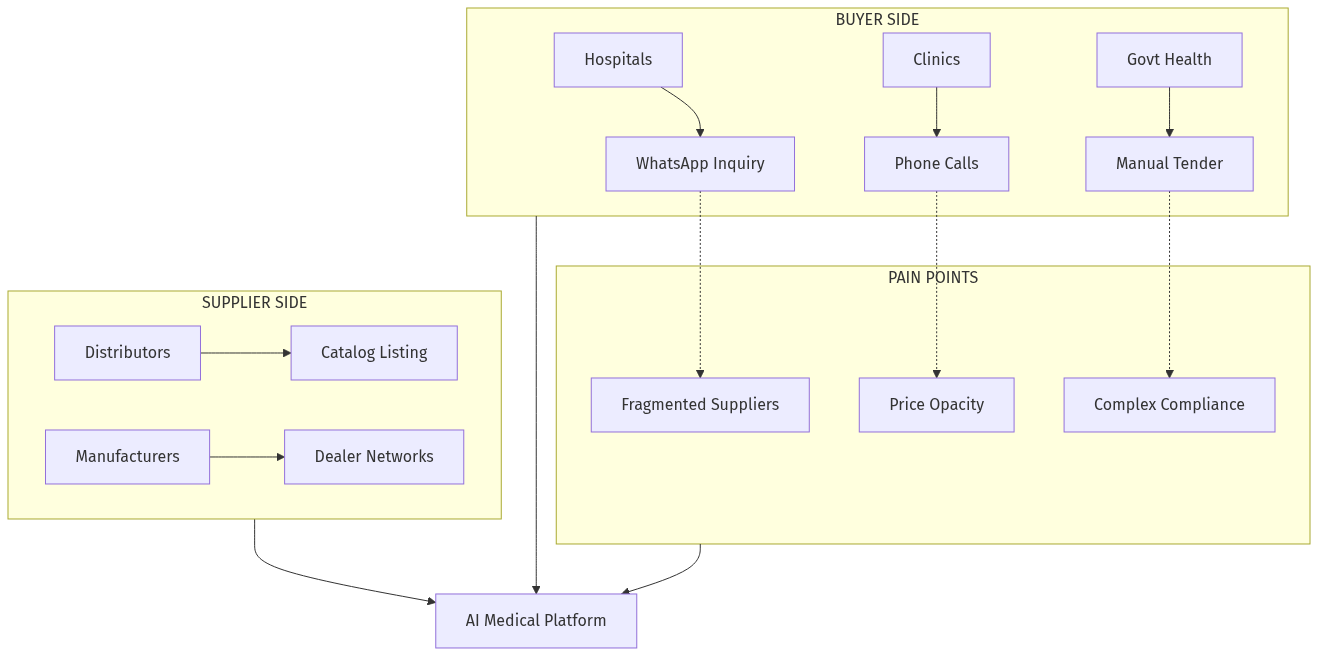
Who Experiences This Pain?
- Private hospitals (500+ bed multi-specialty) requiring consistent supply chains
- Corporate hospital chains (Apollo, Fortis, Max) managing procurement across locations
- Government district hospitals navigating complex tender systems
- Small nursing homes and clinics lacking buying power
- Diagnostic centers needing reliable consumable supply
The Pain Points
| Pain Point | Impact | Current "Solution" |
|---|---|---|
| Specification ambiguity | 25%+ wastage/returns | Manual expert consultation |
| Regulatory compliance | CDSCO/MDAC delays | External regulatory consultants |
| Supplier verification | Quality inconsistency | Past relationships only |
| Price discovery | 15-20% overpayment | Negotiation skill dependent |
| Delivery reliability | OT delays | Buffer stock, redundancy |
| Counterfeit products | Patient safety risk | Post-delivery inspection |
| Govt tender complexity | 3-6 month onboarding | Tender agents |
3.
Current Solutions
| Company | What They Do | Why They're Not Solving It |
|---|---|---|
| IndiaMART | Broad B2B marketplace | No specialization, no verification |
| Medikabazaar | Medical supplies | Limited AI, generic listings |
| 365 Medical | Distributor catalog | No transacting platform |
| Genox | Pharmaceutical supplies | Limited to pharma only |
| WhatsApp Groups | Informal procurement | No structure, no verification |
Why Incumbents Will Struggle
IndiaMART's strength (broad catalog) is its weakness—no specialization, no verification infrastructure, no AI capabilities. Medikabazaar has traction but lacks AI-native workflows.
4.
Market Opportunity
Market Size
- India healthcare market: $50B+ (2026)
- Medical equipment segment: $18B+
- Consumables & supplies: $12B+
- Addressable (AI-matchable): $15B+
Growth Drivers
Why Now
- WhatsApp penetration: 400M+ users, B2B commerce via WhatsApp is native
- UPI for B2B: BharatPe, Razorpay enable easier payments
- AI capabilities: Computer vision for spec recognition is mature
- Trust infrastructure: GST, drug licenses enable verification
- No incumbent: IndiaMART is a directory, not an AI marketplace
5.
Gaps in the Market
Gap 1: Specification Intelligence
No platform reads medical goods certificates (MDC/PMDC) and suggests compliant products. Hospitals manually interpret regulations.Gap 2: Verified Supplier Network
No standardized trust scores for medical suppliers. Buyers rely on personal relationships or gamble with new suppliers.Gap 3: Regulatory Compliance Automation
No platform auto-validates CDSCO registration, MDAC compliance, or drug license requirements.Gap 4: AI Quality Counterfeit Detection
Computer vision can verify packaging, Hologram checks—but no platform offers this.Gap 5: WhatsApp-Native Transaction
IndiaMART is web-first. 90%+ medical commerce happens via WhatsApp.6.
AI Disruption Angle
How AI Agents Transform the Workflow
Today:Hospital Procurement → WhatsApp group → Ask for quotes → Wait → Compare → Negotiate → Order → Track manuallyHospital → Upload spec/MDC certificate → AI matches products → Verified quotes in 1 hour → Order via WhatsApp → Track automaticallyKey AI Capabilities
7.
Product Concept
Core Features
| Feature | Description |
|---|---|
| SpecMatch AI | Upload specs → AI extracts products → Supplier matching |
| Verified Suppliers | Trust-scored, GST-verified, drug-licensed |
| Price Discovery | Real-time quotes from multiple suppliers |
| Compliance Engine | Auto CDSCO/MDAC validation |
| WhatsApp Ordering | End-to-end via WhatsApp |
| Logistics Track | Real-time delivery tracking |
| Hospital Dashboard | Purchase history, consumption patterns |
User Flows
Buyer Flow:8.
Development Plan
| Phase | Timeline | Deliverables |
|---|---|---|
| MVP | 8 weeks | Spec upload, basic supplier matching, WhatsApp inquiry flow |
| V1 | 12 weeks | Trust scores, compliance verification, order flow |
| V2 | 16 weeks | AI quality inspection, logistics integration |
| V3 | 20 weeks | Credit/financing, hospital management features |
Tech Stack
- Backend: Node.js/PostgreSQL
- AI: Python (TensorFlow/PyTorch) for CV, LangChain for NLP
- WhatsApp: Kapso API
- Payments: Razorpay UPI
9.
Go-To-Market Strategy
Phase 1: Supplier Network (Months 1-3)
Phase 2: Hospital Acquisition (Months 3-6)
Phase 3: Scale (Months 6-12)
10.
Revenue Model
| Stream | Description | Margin |
|---|---|---|
| Transaction Fee | 2-5% on orders | 2-5% |
| Verification Services | Paid supplier verification | ₹1000-5000/supplier |
| Premium Listings | Featured placement for suppliers | ₹5000-20000/month |
| Logistics_markup | Managed delivery service | 8-12% |
| Financing Interest | Credit facility for buyers | 14-20% APR |
| Compliance Services | Drug license consulting | ₹5000-25000/process |
11.
Data Moat Potential
Proprietary Data That Accumulates
Why This Creates Moat
- New entrants need to build trust from zero
- Compliance data takes years to aggregate
- Hospital relationships are sticky
12.
Why This Fits AIM Ecosystem
Vertical Synergies
| Existing Asset | Integration Point |
|---|---|
| Construction materials | Hospital infrastructure buyers |
| Industrial supplies | Cross-sell to same buyers |
| Healthcare directory | Provider network |
Shared Infrastructure
- WhatsApp ordering (same flow)
- Trust score engine (reused)
- Compliance AI (adapted from construction)
- Payment infrastructure (shared)
13.
Diagram
## Verdict
Opportunity Score: 8/10
| Factor | Score | Rationale |
|---|---|---|
| Market size | 8/10 | $50B+, growing |
| Timing | 8/10 | WhatsApp + AI ready |
| Competition | 7/10 | Medikabazaar exists, limited AI |
| Moat potential | 8/10 | Compliance + trust |
| GTM complexity | 8/10 | Hospital-first approach |
Recommendation
BUILD. Medical equipment distribution is a massive, fragmented market ready for AI transformation. The regulatory complexity creates barriers for generic marketplaces. Key differentiation: SpecMatch AI + Compliance Auto-Verify + Trust Scores. Watch Outs:- Regulatory changes need monitoring
- Drug license requirements vary by state
- Hospital empanelment is slow but valuable
## Sources
❧