ResearchWednesday, May 6, 2026

AI-Powered B2B Food & Beverage Ingredients Marketplace for India

Uncovering a $40B+ opportunity at the intersection of fragmented suppliers, WhatsApp-native ordering, and FSSAI compliance — where no AI-first platform exists yet.

1.

Executive Summary

India's food and beverage ingredients market is a $40+ billion opportunity that remains fundamentally fragmented. Manufacturers, bakeries, restaurants, and food processors rely on a patchwork of local distributors, WhatsApp orders, and periodic trader's visits to source ingredients ranging from spices and flavors to specialty flours and oils.

The incumbent digital players (IndiaMART, TradeIndia) serve as lead generators — not transaction platforms. No AI-first player has emerged to structure this market, verify supplier credentials, or provide conversational ordering through WhatsApp.

This article presents the opportunity to build an AI-powered B2B food ingredients marketplace that combines:

  • AI conversational intake (describe recipes, get recommendations)
  • FSSAI compliance automation (license verification, lab report tracking)
  • Trust scoring (supplier quality ratings, delivery consistency)
  • Price benchmarking (real-time rate comparisons)
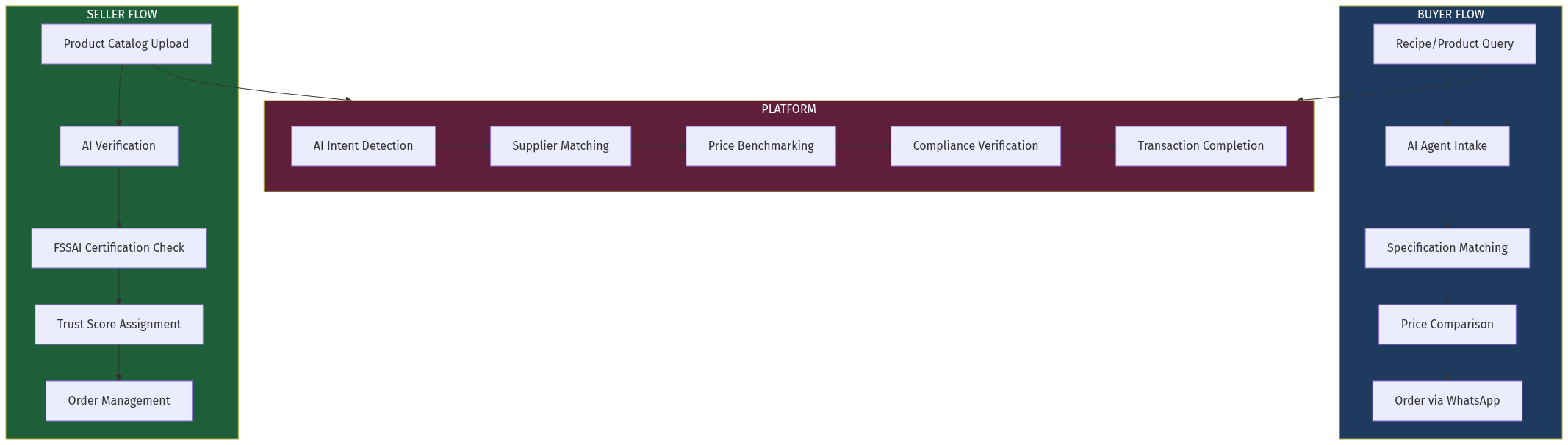
The result: A platform that doesn't just list suppliers — it transacts on behalf of buyers and sellers through AI agents.


2.

Problem Statement

The Daily Pain of Every Food Business Owner

Who faces this problem:
  • Small to mid-sized bakeries in Tier 2/3 cities
  • Hotel chains sourcing across multiple locations
  • Cloud kitchen operators managing 20+ ingredient SKUs
  • Food processing units requiring consistent quality
  • Restaurant groups negotiating bulk rates
What's broken today:
Pain PointCurrent RealityTime Wasted
Finding trusted suppliersWhatsApp groups, trader's visits2-4 hours/week
Price discoveryCall 5+ suppliers individually1-2 hours/order
Quality verificationSample orders, trial batches1-2 weeks per new supplier
FSSAI compliance checkManual verification30 min per supplier
Credit termsFace-to-face negotiationVaries
Reorder frictionWhatsApp message search15 min/order

Why This Problem Exists

Applying Zeroth Principles: We assume that buying ingredients is inherently a manual, relationship-driven process. But the underlying need is simple — "get the right ingredient, at the right price, on time, with quality assured."

This need can be fulfilled through AI agents that:

  • Understand natural language queries (e.g., "I need 50kg maida for bakery, delivery in 3 days")
  • Match against verified supplier catalogs
  • Verify FSSAI licenses programmatically
  • Execute transactions without friction

  • 3.

    Current Solutions

    Incumbent Players

    PlatformWhat They DoWhy They're Not Solving It
    IndiaMARTLead generator for B2B connectionsNo transaction, no verification, no AI
    TradeIndiaCatalog listing platformNo compliance check, WhatsApp-native ordering absent
    FoodSeller (defunct)B2B food marketplaceNo AI layer, limited supplier verification

    What's Missing

    Applying Anomaly Hunting: A market of $40B+ with no AI-first player is an anomaly. The structural reasons:

  • Trust asymmetry — Buyer cannot verify supplier quality without trial
  • Relationship moat — Existing traders resist disintermediation
  • Compliance complexity — FSSAI licenses, lab reports, product-specific certifications
  • Fragmentation — Thousands of regional suppliers, no central database
  • WhatsApp dominance — All transactions happen on WhatsApp; no platform integrates
  • These gaps represent the opportunity for an AI-native platform.


    4.

    Market Opportunity

    Market Size

    • India F&B Ingredients Market: $40B+ (2025 estimate)
    • Growth Rate: 8-10% CAGR through 2030
    • Organized Segment: ~15% (the rest is unorganized/local)
    • Online Penetration: <3%

    Why Now

  • WhatsApp as default — UPI payments, business accounts make WhatsApp a transaction channel
  • FSSAI digitization — License verification APIs becoming available
  • AI agent maturation — Conversational ordering is now possible
  • Cloud kitchen expansion — 5000+ cloud kitchens in India, growing 40% YoY
  • No AI-first player — First-mover advantage is significant
  • Target Buyers

    SegmentEstimated CountAnnual Spend
    Cloud Kitchens5,000+₹5-50L each
    Hotel Chains15,000+₹10L-2Cr each
    Bakeries (organized)50,000+₹2-10L each
    Food Processors10,000+₹20L-5Cr each
    Restaurants (chain)5,000+₹5-20L each
    ---
    5.

    Gaps in the Market

    Applying Distant Domain Import

    Looking at how other industries solved similar trust problems:

    • Pharma: Janaushadhi verified_generic_suppliers for government pricing
    • Agri: eNAM (Electronic National Agriculture Market) unified mandis
    • Auto: PartBox, OttoCommerce for parts verification
    What worked: Trust layer + transaction execution + price transparency

    Applying to Food Ingredients:

    GapCurrent StateRequired State
    FSSAI verificationManual, 30 min/supplierAPI verification, 2 seconds
    Supplier qualityWord of mouthTrust scores, reviews, verified orders
    Price discoveryPhone callsReal-time benchmarking
    Reorder frictionWhatsApp searchConversational reordering
    Credit termsNegotiatedPlatform-guaranteed
    Delivery trackingPhone follow-upAutomated SMS/in-app tracking
    ---
    6.

    AI Disruption Angle

    How AI Agents Transform the Workflow

    Current (Manual):
    Buyer needs maida → WhatsApp trader → Get quotes → Negotiate → Order → Follow delivery → Quality check
    Future (AI Agent):
    Buyer to AI Agent: "Need 100kg premium maida, delivery Friday, Taj hotel kitchen"
    AI Agent: "Found 3 verified suppliers. Price range ₹28-32/kg. Supplier A has FSSAI verified + 4.8★ rating. Shall I order 100kg at ₹30/kg?"
    Buyer: "Yes"
    AI Agent: [Executes order, notifies supplier, tracks delivery]

    Incentive Mapping

    Who profits from the status quo:
    • Local traders (margin: 15-25%)
    • WhatsApp group admins (kickbacks: 2-5%)
    • Unverified suppliers (quality escapes)
    What keeps the status quo:
    • Relationship dependency
    • No alternative trust infrastructure
    • FSSAI verification complexity
    Disruption incentive:
    • Save buyers 2-4 hours/week on sourcing
    • Reduce quality failures (current rate: ~15%)
    • Enable credit terms through platform escrow

    7.

    Product Concept

    Core Features

  • AI Conversational Intake
  • - Natural language product queries - Recipe-based ingredient suggestions - Contextual reordering ("same as last order")
  • Supplier Verification Engine
  • - FSSAI license verification (API integration) - Lab report validation - Quality incident tracking
  • Trust Score System
  • - Delivery consistency score - Quality rating (post-delivery verification) - Response time score - Credit fulfillment score
  • Dynamic Pricing
  • - Real-time price benchmarking - Bulk discount automation - Credit period pricing
  • WhatsApp Commerce
  • - Order via WhatsApp - Order updates via WhatsApp - Voice order support (voice-to-text)
  • Logistics Integration
  • - Multi-supplier aggregation - Cold chain tracking - Delivery scheduling

    User Flow

    Architecture Diagram
    Architecture Diagram

    8.

    Development Plan

    PhaseTimelineDeliverables
    MVP8 weeksAI intake + supplier catalog + WhatsApp ordering
    V112 weeksFSSAI verification + trust scores
    V216 weeksCredit terms + logistics integration
    V324 weeksAI-agent autonomous ordering

    MVP Features

    • Natural language ingredient search
    • 100 supplier onboarded (manual + API)
    • WhatsApp ordering flow
    • Basic trust scores (delivery tracking)
    • Manual FSSAI verification

    Technical Stack

    • Frontend: Next.js + Tailwind
    • Backend: Node.js + Supabase
    • AI Layer: OpenAI / Claude for intent detection
    • WhatsApp: Kapso API
    • Payments: Razorpay UPI

    9.

    Go-To-Market Strategy

    Phase 1: Hyderabad & Mumbai (Cloud Kitchens)

  • Target: 100 cloud kitchens in Hyderabad, 200 in Mumbai
  • Acquisition: Direct outreach via WhatsApp groups
  • Onboarding: Free trial (first 10 orders)
  • Incentive: Free FSSAI verification worth ₹500/supplier
  • Phase 2: Tier 1 Expansion (Delhi, Bangalore, Chennai)

  • Focus: Hotel chains, restaurant groups
  • Sales: Direct sales team (2 cities, 2 reps each)
  • Partnerships: State F&B associations
  • Phase 3: Tier 2/3 Expansion

  • Model: WhatsApp-first, vernacular support
  • Acquisition: Partner with regional distributors
  • Incentive: Credit terms enabled via platform escrow
  • GTM Tactics

    ChannelTacticExpected Conversion
    WhatsApp groups10% discount on first order15% of leads
    Direct outreachSales call, demo20% of leads
    F&B associationsSpeaking + demo10% of leads
    Cloud kitchen platformsPartnership5% of leads
    ---
    10.

    Revenue Model

    Primary Revenue Streams

    StreamModelEst. Margin
    Commission8-12% on GMV8-12%
    Verification ServicesPaid FSSAI verification₹200-500/supplier
    Premium ListingsFeatured suppliers₹2000-5000/month
    Data LicensingPrice index data to investorsVariable
    Credit InterestPlatform escrow interest6-10% APR

    LTV:CAC Analysis

    MetricEstimate
    CAC (acquisition)₹3000-5000
    LTV (first year)₹15,000-30,000
    LTV:CAC5:1

    Year 1 Revenue Projection

    • GMV: ₹5 Crore
    • Commission: ₹50-60 Lakhs
    • Verification: ₹10 Lakhs
    • Premium Listings: ₹15 Lakhs
    • Total Revenue: ₹75-85 Lakhs

    11.

    Data Moat Potential

    Proprietary Data That Accumulates

    Data TypeMoat Strength
    Supplier quality scoresStrong (requires volume)
    Price benchmarksMedium (public to all)
    Buyer preferencesStrong (behavioral)
    Recipe ingredient mappingsVery strong (unique dataset)
    FSSAI compliance historiesStrong (regulatory)

    Moat Defense

    The moat is not the technology — it's the accumulated trust scores and price data. A new entrant would need:

    • 6-12 months to build equivalent trust data
    • Supplier willingness to get re-verified
    • Buyer trust to switch from existing relationships
    ---

    12.

    Why This Fits AIM Ecosystem

    Vertical Integration

    This platform can become a vertical under AIM.in:

  • Domain Portfolio Synergy:
  • - foodingredients.in, masala.in, spices.in, bakerysupplies.in → parked pages driving organic traffic
  • WhatsApp Integration:
  • - Use existing WhatsApp infrastructure (Kapso API) - Vishnu handles lead response
  • Data Aggregation:
  • - Price indices inform domain valuation - Trust scores inform supplier verification
  • Existing Network:
  • - Vizag Startups F&B members as initial buyers - Restaurant associations as partners

    Expansion Path

    • Horizontals: Additives, packaging, equipment
    • Verticals: Meat, dairy, bakery, confectionery
    • Geographic: Tier 2/3 cities via WhatsApp-first model

    ## Verdict

    Opportunity Score: 8.5/10

    Why 8.5/10

    Strengths:
    • Large market ($40B+) with <3% online penetration
    • Clear problem that AI can solve (conversational ordering + compliance)
    • WhatsApp as familiar transaction channel for buyers
    • No AI-first incumbent (first-mover advantage)
    • Strong data moat potential
    Risks:
    • Supplier onboarding friction (need critical mass)
    • Trust building takes time
    • Trader resistance in traditional markets
    • FSSAI verification complexity varies by state

    Recommendation

    Build MVP focused on Hyderabad + Mumbai cloud kitchens first. Use WhatsApp for ordering, offer free verification to attract suppliers. Target 500 cloud kitchens in 12 months as proof of concept.

    The key insight: Don't try to replace traders. Replace the manual, fragmented, trust-deficient process with AI agents that verify, match, and execute — while traders fulfill orders.


    ## Sources