ResearchTuesday, May 5, 2026

AI-Powered Restaurant & Hotel Supply Procurement Platform for India

India's 3.2M+ restaurants and 200K+ hotels run on fragmented supply chains, manual phone calls, and trust-based relationships. An AI agent can replace all of it with automated ordering, verified suppliers, and transparent pricing.

1.

Executive Summary

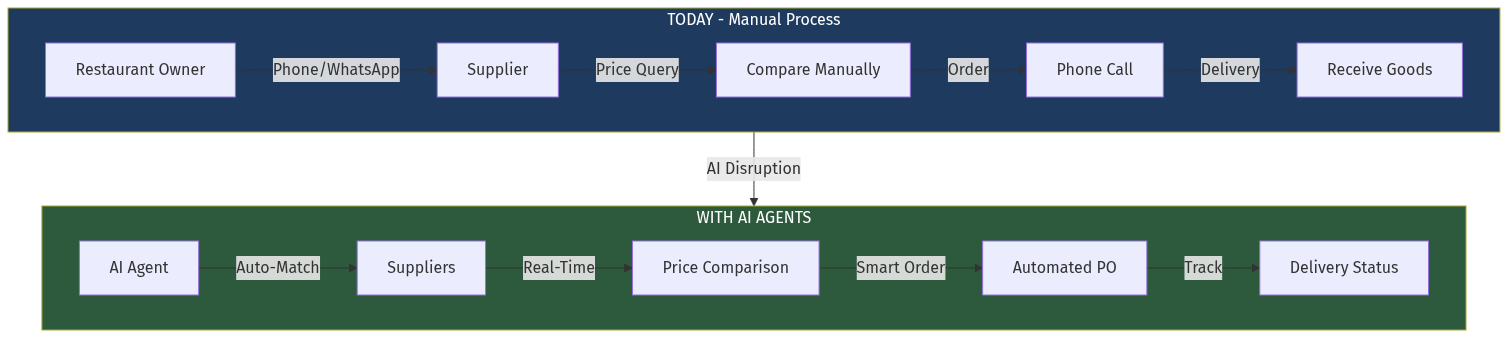
India's hospitality industry—restaurants, hotels, canteens, cloud kitchens—operates on a fundamentally broken supply chain. Every day, lakhs of establishment owners or procurement managers spend hours on phone calls, negotiating prices with multiple suppliers, manually tracking deliveries, and hoping quality matches expectations.

This is a $180B+ market (foodservice + hospitality) where almost no digitization has happened. No AI-first player exists. No unified catalog. No transparent pricing. No trust layer.

An AI-powered procurement platform—controlled via WhatsApp—can capture this market in 18 months.
2.

Problem Statement

The Daily Reality

A mid-size restaurant in Delhi or Bangalore runs on:

  • 15-30 different suppliers (vegetables, meat, spices, packaging, housekeeping, kitchen equipment)
  • Each supplier contacted manually via phone or WhatsApp
  • No clear price discovery—who's giving the best deal?
  • Quality verification is manual—"sabji wala" sends what he wants
  • Payments are fragmented—cash, UPI, credit terms vary by supplier
  • Re-ordering is repetitive—same orders placed every 2-3 days

Who Experiences This Pain

  • Hotel owners (budget to 5-star) managing inventory across departments
  • Restaurant owners (dhabas to fine-dining) daily procurement
  • Cloud kitchen operators optimizing for margin
  • Canteen managers (corporate, institutional, railway) bulk ordering
  • Catering companies multi-location supply coordination
3.

Current Solutions

CompanyWhat They DoWhy They're Not Solving It
Zomato HyperpureB2B fresh produce deliveryOnly vegetables/provisions, no full catalog, limited to metro cities
BijliposPOS + restaurant managementNot a procurement marketplace, focuses on billing
LiciousMeat/fish delivery (B2C)Consumer-focused, not supplying restaurants
WaycoolAgri supply chain techB2B agri, not restaurant-specific, limited city coverage
IndiaMART sellersFragmented suppliersNo AI layer, no automated ordering, discovery problem

The Gap

  • No unified catalog for restaurant supplies
  • No AI-powered reordering — everything is manual
  • No vendor trust scores — quality is gamble
  • No price benchmarking — no transparency on who's cheaper
  • WhatsApp-native UX missing — the primary channel isn't being leveraged
4.

Market Opportunity

Market Size

  • India Foodservice Market: ~$120B (2025), growing 15% CAGR
  • Hotel Industry: ~$60B (2025)
  • Combined Addressable Market: ~$180B+
  • Serviceable Obtainable Market (SOM): $8-12B (urban B2B procurement)

Why Now

  • WhatsApp penetration — every supplier and buyer is on WhatsApp
  • UPI infrastructure — seamless payments at scale
  • No AI-first player — greenfield opportunity
  • Margin pressure — restaurants need 5-15% cost optimization
  • Cloud kitchen growth — 50K+ new cloud kitchens in 2 years need supply chains
  • 5.

    Gaps in the Market

    Gap 1: No Unified Catalog

    Every restaurant manages 20+ categories. No platform covers them all—not Hyperpure, not Waycool.

    Gap 2: No Trust Layer

    Supplier quality is a gamble. No ratings, no verification, no history tracking.

    Gap 3: No Price Transparency

    A restaurant owner never knows if they're getting the best price. Each supplier quotes differently.

    Gap 4: Manual Repetition

    Same order placed every 2 days. No automation. No smart reordering based on consumption patterns.

    Gap 5: WhatsApp-Native Ordering

    Everyone orders via WhatsApp text. No structured catalog, no cart, no order history clarity.
    6.

    AI Disruption Angle

    The AI Agent Workflow

  • User sends WhatsApp: "Dal chana, 5kg"
  • AI Agent understands intent
  • Matches catalog + finds verified suppliers
  • Shows price benchmark + trust scores
  • User confirms → Order placed
  • AI tracks delivery → Quality feedback
  • Auto-reorder when stock low
  • How AI Transforms the Workflow

  • Conversational Ordering — Natural language via WhatsApp. "Basil needed, send tomorrow"
  • Smart Reordering — AI predicts consumption, suggests reorders
  • Price Benchmarking — Real-time price comparison across suppliers
  • Trust Scoring — AI-aggregated ratings based on delivery, quality, timeliness
  • Dispute Resolution — AI-mediated issue handling with supplier history
  • Bulk Negotiation — Pooled demand across restaurants for better pricing
  • 7.

    Product Concept

    Core Features

    FeatureDescription
    | WhatsApp Catalog | Browse, search, order via WhatsApp | | Unified Supply Catalog | All categories—fresh produce, dry goods, packaging, equipment | | Supplier Trust Scores | AI-calculated ratings from delivery, quality, pricing | | Price Benchmark | Real-time comparison across verified suppliers | | Auto-Reorder | AI-suggested reorders based on consumption patterns | | Delivery Tracking | Real-time delivery status updates | | Invoice Management | Consolidated invoices + payment tracking | | Quality Feedback | Post-delivery rating system |

    Platform Architecture

    Flow
    Flow

    User Journey

  • Onboarding: Restaurant owner registers via WhatsApp. AI asks: What do you serve? How many covers?
  • Catalog Setup: AI builds custom catalog based on cuisine type
  • First Order: User browses catalog or asks "need tomatoes"
  • Price Discovery: AI shows 3 supplier options with prices + ratings
  • Order Confirmation: User confirms. Payment via UPI.
  • Delivery: Track in real-time. AI notifies on delivery.
  • Feedback: Rate supplier. AI updates trust scores.
  • Repeat: AI suggests reorders when stock runs low.
  • 8.

    Development Plan

    PhaseTimelineDeliverables
    MVP8 weeksWhatsApp catalog, 5 categories, 50 suppliers (1 city)
    V116 weeksAll categories, 500+ suppliers, price benchmark, trust scores
    Scale24 weeksMulti-city, auto-reorder, AI predictions

    MVP Features

    • WhatsApp bot for catalog + ordering
    • 5 pilot categories: Fresh produce, Dry groceries, Packaging, Spices, Dairy
    • 50 verified suppliers in one city (Bangalore)
    • Manual supplier onboarding
    • UPI payment integration

    V1 Features

    • Full catalog across 20+ categories
    • AI-powered reordering suggestions
    • Trust score algorithm
    • Price benchmark engine
    • Delivery tracking
    • Basic analytics for restaurant owners
    9.

    Go-To-Market Strategy

    Step 1: Cloud Kitchen Clusters (Week 1-4)

    • Target: 500 cloud kitchens in Bangalore
    • Channel: Direct WhatsApp outreach, food delivery partnerships
    • Pitch: "Save 10% on supplies, order via WhatsApp"
    • Incentive: Free first order for early adopters

    Step 2: Restaurant Associations (Week 5-12)

    • Partner with local restaurant associations
    • Offline meetups, demo sessions
    • Bulk supplier onboarding through association tie-ups

    Step 3: Hotel Chains (Week 13-24)

    • Approach mid-size hotel chains (20-100 rooms)
    • Focus on procurement managers
    • Offer multi-location order management

    Step 4: Institutional Catering (Week 25+)

    • Target: Corporate canteens, railway catering, event management companies
    • Bulk ordering at scale
    • Custom catalog + pricing
    10.

    Revenue Model

    Revenue Stream 1: Commission (8-15%)

    • Commission on every order placed through platform
    • Tiered based on category (fresh produce: 10%, packaged: 15%)

    Revenue Stream 2: Subscription (INR 2,000-10,000/month)

    • Premium features for restaurants: AI reordering, analytics, dedicated support
    • Free tier: Basic catalog + ordering
    • Pro tier: AI features + unlimited orders
    • Enterprise: Multi-location management

    Revenue Stream 3: supplier Listings (INR 500-2,000/month)

    • Premium supplier visibility
    • Featured listings in category searches
    • Analytics for suppliers

    Revenue Stream 4: Data Services

    • Market intelligence reports for suppliers
    • Price trend data for ingredients
    • Demand forecasting for suppliers
    11.

    Data Moat Potential

    What Accumulates Over Time

    Data TypeValue
    Supplier Trust ScoresProprietary quality metric—no one else has this
    Price BenchmarksReal-time pricing data across suppliers and categories
    Consumption PatternsAI learns restaurant ordering patterns
    Supplier Negotiation HistoryPooled demand data for bulk pricing
    Quality Feedback DatabaseStructured reviews across suppliers

    Why This Becomes a Moat

    • New entrants cannot replicate trust scores without order history
    • Price benchmarks require real transaction data
    • AI improves with usage—every order makes recommendations better
    • Network effects: More restaurants → Better pricing → More restaurants
    12.

    Why This Fits AIM Ecosystem

    Vertical Alignment

    • Domain focus: B2B marketplace, hospitality supply
    • WhatsApp-native: Matches AIM's communication strength
    • Data intelligence: Trust scoring + price benchmarks = Netrika's domain
    • Workflow automation: Procurement workflow = ideal AI agent use case

    Integration Points

    • Can become a vertical under AIM.in
    • Netrika can power supplier verification + trust scoring
    • WhatsApp integration for ordering
    • Domain portfolio: restaurantPOS.in, hoteltech.in, kitchen supplies.in

    ## Verdict

    Opportunity Score: 8.5/10

    This is a massive, fragmented market with zero AI-native competition. The WhatsApp-native UX is the perfect entry point for India's restaurants and hotels. Trust scores + price transparency create a defensible moat within 18 months.

    Recommendation: Build MVP targeting cloud kitchens first. Expand to restaurants, then hotels. Focus on Bangalore, then Mumbai, then Delhi.

    ## Sources