ResearchTuesday, May 5, 2026

AI-Powered Restaurant & Hotel Grocery Procurement Platform for India

Building an AI-first B2B grocery marketplace that transforms how hotels, restaurants, and cloud kitchens source fresh produce — replacing fragmented phone/WhatsApp ordering with intelligent agent-mediated procurement featuring automated quality verification, price benchmarking, and predictive demand planning.

9
Opportunity
Score out of 10
1.

Executive Summary

The $95 billion Indian restaurant and hotel industry's grocery procurement remains deeply fragmented, manual, and trust-deficient. Hotels and restaurants currently rely on a chaotic web of local wholesalers, weekend market visits, and phone-based orders — with no standardized quality verification, no price transparency, and minimal leverage for negotiation.

This presents a massive opportunity for an AI-powered procurement platform that acts as a trusted intermediary between food businesses and verified produce suppliers. The platform would leverage AI agents to understand natural language requirements ("I need 50kg onions, grade A, delivered by 6 AM"), match with pre-verified suppliers, benchmark pricing in real-time, and ensure quality through standardized inspection protocols.

Key Insight: Unlike general B2B marketplaces (IndiaMART, TradeIndia), this vertical requires domain-specific trust layers — quality verification protocols, delivery SLAs, and AI conversational intake — that generic platforms cannot provide.
2.

Problem Statement

The Daily Pain of Restaurant Procurement

Every morning across India's 3.2 million restaurants, hotel kitchens, and cloud kitchens, procurement managers face the same challenges:

  • Multiple vendor relationships — Managing 10-20+ local vendors for different produce categories (vegetables, fruits, spices, dairy, meat)
  • No quality assurance — Accepting deliveries without standardized quality checks; disputes are resolved through arguments, not contracts
  • Price opacity — No visibility into market rates; negotiating blindly each day
  • Time-intensive ordering — Phone calls, WhatsApp messages, follow-ups for each category
  • Wastage uncertainty — Over-ordering to avoid stockouts, leading to 8-15% produce wastage
  • No structured data — No historical purchase data, no demand forecasting, no supplier performance tracking
  • Who Experiences This Pain

    • Small restaurants (seating 20-50): Owner or chef personally handles procurement; 2-3 hours daily on ordering
    • Medium restaurants (50-100 seats): Dedicated procurement staff; still manual phone/WhatsApp process
    • Hotel chains: Centralized procurement teams but fragmented supplier networks across cities
    • Cloud kitchens: Scale-dependent demand forecasting; high wastage during demand swings
    • Catering companies: Event-based bulk orders; no reliable supplier network

    3.

    Current Solutions

    CompanyWhat They DoWhy They're Not Solving It
    IndiaMARTGeneral B2B marketplaceNo domain specificity; no quality protocols; transactional only
    TradeIndiaB2B directoryListing platform; no trust layer or procurement workflow
    UdaanB2B wholesaleFocus on general merchandise; limited fresh produce; no restaurant vertical
    Jiomart B2BWholesale platformConsumer-focused; limited supplier network for restaurants
    Local WhatsApp groupsInformal supplier networksNo verification, no quality track record, no scalability

    Current Workarounds

  • Chef's Table networks — Some restaurants use premium supplier networks but limited to metro cities
  • Cooperative societies — Hotel associations in some cities organize collective purchasing but limited scale
  • Property managers — Some office complexes manage vendor relationships for in-house food businesses
  • The Gap: No AI-first platform that understands restaurant procurement as a workflow, not just a transaction.
    4.

    Market Opportunity

    Market Size

    SegmentEstimated SizeNotes
    Hotel & Restaurant Grocery Procurement$95 billionIndia HoReCa segment
    Fresh Produce (Vegetables + Fruits)$45 billionCore category
    Dairy + Meat + Spices$30 billionHigh-margin categories
    Cloud Kitchens$8 billionGrowing fast (35% CAGR)
    Catering Services$12 billionEvent-based

    Growth Drivers

  • Food services growth — India's restaurant industry growing at 18% CAGR
  • Cloud kitchen explosion — 5000+ cloud kitchens in major metros alone
  • Quality consciousness — Post-COVID hygiene and quality focus
  • AI adoption — Rising acceptance of AI tools in food businesses
  • Why Now

    • Supplier readiness — Wholesale markets digitized; APMC mandis increasingly connected
    • Restaurant technology adoption — POS, delivery apps normalize digital workflows
    • Trust infrastructure — UPI, digital payments reduce transaction friction
    • AI capability maturity — Conversational AI can handle complex natural language procurement

    5.

    Gaps in the Market

    Identified Gaps (Applying Anomaly Hunting)

  • No quality standardization — No accepted quality grades for restaurant produce; each buyer defines "quality" differently
  • No delivery reliability tracking — No systematic measurement of supplier on-time, in-full delivery
  • No price transparency — No public or aggregated pricing data for restaurant-grade produce
  • No demand forecasting — Restaurants order based on gut, not data; leads to wastage
  • No supplier credit history — No creditworthy supplier database for restaurant businesses
  • No AI conversational intake — All ordering still requires manual phone/WhatsApp
  • No cross-category optimization — Can't optimize across vegetable + dairy + meat suppliers
  • Fragmented last-mile — No dedicated cold-chain logistics for restaurant deliveries

  • 6.

    AI Disruption Angle

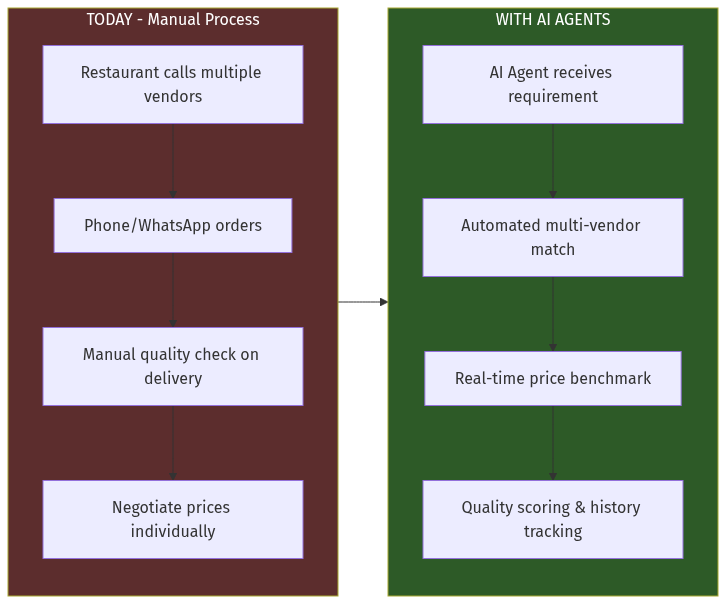
    How AI Agents Transform the Workflow

    The key insight: Restaurant procurement is fundamentally a conversational workflow that AI agents can mediate.

    #### Current State (Manual)

    Restaurant: Calls 5 vendors → Describes requirements → Negotiates price → 
    Confirms delivery → Quality check on arrival → Payment

    #### With AI Agents

    Restaurant: "AI, I need 50kg onions, grade A, 20kg tomatoes, 10kg potatoes 
    - delivered to Kitchen by 6 AM tomorrow"
    → AI Agent: Matches suppliers, benchmarks pricing, verifies quality history
    → AI Agent: "Found 3 suppliers. Best match: Supplier X - ₹28/kg onions, 
    verified 94% on-time delivery, quality score 4.2/5"
    → Restaurant: "Proceed"
    → AI Agent: Places order, tracks delivery, verifies quality, processes payment

    AI Capability Requirements

  • Natural Language Understanding — Parse restaurant requirements ("grade A onions", "daily supply")
  • Supplier Matching — Match requirements with verified supplier database
  • Price Benchmarking — Real-time price aggregation across suppliers
  • Quality Scoring — Historical quality data → supplier trust scores
  • Predictive Ordering — AI learned from purchase patterns → demand forecasting
  • Dispute Resolution — AI-mediated quality disagreement resolution

  • 7.

    Product Concept

    Platform: FreshPro AI (Hypothetical Name)

    #### Key Features

    FeatureDescription
    AI Conversational IntakeNatural language ordering via WhatsApp/Chat; understands quantities, grades, delivery times
    Supplier VerificationOn-ground verification team; certification, quality history, business legitimacy
    Quality ScoringPost-delivery quality ratings; accumulated supplier trust scores
    Price BenchmarkReal-time market pricing; prevents overcharging
    Smart RoutingAI optimizes supplier selection based on location, quality, price
    Demand ForecastingAI predicts daily/weekly demand based on historical patterns
    Credit & PaymentsNet-15/30 payment terms; digital payment infrastructure
    Dispute ResolutionAI-moderated quality disputes with photo evidence

    User Journeys

    #### Restaurant Buyer Journey

  • Onboarding — Register business, verify license (FSSAI), set procurement requirements
  • AI Training — AI learns buyer preferences (quality tiers, delivery times, budget)
  • Ordering — Conversational ordering via WhatsApp or app ("need tomatoes by tomorrow")
  • Matching — AI matches with 2-3 verified suppliers, shows pricing + quality scores
  • Confirmation — Buyer confirms; order placed with supplier
  • Delivery — Supplier delivers; buyer verifies quality (photo upload)
  • Rating — Buyer rates quality; AI updates supplier score
  • Payment — Platform processes payment; reconciliation done
  • #### Supplier Onboarding

  • Application — Submit business documents, photos of setup
  • Verification — On-ground verification (quality of produce, storage, delivery capability)
  • Onboarding — Training on platform, quality standards, packaging requirements
  • Activation — Listed in platform, receives AI-matched orders
  • Performance — Ratings accumulate; credit limits increase

  • 8.

    Development Plan

    PhaseTimelineDeliverables
    MVP8 weeksWhatsApp ordering, 50 verified suppliers (1 city), manual order matching
    V112 weeksAI conversational intake, price benchmarks, supplier scoring
    V216 weeksDemand forecasting, multi-city expansion, credit engine
    V324 weeksLogistics integration, enterprise features, B2B API

    MVP Features Checklist

    • [ ] WhatsApp Business API integration
    • [ ] Restaurant signup + FSSAI verification flow
    • [ ] Supplier verification team + protocol
    • [ ] Basic supplier database (50 suppliers)
    • [ ] Manual order matching (not AI)
    • [ ] Simple rating system
    • [ ] Payment integration (UPI/bank transfer)

    V1+ AI Features

    • [ ] NLP-trained conversational intake
    • [ ] Price benchmarking engine
    • [ ] Supplier quality scoring algorithm
    • [ ] Demand prediction model
    • [ ] Smart supplier matching

    9.

    Go-To-Market Strategy

    Phase 1: Single-City Focus (Months 1-3)

    Target: 200+ restaurants in one metro (e.g., Bengaluru or Hyderabad)
    ChannelStrategy
    Direct SalesDoor-to-door restaurant outreach; chef relationships
    Food parksTarget food court/cluster restaurants
    Hotel associationsPartner with AHAR (Hotel & Restaurant Association)
    Cloud kitchen networksTarget Zomato, Swiggy cloud kitchen partners
    ReferralsIncentive-based referral program

    Phase 2: Market Expansion (Months 4-8)

  • Supplier acquisition — Recruit wholesale market suppliers in new cities
  • Restaurant aggregation — Partner with restaurant POS providers
  • Corporate catering — Target corporate cafeteria operators
  • Phase 3: Scale (Months 9-18)

  • Geographic expansion — 5-10 major metros
  • Category expansion — Add dairy, meat, spices, packaged goods
  • Private label — Own fresh produce brand

  • 10.

    Revenue Model

    Revenue StreamDescriptionPotential
    Commission3-8% commission on GMVPrimary
    Subscription₹2,000-10,000/month for restaurantsMedium
    Premium VerificationPaid verification for suppliersLow
    Data ServicesMarket intelligence reportsLong-term
    LogisticsLast-mile delivery commissionHigh-margin

    Unit Economics

    MetricTarget
    Average Order Value₹8,000-15,000
    Commission Rate5%
    Gross Margin per Order₹400-750
    Customer Acquisition Cost₹3,000-5,000
    Lifetime Value₹40,000-80,000
    ---
    11.

    Data Moat Potential

    Proprietary Data Accumulation

  • Supplier Quality History — Years of quality ratings per supplier → unique database
  • Price Intelligence — Daily market pricing → unprecedented market data
  • Demand Patterns — City-wise, season-wise, event-wise demand data
  • Restaurant Preferences — Granular purchase behavior data
  • Supplier Credit History — Payment behavior database
  • Competitive Moat

    • Trust compound — Supplier quality scores compound over time; hard to replicate
    • Network effects — More restaurants → better supplier pricing → more restaurants
    • Data advantage — Demand forecasting improves with more transactions

    12.

    Why This Fits AIM Ecosystem

    Vertical Integration with AIM.in

    This platform aligns directly with AIM's vision:

  • B2B Marketplace — Core marketplace model matching buyers and suppliers
  • Verification Trust Layer — AI-verified supplier trust scores as differentiation
  • WhatsApp-Native — Conversational AI integrates with India's default channel
  • India Focus — Domain-specific for Indian restaurant ecosystem
  • Cross-Sell Opportunities

    • Chemical Supplies — Kitchen cleaning, hygiene chemicals
    • Safety Equipment — Fire safety, kitchen safety gear
    • Packaging — Food packaging, delivery containers
    • Equipment — Kitchen equipment, maintenance

    ## Verdict

    Opportunity Score: 9/10

    This is a high-potential B2B vertical that combines:

    • Large market ($95B+)
    • Clear pain (manual, fragmented procurement)
    • AI-native fit (conversational workflow)
    • Data moat (quality scores compound)
    • Timing (AI capability + trust infrastructure mature)

    Why Score 9/10

    FactorScoreRationale
    Market Size10/10$95B+ addressable
    Pain Intensity9/10Daily manual work; significant wastage
    AI Fit9/10Conversational workflow native
    Timing8/10Market readiness improving
    Competition8/10No AI-first player
    Moat Potential9/10Quality scores compound

    Risks & Mitigation

    RiskSeverityMitigation
    Supplier acquisitionMediumPartner with APMC mandis
    Quality standardizationHighAI-assisted quality scoring
    Unit economicsMediumStart with premium segment
    CompetitionMediumFast execution, trust layer

    Recommendation

    Proceed with pilot in one metro. Target 200 restaurants, 50 verified suppliers. Prove unit economics before scaling.

    ## Sources


    ## Diagrams

    Platform Architecture

    Architecture Diagram
    Architecture Diagram

    AI Transformation Flow

    AI Transformation
    AI Transformation