ResearchTuesday, May 5, 2026

AI-Powered Hotel & Hospitality Supplies Marketplace for India

An 8B+ opportunity to build India's first AI-first B2B procurement platform for hotels, restaurants, and cafes—replacing fragmented WhatsApp orders with intelligent matching, verified suppliers, and automated quoting.

1.

Executive Summary

India's hotel and hospitality industry is growing at 16% CAGR, yet procurement remains brutally fragmented. Hotels still place orders via WhatsApp voice notes, phone calls to multiple suppliers, and manual email comparisons. No single platform handles the full procurement workflow.

This article proposes an AI-powered B2B marketplace connecting hotels, restaurants, caterers, and cafes with verified suppliers—using conversational AI to understand requirements, smart matching to pair buyers with suppliers, and automated quote comparison.

Total Addressable Market: 8B+ (India hospitality procurement) Serviceable Obtainable Market: 00M (B2B e-procurement) GTM: Vertical-first, region-focused, WhatsApp-native
2.

Problem Statement

The Indian hospitality sector faces acute procurement pain:

2.1 Fragmented Supplier Network

  • Hotels maintain relationships with 50-200+ suppliers across categories
  • Each category (kitchen equipment, linens, furniture, cleaning supplies) requires separate sourcing
  • No consolidated supplier database exists

2.2 Manual Inquiry Process

  • Purchasing managers spend 40%+ of time on phone calls and follow-ups
  • Quote comparison done via Excel sheets or WhatsApp screenshot comparisons
  • No visibility into market pricing or supplier track records

2.3 Trust Deficits

  • Quality inconsistency: sample products differ from bulk orders
  • Delivery reliability: late deliveries during peak seasons
  • Payment issues: delayed payments to preferred suppliers
  • No verified review ecosystem

2.4 Price Opacity

  • Hotels never know if they're getting competitive pricing
  • No benchmark for "market rate" per product category
  • Suppliers quoted differently based on relationship strength
Who experiences this pain:
  • Hotel purchasing managers (40,000+ properties in India)
  • Restaurant owners (5M+ food service establishments)
  • Cafe chains and catering companies

3.

Current Solutions

CompanyWhat They DoWhy They're Not Solving It
IndiaMARTB2B product catalogCatalog only—no transactions, no AI, discovery broken
WhatsApp BusinessSuppliercatalogManual searching, no verification, no quote management
Zomato HyperpureRestaurant suppliesFood ingredients only, limited categories, metro-focused
HotelBeds (global)Hotel procurementNot India-specific, enterprise-only
UdaanB2B wholesaleGeneralist—hospitality is tiny niche, no specialization

What's Missing

  • AI conversational intake — Nobody wants to click filters. Just ask: "I need 100 king sheets, cotton, white, 300TC, delivery in 7 days"
  • Supplier verification — No trusted review/reputation system
  • Smart matching — Auto-match requirements to best suppliers
  • Quote comparison — Automated side-by-side quote views
  • Trust scoring — Verified reviews, past performance, delivery ratings

  • 4.

    Market Opportunity

    Market Size

    • India hospitality market: ~5B (2025)
    • Procurement spend: ~8B+ (hotels, restaurants, cafes, catering)
    • Online penetration: <2%
    • E-procurement TAM: 00M (5% of total)

    Growth Drivers

  • Tier 2/3 city expansion — New hotels opening in smaller cities
  • Organized sector growth — Branded chains vs unorganized dhabas
  • GST compliance — Digital records becoming mandatory
  • AI adoption — whatsapp-first buyers comfortable with conversational UI
  • Post-COVID digital push — Hygiene and transparency expectations
  • Why Now

  • WhatsApp is the default B2B communication channel
  • AI can now understand conversational product requirements
  • Trust and verification can be digitized (not possible 5 years ago)
  • No incumbent has AI-first approach
  • IndiaMART is too slow, too broad, too basic

  • 5.

    Gaps in the Market

    Gap 1: Intent-to-Delivery Friction

    • Current: Inquiry → Multiple calls → Quotes → Negotiate → Order → Delivery → Payment → Dispute
    • No platform connects entire workflow

    Gap 2: No Reputation Infrastructure

    • No verified supplier reviews for specific product categories
    • No delivery timeliness tracking
    • No quality consistency verification

    Gap 3: Conversational Discovery

    • Still need to browse catalogs and apply filters
    • "I need commercial dishwasher for 50-room hotel" → requires domain knowledge
    • AI could interpret and match automatically

    Gap 4: Price Discovery

    • No "fair market price" benchmark exists
    • No transparent competitive quoting

    Gap 5: Category Fragmentation

    • Kitchen: hundreds of sub-categories
    • linens, furniture, cleaning, amenities—each separate
    • No unified hospitality procurement platform

    6.

    AI Disruption Angle

    6.1 Conversational AI Agent

    Instead of search filters, buyers converse with AI:

    User: "I need 50 queen bedsheets, 250TC cotton, white, delivery in Bangalore by Friday" AI Agent:
  • Parses: quantity, spec, timeline, location
  • Matches: 3-5 verified suppliers who stock these
  • Quotes: gets live quotes with delivery dates
  • Compares: presents side-by-side comparison
  • Books: processes order on buyer confirmation
  • 6.2 Supplier Trust Layer

    AI-verified supplier profiles:

    • Verification: GST, business documents, product certifications
    • Ratings: Category-specific (not generic)
    • Delivery score: On-time %, late %, never-miss %
    • Quality score: Return rate, complaint rate
    • AI fraud detection: Anomaly detection in pricing/quality

    6.3 Auto-Quote Engine

    When inquiry received:

  • AI identifies product specs and category
  • Broadcasts to 5-10 relevant suppliers
  • Collects quotes with lead times
  • Auto-compares: price, delivery, payment terms
  • Presents ranked options to buyer
  • 6.4 Future: Autonomous Ordering

    For repeat purchases (monthly consumables):

    • AI monitors inventory
    • Auto-reorders based on consumption patterns
    • Buyer verifies and confirms
    • Full autonomous procurement for approved items
    ---

    7.

    Product Concept

    7.1 Core Features

    FeatureDescription
    AI InquiryConversational product search in WhatsApp
    Supplier VerificationAI-verify GST, docs, certifications
    Smart MatchingAuto-match requirements to best suppliers
    Quote EngineMulti-supplier quote comparison
    Trust ScoresCategory-specific supplier ratings
    Order ManagementTrack orders, deliveries, payments
    Repeat OrdersAuto-reorder for consumables

    7.2 User Flow

    7.3 Platform Architecture

    Platform Architecture
    Platform Architecture

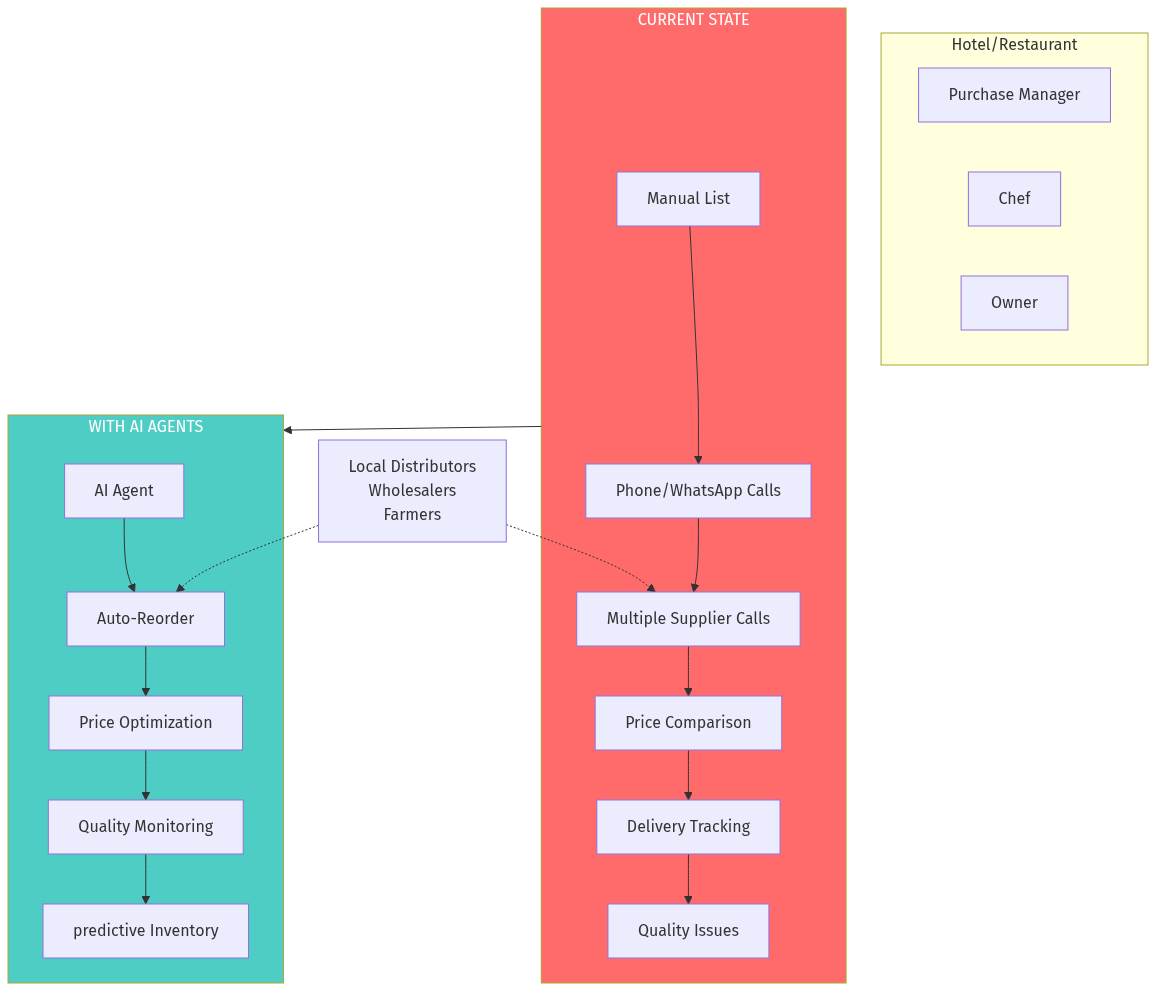
    7.4 Comparison with Today

    Today's vs AI-Powered
    Today's vs AI-Powered

    8.

    Development Plan

    PhaseTimelineDeliverables
    MVP8-10 weeksWhatsApp bot, 3 categories, 50 suppliers, basic quote collection
    V112-16 weeksAI conversational intake, trust scores, order management, repeat orders
    V220-24 weeksInventory AI, autonomous ordering, analytics dashboard
    ScaleongoingTier 2/3 expansion, supplier financing, category expansion

    MVP Features

    • WhatsApp bot for inquiry intake
    • Supplier onboarding (3 key categories)
    • Quote collection workflow
    • Basic supplier profiles

    V1 Features

    • Full conversational AI
    • Category-specific trust scores
    • Order tracking
    • Repeat order automation

    9.

    Go-To-Market Strategy

    Phase 1: Beachhead (Months 1-3)

  • Target: 50 hotels in Bangalore (high density)
  • Categories: Kitchen equipment, linen, cleaning—high frequency
  • Acquisition: Direct sales team, relationship penetration
  • Incentive: First 3 orders free, supplier verification for suppliers
  • Phase 2: Expand (Months 4-8)

  • Geography: Mumbai, Delhi NCR, Hyderabad, Chennai
  • Categories: Add furniture, amenities, tableware
  • Supplier: 500+ verified suppliers across categories
  • Marketing: Referral program, industry events
  • Phase 3: Scale (Months 9-16)

  • Tier 2/3: Jaipur, Chandigarh, Kochi, Vizag
  • WhatsApp Channel: Enable WhatsApp Business for all interactions
  • Suppliers: Financing partnership for supplier liquidity
  • Category expansion: Full hospitality suite
  • GTM Channels

    ChannelRationale
    Direct salesHigh-touch for initial hotels
    WhatsApp-firstTarget audience channel
    Hotel associationsDistribution through networks
    Industry eventsIHHA, FHRAI connections
    ReferralWord-of-mouth in hospitality
    ---
    10.

    Revenue Model

    Revenue Streams

    StreamModelTake Rate
    Transaction feePer order2-5%
    Supplier subscriptionMonthly listingRs 2,000-10,000/mo
    Premium listingsFeatured placementRs 5,000-20,000/mo
    Verification servicePremium verificationRs 5,000-15,000/mo
    AdvertisingCategory sponsorsRs 50,000-2,00,000/mo

    Revenue Projections

    Assuming:

    • 500 hotels transacting, Rs 50,000 average order
    • 2 orders/month
    • 2% transaction fee
    Month 6: Rs 10L MRR (500 hotels × 50,000 × 2 × 2%) Month 12: Rs 50L MRR (scaled 5×) Month 24: Rs 2Cr+ MRR (full ecosystem)


    11.

    Data Moat Potential

    Proprietary Data Accumulation

  • Supplier behavior data
  • - Pricing patterns across seasons - Delivery reliability metrics - Quality consistency over time - Response patterns to inquiries
  • Buyer behavior data
  • - Category preferences - Price sensitivity curves - Seasonal demand patterns - Repeat order patterns
  • Market intelligence
  • - Real-time pricing benchmarks - Category demand heatmaps - Supplier performance league tables - Regional price variations

    Defensive Moats

    • Network effects: More buyers → more supplier interest → better pricing
    • Trust积累: Verified reviews compound over time
    • AI training: Conversational intake improves with more interactions
    • Suppliers locked in: Reputation investment disincentivizes leaving

    12.

    Why This Fits AIM Ecosystem

    This vertical aligns with AIM.in's strategy for multiple reasons:

    12.1 Domain Fit

    • B2B marketplace: Core AIM competency
    • Verticalized: Hotel/hospitality is naturalextension from existing research
    • India-first: No global competitor serves India well

    12.2 Infrastructure Leverage

    • WhatsApp integration (existing)
    • Supplier databases (can build from IndiaMART data)
    • Trust infrastructure (domain + ratings)
    • AI agent stack (can adapt Krishna avtar)

    12.3 Scalability Path

    • Horizontal: Add restaurant supplies, cafe supplies
    • Geographic: India-first, then regional (SE Asia)
    • Adjacent: Supplier financing, logistics, fulfillment

    12.4 Integration Point

    Can use existing:
    • Krishna avtar (Bhavya) for WhatsApp commerce
    • Netrika research for market intelligence
    • AIM domain infrastructure for verification

    ## Verdict

    Opportunity Score: 8.5/10

    Strengths

    • 8B+ huge addressable market
    • <2% online penetration = massive whitespace
    • AI-first approach has genuine competitive advantage
    • WhatsApp-native fits target buyer behavior
    • Trust layer becomes defensible moat
    • Transaction revenue well-understood

    Risks

    • Supplier adoption: Chicken-and-egg, need both sides
    • Category complexity: Hospitality has 100+ sub-categories
    • Trust building: Hard in first 12 months
    • Competition: IndiaMART could add features
    • Category depth: Hard to be good at everything

    Recommendation

    Pursue with caution:
    • Start with 3 high-frequency categories
    • Single geography (Bangalore) beachhead
    • Heavy B2B sales focus in phase 1
    • Verify product-market fit before scaling
    • Consider acquiring small hospitality catalog
    Next steps:
  • Conduct 20 buyer interviews (hotel purchasing managers)
  • Survey 50 potential suppliers
  • Map category priorities
  • Build MVP with kitchen equipment category
  • Test demand in one city before expanding

  • ## Sources