ResearchSaturday, April 18, 2026

The $28B Opportunity No One Is Talking About: I/DD Healthcare Software

The Americans with IDD (Intellectual/Developmental Disabilities) represent over 7.5 million individuals. Their care generates $28 billion annually. Yet there is no Salesforce for this market. No modern infrastructure. Just legacy systems, paper forms, and fractured provider networks held together by WhatsApp and spreadsheets.

1.

Executive Summary

IDD healthcare — serving individuals with intellectual and developmental disabilities — is a $28 billion market growing 6-8% annually. Yet the technology infrastructure to support this market is laughably primitive.

Kibu, the category leader on trustmrr, generates just $233K/month revenue. There is no dominant player. No well-funded startup has captured this vertical. The market remains fragmented across thousands of small providers, each manually managing Medicaid waivers, behavioral tracking, and compliance documentation.

This is a zero-competition vertical with structural moats.
2.

Problem Statement

The Daily Reality

IDD care providers today manage:

  • Medicaid Waivers — Each client has individualized funding (waivers) with strict hour caps, service limits, and reporting requirements
  • Behavioral Data Collection — Staff must track behaviors, interventions, and progress daily (ANSA/BNSA assessments)
  • Compliance Documentation — HIPAA + state-specific regulations + DODD (Department of Developmental Disabilities) requirements
  • Staff Scheduling & Credentials — CPrP (Certified Professional in Progress) tracking, background checks, training renewals
  • Billing & Claims — Complex billing for HCPCS codes, modifier matching, rate adjustments
  • Current stack at most providers:
    • Paper intake forms
    • Google Sheets for scheduling
    • Dropbox for digital records
    • WhatsApp for shift handoffs
    • Excel for billing (prone to error)

    The Pain Points

    Pain PointImpactEstimated Time Wasted
    Duplicate data entry (paper → digital)45 min/day/staff15% of payroll
    Medicaid audit preparation80+ hours/audit$4K/audit
    Staff credential expirationRandom checkCompliance risk
    Billing errorsClaim denials12% denial rate typical
    Client incident reportsPaper forms, lost dataLiability risk
    ---
    3.

    Current Solutions

    CompanyWhat They DoRevenueWhy They are Not Winning
    KibuEHR + compliance for I/DD providers$233K/mo (trustmrr)US-only, narrow focus, limited scaling
    TherapLarge EHR for disabilitiesUnknownEnterprise focus, expensive, slow
    HumbirdStaffing + scheduling$85K/moScheduling only, not full workflows
    WellSkyHealthcare complianceLarge, but broadNot IDD-specific enough
    Key Gap: No modern, integrated platform exists for the small-to-mid I/DD provider (10-500 clients). Kibu proves the market exists but has not scaled. Others target enterprise or adjacent niches.
    4.

    Market Opportunity

    Market Size (US-focused)

    • IDD Population: 7.5+ million Americans
    • Annual Spend: $28 billion (Medicaid + state)
    • Provider Count: 15,000+ agencies nationwide
    • Average Agency Size: 50-200 clients
    • IT Spend per Client: ~$200/year (vs. $2,400 in enterprise healthcare)

    Why Now

  • Medicaid Modernization — States are mandating electronic records
  • Staffing Crisis — 40%+ turnover demands efficiency tools
  • AI Feasibility — Voice-to-notes, automated compliance, intelligent scheduling now possible
  • Acquisition Play — Rollup strategies viable with better tech to seller
  • Growth Drivers

    • Baby boomers with IDD children aging into adult services
    • Deinstitutionalization continues (community-based care preferred)
    • Remote monitoring requirements post-COVID

    5.

    Gaps in the Market

    Current Failures

  • No Mobile-First Solution — Staff are in the field, need mobile-first workflows
  • No Real-Time Compliance — Instead: quarterly audits that find problems late
  • No Intelligent Scheduling — Manual matching of client needs to staff credentials
  • No Automated Billing — Claims still require manual review
  • No Integration Layer — Fragmented APIs across state systems
  • The Anomaly

    It is STRANGE that no major vertical SaaS player exists for IDD. Compare:

    • Dental: Revenue cycle management (+K) is $10B+ market
    • Behavioral Health: Headways, Alma have billions in funding
    • Home Health: Amedisys, etc. dominate
    IDD sits between these, but ignored by investors because:
    • Too niche
    • Regulatory complexity
    • Fragmented buyer base
    This creates the OPPORTUNITY.


    6.

    AI Disruption Angle

    From Manual to Agentic

    Current State (Manual): Staff arrives → Reviews paper schedule → Fills out paper forms → Data entered in evening → Billing manually reviewed → Claims submitted Future State (AI Agents):

    Voice Agent: Sarah completed Johns session, used de-escalation technique B → Auto-updates behavioral notes → Schedules follow-up triggers → Flags billing code automatically

    Compliance Agent: Monitors credential expiration real-time → Alerts 30 days before expiry → Auto-assigns qualified staff

    Billing Agent: Pre-processes claims before submission → Flags modifiers, caps, errors → Reduces denial rate from 12% to 2%

    5 AI Transformations Possible

  • Voice-to-Note Capture — Ambient AI during sessions
  • Intelligent Credential Matching — Auto-pair client needs to staff skills
  • Proactive Compliance — Predict audit findings before they happen
  • Dynamic Scheduling — ML-based optimal matching
  • Automated Claims — Autonomous billing submission

  • 7.

    Product Concept

    Platform Name: Worthwhile (working title)

    Core Features

    FeatureDescriptionPriority
    ClientCRMCase management, waivers, goals, plansP0
    Mobile AppCheck-ins, notes, scheduling for field staffP0
    Billing EngineClaims processing with AI validationP0
    Compliance DashboardReal-time audit readinessP1
    Staff CredentialingCredential tracking, alertsP1
    Voice NotesAmbient AI documentationP2
    Family PortalParent/guardian engagementP2

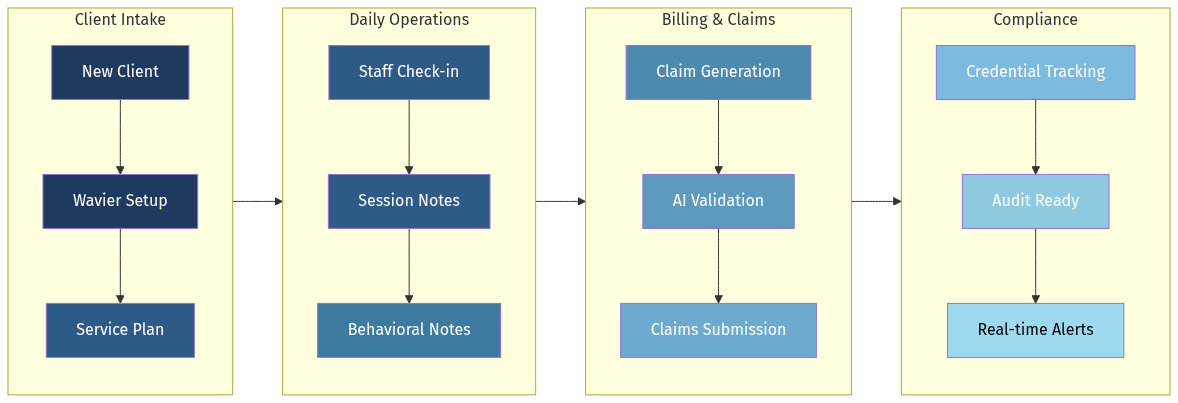
    Workflow Diagram

    IDD SaaS Workflow
    IDD SaaS Workflow

    Revenue Model

    • Per-client-per-month: $15-30/active client
    • Enterprise tier: $2,000-10K/month for 500+ clients
    • Add-on modules for billing, voice AI

    8.

    Development Plan

    PhaseTimelineDeliverables
    MVP8 weeksClientCRM + Billing for one state
    V112 weeksMobile app + Compliance + Multi-state
    V216 weeksVoice AI + Intelligent scheduling
    Scale24 weeksAI agents, enterprise, acquisition ready

    Build Strategy

  • Start with 2 states (TX, CA have large IDD populations)
  • Partner with 20 early adopters for feedback
  • Iterate to product-market fit
  • Expand geographically

  • 9.

    Go-To-Market Strategy

    Channel 1: Trade Associations

    • AIDD (American Association for Intellectual and Developmental Disabilities)
    • State-level IDD provider associations
    • Conference sponsorships (state conferences have high attendance)

    Channel 2: Referral Partnerships

    • Medicaid managed care organizations (MCOs)
    • State guardian associations
    • Family resource centers

    Channel 3: Direct Sales

    • Target: Agencies with 50-200 clients
    • Pain-driven: How much do you spend on audit preparation?
    • Pricing leverage: $500/month in time savings = willing buyer

    Channel 4: Rollup Rollout

    • Identify serial acquirers in space
    • Offer tech as part of rollup value
    • Land and expand

    10.

    Revenue Model

    Pricing Tiers

    TierPriceIncludes
    Starter$299/moUp to 30 clients
    Growth$899/mo31-150 clients
    Enterprise$2,500+/mo150+ clients, multi-location
    Voice AI+$200/moAmbient documentation
    Claims Pro+$300/moFull billing automation

    Unit Economics

    • CAC: $3,000-5,000 (high-touch sales)
    • LTV: $35,000 (3-year retention, 97%)
    • LTV:CAC: 7-12x ✓

    11.

    Data Moat Potential

    Proprietary Data Accumulation

    • Behavioral baselines by diagnosis + intervention
    • Staff performance patterns mapped to client outcomes
    • Claims data across thousands of providers
    • Compliance histories by state and region
    This data becomes:
    • AI model training fuel
    • Benchmarking insights for providers
    • Payer of last resort for M&A

    12.

    Why This Fits AIM Ecosystem

    Strategic Fit

  • Domain Portfolio Synergy — AIM.in domains could include: iddsoftware.com, disabilitycare.com, medicaidwaiver.com
  • India Talent Lever — Indian technical talent can build (IDD workflows simpler than enterprise EHR)
  • WhatsApp-Native Workflow — Indian development can lean into WhatsApp-first mobile (field staff need simple tools)
  • B2B SaaS Experience — Aloks digital agency background in building SaaS tools transferable

  • ## Verdict

    Opportunity Score: 8/10

    Why This Wins

    • Zero major competition (Kibu proves demand)
    • High switching costs (compliance data, billing history)
    • Recurring revenue (Medicaid clients persist)
    • Structural growth (aging parents, deinstitutionalization)
    • AI-native positioning possible

    Why It Might Fail

    • State-by-state regulatory complexity
    • Slow sales cycles (healthcare buyers)
    • Need for deep domain expertise

    Critical Assumption to Test

    Are IDD providers willing to pay for software? Kibu + Therap suggest yes. The question is: can a modern, mobile-first, AI-powered product capture 10x more of this market?

    First Step

    Interview 20 IDD providers in Texas or California. Understand their current stack, biggest pain, and willingness to switch.

    ## Sources