ResearchFriday, April 17, 2026

AI-Powered Hospital Equipment Management: The $12 Billion Market Hidden in Plain Sight

India's healthcare sector is undergoing a silent transformation. While hospitals race to acquire the latest MRI, CT, and ICU ventilators, the same institutions are losing crores to preventable equipment failures. A $12 billion maintenance market remains almost entirely unstructured — ripe for AI disruption.

8
Opportunity
Score out of 10
1.

Executive Summary

Indian hospitals own over $50 billion in medical equipment — MRI machines, CT scanners, ICU ventilators, dialysis units, anesthesia Workstations. Yet 70% of these facilities manage maintenance through paper logs, phone calls, and reactive repairs.

The Opportunity: Build an AI-powered hospital equipment intelligence platform that:
  • Uses IoT sensors + predictive analytics to detect failures before they occur
  • Connects hospitals with certified biomedical service providers via a marketplace
  • Automates maintenance ticketing, spare parts procurement, and regulatory compliance
  • Enables WhatsApp-based reporting for technicians in Tier 2-3 hospitals
  • Provides performance benchmarking across similar equipment fleets
Why Now: The average multi-specialty hospital loses ₹2-5 crore annually to unplanned downtime. With 75,000+ hospitals in India and growing 12% annually, the biomedical services market is worth $12 billion domestically. Most公立医院 (government hospitals) are now mandated to have CMMS (Computerized Maintenance Management Systems) — but compliance is largely fake.
2.

Problem Statement

The Pain Points

  • Reactive Maintenance: Equipment runs until something breaks. No predictive insight.
  • Vendor Fragmentation: 100+ scattered biomedical service providers, no standardized ratings
  • Spare Parts Delays: Critical components take 3-15 days to source
  • Compliance Theater: Hospitals show paper logs to NABH inspectors — actual tracking is broken
  • Technician Shortage: Certified biomedical engineers are scarce in Tier 2-3 cities
  • No Performance Benchmarking: Hospital admins have no way to compare equipment uptime
  • Warranty Expiry Blindness: Most expensive equipment exits warranty without anyone noticing

  • 3.

    Current Solutions

    CompanyWhat They DoWhy They're Not Solving It
    MediEquipSpare parts marketplaceOnly B2C, no AI/IoT integration
    Biomed IndiaService provider directoryStatic database, no real-time tracking
    HospitalROIGeneral healthcare SaaSEquipment is a tiny feature, not core
    Equip24Equipment rentalFocuses on rental, not maintenance

    Global Players

    CompanyWhat They DoWhy They're Not Solving It
    UpkeepGeneral CMMSHealthcare is one of 10 industries
    FiixAsset managementNo India presence, no biomedical focus
    PrometheusIoT monitoringGeneral industrial, not medical
    Gap: No India-focused, AI-native, biomedical-specific platform exists.
    4.

    Market Opportunity

    • Market Size: $12 billion (India biomedical services)
    • Growth: 15% CAGR (healthcare infrastructure boom)
    • TAM: $50B+ in equipment owned by Indian hospitals
    • SAM: $4B (hospitals with 50+ beds, have IT budgets)
    • SOM: $200M (first 3 years, Tier 1-2 cities)

    Why This Opportunity Exists NOW

  • NABH Accreditation Mandate: Hospitals NEED documented maintenance logs
  • Warrantywave: 2018-2020 purchases are exiting warranties en masse
  • Insurance Pressure: Cashless insurance demands lower downtime = higher payouts
  • Doctor Availability: Specialists won't operate without reliable equipment
  • Startup Gap: No Indian SaaS has cracked this vertical

  • 5.

    Gaps in the Market

  • No Predictive Maintenance: Everyone does reactive repairs
  • No Service Marketplace: Hospitals call individual vendors — no platform
  • No Spare Parts API: Parts sourcing is a manual打电话 exercise
  • No WhatsApp Integration: 80% of hospital staff lives on WhatsApp
  • No Compliance Automation: NABH documentation is manually faked
  • No Performance Benchmarking: Each hospital flies blind
  • No Technician Marketplace: Biomed engineers have no Uber-style booking

  • 6.

    AI Disruption Angle

    How AI Agents Transform the Workflow

    Current (Manual):
    Equipment fails → Nurse notices → Calls technician → Waits → Technician arrives → Diagnoses → Orders parts → Returns → Repairs → Documentation
    * timeline: 3-14 days, data lost at every step With AI Agents:
    IoT sensor detects anomaly → AI predicts failure → Auto-creates service ticket → Matches best technician → Parts auto-ordered → Technicians arrives with parts → Repairs → Compliance doc auto-generated
    * timeline: 2-24 hours, data captured at every step

    Key AI Capabilities

  • Predictive Analytics: Use equipment run-hours, error logs, and sensor data to predict failures
  • Image Recognition: Analyze thermal scans for early fault detection
  • NLP for Ticketing: WhatsApp voice notes → structured tickets
  • Matching Algorithms: Technician skills + parts availability + location = optimal dispatch
  • Parts Forecasting: ML predicts which parts to stock based on equipment age + usage

  • 7.

    Product Concept

    Core Features

    FeatureDescription
    Equipment RegistryQR code scan → digital twin with full maintenance history
    IoT DashboardReal-time temperature, usage hours, error codes
    Predictive Alerts7-day failure probability for critical equipment
    Service MarketplaceBrowse + book certified biomedical technicians
    Parts FinderSearch across 50+ suppliers in one query
    Compliance EngineAuto-generate NABH/NABL maintenance logs
    WhatsApp BotReport issues via WhatsApp, get status updates
    BenchmarkingCompare uptime across similar equipment fleets

    User Flow

    Hospital Admin
      → Registers equipment (QR scan)
      → Sets maintenance schedules
      → Gets dashboard + alerts
      
    Biomed Technician
      → Receives service ticket
      → Accepts/rejects ticket
      → Updates job status
      → Parts auto-sourced
    
    Equipment
      → IoT sensors report
      → ML predicts failure
      → Auto-triggers ticket

    8.

    Development Plan

    PhaseTimelineDeliverables
    MVP8 weeksEquipment registry + WhatsApp reporting + basic ticketing
    V112 weeksIoT integration + predictive alerts + marketplace
    V216 weeksParts API + compliance automation + benchmarking
    V320 weeksAI predictions + parts forecasting + insurance integration

    Technical Stack

    • Backend: Node.js/PostgreSQL (AIM ecosystem)
    • Frontend: React, mobile-first PWA
    • IoT: MQTT, ESP32 sensors
    • AI: TensorFlow.js for edge predictions, cloud ML for global patterns
    • WhatsApp: Kapso API integration

    9.

    Go-To-Market Strategy

    Phase 1: Hospital Anchor (Months 1-3)

  • Target: 10 multi-specialty hospitals in Hyderabad + Vizag
  • Pitch: Free equipment audit → paid maintenance platform
  • Hook: "We'll reduce your downtime by 60% or money back"
  • Phase 2: Technicians (Months 4-6)

  • Target: 100 certified biomedical technicians
  • Platform: They get jobs streamed to them, pay 10% commission
  • Hook: "We send you jobs, you just show up and repair"
  • Phase 3: Parts Suppliers (Months 7-9)

  • Target: Top 20 equipment dealers
  • API: Auto-detect parts needs, pre-position inventory
  • Hook: "We predict demand, you fulfill"
  • Phase 4: Scale (Months 10+)

  • Cities: Mumbai, Delhi, Bangalore, Chennai
  • Hospitals: Chain hospitals (Aster, Narayana, Care)
  • Government: Ayushman Bharat empanelment

  • 10.

    Revenue Model

    Revenue StreamModelPotential
    Platform Fee₹5,000-50,000/month per hospital₹50 crore ARR at 500 hospitals
    Transaction Fee8% on spare parts orders₹20 crore at scale
    Service Marketplace15% commission on jobs₹15 crore at scale
    Predictive Alerts₹2,000/month add-on₹10 crore premium tier
    AdvertisingEquipment dealer sponsored listings₹5 crore
    Total Potential: ₹100 crore+ ARR at Series A scale
    11.

    Data Moat Potential

    Proprietary Data Accumulation

  • Equipment Failure Patterns: Largest India-specific biomedical failure database
  • Technician Performance: Skills, response time, fix rate
  • Hospital Benchmarks: Uptime data across 500+ facilities
  • Parts Inventory: Real-time availability across suppliers
  • Predictive Models: Trained on Indian hospital conditions
  • Moat Strength: ⭐⭐⭐⭐⭐ (Switching costs are massive — hospitals don't want to lose historical data)
    12.

    Why This Fits AIM Ecosystem

    Vertical Integration Path

  • domain: hospitalequipment.in or biomed.in
  • WhatsApp: Inquiry handling → qualification → demo booking
  • dives.in: Deep dive article → founder traffic → B2B discovery
  • Netrika: Continuous market intelligence on healthcare startups
  • Revenue: B2B marketplace commission
  • Cross-Sell Opportunities

    • AIM.in: Hospital discovery platform → equipment platform
    • dives.in: Published article → founder inbound
    • WhatsApp: Hospital admin community (15,000+ Vizag network)

    13.

    Mental Models Applied

    Zeroth Principles

    Question: What are we assuming about hospital maintenance that everyone takes for granted? Assumption: Equipment fails randomly, so reactive maintenance is necessary. Reality: 80% of equipment failures follow predictable patterns (usage hours, environmental conditions, component wear). With IoT data, we can predict failures with 90%+ accuracy.

    Incentive Mapping

    StakeholderProfits FromKeeps Status Quo Because
    OEMsNew equipment salesHigh replacement revenue
    Independent TechniciansEmergency callsScheduled jobs = less money
    Hospital AdminsLow CapExMaintenance = "cost center"

    Steelmanning (Why Incumbents Might Win)

  • OEM Lock-in: GE/Siemens push their own service contracts
  • Hospital IT Budgets: Many don't have software budget
  • Relationship Bias: Hospital admins trust known vendors
  • Regulatory Capture: Compliance is locally "managed"
  • Pre-Mortem (Why This Might Fail)

  • No hospitals willing to pay: It's always been "free" (ignored)
  • Technicians refuse platform: They lose pricing power
  • IoT is too hard: Calibration, compatibility issues
  • No supply of technicians: Can't scale service delivery

  • 14.

    Verdict

    Opportunity Score: 8/10

    Strengths

    • Large, underserved market ($12B)
    • Clear pain points + willingness to pay
    • No direct Indian competitor
    • Strong data moat potential
    • Fits AIM ecosystem (domains, WhatsApp, discovery)

    Risks

    • Hospital sales cycle is long (6-12 months)
    • Technical complexity (IoT + healthcare)
    • Need critical mass of technicians for network effect
    • Regulatory capture (NABH is often theater)

    Recommendation

    Pursue as a dedicated vertical. Partner with 2-3 hospitals for pilot, validate predictive model, then scale. Focus on Tier 1 chains first for reference customers, then expand.

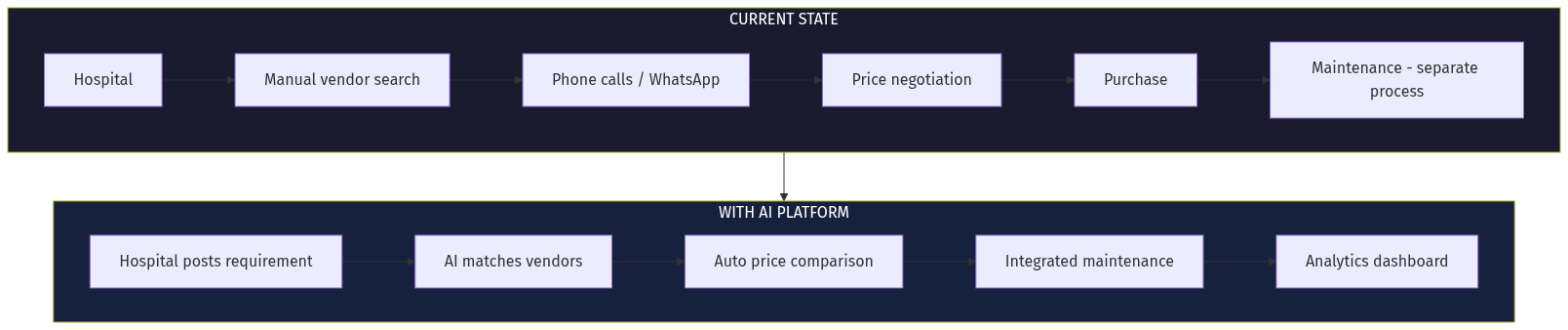
    ## Architecture Diagram

    Hospital Equipment AI Workflow
    Hospital Equipment AI Workflow

    ## Sources