ResearchFriday, April 17, 2026

API Extraction as a Service: The Missing Layer Between Legacy Software and AI Agents

Every enterprise software tool has an API buried inside it — most just don't expose it. A new wave of startups is using MITM proxies and AI to reverse-engineer closed systems into usable APIs, enabling AI agents to interact with legacy software that was never designed for automation.

1.

Executive Summary

The enterprise software landscape is filled with closed systems — ERPs without APIs, legacy CRMs, property management tools, and vertical SaaS that never anticipated being accessed programmatically. Yet every one of these systems communicates over HTTP, meaning the API already exists — it's just not exposed.

A new category of startups is emerging to solve this problem: API Extraction as a Service (AEaaS). Using MITM (Man-in-the-Middle) proxy technology combined with LLMs that analyze request/response patterns, these companies can reverse-engineer any web or mobile application into a documented, usable API — in hours, not weeks.

The market opportunity is massive: every company with legacy software is a potential customer. The data moat is compounding — each extraction builds a library of API specs that can be reused or sold. And the timing is perfect: AI agents need to interact with these systems, but they can't click buttons or read screens the way humans do.
2.

Problem Statement

The Legacy Software Trap

Every enterprise has software that:

  • Has no public API — Built before REST was standard, or intentionally closed
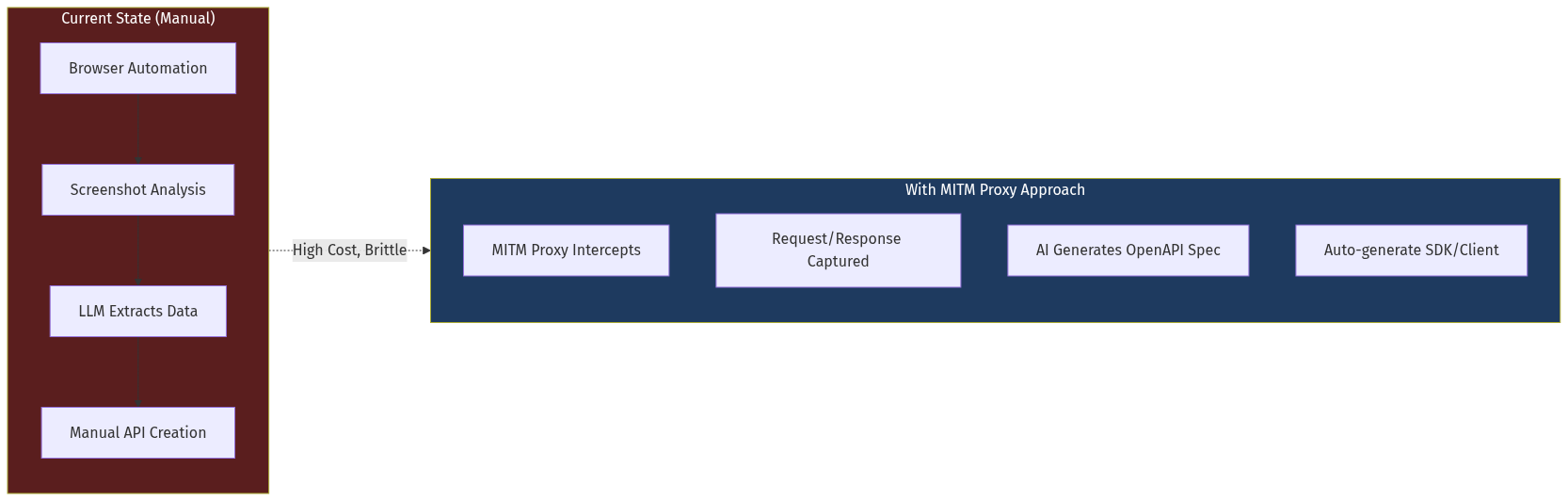
  • Requires browser automation — Requires "computer use" agents that are slow and brittle
  • Uses anti-bot protections — Cloudflare, reCAPTCHA, and fingerprinting blocks automation
  • Was never designed for AI — No vector embeddings, no webhooks, no structured data
Who experiences this pain?
  • AI developers building agents that need to interact with CRM, ERP, or vertical SaaS
  • Automation teams trying to connect systems that weren't meant to connect
  • Process engineers stuck with manual workarounds and fragile scripts
  • System integrators spending weeks reverse-engineering systems that should take hours

The Current Workarounds (All Broken)

ApproachProblem
Browser automation (Playwright/Selenium)Slow, fragile,容易被检测
Screen scraping + LLM extractionToken-intensive, high latency
Computer use agentsExpensive, rate-limited, unreliable
Manual API developmentTime-consuming, requires reverse-engineering expertise
The core problem: we need APIs, but they don't exist. And creating them manually costs $5,000–50,000 per integration.
API Extraction Flow
API Extraction Flow

3.

Current Solutions

CompanyApproachWhat's Missing
Kampala (YC W26)MITM proxy + AI spec generationNew, narrow focus on web apps only
ApiMockerMock APIs from recordingsNo AI analysis, manual setup
Postman (Mock Servers)Static mocksNo reverse-engineering capability
BrowserbaseBrowser infrastructureStill requires screen understanding
RequestlyRequest modificationNot AI-powered, manual
mitmproxyOpen source interceptionNo AI, requires technical expertise
Gap: No solution combines MITM interception, AI-powered API spec generation, AND automated client SDK generation — while handling real-world obstacles like SSL pinning, authentication sessions, and anti-bot protections.
4.

Market Opportunity

  • Addressable Market: $12 billion (API integration services + automation tooling)
  • Growth Driver: AI agent adoption requires programmatic system access
  • Why Now:
- LLMs can understand HTTP traffic patterns - AI agents need APIs to do useful work - Legacy software isn't going anywhere

TAM Breakdown

SegmentMarket SizeNotes
Enterprise automation$8BLegacy system integration
AI agent tooling$2.5BNew market, fast-growing
Developer tools$1.5BAPI design and testing
---
5.

Gaps in the Market

  • No end-to-end solution — Existing tools require manual steps at every stage
  • SSL pinning not handled — Most proxies fail when apps have certificate pinning
  • Authentication complexity — Sessions, tokens, and OAuth flows are manual
  • No SDK generation — Developers still have to write client code
  • No multi-protocol support — gRPC, WebSocket, GraphQL require custom work
  • No reusability — Each extraction is a one-off project

  • 6.

    AI Disruption Angle

    How AI Transforms This

    From hours to minutes:
    • LLMs analyze captured HTTP traffic and automatically identify endpoints, parameters, and data models
    • Pattern recognition identifies CRUD operations, authentication flows, and pagination
    From manual to automatic:
    • AI generates OpenAPI specs from traffic analysis
    • AI identifies authentication patterns (bearer tokens, session cookies, signed headers)
    • AI resolves nested data structures and relationships
    From one-off to reusable:
    • Library of common API patterns (CRUD, auth, pagination)
    • Version control for API specifications
    • Community-shared specs for common SaaS products

    The Future: AI Agents That "Read" APIs

    When every application has a generated API:

    • AI agents can interact with ANY software
    • No more "computer use" — just API calls
    • 100x faster, 10x cheaper than screen automation
    • Deterministic, testable, reliable
    ---

    7.

    Product Concept

    Core Platform: "ExtractAPI"

    ExtractAPI Architecture
    ExtractAPI Architecture
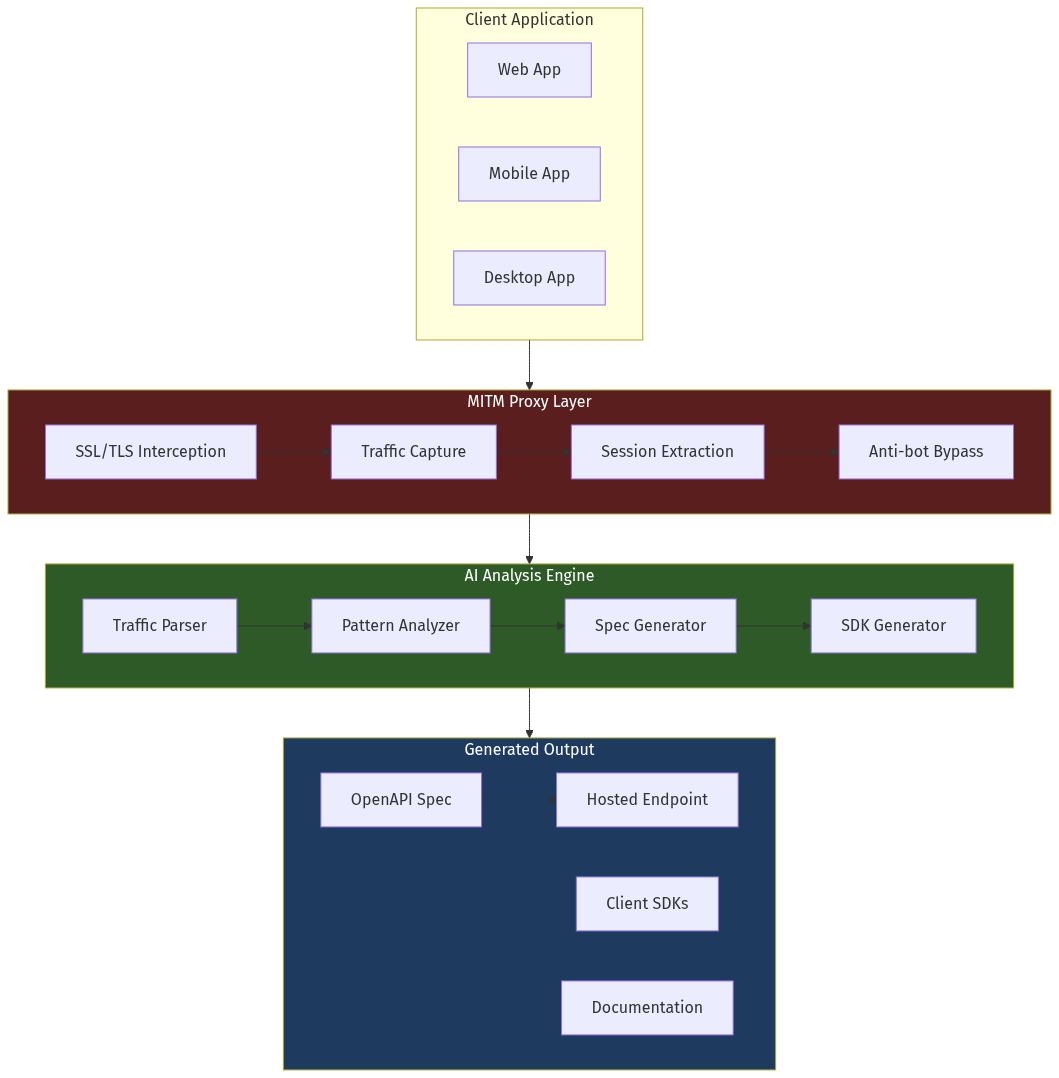
    Phase 1: Traffic Capture
    • Deploy MITM proxy (custom or modified mitmproxy)
    • Handle SSL/TLS interception (certificate injection)
    • Capture HTTP/2, gRPC, WebSocket traffic
    • Session and authentication token extraction
    Phase 2: AI Analysis
    • Feed traffic logs to LLM for pattern analysis
    • Identify endpoints, methods, parameters, responses
    • Generate OpenAPI 3.0 specification
    • Document authentication requirements
    Phase 3: SDK Generation
    • Generate client libraries (Python, JavaScript, TypeScript, Go)
    • Generate type definitions
    • Create wrapper classes for common patterns
    Phase 4: Integration
    • Provide hosted API endpoint for extracted service
    • Offer webhook triggers for real-time events
    • Support for OAuth token refresh
    • Rate limiting and quota management

    Key Features

    FeatureDescription
    Auto-SSLBypass certificate pinning automatically
    Session RecoveryExtract and reuse authentication sessions
    Protocol SupportHTTP/1.1, HTTP/2, gRPC, WebSocket
    SDK GeneratorAuto-generate client libraries in 5+ languages
    API ExplorerVisual documentation of extracted API
    Version TrackingTrack changes when app updates
    ---
    8.

    Development Plan

    PhaseTimelineDeliverables
    MVP8 weeksMITM proxy with basic traffic capture, manual spec generation
    V112 weeksLLM-powered spec generation, authentication handling
    V216 weeksSDK generation, hosted endpoint option
    V320 weeksEnterprise features, team collaboration, audit logs

    Technical Stack

    • Proxy: Custom Go-based MITM proxy (based on mitmproxy)
    • Analysis: Claude/GPT-4 for traffic pattern analysis
    • Storage: PostgreSQL for captured traffic, generated specs
    • SDK Generation: Template-based code generation
    • Frontend: React dashboard for monitoring and management

    9.

    Go-To-Market Strategy

    Target Customers (Priority Order)

  • AI Agent Developers — Already building agents that need system access
  • Enterprise Automation Teams — Burdened with legacy integration projects
  • System Integrators — Want to speed up implementation projects
  • SaaS Vendors — Need to integrate with customer systems
  • Acquisition Channels

  • Developer Communities — Hashnode, Dev.to, Hacker News
  • AI Agent Platforms — Integrate with LangChain, AutoGen, CrewAI
  • Partner with RPA vendors — UiPath, Automation Anywhere
  • Content Marketing — "How to extract APIs from any app" guides
  • Pricing Model

    TierPriceFeatures
    HobbyFree100 requests/day, community support
    Pro$49/mo10K requests, 3 extractions, SDK generation
    Team$199/moUnlimited extractions, team collaboration
    EnterpriseCustomOn-premise, SLA, dedicated support
    ---
    10.

    Revenue Model

    • Subscription revenue — Monthly/annual platform subscriptions
    • Extraction fees — Per-application extraction (for complex targets)
    • Enterprise licensing — On-premise deployment with support
    • SDK marketplace — Revenue share on pre-built API specs for popular apps

    11.

    Data Moat Potential

    High moat: Each extraction creates:
    • API specification library — Reusable specs for similar applications
    • Authentication patterns — Documented auth flows for common SaaS
    • Integration knowledge — Understanding of how specific categories work
    • Community contributions — User-submitted specs create network effects
    Over time, the company with the largest library of extracted APIs will have a defensible advantage — similar to how Postman built a library of API specifications.
    12.

    Why This Fits AIM Ecosystem

    This directly enables the AI agent workflow vision:

    • B2B procurement agents can interact with ERPs and supplier portals
    • Invoice processing agents can read billing systems
    • CRM automation can work with any CRM, not just those with APIs
    • Workflow orchestration becomes possible across all business software
    Every vertical AI agent in the AIM ecosystem needs to interact with existing software. ExtractAPI becomes the integration layer that makes that possible.

    ## Verdict

    Opportunity Score: 9/10 Why 9:
    • Clear problem with expensive current solutions
    • Compounding data moat
    • AI-native timing (LLMs make this possible now)
    • Multiple monetization paths
    • Enables entire category of AI agents
    Risks:
    • Legal gray area (ToS of target applications)
    • Anti-bot arms race (Cloudflare, etc.)
    • Requires deep technical expertise
    • Trust building with enterprises
    Why Not 10:
    • Legal uncertainty around reverse-engineering
    • Technically complex (SSL pinning, authentication)
    • May face competition from major platforms
    Recommendation: This is a platform play — not a single product. Build the extraction engine, then open it to community contributions. The API specification library becomes the moat.

    ## Sources