ResearchWednesday, April 15, 2026

AI-Powered Industrial Packaging Sourcing: The $42B Opportunity to Digitize India's Manufacturing Supply Chain

India's 150,000+ manufacturing companies spend ₹50,000-50 lakhs annually on packaging — yet 90% still procure via phone calls, WhatsApp messages, and local dealers. No price transparency, inconsistent quality verification, and zero digital audit trails. AI agents can now automate supplier discovery, material certification verification, price benchmarking, and inventory-linked procurement — creating the first vertical B2B marketplace for industrial packaging in India.

8
Opportunity
Score out of 10
1.

Executive Summary

India's industrial packaging market is a $42 billion opportunity stuck in the phone-call era. With 150,000+ manufacturing companies, 8,000+ packaging material manufacturers, and zero digital infrastructure for procurement, the entire industry runs on WhatsApp messages, personal relationships, and manual price negotiation.

An AI-powered packaging sourcing platform can:

  • Reduce procurement time from 5-7 days to 2 hours
  • Cut material costs by 15-25% through price transparency
  • Eliminate quality risks via automated certification verification
  • Create a digital audit trail for compliance and accounting
This article analyzes the market structure, identifies gaps, and proposes a product concept that can capture this underserved vertical.


2.

Problem Statement

The Procurement Pain

A typical manufacturing company in India faces these challenges when sourcing industrial packaging:

  • Supplier Discovery — Finding verified packaging suppliers requires personal networks. Google searches return distributors, not manufacturers. Trade shows are infrequent and regional.
  • Price Opacity — No two suppliers quote the same price for the same material. There's no way to benchmark. Buyers either accept the first quote or spend days calling 10+ suppliers.
  • Quality Uncertainty — Packaging materials have grades (GSM, material composition, bursting strength). Suppliers sometimes deliver lower grade than ordered. Inspection is manual and inconsistent.
  • Certification Chaos — Food-grade packaging needs FSSAI compliance. Pharmaceutical packaging needs FDA approval. Export packaging needs ISPM 15 certification. Tracking which supplier has which certification is a nightmare.
  • No Audit Trail — Procurement happens over phone calls and WhatsApp. No digital records for accounting, compliance, or dispute resolution.
  • Inventory Mismatch — Companies either over-order (tying up capital) or under-order (production delays). No AI-driven demand forecasting links procurement to production schedules.
  • Who Experiences This Pain

    • Small manufacturers (₹5-50Cr revenue): No dedicated procurement team. Owner handles packaging personally alongside production.
    • Mid-size manufacturers (₹50-500Cr): Basic procurement exists but relies on 2-3 trusted vendors with no competitive pressure.
    • Large manufacturers (₹500Cr+): Enterprise procurement exists but still manual, with limited supplier diversity.

    3.

    Current Solutions

    CompanyWhat They DoWhy They're Not Solving It
    IndiaPackDirectory of packaging suppliersPassive listing, no procurement automation, no verification
    Packaging BazaarE-commerce for packaging materialsConsumer-focused, limited B2B features, no enterprise integration
    VeriforceSupply chain verification (global)Not India-specific, expensive for SMBs, not packaging vertical
    SupplyShiftSupplier sustainability scoringSustainability focus, not procurement automation
    Local dealers (80% of market)Phone-based salesNo technology, no price transparency, relationship-dependent

    Key Insight

    The market has:

    • Listing sites (directories, not procurement)
    • Consumer marketplaces (wrong audience)
    • Global compliance tools (too expensive, wrong focus)
    • Local dealers (no technology at all)
    The gap: A vertically integrated, AI-powered B2B procurement platform for industrial packaging in India.

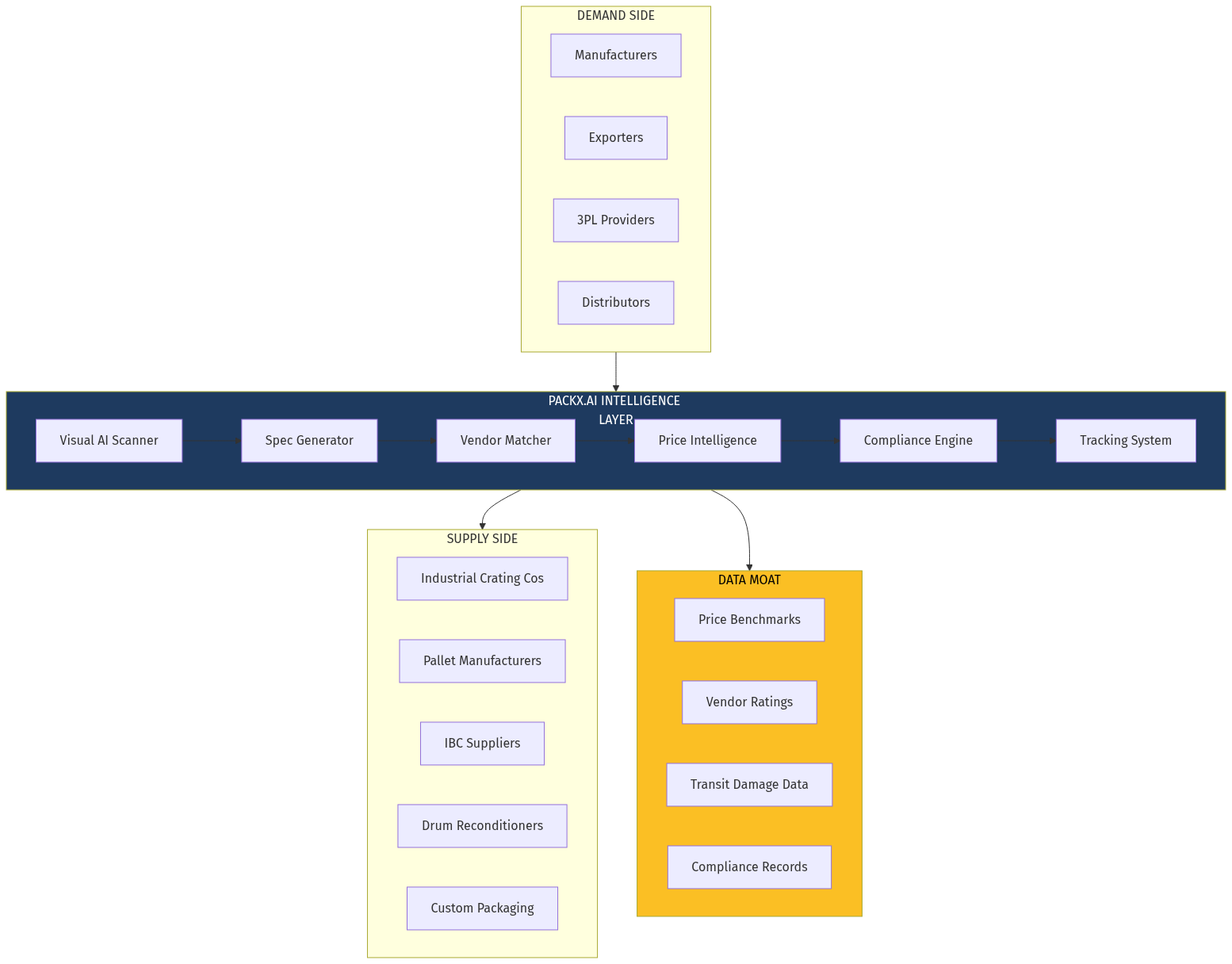
    Platform Architecture
    Platform Architecture

    4.

    Market Opportunity

    Market Size

    • India Industrial Packaging: $42 billion (2025)
    • CAGR: 12-14% through 2030
    • Online penetration: <2% (vs. 15%+ in China)

    Why Now

  • UPI for B2B — Digital payments between businesses are now frictionless
  • GST infrastructure — Every transaction is now digitally traceable
  • AI voice agents — Can handle procurement conversations in Hindi/English/Tamil
  • Warehouse digitisation — Companies have started digital inventory management
  • Export growth — 800,000+ exporters need international-standard packaging
  • Fragmentation

    The Indian packaging industry has:

    • 8,000+ corrugated box manufacturers (highly fragmented, regional)
    • 2,000+ flexible packaging manufacturers
    • 500+ plastic packaging manufacturers
    • 1,000+ specialty packaging (food-grade, pharma-grade)
    No single player has >3% market share. This creates opportunity for a platform that brings them together.


    5.

    Gaps in the Market

    Gap 1: No Verification Layer

    No platform verifies supplier capabilities, certifications, or quality track record. Anyone with a website claims to be a manufacturer.

    Gap 2: No Price Benchmarking

    There's no publicly available pricing index for packaging materials. Buyers cannot verify if they're getting a fair price.

    Gap 3: No Quality Assurance

    Physical inspection is the only quality check. AI-powered image analysis of materials could automate this.

    Gap 4: No Demand Forecasting

    Packaging demand correlates with production schedules. No platform connects to ERP or production planning tools.

    Gap 5: No Certification Tracking

    FSSAI, FDA, ISPM 15 — tracking which supplier has which certification is manual. An automated certification dashboard would save weeks of work.

    Gap 6: No SME Access

    Large manufacturers have procurement teams. 90% of Indian manufacturing (SMEs) has zero procurement technology.
    6.

    AI Disruption Angle

    How AI Agents Transform the Workflow

    Today (Manual):
    Manufacturer → Calls 10 suppliers → Waits for quotes → Compares prices → Negotiates → Orders → Tracks manually
    With AI Agents:
    Manufacturer: "I need 5000 corrugated boxes, 18x12x10 inches, 7-ply, delivered to Chennai by April 25"
    AI Agent: [Searches verified suppliers → Requests quotes → Compares prices → Verifies certifications → Places order → Tracks delivery]

    Specific AI Capabilities

  • Voice-Activated Procurement — Manufacturer calls/whatsapps the AI agent with requirements. Agent handles entire procurement conversation.
  • Certification Auto-Verification — AI scrapes and verifies FSSAI, drug license, ISPM 15 certificates in real-time.
  • Price Intelligence Engine — Aggregates historical pricing data to benchmark every quote against market rates.
  • Quality Prediction — Analyzes supplier history, material specifications, and buyer feedback to predict quality outcomes.
  • Demand Forecasting — Integrates with production schedules to predict packaging needs 2-4 weeks in advance.
  • The Agent Workflow

    User (WhatsApp/Call)
        ↓
    AI Procurement Agent (Understands intent)
        ↓
    Supplier Discovery Engine (Filters by location, certs, capacity)
        ↓
    Quote Aggregation (Parallel requests to 5+ suppliers)
        ↓
    Price Benchmarking (Compares against market index)
        ↓
    Recommendation (Best price + quality + delivery match)
        ↓
    Order Automation (PO generation, payment link, tracking)
        ↓
    Delivery Verification (Photo proof, quality feedback)

    7.

    Product Concept

    Name: PackFlow.ai

    Core Features

  • AI Procurement Agent
  • - WhatsApp-based interface - Voice-enabled (Hindi, English, Tamil, Telugu) - Understands packaging specifications automatically - Handles entire procurement lifecycle
  • Supplier Marketplace
  • - Verified supplier profiles with certification documents - Real-time capacity and lead time indicators - Rating system based on delivery, quality, and service
  • Price Intelligence
  • - Live pricing index for all packaging materials - Historical trend analysis - Buyer's guide for material selection
  • Quality Assurance
  • - AI-powered material inspection (photo analysis) - Third-party inspection scheduling - Dispute resolution with evidence档案
  • Integration Layer
  • - ERP connectors (SAP, Tally, Zoho) - E-invoicing integration - GST-compliant billing

    User Experience

    For a small manufacturer (2-3 people):
    • No app to install — use WhatsApp
    • Type: "Need 2000 boxes for pharma products, 30x20x15 cm, delivery to Hyderabad by April 20"
    • AI responds with: 3 verified suppliers, prices, certifications, delivery dates
    • User selects one → AI places order → Payment link sent → Tracking updated
    For a mid-size manufacturer:
    • Web dashboard for team采购
    • Approval workflows
    • Multiple locations support
    • Historical spend analytics

    8.

    Development Plan

    PhaseTimelineDeliverables
    MVP8 weeksWhatsApp AI agent, 50 verified suppliers, basic quote matching, manual order fulfillment
    V112 weeksSupplier verification system, price index, payment integration, basic analytics
    V216 weeksQuality inspection layer, ERP integrations, certification tracking, demand forecasting
    Scale24 weeks500+ suppliers, pan-India coverage, enterprise features, AI voice agents

    Key Milestones

    • Week 4: First AI agent conversation live
    • Week 8: First order placed through platform
    • Week 12: 100 suppliers onboarded
    • Week 24: ₹5Cr monthly GMV target

    9.

    Go-To-Market Strategy

    Phase 1: Seed Suppliers (Weeks 1-4)

  • Target: 50 packaging manufacturers in Gujarat, Maharashtra, Tamil Nadu
  • Approach: Direct sales team (5 people) visiting manufacturers
  • Offer: Free listing + guaranteed orders
  • Incentive: 0% commission for first 3 months
  • Phase 2: Seed Buyers (Weeks 5-12)

  • Target: 100 small manufacturers (₹5-25Cr revenue)
  • Channel: Trade shows, industry associations (ASIA, PHD Chamber)
  • Offer: 5% discount on first order
  • Activation: WhatsApp outreach to existing manufacturing leads
  • Phase 3: Network Effects (Weeks 13-24)

  • Buyer-driven supply: Buyers request specific materials → Platform recruits suppliers
  • Referral program: ₹5000 credit for each new buyer, ₹3000 for each new supplier
  • Vertical focus: Pharmaceuticals, food, exports — where certifications matter most
  • Key Partnerships

    • State industries: Get listed in Gujrat, Maharashtra, Karnataka state portals
    • EPC: Export Promotion Councils for pharma, food exporters
    • B2B platforms: Partner with IndiaMART, TradeIndia for lead flow

    10.

    Revenue Model

    Revenue Streams

  • Commission on Transactions (Primary)
  • - 3-5% commission on GMV - Paid by suppliers (marketplace model) - Target: ₹150-250 per ₹5000 order
  • Premium Listings (Secondary)
  • - Verified supplier badge: ₹5000/month - Priority placement in searches: ₹3000/month
  • Value-Added Services
  • - Quality inspection: ₹2000-5000 per inspection - Certification verification: ₹1000 per certification - AI-powered material recommendation: ₹5000/month
  • Data & Intelligence
  • - Pricing reports for enterprise buyers: ₹10,000/month - Market intelligence for suppliers: ₹5000/month

    Unit Economics

    • Average order value: ₹25,000
    • Platform commission (4%): ₹1,000/order
    • Cost to serve: ₹200/order (AI agent, payment processing)
    • Gross margin: ₹800/order (32%)

    Projections

    YearGMVRevenue
    Y1₹20Cr₹80L
    Y2₹100Cr₹4Cr
    Y3₹500Cr₹20Cr
    ---
    11.

    Data Moat Potential

    Proprietary Data Accumulated

  • Pricing Intelligence
  • - Historical transaction data creates unbeatable price benchmarking - Competitors cannot replicate without similar transaction volume
  • Supplier Quality Scores
  • - Real performance data from thousands of orders - Creates a trust infrastructure that takes years to build
  • Material Specifications Database
  • - Maps packaging requirements to supplier capabilities - Enables AI to match buyer needs to supplier capacity
  • Certification Records
  • - Centralized database of supplier certifications - Valuable for compliance and audit purposes

    Competitive Moat

    • Network effects: More buyers attract more suppliers → better prices → more buyers
    • Data effects: More transactions → better AI → better recommendations → more transactions
    • Trust effects: Verified supplier network becomes the industry standard

    12.

    Why This Fits AIM Ecosystem

    Integration with AIM.in Vision

    This platform directly aligns with AIM.in's mission of structured B2B discovery:

  • Vertical Specialization — Packaging is a specific vertical within manufacturing, not a horizontal marketplace
  • AI-First Design — Built on AI agents from day one, not a legacy marketplace with AI add-ons
  • India-First — Addresses specific Indian market gaps (certifications, regional languages, payment infrastructure)
  • Supply Chain Bridge — Connects to other AIM verticals (procurement, logistics, compliance)
  • Potential Expansions

    • Packaging Design AI — AI-generated packaging designs for brands
    • Logistics Integration — Connect with freight forwarding agents for delivery
    • Compliance AI — Auto-generate documentation for food-grade, pharma-grade packaging
    • Material Intelligence — Suggest alternative materials based on cost, availability

    ## Verdict

    Opportunity Score: 8/10

    Rationale

    This is a high-potential opportunity because:

  • Large market: $42B with <2% digitisation
  • Clear pain: Procurement is manual, slow, and opaque
  • AI-ready: Voice agents can handle the entire workflow
  • No competition: No vertical B2B packaging platform exists in India
  • Network effects: Strong flywheel once both sides are on board
  • Risks to Consider

  • Supplier adoption: Getting manufacturers to adopt new sales channels
  • Quality assurance: Managing quality without physical inspection
  • Price war: Suppliers may compete aggressively on price, hurting margins
  • Trust building: New platform needs to prove reliability
  • Why It Might Work

    The barriers are lower now than ever:

    • UPI enables easy payments
    • WhatsApp provides distribution
    • AI reduces service costs
    • GST creates digital trail
    The question is not whether this market will be digitised — it's who will do it first.


    ## Sources