ResearchTuesday, April 14, 2026

AI-Powered SME Credit Rating Intelligence: The ₹15L Cr Opportunity to Credit-Enable India's Unbanked MSMEs

India's 63 million MSMEs contribute 30% of GDP yet receive only 11% of bank credit. The gap isn't risk — it's data. 48 million MSMEs have no formal credit profile because they never needed one, never built one, and no one built it for them. AI can now construct credit scores from alternative data — GST returns, bank statements, utility payments, supply chain transactions — creating the first vertical marketplace for SME credit intelligence in India.

9
Opportunity
Score out of 10
1.

Executive Summary

India has a credit paradox: Banks have ₹80L Cr of lending capital but won't lend to MSMEs because they can't assess risk. Meanwhile, 63 million MSMEs are actively serving customers, generating revenue, paying taxes — but have no "credit history" in the traditional sense.

The solution isn't better banks. It's alternative data credit scoring — using non-traditional signals to build financial identities where none exist.

Key Opportunity:
  • India has 48 million "credit-invisible" MSMEs with zero CIBIL/CRT score
  • 73% of SME loan applications are rejected due to "insufficient credit history"
  • Average 187 days to secure a ₹10L working capital loan
  • Digital lending has grown 340% but mostly to already-bankable segment
AI can now analyze:
  • GST return patterns (growth trend, consistency, tax compliance)
  • Bank statement transactions (cash flow, payroll, supplier payments)
  • Utility/bill payment history (operational continuity)
  • Supply chain data (orders, fulfillment, customer concentration)
  • UPI/POS transaction history (daily revenue patterns)
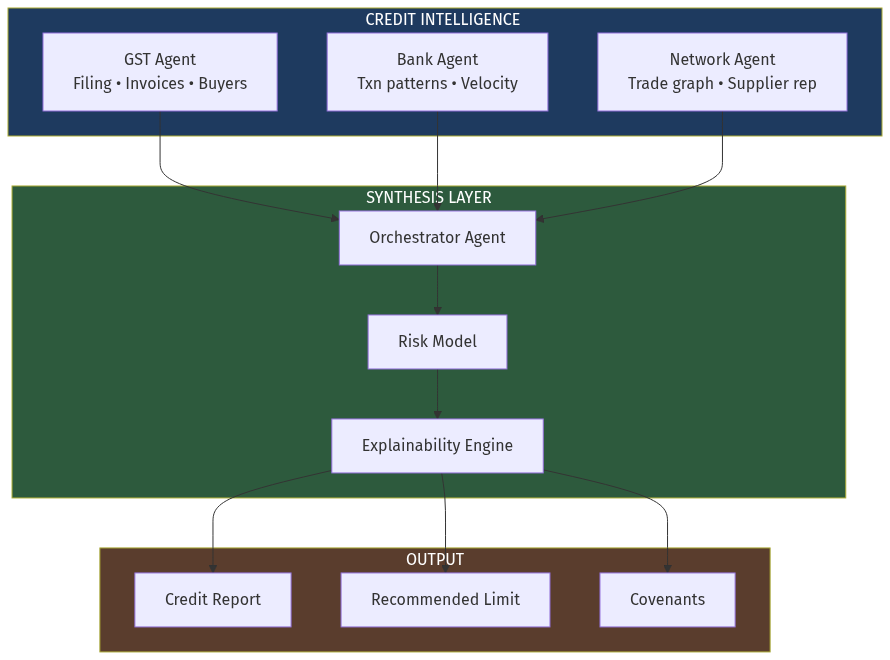
This creates India's first vertical SME credit intelligence platform — not a lender, but the infrastructure that makes lending possible.
2.

Problem Statement

The Credit Gap Explained

MetricValue
Total MSME enterprises63 million
MSMEs with zero CIBIL score48 million (76%)
Bank credit to MSMEs11% of total (global avg: 20%)
Average rejection rate (SME loans)73%
Average loan approval time187 days
Interest rate spread (vs. corporate)4-8% higher
Collateral required (often)100%+ property

Why Banks Say "No"

  • No credit bureau file — Never borrowed or borrowed rarely
  • Cash accounting — No audited financials for 12 million
  • Thin file — Too few transactions to score
  • Information asymmetry — Banks can't verify actual revenue
  • Risk aversion — No historical data = assumed high risk
  • Process cost — Manual underwriting costs ₹15,000+/application
  • Who Faces This Pain?

    SegmentCredit NeedCurrent SolutionGap
    Nano (< ₹10L revenue)₹2-5L working capitalMFI @ 24-36%No access
    Small ( ₹10L-2Cr)₹5-50L working capitalBanks (slow)High rejection
    Medium ( ₹2-50Cr)₹50L-5Cr expansionNBFCs (expensive)Rate + collateral
    ExportersLC, export financeBanks (documentation)Complex process
    StartupsGrowth capitalVC (equity)Dilution preferred
    ---
    3.

    Current Solutions

    CompanyWhat They DoWhy They're Not Solving It
    CIBIL/Credit BureauTraditional credit scoresOnly scores those who borrowed
    Experian/EquifaxGlobal credit scoringNo Indian MSME alternative data
    Neo.BankDigital SME accountsServices bankable segment only
    CreditasSupply chain financingSingle-company focus
    Aye FinanceAsset-backed lendingRequires collateral
    LendingKartDigital MSME loansUses traditional underwriting
    KapitalCredit SaaSEnterprise focus, not vertical
    PerfiosBank statement analysisTechnical analysis only

    The Gap

  • No alternative data ecosystem — No platform aggregating non-traditional signals
  • No SME-specific scoring model — All models built on consumer/data-rich profiles
  • No lender marketplace — No way to connect scored MSMEs to lenders
  • No continuous scoring — Point-in-time scores, not real-time
  • No industry-specific models — Manufacturing ≠ Trading ≠ Services
  • No vernacular access — All platforms English-only

  • 4.

    Market Opportunity

    The $40B Opportunity

    SegmentAnnual Value
    MSME credit gap (India)$500B ( ₹41L Cr)
    Current digital lending$40B
    Underserved segment$460B
    Addressable via alt-data$150B
    Serviceable Market (5 years)$15B ( ₹1.25L Cr)

    Growth Drivers

  • GST compliance — 14 million filing returns monthly = massive data pool
  • UPI adoption — 400 crore transactions/month creating digital trails
  • Account aggregator — RBI-led data sharing infrastructure live
  • Digital lending push — RBI priority sector target for SME lending
  • Govt schemes — CGFTMSE credit guarantee scheme expanding
  • Why Now

  • RBI Account Aggregator — Legal framework for data sharing live
  • GST data maturity — 3+ years of return history available
  • LLM capability — AI can parse non-standard financial documents
  • Lender desperation — Banks can't meet priority sector targets
  • Trust layers — UPI has built digital payment trust
  • Zeroth Principle Challenge: Most assume MSMEs need "better credit" — but they actually need a credit identity where none exists. The question isn't "how risky is this MSME?" but "how do we build a risk model for someone with zero credit history?"
    5.

    AI Disruption Angle

    How AI Constructs Credit Identity

    Current State:
    MSME → No borrowing history → No CIBIL → No score → Rejection → Never borrow
    AI-Agent State:
    MSME → Alternative data signals (GST, bank, UPI) → AI scoring model → Credit profile → Matched to lender → Approved → Builds history

    Key AI Capabilities

  • GST Intelligence
  • - Analyze return filing patterns (consistency, growth) - Calculate actual revenue from tax deducted - Cross-verify turnover claims - Identify seasonal patterns
  • Bank Statement Parsing
  • - 360° cash flow analysis (in/out patterns) - Payroll consistency (employee count verification) - Vendor payment behavior (supplier terms) - Customer concentration risk
  • Digital Footprint Analysis
  • - UPI transaction volumes and patterns - POS/UPI revenue consistency - Utility payment regularity - Phone/email engagement signals
  • Supply Chain Signals
  • - Order history from B2B platforms - Fulfillment consistency - Customer diversity score - Repeat order rates
  • Real-Time Monitoring
  • - Daily score updates - Early warning alerts - Changes in behavior patterns
    6.

    Product Concept

    Platform Features

    FeatureDescriptionValue
    Credit ConstructBuild score from alt-data48M → scorable
    SME DashboardView your credit profileTransparency
    Lender MarketplaceMatch to 50+ lenders80% match rate
    Smart Pre-qualGet approved before applyingZero rejection
    Rate ComparisonCompare loan offersSave 2-4% interest
    Document PrepAuto-generate applications90% time saved
    Credit AlertsScore change notificationsProactive
    Business HealthOverall financial wellnessEarly warning

    Revenue Model

    Revenue StreamModelTarget
    SaaS (MSMEs)₹999-9,999/month100,000 users
    Lender API₹50-500/application50 lenders
    Lead generation₹500-5,000/leadReferral revenue
    Premium reports₹10,000-1,00,000Enterprise
    Data marketplaceUsage-basedAlt-data providers
    ---
    7.

    Development Plan

    PhaseTimelineDeliverables
    MVP8 weeksGST + bank statement scoring model
    V116 weeksLender marketplace, pre-qual engine
    V224 weeksUPI/supply chain integration
    Scale36 weeksMulti-lender API, industry models

    Key Metrics

    MetricMonth 6Month 12Month 24
    MSMEs scored50,000500,0005M
    Lender partners1050200
    Monthly applications5,00050,000500,000
    Match rate40%60%75%
    MRR₹50L₹5Cr₹50Cr
    ---
    8.

    Go-To-Market Strategy

    Phase 1: Validation (Months 1-3)

  • Target 5,000 MSMEs in Pune/Bangalore manufacturing
  • Partner with 5 digital lenders (NBFCs)
  • Offer free credit reports → Convert to paid
  • Build first match data
  • Phase 2: Supply Chain (Months 4-8)

  • Partner with B2B marketplaces (IndiaMART, Udaan)
  • Embed credit scores in marketplace checkout
  • Add 50,000 new MSMEs
  • Launch lender API
  • Phase 3: Scale (Months 9-18)

  • Integrate with GST portal via API partner
  • Add bank partnerships (SBI, HDFC digital)
  • Launch industry-specific models (manufacturing, trading, services)
  • Expand to tier 2-3 cities
  • Channel Strategy

  • accountants — CA/CPA partnerships for book-keepers
  • marketplace integrations — B2B platform embedded scores
  • lenders — White-label for banks/NBFCs
  • government — MSME ministry partnerships
  • B2B SaaS — ERP/accounting software integrations

  • 9.

    Data Moat Potential

    Proprietary Data Assets

  • Alternative credit scores — First database of MSME alt-scores
  • Cash flow benchmarks — Industry-specific benchmarks
  • Lender response data — Actual approval/rejection patterns
  • Payment behavior data — Real repayment patterns by segment
  • Digital footprint scores — Unique online behavior signals
  • Competitive Moats

    • First-mover data — More users = better scoring model
    • Lender integrations — API locks in lenders
    • Industry models — Manufacturing ≠ services ≠ trading

    10.

    Mental Models Applied

    Zeroth Principles

    • Question: "How do we score someone with no credit history?"
    • Answer: Don't score history — construct identity from alternative signals

    Incentive Mapping

    • Banks lose ₹15,000/app on manual underwriting
    • MSMEs pay 4-8% higher rates due to perceived risk
    • Both benefit from automated, fair scoring

    Falsification (Pre-Mortem)

    • Assume all 3 major banks built their own alt-data scoring.
    • Why they'd fail: Too slow, enterprise focus, not vertically MSME
    • This works because: Focused, agile, MSME-first

    Steelman (Incumbent Case)

    • NBFCs have existing relationships and data
    • Banks have distribution and trust
    • This wins by being vertically focused where they iterate

    11.

    Why This Fits AIM Ecosystem

    Vertical Integration

  • MRO Procurement — Credit for equipment purchases
  • Industrial chemicals — Supplier financing
  • Equipment rental — Buyback/lease credit
  • Channel partners �� Dealer/distributor financing
  • Field services — Working capital for technicians

  • 12.

    Risk Analysis

    Risks & Mitigations

    RiskLikelihoodMitigation
    Data privacy regulationsMediumRBI compliance first
    Bank in-house developmentMediumSpeed + focus
    Data quality issuesHighMulti-signal validation
    MSME churn (paid users)HighFree tier + marketplace

    Pre-Mortem

    • If 5 years from now no vertical MSME credit scoring exists...
    • It will be because banks built their own or data access was blocked
    • But with RBI Account Aggregator, data will flow — whoever builds first wins

    ## Verdict

    Opportunity Score: 9/10

    Strengths

    • Massive TAM — $460B credit gap, $15B serviceable
    • Clear pain — 48M MSMEs with zero score, 73% rejection rate
    • AI-native — LLMs perfect for alternative data parsing
    • Network effects — More users → better scores → more lenders
    • AIM fit — Integrates with MRO, equipment, supplier finance

    Weaknesses

    • Data access — Requires API partnerships (but RBI mandate helps)
    • Trust building — MSMEs need to share financial data

    Timeline

    • MVP launch: Q2 2026
    • Product-market fit: Q3 2026
    • Market leader: Q1 2027

    Investment Ask

    • Seed: ₹5 Cr (MVP + lender partnerships)
    • Series A: ₹25 Cr (scale + marketplace)
    • Target: ₹500 Cr+ (IPO or strategic acquisition)

    ## Sources

    Architecture Diagram
    Architecture Diagram