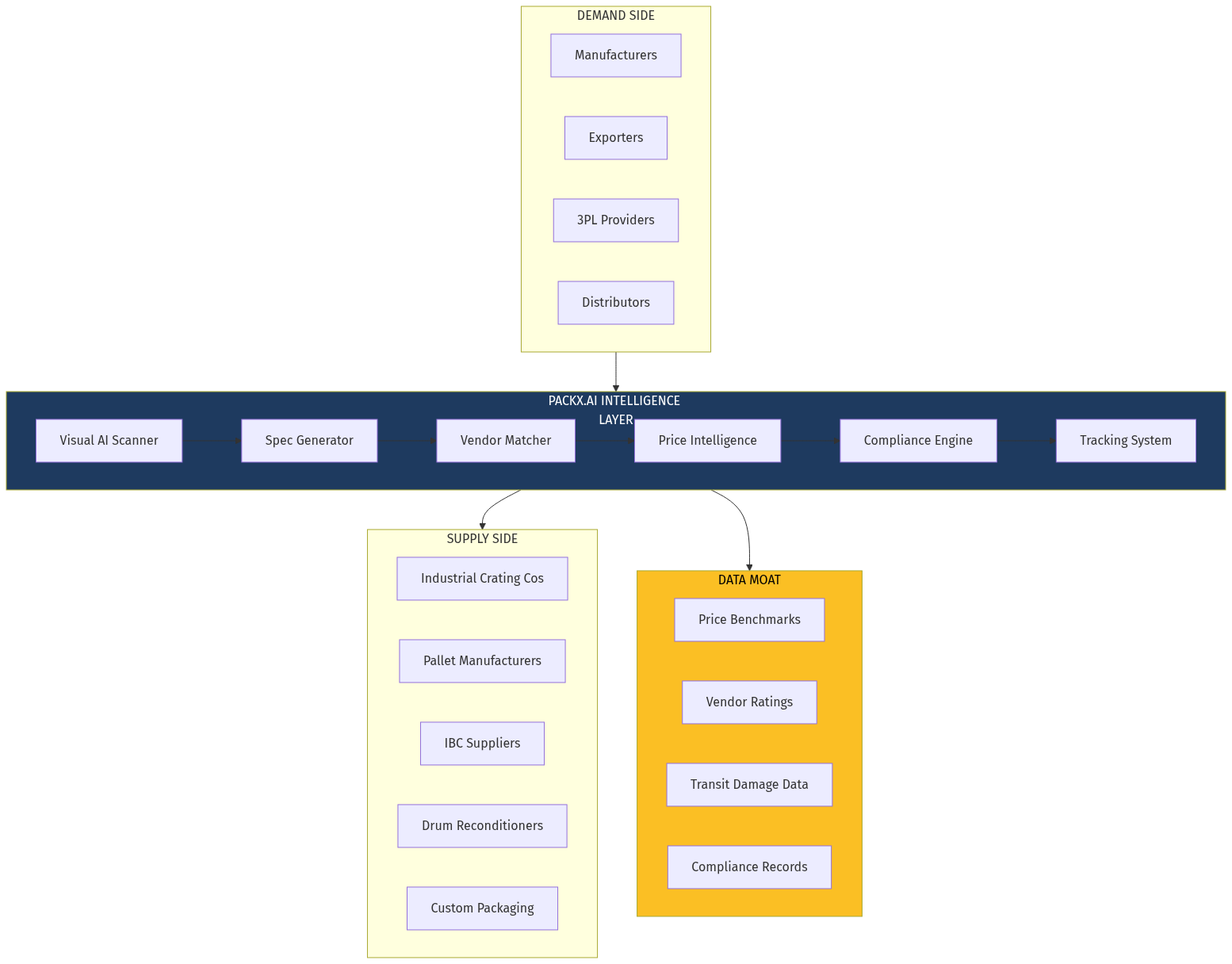
AI-Powered Industrial Packaging Sourcing Platform: The $28B Opportunity in India's Manufacturing Supply Chain
Every manufacturing plant in India spends ₹50 lakhs to ₹5 crores annually on industrial packaging — boxes, crates, pallets, FIBC bags, corrugated sheets, stretch films. Yet 90%+ of procurement happens via phone calls, WhatsApp messages, and trusted local suppliers. No catalog, no price discovery, no quality standardization. An AI-powered B2B marketplace can capture this fragmented market by automating supplier matching, quality verification, and bulk pricing negotiation.
1.
Executive Summary
India's industrial packaging market is a $28 billion opportunity hiding in plain sight. Every manufacturing facility — from auto components to pharmaceuticals to food processing — requires packaging materials daily. Yet the industry operates like it did 30 years ago:
No centralized discovery — buyers find suppliers through phone calls, WhatsApp, and neighborhood relationships
No pricing transparency — same corrugated box costs 3x different suppliers
No quality standardization — specifications are verbal, not structured
No capacity visibility — lead times are guesses, not data-driven
An AI-powered industrial packaging marketplace can:
Map suppliers — Create structured profiles of packaging manufacturers by capability, material, location
Intelligent matching — Connect requirements to verified suppliers automatically
Price intelligence — Build transparency into a previously opaque market
Quality scoring — Standardize quality verification with AI-powered inspection
Capacity prediction — Predict lead times based on supplier utilization data
2.
Problem Statement
The Packaging Procurement Conundrum
Every procurement manager faces this reality: > "I need 10,000 corrugated boxes for our pharma exports. I know some suppliers in Mumbai, but which ones do food-grade? What's fair pricing? Can they deliver in 10 days? And how do I verify the quality matches specifications?"
The pain points cascade:
1. Discovery Gap
"Packaging suppliers near me" Google search returns hundreds of results with no capability clarity
Most manufacturers have minimal web presence
Word-of-mouth is the primary discovery mechanism
2. Capability Opacity
A supplier says "we make boxes" — but what sizes? What grades? What certifications?
Materials: corrugated, plastic, metal, fabric, foam — each requires different expertise
Industries: food-grade, pharma-grade, export, automotive — each has different requirements
3. Pricing Arbitrariness
Same 12x12x12 inch corrugated box: ₹25 at one supplier, ₹65 at another
No benchmark for what's reasonable
Negotiation is the norm, not the exception
4. Quality Uncertainty
"300 GSM" means different things to different suppliers
No standard testing methodology
Rejections happen after delivery, causing production delays
5. Timeline Opacity
"Standard lead time" ranges from 7 days to 45 days
Rush charges are arbitrary
Capacity constraints are invisible to buyers
6. Coordination Overhead
Multiple packaging types needed for single order
Delivery scheduling is manual
Quality disputes are resolved through arguments, not data
Why This Persists
The packaging industry operates like it did 40 years ago:
Manufacturers rely on repeat clients and regional relationships, not discoverability
No incentive to compete on price or capability in structured ways
Small-scale manufacturers lack digital infrastructure
Limited geographic reach, minimum order quantities
WhatsApp groups
Informal trading
No verification, no structured transactions
The gap: No platform exists that maps supplier capabilities structurally, provides intelligent matching based on specifications, builds pricing transparency, and verifies quality at scale.
4.
Market Opportunity
Market Size
India industrial packaging market: $28 billion (2025)
CAGR: 12-15% through 2030
Registered packaging manufacturers: 50,000+
SME packaging workshops: 200,000+
Average packaging spend per manufacturing plant: ₹50L-5Cr annually
Segmentation
Segment
Market Size
Growth
Key Players
Corrugated boxes
$8B
14%
Century Board, IDPL, S间接
Flexible packaging
$7B
16%
Uflex, EPL, Cosmo
Rigid plastic
$5B
12%
Responsiv, Inno, Alpha
FIBC bags
$3B
10%
Alpha, Emmbi, Virgo
Metal containers
$2B
8%
Tin Box Co, MJO
Wood pallets
$2B
6%
Regional players
Others
$1B
7%
Specialty packaging
Growth Drivers
Manufacturing surge — PLI schemes driving new factories, new packaging needs
Export growth — Every export shipment requires compliant packaging
E-commerce expansion — Packaging for D2C brands growing 40%+ annually
Sustainability push — Regulations driving shift to eco-friendly packaging
AI capability extraction — Can map suppliers at scale without manual data entry
Why Now
WhatsApp for suppliers — Indian packaging manufacturers are reachable via WhatsApp
AI parsing — Can extract capabilities from minimal web presence
Quality verification — Image-based AI can verify packaging specs
Manufacturing density — Tier 2/3 cities have concentrated packaging clusters
Digital payment infrastructure — UPI enables easy B2B transactions
TAM/SAM/SOM
Segment
Addressable
Notes
TAM
$28B
All Indian industrial packaging
SAM
$10B
Organized segment, manufacturers with digital readiness
SOM
$150M
Year 1-2 achievable with platform
---
5.
Gaps in the Market
Gap 1: Capability Mapping
No structured database exists of what each manufacturer actually produces. "Corrugated boxes" is meaningless — what size? What grade? What certifications? What minimum order?
Gap 2: Specification Standardization
"300 GSM" and "32 ECT" mean different things to different suppliers. No common language exists for packaging specifications.
Gap 3: Price Discovery
No benchmark exists for packaging prices. Buyers overpay, suppliers underprice, market is inefficient.
Gap 4: Quality Verification
No standardized way to verify packaging quality before bulk orders. Samples are subjective, not data-driven.
Gap 5: Capacity Visibility
When a buyer needs 50,000 boxes in 10 days, no way to know which suppliers have capacity.
Gap 6: Logistics Integration
Packaging is heavy, logistics is complex. No platform handles freight coordination.
6.
AI Disruption Angle
Capability AI
AI can:
Parse manufacturer websites and extract capabilities
Process WhatsApp catalog images to build structured profiles
AI matching, quality scoring, capacity predictions
V2
16 weeks
Logistics integration, analytics, bulk ordering
Technical Stack
Frontend: Next.js, React, Mapbox for geospatial
Backend: Node.js, PostgreSQL, embeddings for matching
AI: GPT-4 for specification parsing, embeddings for semantic search
Image AI: Vision models for quality verification
Key Partnerships to Build
Industry associations — FIBA (Flexible Packaging), CIPRA (Corrugated)
E-commerce platforms — Amazon, Flipkart for packaging requirements
Manufacturing clusters — Work with local manufacturing associations
9.
Go-To-Market Strategy
Phase 1: Supplier Supply (Month 1-3)
Cluster targeting
- Mumbai (corrugated, flexible)
- Pune (automotive packaging)
- Chennai (export packaging)
- Delhi-NCR (industrial packaging)
- 200 suppliers per cluster for density
Onboarding approach
- Free profile and leads for first 90 days
- Profile building assistance via WhatsApp
- Training on platform features
Verification badges
- Visit-based verification for key suppliers
- Sample-based quality scoring
From India → emerging markets with similar challenges
From B2B → E-commerce packaging (D2C brands)
## Verdict
Opportunity Score: 7.5/10
This is a high-impact opportunity in a market that desperately needs consolidation and transparency. The key is starting with verified suppliers in 2-3 industrial clusters (Mumbai, Pune, Chennai) and focusing on buyers with the most stringent requirements — export-oriented manufacturers, pharma companies, and automotive suppliers.
Recommendation: Start with corrugated boxes (largest segment, easiest to standardize) in one industrial cluster. Build supplier profiles via WhatsApp outreach. Focus on quality verification as the key differentiator — packaging quality directly affects buyer product safety.
Risk mitigation: Start with minimum order quantities to ensure supplier engagement. Build quality scoring early to create trust. Focus on repeat purchases rather than one-time transactions.
Steelman's case: Incumbents (existing dealer networks, industry relationships) have trust that takes years to build. Small manufacturers may resist platformization if it exposes their pricing. Quality verification is hard to scale without physical inspection infrastructure.