ResearchThursday, March 19, 2026

AI-Powered Healthcare Staffing Platform: India's $12B Opportunity

India faces a 70% shortage of healthcare workers. Meanwhile, thousands of qualified nurses, paramedics, and technicians are underemployed or working in suboptimal roles. The friction in hiring is so high that hospitals resort to WhatsApp groups and personal networks — a $12B market waiting to be digitized.

1.

Executive Summary

India's healthcare sector is growing at 22% annually, yet staffing remains a manual, relationship-driven process. Small hospitals, nursing homes, and diagnostic centers struggle to find qualified staff. Meanwhile, healthcare professionals lack visibility into opportunities and often rely on word-of-mouth.

This creates a massive marketplace opportunity: an AI-powered platform that matches healthcare facilities with qualified staff — nurses, paramedics, lab technicians, pharmacists, and even part-time doctors — within hours, not weeks.

2.

Problem Statement

The Pain:
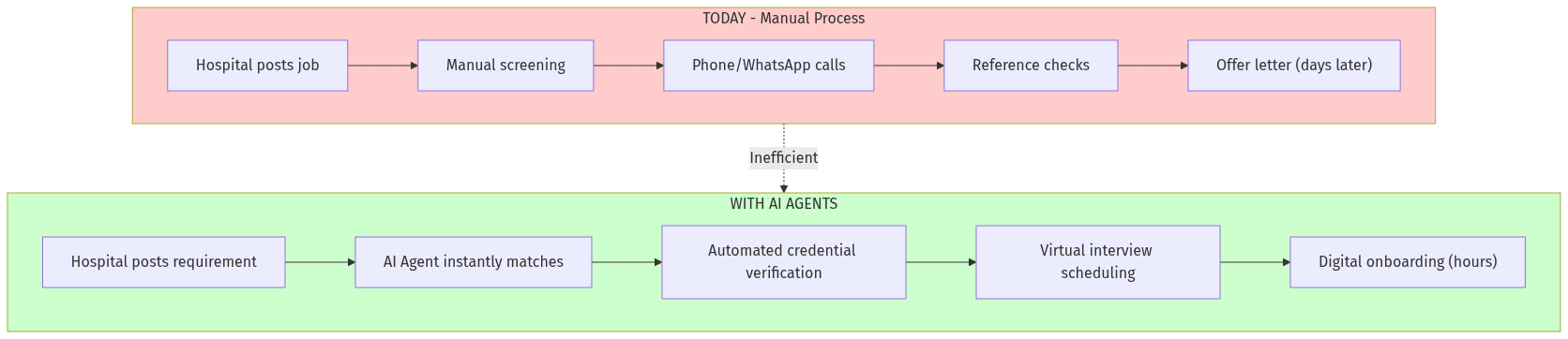
  • Hospitals take 3-8 weeks to fill a single nursing position
  • 70% of healthcare facilities rely on WhatsApp groups and personal referrals
  • Credential verification is manual — hospitals call previous employers, verify licenses through state nursing councils
  • No flexible staffing — facilities can't easily scale staff up/down based on patient load
  • High turnover — poor matches lead to resignations within 3 months
Who Experiences This:
  • Small to mid-sized hospitals (50-200 beds)
  • Nursing homes and clinics
  • Diagnostic centers and labs
  • Healthcare staffing agencies (who also struggle)

3.

Current Solutions

CompanyWhat They DoWhy They're Not Solving It
Naukri HospitalGeneric job board for healthcareNo verification, no matching, volume play
CareerRideHealthcare-specific job boardStill manual screening, no AI
SimplyHired HealthcareAggregatorNot India-focused, no credential layer
Staffing Agencies (local)Manual placement firmsHigh fees (15-20% of salary), slow
WhatsApp GroupsInformal matchingNo trust, no verification, chaotic
Gap Analysis:
  • No platform combines credential verification + AI matching + flexible staffing
  • No "Uber for healthcare staff" exists in India
  • No unified database of verified healthcare professionals

4.

Market Opportunity

  • Addressable Market: $12B (India healthcare staffing market)
  • Growth: 15-18% CAGR through 2030
  • Digital Addressable: ~$2B (facilities open to online hiring)
Why Now:
  • Post-COVID staffing crisis — hospitals are actively seeking better staffing solutions
  • Rise of small healthcare facilities — diagnostic chains, day-care centers, polyclinics exploding
  • Healthcare professionals going digital — WhatsApp and smartphone adoption is universal
  • AI verification maturity — OCR, API integrations with state nursing councils now possible
  • Regulatory push — stricter credential requirements make verification valuable

  • 5.

    Gaps in the Market

    Gap 1: No Unified Credential Database

    Every hospital verifies credentials manually. There's no "LinkedIn for healthcare credentials" where licenses, certifications, and experience are pre-verified.

    Gap 2: No Flexible Staffing Options

    Most positions are full-time. But many professionals want part-time, shift-based, or contract work. No platform enables this.

    Gap 3: No Skill-Based Matching

    Jobs are posted with descriptions. No AI analyzes: "This nurse has ICU experience, ACLS certification, and prefers night shifts in South Delhi."

    Gap 4: No Reputation System

    Unlike Uber or Airbnb, there's no rating system for healthcare workers or facilities. Bad matches cost both sides heavily.

    Gap 5: No Automated Compliance

    State-specific licensing requirements, continuing education mandates, background checks — all manual today.
    6.

    AI Disruption Angle

    How AI Transforms the Workflow:

    1. Intelligent Matching
    • AI analyzes job requirements + candidate profiles + historical data
    • Matches based on: skills, location, shift preferences, salary expectations, cultural fit indicators
    • Ranks candidates with confidence scores
    2. Automated Credential Verification
    • OCR extracts data from degree certificates, licenses
    • API integration with State Nursing Councils, Indian Medical Council
    • Automated reference checks via AI voice agents
    • Background verification orchestration
    3. Virtual Interview Scheduling
    • AI coordinates between hospital recruiters and candidates
    • Auto-schedules based on availability
    • Conducts preliminary screening calls
    4. Predictive Retention
    • ML model predicts flight risk based on: commute time, team composition, shift patterns
    • Alerts hospitals before resignations happen
    5. Dynamic Pricing
    • Market-rate intelligence for different roles/locations
    • Helps hospitals budget and plan

    The Future: Agent-to-Agent Transactions

    [Hospital AI Agent] ----> [Platform] ----> [Staff AI Agent]
           |                       |                    |
      "Need 2 ICU           "Verified candidates    "Available for
       nurses for             with match score       12-hour shifts
       night shift"           > 0.85"               starting Monday"

    AI agents from hospitals negotiate directly with AI agents representing healthcare professionals. No human in the loop for initial matching — only for final selection.


    7.

    Product Concept

    Core Platform: "HealthStaff AI"

    For Facilities:
    • Post jobs in 30 seconds (or let AI write job descriptions)
    • Get verified candidate shortlists within hours
    • Conduct video interviews via platform
    • Digital offer letters and contracts
    • Staff management dashboard (attendance, shifts, payroll)
    For Healthcare Professionals:
    • Create profile once, verify credentials once
    • Get matched with relevant opportunities
    • Track applications, interviews, offers
    • Build reputation through ratings
    • Access flexible/shift-based work
    Key Features:
  • One-Click Credential Upload — OCR extracts all relevant data
  • AI Job Description Generator — Describe your needs in plain English
  • Verified Badge System — Green tick for fully verified profiles
  • Shift Marketplace — Browse and bid on part-time shifts
  • Salary Insights — Real-time data on market rates
  • Compliance Calendar — Alerts for license renewals, certifications

  • 8.

    Development Plan

    PhaseTimelineDeliverables
    MVP8 weeksProfile creation, job posting, basic matching, manual verification workflow
    V112 weeksAI matching, OCR credential extraction, automated scheduling, ratings
    V216 weeksAPI integrations (councils), background checks, shift marketplace, analytics
    Scale24 weeksMobile apps, voice interface, agent marketplace, national coverage

    Technical Stack:

    • Frontend: Next.js + React Native (mobile)
    • Backend: Node.js + PostgreSQL
    • AI: OpenAI for matching + document extraction
    • Verification: ocr.space, council APIs, background check integrations
    • Payments: Razorpay for escrow

    9.

    Go-To-Market Strategy

    Phase 1: Hospital Acquisition (Months 1-3)

  • Target 50 small hospitals in 2-3 cities (start with Bangalore, Hyderabad)
  • Free trial — first 3 placements free
  • Dedicated account manager for each hospital
  • White-label option for large hospital chains
  • Phase 2: Supply-Side Growth (Months 3-6)

  • Partner with nursing colleges — co-create curriculum, offer placement services
  • Referral program — ₹500 per successful referral
  • Campus drives — organized recruitment events
  • Staffing agency partnerships — list their talent on platform
  • Phase 3: Network Effects (Months 6-12)

  • Freemium for professionals — free profile, paid for premium matches
  • Verified badge monetization — hospitals pay for verified candidates
  • Shift marketplace launch — enable part-time work
  • Geographic expansion — Mumbai, Delhi, Chennai, Kolkata
  • Key Partnerships:

    • State Nursing Councils (data access)
    • Hospital associations (IHF, AHPI)
    • Nursing colleges
    • Background verification companies
    • Healthcare insurance providers

    10.

    Revenue Model

    Revenue StreamModelPotential
    Placement Fees8-12% of annual salary (one-time)High
    Subscription₹5,000-50,000/month for hospitalsMedium
    Verification Services₹500-2,000 per verificationMedium
    Shift Marketplace10% commission on shift paymentsHigh (at scale)
    Premium Listings₹1,000-5,000 for featured jobsLow-Medium
    Background ChecksPartner revenue shareMedium
    Unit Economics:
    • Cost to acquire hospital: ₹3,000-5,000
    • Average placement value: ₹25,000 (8% of ₹300K avg nurse salary)
    • LTV: ₹50,000-100,000 per hospital (recurring hiring)

    11.

    Data Moat Potential

    This business accumulates:
  • Credential database — verified licenses, certifications, employment history
  • Salary intelligence — real-time compensation data across roles/locations
  • Matching algorithm — proprietary ML model improving with every placement
  • Retention data — what predicts success vs. failure
  • Provider reputation — ratings and reviews from both sides
  • Moat Strength: HIGH
    • Network effects create defensibility
    • Data accumulation improves matching over time
    • Trust (verification) takes years to build

    12.

    Why This Fits AIM Ecosystem

    Vertical Alignment:
    • AIM.in focus: B2B discovery and decision-making
    • This platform: Enables hospitals to DISCOVER and DECIDE on staffing
    • Complements existing vertical portals (could integrate with hospital directories)
    Synergies:
    • Can leverage AIM's domain intelligence for market research
    • Data feeds into healthcare industry insights
    • Potential to expand into medical equipment, supplies marketplace
    • Cross-sell to same hospital customer base
    Strategic Fit:
    • Addresses critical healthcare infrastructure gap
    • AI-native from day one
    • Recurring revenue potential
    • Scalable across India

    ## Verdict

    Opportunity Score: 8.5/10

    Why High Score:

    • Massive market ($12B) with acute pain
    • Clear path to network effects
    • AI-native differentiation possible
    • Recurring revenue via staffing agencies
    • Strong data moat potential

    Risks to Monitor:

    • Regulatory complexity — state-by-state nursing council integration
    • Trust building — healthcare is high-stakes
    • Competition — existing job boards may add verification
    • Unit economics — verification costs may eat margins

    Recommended Next Steps:

  • Start narrow — focus on nurses in 2 cities
  • Build verification proof-of-concept — integrate with one state council
  • Talk to 20 hospitals — validate pain points and willingness to pay
  • Hire healthcare domain expert — avoid naive product decisions

  • ## Diagrams

    Current vs. Future Workflow

    Healthcare Staffing Flow
    Healthcare Staffing Flow

    Platform Architecture

    Healthcare Staffing Architecture
    Healthcare Staffing Architecture

    ## Sources

    • National Health Profile 2023 - Ministry of Health
    • Healthcare Staffing Market Size - Grand View Research
    • India Nursing Council Data
    • Naukri Healthcare Insights
    • WHO Global Health Workforce Statistics
    • Indian Hospital Association Reports
    • TrustMRR - Healthcare Startups
    • MedTech India Report - Invest India