ResearchThursday, March 19, 2026

AI Agents for B2B Medical Supplies: The $50B Opportunity India Is Sleeping On

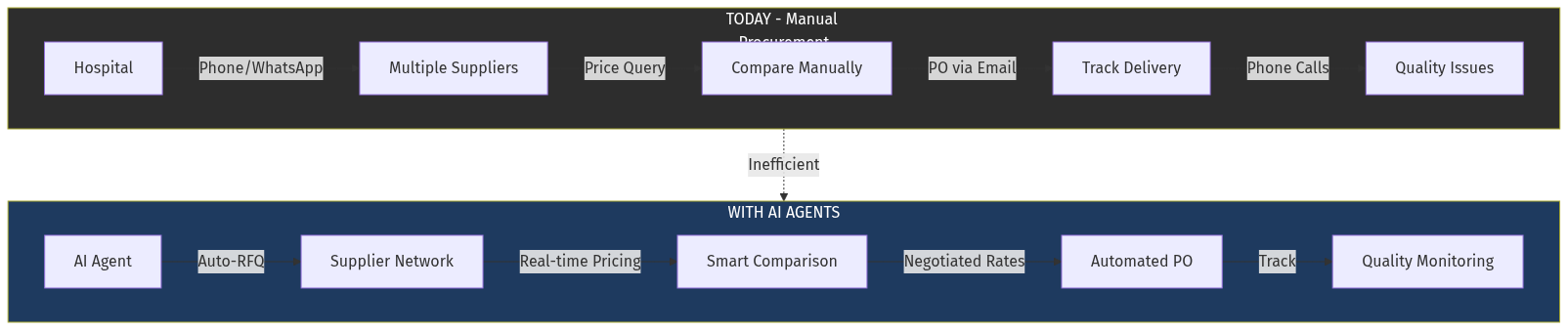
India's healthcare procurement is stuck in 1995. Hospitals and clinics still rely on phone calls, WhatsApp messages, and fax-like email exchanges to source supplies. A single hospital in Mumbai might manage relationships with 50+ suppliers manually. This fragmentation creates massive inefficiency—and a massive opportunity for AI agents to automate B2B medical procurement.

1.

Executive Summary

India's medical supplies market is a $50+ billion industry operating with 1980s-era procurement workflows. Hospitals, clinics, and diagnostic centers spend disproportionate time on sourcing—calling multiple suppliers, comparing prices manually, tracking deliveries via phone, and managing quality issues reactively.

This creates a prime opportunity for an AI-agent-powered B2B marketplace. The platform would function as an intelligent procurement layer: understanding hospital inventory needs, auto-requesting quotes from a network of verified suppliers, negotiating prices, placing orders, and monitoring quality—all without human intervention.

Opportunity Score: 8.5/10
2.

Problem Statement

The Daily Reality

A mid-sized hospital in India (100-300 beds) manages approximately:

  • 2,000-5,000 SKUs of medical supplies
  • 30-100 active suppliers at any time
  • 50-200 orders per month across categories
Procurement teams spend 60-70% of their time on:

Pain PointTime WastedImpact
Price discovery3-5 hrs/weekAlways paying above market
Supplier verification2-3 hrs/weekRisk of substandard supplies
Order tracking2-4 hrs/weekStockouts due to delays
Quality disputesOngoingPayment delays, relationship strain
Inventory planning5-10 hrs/weekOverstocking or stockouts

The Structural Problem

Fragmentation without standardization. Unlike the US or EU where GPOs (Group Purchasing Organizations) consolidate buying power, India has:
  • 5,000+ manufacturers
  • 100,000+ distributors
  • 200,000+ sub-distributors
  • No unified cataloging system
  • No standard product identification (same product has 10 different names)
A hospital procurement manager must mentally map "Ciprofloxacin 500mg tablets" across 20 different supplier catalogs—each using different SKUs, pack sizes, and pricing units.
3.

Current Solutions

CompanyWhat They DoWhy They're Not Solving It
MedikabazaarB2B medical supplies marketplaceFocuses on catalog aggregation; no AI procurement
MediAssistCorporate health benefitsInsurance-focused, not procurement
PharmEasyB2C pharmacyConsumer focus; limited B2B capabilities
Apollo Hospitals Supply ChainInternal supply chain onlyNot available to external buyers

What's Missing

None of these players offer:

  • Autonomous procurement agents that understand hospital inventory cycles
  • Intelligent price discovery across fragmented suppliers
  • Quality verification with automated incident tracking
  • Predictive inventory that auto-reorders before stockouts
---

4.

Market Opportunity

Market Size

SegmentIndia SizeGrowth
Medical supplies (consumables)$25B15% CAGR
Pharmaceutical distribution$22B12% CAGR
Medical equipment$8B10% CAGR
Total addressable$55B

Target Segments

SegmentHospitalsAnnual ProcurementPain Level
Large corporate500$5M-50MHigh
Mid-size3,000$500K-5MVery High
Small clinics100,000+$50K-500KExtremely High
Diagnostic labs50,000+$100K-1MHigh

Why Now

  • Post-pandemic digital adoption — Hospitals accelerated digital transformation
  • Regulatory pressure — New quality tracking requirements make provenance critical
  • Thin margins — 60% of hospitals operate on <5% margin; procurement savings = survival
  • Healthcare expansion — GOI targeting 1.5M hospital beds by 2025
  • WhatsApp ubiquity — India's B2B communication already runs on WhatsApp; AI agents can layer on top

  • 5.

    Gaps in the Market

    Gap 1: No Intelligent Price Discovery

    Every supplier quotes differently. Hospitals cannot easily compare "Appx 500 units" vs "Box of 10 strips x 50" without manual conversion.

    Gap 2: Supplier Verification Is Manual

    No automated way to verify:
    • GST compliance
    • Drug license validity
    • Quality certifications
    • Creditworthiness

    Gap 3: No Quality Tracking Infrastructure

    When a batch fails QC, there's no systematic way to:
    • Trace the lot back to supplier
    • Flag all buyers who received the same batch
    • Build historical quality scores

    Gap 4: Inventory Prediction Is Primitive

    Most hospitals reorder reactively. AI can predict:
    • Seasonal demand spikes (flu season = mask/gloves)
    • Consumption patterns by department
    • Lead time variations by supplier

    Gap 5:碎片化的支付

    Most transactions are NET 30-60, but payment terms vary wildly. No unified financing layer.
    6.

    AI Disruption Angle

    The Agent Architecture

    flowchart TB
        subgraph Input["Hospital Interface"]
            A[Inventory Data] --> E[AI Agent]
            B[Past Orders] --> E
            C[Budget Rules] --> E
        end
        
        subgraph Agent["Procurement AI Agent"]
            E --> F[Understanding Engine]
            F --> G[Multi-Supplier RFQ]
            G --> H[Price Intelligence]
            H --> I[Negotiation Engine]
            I --> J[Order Execution]
        end
        
        subgraph Output["Automated Workflow"]
            J --> K[Purchase Order]
            K --> L[Delivery Tracking]
            L --> M[Quality Verification]
            M --> N[Payment Processing]
        end
        
        style Agent fill:#1e3a5f,color:#fff

    How Agents Transform Procurement

  • Natural Language Procurement
  • - Hospital manager: "We need 500 N95 masks, delivery by Friday" - Agent: Auto-identifies SKU, checks inventory, quotes from 5 suppliers, recommends best option
  • Continuous Price Monitoring
  • - Agent scrapes/connects with supplier APIs - Alerts when prices drop or quality issues emerge
  • Autonomous Reordering
  • - Agent monitors inventory levels vs. patient forecasts - Auto-generates POs when stock hits reorder threshold - Escalates only for exceptions
  • Quality Incident Response
  • - When QC fails, agent automatically: - Traces all recipients of affected lot - Opens dispute with supplier - Suggests alternative suppliers
    7.

    Product Concept

    Core Platform: MedSource AI

    Platform Name: MedSource AI Tagline: Your autonomous procurement team

    Key Features

    FeatureDescription
    AI Procurement AgentConversational interface to place orders
    Supplier NetworkVerified catalog of 50,000+ SKUs across 500+ suppliers
    Price IntelligenceReal-time comparison across all suppliers
    Quality TrackerAutomated lot tracking and QC incident management
    Inventory PredictorML-based consumption forecasting
    Finance LayerIntegrated credit/EMI for qualified buyers

    User Experience

    Scenario: Dr. Sharma's Clinic (20 beds) Current (Manual):
  • Realizes surgical gloves running low
  • WhatsApp 3 suppliers for quotes
  • Wait 2-4 hours for responses
  • Compare prices manually
  • Call to place order
  • Follow up on delivery
  • Receive, verify, pay
  • With MedSource AI:
  • "Alexa, we need Level 3 surgical gloves, 1000 pieces, by tomorrow"
  • Agent: "Found 3 suppliers. Mediwear at ₹12/piece (delivery 2pm), Medilife at ₹14/piece (delivery 10am). Recommendation: Mediwear—cheapest and 98% on-time. Order?"
  • "Yes"
  • Order placed, tracked, delivered automatically

  • 8.

    Development Plan

    PhaseTimelineDeliverables
    MVP8 weeksSupplier portal, basic catalog (5,000 SKUs), manual ordering
    V112 weeksAI agent for RFQ, price comparison, order tracking
    V216 weeksQuality tracking, inventory prediction, payment integration
    V324 weeksFull autonomous procurement, multi-hospital networks

    Technical Architecture

    System Architecture
    System Architecture

    9.

    Go-To-Market Strategy

    Phase 1: Hospital Acquisition (Month 1-3)

  • Target: 50 mid-size hospitals in Mumbai/Pune
  • Strategy: Free pilot program
  • - Offer 3 months free procurement management - Demonstrate 10-15% cost savings
  • Channel: Direct sales + medical association partnerships
  • Phase 2: Supplier Network (Month 3-6)

  • Incentivize suppliers with volume guarantees
  • Quality badges for verified suppliers
  • Priority placement for those offering best prices
  • Phase 3: Network Effects (Month 6-12)

  • Multi-hospital buying groups — aggregate demand for better pricing
  • Geographic expansion — Delhi-NCR, Chennai, Bangalore
  • Category expansion — pharmaceuticals, equipment

  • 10.

    Revenue Model

    StreamDescriptionPotential
    Commission2-5% on transaction valuePrimary
    Subscription₹10K-50K/month for AI agent featuresHigh margin
    Data ServicesMarket intelligence reports for suppliersRecurring
    FinanceInterest on BNPL / credit facilitiesLarge upside

    Unit Economics

    MetricTarget
    Average order value₹50,000
    Commission rate3%
    Gross margin25-30%
    CAC₹15,000
    LTV₹1,50,000
    LTV:CAC10:1
    ---
    11.

    Data Moat Potential

    Proprietary Data Accumulation

  • Price intelligence — Historical transaction data across 1000s of suppliers
  • Quality metrics — Supplier quality scores based on QC data
  • Consumption patterns — Hospital-level usage data
  • Supplier credit — Payment behavior data
  • Product catalog mapping — Standardized taxonomy across fragmented supplier catalogs
  • Competitive Moat

    • First-mover advantage in AI procurement
    • Network effects: more buyers → more suppliers → better prices → more buyers
    • Data moat compounds over time

    12.

    Why This Fits AIM Ecosystem

    Vertical Alignment

    • B2B Marketplace: Core AIM competency
    • Workflow Automation: AI agent layer matches AIM's vision
    • Healthcare: Massive vertical, underserved digitally

    Domain Transfer

    • Domain expertise from RCC pipes, logistics marketplaces transfers to medical supplies
    • Supplier verification workflows similar to existing marketplace patterns
    • WhatsApp integration (India communication layer) already proven

    Expansion Path

    StageExpansion
    Medical supplies→ Lab supplies
    → Pharmaceutical distribution
    → Medical equipment
    → Hospital operations (staffing, maintenance)
    ---

    ## Verdict

    Opportunity Score: 8.5/10

    This is one of the largest, most underserved B2B opportunities in India. The fragmentation is extreme, the pain is real, and the timing is right for AI agents to automate what WhatsApp-enabled manual processes cannot.

    Why Score Is High

    • Market size: $50B+ with 15%+ growth
    • Pain intensity: Hospitals operate on thin margins; procurement savings directly impact survival
    • Timing: Post-pandemic digital adoption + WhatsApp ubiquity
    • AI readiness: Perfect use case for autonomous agents

    Risks to Consider

    RiskMitigation
    Hospital IT infrastructure variesBuild mobile-first, work on low bandwidth
    Regulatory complexityPartner with established compliance players
    Supplier resistanceVolume guarantees, not displacing, adding value
    Long sales cyclesTarget hospital groups, not individual

    Next Steps

  • Pilot: Partner with 5 mid-size hospitals in Mumbai
  • Catalog: Onboard 50 suppliers for top 500 SKUs
  • Learn: Iterate on AI agent before scaling

  • ## Sources