ResearchThursday, March 19, 2026

AI-Powered B2B Hospital Equipment Marketplace: India's $28B Healthcare Procurement Opportunity

India's hospital equipment market is worth $28 billion and growing 16% annually — yet 80% of procurement still happens through manual phone calls, WhatsApp messages, and fragmented dealer networks. An AI-powered B2B marketplace could capture this by automating vendor matching, price discovery, and post-sale maintenance coordination.

1.

Executive Summary

India's healthcare sector is experiencing unprecedented growth, driven by insurance expansion, government schemes like Ayushman Bharat, and rising private investments. The hospital equipment market alone is projected to reach $28 billion by 2027. Yet the procurement process remains stubbornly analog — hospitals rely on personal networks, phone calls, and WhatsApp groups to source equipment.

This creates a massive opportunity for an AI-powered B2B marketplace that:

  • Automates vendor discovery and matching
  • Provides real-time price benchmarking
  • Integrates maintenance and service contracts
  • Enables data-driven procurement decisions
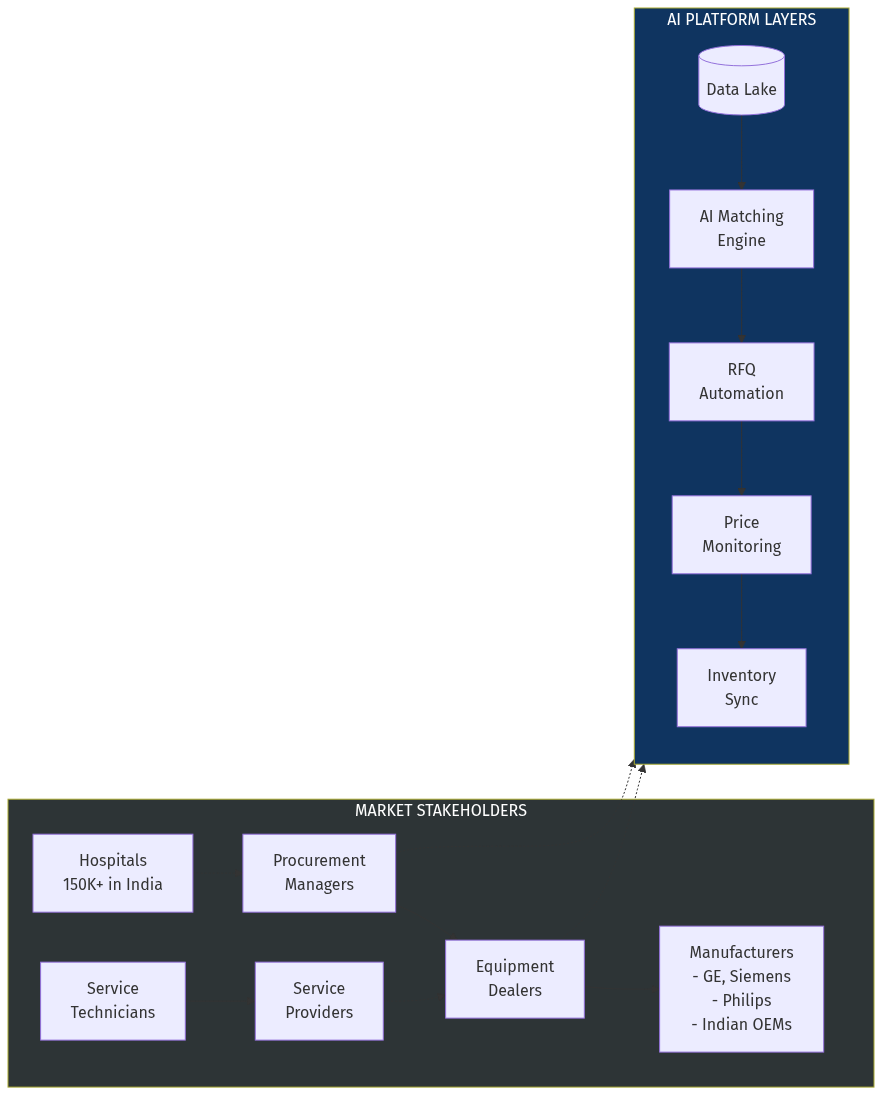
The winner of this space won't just be a marketplace — it'll be the company that builds the operational infrastructure and trust layer that the healthcare industry desperately needs.


2.

Problem Statement

For Hospitals (Buyers):
  • Information asymmetry: Procurement managers don't know all available vendors or true market prices
  • Time-intensive sourcing: Average RFQ process takes 2-4 weeks for specialized equipment
  • Quality uncertainty: Hard to verify vendor credibility without established relationships
  • Fragmented service: Equipment purchase and maintenance are separate processes, creating coordination overhead
  • No audit trail: Procurement decisions are often undocumented and inconsistent
For Dealers/Vendors:
  • Customer acquisition costs: Relying on personal networks limits growth
  • Price opacity: Can't differentiate on service when all compete on lowest price
  • Inventory risk: Must stock equipment hoping for demand
  • Payment delays: No structured financing or payment terms
For the Market:
  • No data infrastructure: No systematic way to track equipment pricing, market share, or demand trends
  • Maintenance gap: 40%+ of hospital equipment is under-maintained due to poor service coordination

3.

Current Solutions

CompanyWhat They DoWhy They're Not Solving It
MedikabazaarB2B medical supplies marketplaceFocuses on consumables, not high-ticket equipment
E-MedikartHospital equipment marketplaceLimited vendor network, basic catalog
Amazon BusinessGeneral B2B marketplaceNo healthcare specialization or service layer
IndiaHealthDirectory + referralsNot a transacting marketplace
Local dealersRelationship-based salesFragmented, no technology layer
The gap: No platform combines:
  • Comprehensive equipment catalog with specs
  • Verified vendor network with quality scores
  • AI-powered matching based on hospital requirements
  • Integrated maintenance/service contracts
  • Price benchmarking and negotiation tools

  • 4.

    Market Opportunity

    Market Size

    • India hospital equipment market: $28B (2027E), 16% CAGR
    • Global medical equipment market: $200B+, India being fastest growing
    • Hospital procurement spend: $15B+ annually on equipment (capital goods)
    • After-market services: $3B+ (maintenance, consumables, parts)

    Why Now

  • Government push: Ayushman Bharat driving 50K+ empaneled hospitals to upgrade infrastructure
  • Insurance expansion: More patients = more revenue = more equipment buying
  • Quality mandates: NABH accreditation requires documented procurement processes
  • Digital adoption: COVID accelerated comfort with online B2B transactions
  • Generation shift: Younger hospital administrators prefer digital over phone/WhatsApp
  • AI maturity: Large language models can now handle complex technical queries and specifications
  • Target Segments

    • Tier 1 corporate hospitals (100+ beds) — High value, need efficiency
    • Tier 2/3 hospitals (20-100 beds) — Cost-sensitive, growing fast
    • Diagnostic centers — Imaging equipment, specialized needs
    • Government hospitals — Tender-heavy, but moving to e-procurement

    5.

    Gaps in the Market

    Identified Gaps

  • No unified catalog with specs
  • - Equipment specifications are scattered across manufacturer websites - No standardized product information for comparison
  • Vendor discovery is manual
  • - Hospitals rely on personal networks - New vendors can't break into established relationships
  • Price opacity
  • - Same equipment can vary 20-40% between dealers - No benchmark for "fair" pricing
  • Purchase-maintenance disconnect
  • - Equipment breaks → hospital scrambles for service - No preventive maintenance scheduling
  • Financing gap
  • - Capital equipment is expensive; no structured payment options - Dealers lack working capital; hospitals want credit terms
  • Data absence
  • - No market intelligence on equipment trends - Hospitals can't make data-driven procurement decisions
    6.

    AI Disruption Angle

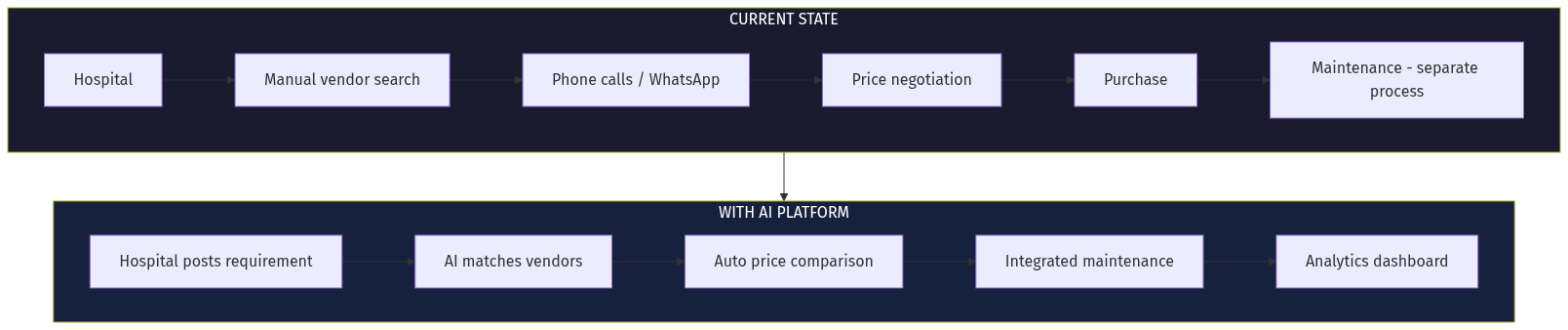
    Current Workflow (Manual)

    Hospital Need → Procurement Manager → Calls 3-5 known dealers → 
    WhatsApp quotes → Negotiate → Purchase → Find service provider (separate)

    AI-Enabled Workflow

    Hospital Need → AI Chatbot/Form → AI matches requirements to vendor catalog → 
    Auto-RFQ to 5+ vendors → Price comparison generated → 
    Negotiation assistance → Purchase → AI schedules maintenance → 
    Service tracking

    AI Capabilities

  • Intelligent matching: Understand equipment requirements → match to vendor capabilities
  • - "MRI machine for 50-bed hospital" → Score vendors on capacity, installation experience, service history
  • Price intelligence:
  • - Historical transaction data → Price benchmarks - Real-time inventory → Availability alerts - Negotiation tips based on market conditions
  • Specification extraction:
  • - Parse manufacturer docs → Standardized specs - Compare across brands/models automatically
  • Service prediction:
  • - Equipment lifespan data → Maintenance scheduling - Predictive alerts for parts replacement
  • Document automation:
  • - Purchase orders, service contracts, compliance docs - Integration with hospital ERP
    7.

    Product Concept

    Core Features

    For Buyers:
    FeatureDescription
    AI Requirements AssistantChat-based help to identify exact equipment needs
    Vendor MarketplaceBrowse + request quotes from verified dealers
    Price BenchmarkView market average, price trends, savings potential
    Order ManagementTrack orders, payments, delivery status
    Maintenance ContractsBook service, track AMC/warranty status
    Analytics DashboardSpend analysis, vendor performance, equipment lifecycle
    For Vendors:
    FeatureDescription
    Catalog ManagementUpload products with specs, images, pricing
    Lead MatchingAI recommends relevant RFQs to bid on
    CRM IntegrationTrack leads, quotes, customers
    Inventory SyncReal-time stock availability
    Finance DashboardPayments, credit terms, working capital

    Revenue Model

    StreamDescriptionPotential
    Transaction fee2-5% on completed purchasesHigh (primary)
    Listing feesPremium placement for vendorsMedium
    SubscriptionAdvanced analytics, AI tools for hospitalsMedium
    Maintenance contractsPlatform-managed service agreementsHigh (recurring)
    Financing spreadInterest on installment paymentsHigh (future)
    Data/analyticsMarket intelligence reportsLow (增值)

    Data Moat

    The platform accumulates:

    • Pricing data: Historical transactions → unbeatable market intelligence
    • Vendor performance: Response times, delivery, service quality scores
    • Hospital preferences: Purchase patterns, brand affinities
    • Equipment lifecycle: Usage patterns, maintenance history, replacement cycles
    This data becomes defensible competitive advantage — any new entrant would need years to accumulate equivalent intelligence.


    8.

    Development Plan

    PhaseTimelineDeliverables
    MVP12 weeksHospital onboarding (50), vendor catalog (200), basic RFQ flow, WhatsApp integration
    V1.020 weeksAI matching engine, price benchmarks, maintenance scheduling, vendor verification
    V1.528 weeksAnalytics dashboard, financing integration, ERP connectors
    V2.040 weeksPredictive maintenance, AI procurement assistant, national expansion

    Key Milestones

    • Month 3: 50 hospitals, 100 vendors, first transactions
    • Month 6: 200 hospitals, 500 vendors, $5M GMV
    • Month 12: 500 hospitals, 1,000 vendors, $25M GMV, Series A ready

    9.

    Go-To-Market Strategy

    Phase 1: Anchor Hospitals (Months 1-3)

  • Target: Corporate hospital chains (Manipal, Apollo, Fortis, Max)
  • Approach: Direct sales to procurement heads
  • Offer: Free pilot for 3 months, dedicated account manager
  • Value prop: Save 15-20% on procurement, reduce vendor management time
  • Phase 2: Vendor Network (Months 2-6)

  • Target: Tier 1/2 equipment dealers in major cities
  • Approach: Partner with established dealers, offer lead generation
  • Incentive: First 6 months free listing, transaction fee waiver
  • Value prop: Access to hospital customers without sales overhead
  • Phase 3: Network Effects (Months 6-12)

  • Expand: Tier 2/3 cities, diagnostic chains
  • Government: E-tender platforms, state health departments
  • Features: Unlock premium features as network grows
  • Lock-in: Integration with hospital systems creates switching costs
  • Channel Strategy

    ChannelInvestmentPriority
    Direct sales (enterprise)High1
    Industry events (medical conferences)Medium2
    Referrals from anchor hospitalsLow3
    LinkedIn/Google AdsMedium4
    Partner dealers (channel)Low5
    ---
    10.

    Competitive Moat

    Why Incumbents Will Struggle

  • Medikabazaar: Focused on consumables, not equipment; no AI layer
  • Amazon Business: Generic B2B, no healthcare expertise or service
  • Local dealers: No technology, no scale, no capital
  • Defensibility

    • Network effects: More hospitals → more vendors → more choices → more hospitals
    • Data advantage: Transaction history compounds over time
    • Trust building: Verified vendor reviews, quality scores
    • Integration depth: ERP, accounting, maintenance — harder to switch
    • Capital efficiency: Unlike e-commerce, equipment sales have high margins

    Steelman: Why This Could Fail

  • Trust barrier: Hospitals prefer established relationships for high-ticket items
  • Complex sales: Equipment requires demos, installation, training — not just transactions
  • Corruption: Some procurement involves commissions; transparent platforms threaten this
  • Capital intensity: Inventory/financing needs significant upfront capital
  • Government market: Tender-based procurement is a different game entirely
  • Mitigation: Start with private hospitals where procurement is more professionalized. Build trust gradually with transaction history. Position as "procurement efficiency" not "disruption."
    11.

    Why This Fits AIM Ecosystem

    This opportunity aligns with AIM's vision:

  • Vertical focus: Healthcare is a massive, underserved vertical
  • B2B marketplace: Core competency from domain expertise
  • Data moat: Accumulated intelligence becomes competitive advantage
  • Agent opportunity: AI agents can handle RFQ responses, vendor matching, maintenance scheduling
  • Geographic fit: India-first, with potential for emerging markets (SE Asia, Africa)
  • Future expansion:
    • Diagnostic equipment → Lab supplies → Pharma manufacturing
    • Maintenance → Consumables → Full healthcare supply chain
    • India → Middle East → Africa (similar fragmented markets)

    12.

    Mental Models Applied

    Zeroth Principles

    The fundamental assumption is that hospital procurement "must be relationship-driven." But as Generation X/Y takes over procurement, digital comfort increases. The question isn't "can hospitals buy online?" but "what's the minimum trust required to transact?"

    Incentive Mapping

    • Current dealers want price opacity — transparent pricing hurts margins
    • Hospitals want efficiency but fear new vendor risk
    • Manufacturers want channel control but are stretched thin
    • Platform aligns all: hospitals get efficiency, dealers get volume, manufacturers get reach

    Falsification (Pre-Mortem)

    Assume 3 well-funded startups failed at this. Why?
  • Built for government tenders (slow, political)
  • Tried to be everything to everyone (no focus)
  • Ignored maintenance — just marketplace
  • We avoid this by:
  • Starting private hospitals (faster decisions)
  • Focusing on equipment + maintenance (clear value prop)
  • Building trust through transaction history

  • ## Verdict

    Opportunity Score: 8/10

    This is a substantial, real market with clear pain points and demonstrated willingness to pay. The key success factors are:

  • Start narrow: Focus on specific equipment categories (imaging, ICU) before expanding
  • Build trust: Verified reviews, escrow payments, service guarantees
  • Vertical integration: Don't just be a marketplace — be the operational backbone
  • AI differentiation: Make the platform smarter than competitors can copy
  • The window is open but not forever — as healthcare grows, more players will enter. First-mover advantage in building the data moat is critical.

    Recommendation: Build. Start with 3 metro cities, 50 hospitals, focus on imaging equipment (high ticket, frequent maintenance, clear specifications).

    ## Sources


    Process Flow
    Process Flow
    Market Architecture
    Market Architecture