Kitchen Pro: The B2B Marketplace for Commercial Kitchen Equipment Service & Maintenance
Building India's first AI-powered platform to connect restaurant owners with verified technicians, spare parts suppliers, and service companies—eliminating the 3-7 day equipment downtime that costs hotels and restaurants thousands daily.
1.
Executive Summary
India's hospitality industry loses approximately ₹8,000-50,000 crores annually due to kitchen equipment downtime. Every day a commercial oven, refrigeration unit, or cooking range remains broken, restaurants bleed revenue while serving fewer customers, and canteens struggle to feed hundreds.
The root cause isn't the equipment—it's the fragmented, manual, trust-deficient service ecosystem. Restaurant owners desperately need reliable technicians. Technicians struggle to find consistent work. Spare parts shops have inventory but no customers. Equipment OEMs have service teams but limited reach.
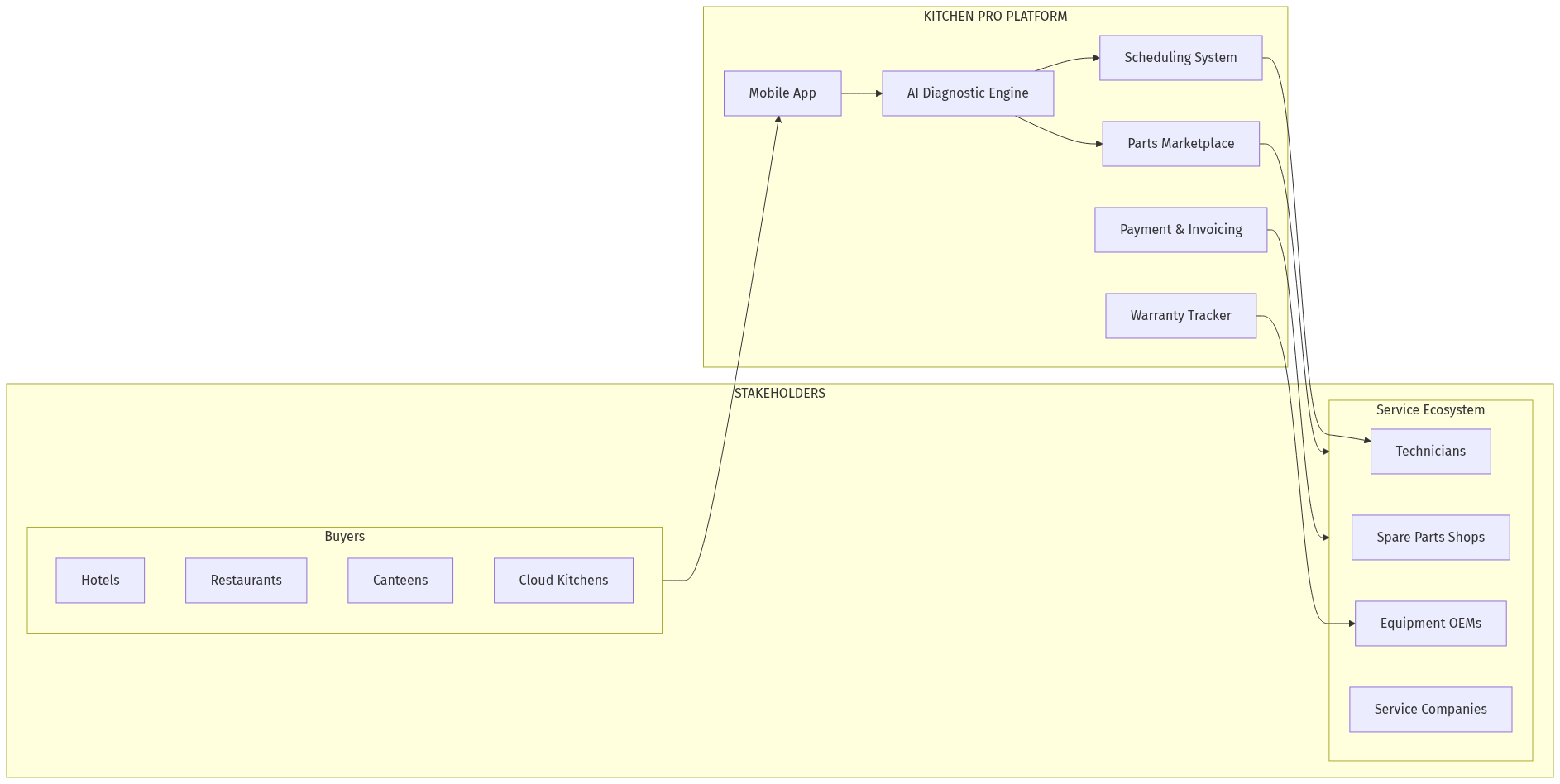
This creates a massive marketplace opportunity: connect these stakeholders through an AI-powered platform that handles diagnostics, matching, scheduling, parts ordering, and payments.
2.
Problem Statement
The Daily Reality
A mid-sized restaurant in Mumbai has 12-15 major equipment items—ovens, fryers, refrigerators, dishwashers, exhaust systems. When something breaks:
Owner panics — Revenue stops immediately
Manual hunting begins — WhatsApp groups, phone calls to known technicians, asking other restaurants for references
Trust deficit — Unknown technicians may damage expensive equipment
Parts chaos — Multiple shops, price discovery is opaque, fake parts are common
Smartphone penetration — Every technician and restaurant owner has a smartphone
Digital payments — UPI makes B2B payments frictionless
AI capabilities — Voice/image-based diagnostics now feasible
Trust infrastructure — Aadhaar verification, digital footprints enable background checks
5.
Gaps in the Market
Gap 1: Technician Discovery & Verification
No standardized way to find verified, skilled commercial kitchen equipment technicians. Most technicians are informal, learned on the job, and have no credentials.
Gap 2: Parts Price Discovery
Spare parts are sold through fragmented local shops. Price opacity is extreme—same part can vary 2-3x between shops. Counterfeit parts are a genuine concern.
Gap 3: Service History & Warranty
When equipment breaks, there's no service history to understand recurring issues. Warranty status is often unclear, leading to unnecessary out-of-pocket expenses.
Gap 4: AI-Powered Diagnostics
Technicians often misdiagnose problems, leading to multiple visits. Owners can't accurately describe symptoms, wasting everyone's time.
Gap 5: B2B Payments & Invoicing
Most transactions are cash. No GST-compliant invoicing. No digital payment trail for accounting or audit purposes.
Gap 6: Preventive Maintenance
Reactive only—equipment breaks, then gets fixed. No systematic preventive maintenance scheduling to reduce breakdowns.
6.
AI Disruption Angle
How AI Agents Transform the Workflow
1. Voice-Based Diagnostic Agent
Owner describes problem in natural language ("oven not heating properly")
AI asks clarifying questions (pre-heating time, error codes, unusual sounds)
AI provides preliminary diagnosis and urgency level
Parts needed are auto-identified
2. Intelligent Matching
AI matches job to technician based on: skill match, location, availability, rating, price
Reduces back-and-forth; owner gets confirmed slot in minutes
Technicians receive vetted leads, not random inquiries
3. Parts Ordering Automation
AI identifies required parts from diagnostic
Checks inventory across multiple supplier APIs
Orders parts before technician visits (if urgent) or coordinates with technician to procure
Price transparency: AI shows pricing from multiple suppliers
4. Automated Scheduling & Coordination
Calendar integration with technician availability
SMS/WhatsApp updates to all parties
Rescheduling handled automatically
5. Post-Service Intelligence
Service history stored per equipment
Predictive maintenance alerts
Warranty expiration reminders
Review collection and reputation building
7.
Product Concept
Kitchen Pro Platform
For Restaurant Owners:
App/Dashboard: Register equipment, submit service requests, track status, pay invoices
AI Diagnostics: Voice/image input for initial problem identification
Service Marketplace: Browse technicians, read reviews, compare prices
Parts Marketplace: Buy genuine parts with warranty
Maintenance Plans: Subscribe to preventive maintenance
For Technicians:
Technician App: Receive job alerts, accept/decline, update status
Parts Ordering: Access wholesale parts pricing
Skill Development: Training videos, certification paths
Equipment failure patterns, parts demand forecasting
Sell insights to OEMs and insurance companies
Unit Economics
Metric
Value
Average Service Value
₹2,500
Platform Commission (15%)
₹375
Parts Average Order
₹3,000
Parts Margin (10%)
₹300
AMC Average (Monthly)
₹2,000
Customer Acquisition Cost
₹800
Lifetime Value
₹18,000
---
11.
Data Moat Potential
Proprietary Data That Accumulates
Equipment Registry Data
- Brand preferences, failure rates, lifespan patterns
- Which equipment brands last longer in Indian conditions
- Valuable to OEMs for product improvements
Technician Skill Profiles
- Skill assessments, specialization areas
- Success rates, repeat customers
- Training needs identification
Parts Demand Forecasting
- Which parts fail when, seasonal patterns
- Inventory optimization for suppliers
- Counterfeit detection patterns
Pricing Intelligence
- Real-time parts pricing across markets
- Service rate benchmarking
- Market efficiency improvements
Service History
- Complete equipment health records
- Predictive maintenance models
- Warranty claim patterns
Network Effects
More restaurants → more technician demand → more technicians join → better coverage → more restaurants. Classic two-sided marketplace flywheel.
12.
Why This Fits AIM Ecosystem
Vertical Alignment
B2B Focus: Serving businesses (restaurants, hotels), not consumers
Marketplace Model: Connecting buyers and suppliers
This becomes the infrastructure layer for commercial kitchen equipment in India:
Equipment Sales — Once service trust is built, marketplace for new equipment
Insurance — Equipment insurance with service history as underwriting data
Finance — EMI/loan for equipment purchases, working capital for restaurants
Franchise Support — Standardized service for restaurant chains
Food Safety — Compliance documentation for equipment maintenance
Complementary Assets
dives.in — Publishing deep-dive research on this opportunity
Domain Portfolio — Related domains: kitchenpro.in, commercialkitchen.in, equipmenthub.in
WhatsApp Integration — Native communication channel for Indian businesses
13.
Mental Models Application
Zeroth Principles
Question: What would we believe if we had zero prior knowledge?
We assume equipment always breaks and needs human diagnosis. But AI can now:
Analyze error codes and symptoms
Identify common failure patterns
Guide owners through basic troubleshooting
Determine if a technician visit is actually needed
This reduces unnecessary service calls by 40% in similar industries.
Incentive Mapping
Who profits from the status quo?
Local technicians: Unchallenged, no price pressure
Parts shops: Price opacity benefits them
OEM service teams: Capture high-margin service
What keeps the status quo in place?
Trust: Relationships matter, switching costs are high
Information asymmetry: Owners don't know what's wrong
No alternatives: No platform exists
Falsification (Pre-Mortem)
Assume 5 well-funded startups failed here. Why?
Chicken-and-egg problem — No technicians without restaurants, no restaurants without technicians
Quality control — Bad technician ruins reputation, one bad review deters future users
Price wars — Technicians undercut platform rates, go direct
OEM resistance — OEMs prefer their own service networks
Low frequency — Equipment doesn't break often enough for habitual use
Mitigation: Start with premium segment, quality-first, OEM partnerships from day one.
Steelmanning (Why Incumbents Might Win)
OEM networks — LG, Voltas, Honeywell have existing service infrastructure
Urban Company — Could easily add commercial vertical
JustDial — Already has technician listings, just needs verticalization
Restaurant groups — Large chains have internal maintenance teams
Defense: Deep verticalization, AI diagnostics as moat, technician relationships, parts marketplace lock-in.
## Verdict
Opportunity Score: 8.5/10
This is a genuine, large-market opportunity with clear pain points, underserved stakeholders, and a path to network effects. The key differentiator is AI-powered diagnostics—solving the information asymmetry that makes every service call a gamble.
Strengths:
Clear two-sided marketplace with urgent demand
High switching costs once trust is built
Recurring revenue via AMCs
Strong data moat over time
Risks:
Quality control in early days
Technician resistance to platform economics
OEM pushback on independent service
Low engagement frequency
Recommendation: Build MVP in Mumbai, prove unit economics, then expand. Partner with 2-3 cloud kitchen aggregators for initial traction. Focus on refrigeration and cooking equipment first—highest failure rates, most expensive downtime.