ResearchWednesday, March 18, 2026

B2B Invoice Discounting: The $300B Opportunity AI Can Unlock

India's 63 million SMEs face a $300+ billion working capital gap. Traditional banks reject 68% of SME loan applications. Invoice discounting—where businesses sell unpaid invoices to investors for immediate cash—could bridge this gap. But manual processing, fragmented data, and trust deficits have kept this market stagnant. AI agents can fix this.

1.

Executive Summary

India's SME sector contributes 30% of GDP and employs 110 million people. Yet these businesses face a chronic $300+ billion working capital gap due to delayed payments from large buyers. Invoice discounting—a $12 trillion global market—remains largely untapped in India due to manual processing, high transaction costs, and trust deficits between buyers, sellers, and funders.

AI agents can automate credit assessment, verify invoice authenticity in real-time, and create a liquid marketplace for invoice trading. This article explores the opportunity to build India's first AI-native invoice discounting platform.

2.

Problem Statement

The Cash Flow Crisis

Indian SMEs survive on thin margins. When a large corporate buyer pays in 60-90 days, the SME must still:

  • Pay employees monthly
  • Purchase raw materials
  • Maintain operations
  • Service other customers
This creates a perpetual cash flow crunch. 67% of Indian SMEs report working capital as their biggest challenge (Sidbi Survey 2025).

The Invoice Discounting Problem

Invoice discounting exists to solve this: a supplier sells their unpaid invoice to a funder at a discount, getting immediate cash. However, the current process is broken:

Pain PointCurrent RealityImpact
Manual verificationPhysical documents, 2-5 daysDelays
Credit assessmentBank statements, 7-14 daysHigh rejection
TrustNo real-time invoice verificationFunder risk
FragmentationNo centralized marketplaceLow liquidity
High costs2-5% per transactionNot viable for small invoices

Who Faces This?

  • Tier 2/3 suppliers to large retailers (Kirana suppliers, manufacturing components)
  • Logistics companies waiting for freight payments
  • Pharma distributors supplying hospitals on credit
  • Construction material suppliers to real estate developers

3.

Current Solutions

Traditional Players

CompanyWhat They DoLimitations
KredXInvoice discounting, working capitalFocuses on tier-1 suppliers only
AavaSupply chain financeRequires lengthy documentation
LendBoxP2P lendingNot invoice-specific
McapCorporate invoice factoringEnterprise-focused
TallyFinInvoice financingNew entrant, limited scale

What's Missing

  • No AI-native platform — All require extensive manual underwriting
  • No real-time verification — Can't confirm invoice is genuine and unpaid
  • No marketplace — Single funder relationships, no competitive bidding
  • Not for micro-SMEs — Minimum invoice sizes of ₹5-10 lakhs
  • No cross-border — No factoring for export receivables

  • 4.

    Market Opportunity

    Market Size

    • Global invoice factoring market: $12.1 trillion (2025)
    • India's working capital gap: $300+ billion
    • Addressable market (SME invoice financing): $80-100 billion
    • Current penetration: <5%

    Growth Drivers

  • UPI success — India's digital infrastructure enables real-time transactions
  • GST data — Comprehensive tax data enables instant credit assessment
  • E-invoicing mandate — Government-mandated e-invoicing creates digital audit trails
  • MSME focus — Priority sector lending mandates drive bank interest
  • AI cost reduction — Automated underwriting cuts processing costs by 80%
  • Why Now

    The convergence of GST data availability, e-invoicing mandates, and mature AI credit models makes this the perfect time. Platforms like Clear (tax tech) have proven that AI can parse Indian financial documents at scale.


    5.

    Gaps in the Market

    Gap 1: No Real-Time Invoice Verification

    Currently, there's no way to verify if an invoice is:
    • Genuine (not fake)
    • Unpaid (not already discounted elsewhere)
    • From a creditworthy buyer
    Anomaly: GST data exists but isn't integrated with financing platforms.

    Gap 2: Micro-Invoice Financing

    Existing platforms require minimum invoice sizes of ₹5-10 lakhs. The average SME invoice is ₹50,000-2 lakhs—94% of invoices are too small for traditional factors.

    Gap 3: Multi-Buyer Supply Chains

    Suppliers to multiple large buyers have fragmented payment terms. No platform manages the full receivables portfolio.

    Gap 4: Dynamic Pricing

    Invoice pricing is fixed. AI can enable:
    • Real-time risk-based pricing
    • Competitive bidding (multiple funders)
    • Auction-based discounting

    Gap 5: Cross-Border Factoring

    Indian exporters wait 60-120 days for international payments. No platform connects them to global invoice buyers.
    6.

    AI Disruption Angle

    How AI Transforms Invoice Discounting

    1. Intelligent Document Processing (IDP)
    • OCR + LLM extracts invoice data from any format
    • Auto-validates against GST/E-waybill databases
    • Reduces verification from 5 days to 5 minutes
    2. Real-Time Credit Scoring
    • ML models ingest GST returns, bank statements, transaction history
    • Continuous monitoring of buyer creditworthiness
    • Instant risk scoring for each invoice
    3. Fraud Detection
    • Pattern recognition identifies duplicate invoices
    • Network analysis detects fake buyer/supplier rings
    • Anomaly detection flags unusual transaction patterns
    4. Automated Underwriting
    • Rule-based + ML hybrid approval
    • 90% of invoices auto-approved
    • Human review only for exceptions
    5. Smart Marketplace Matching
    • AI matches invoices to appropriate funders
    • Dynamic pricing based on risk appetite
    • Real-time auction for best rates

    The Future: Autonomous Finance

    When AI agents can:

  • Monitor a supplier's receivables in real-time
  • Auto-detect when an invoice qualifies for discounting
  • Execute discounting at optimal rates without human intervention
  • Predict cash flow needs and proactively offer financing
  • This is "autonomous finance" — the next evolution of B2B fintech.
    7.

    Product Concept

    Core Platform Features

    FeatureDescription
    Invoice UploadPhoto/PDF upload, auto-extraction via AI
    Buyer VerificationReal-time GST/E-invoice validation
    Credit ScoreML-based buyer risk score (0-100)
    MarketplaceMultiple funders bid on invoices
    Smart ContractsAutomated payment on due date
    DashboardReal-time receivables, cash flow predictions

    User Flows

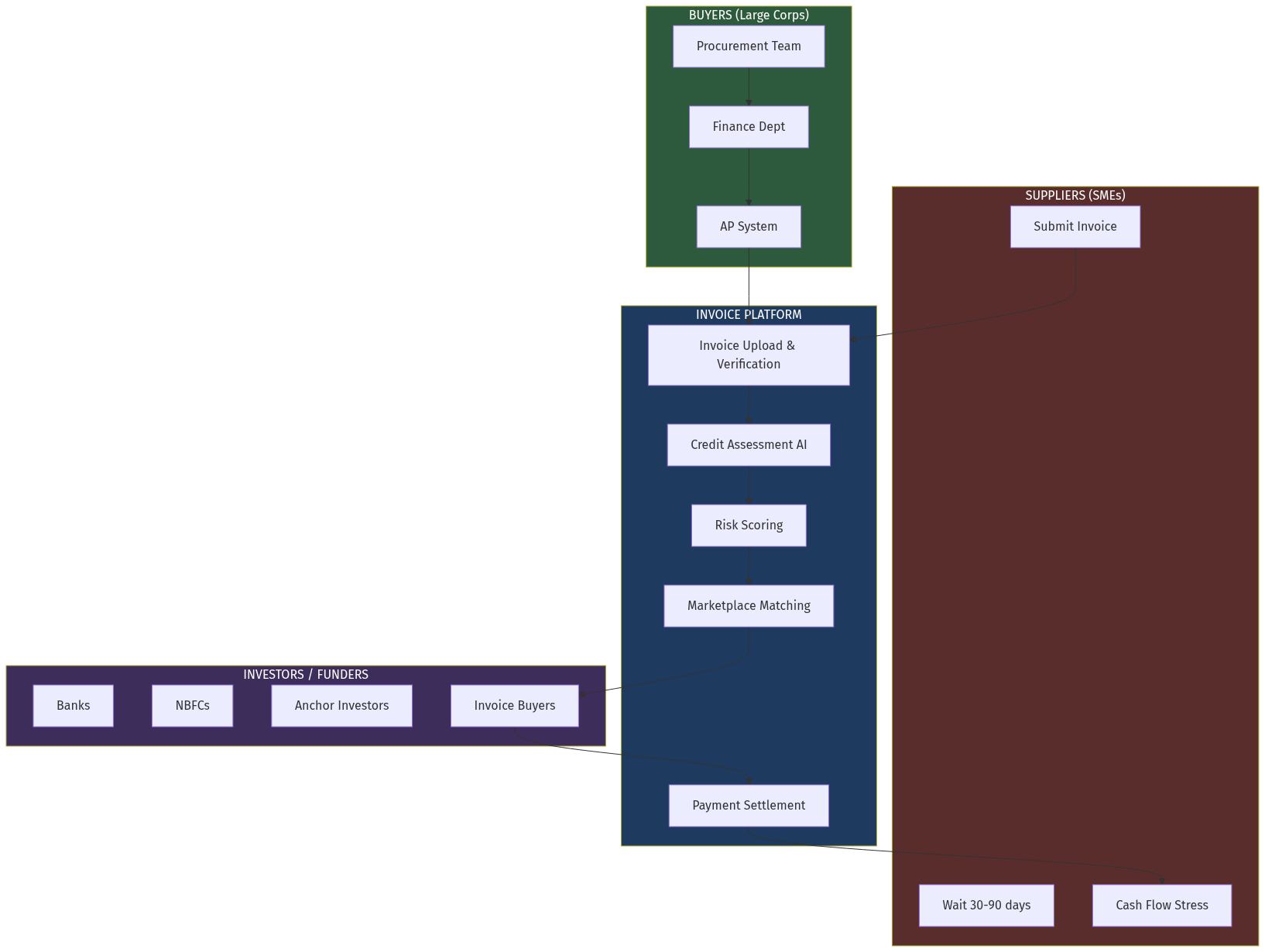
    For Suppliers:
  • Upload invoice (photo or PDF)
  • AI verifies authenticity against GST
  • Submit for discounting
  • Funder bids (or auto-matched)
  • Receive funds in <24 hours
  • Platform collects on due date
  • For Funders:
  • Browse verified invoices
  • See buyer credit score
  • Bid or set auto-invest rules
  • Earn 8-15% annualized returns

  • 8.

    Development Plan

    PhaseTimelineDeliverables
    MVP8 weeksInvoice upload, GST verification, single funder integration
    V112 weeksMarketplace bidding, risk scoring model, API for ERPs
    V216 weeksMulti-funder, cross-border, smart contracts
    ScaleOngoingAI auto-financing, predictive cash flow

    Tech Stack

    • Frontend: React, TypeScript
    • Backend: Node.js, Python (ML)
    • Database: PostgreSQL, Redis
    • ML: TensorFlow, LangChain
    • Integrations: GST API, Bank APIs, UPI

    9.

    Go-To-Market Strategy

    Phase 1: Anchor Buyers (Months 1-3)

  • Partner with 3-5 large buyers (retail chains, manufacturers)
  • Onboard their suppliers automatically
  • Use buyer credibility to attract funders
  • Why buyers participate: They get better payment terms from suppliers, stronger supplier relationships.

    Phase 2: Funder Acquisition (Months 2-4)

  • Target NBFCs, family offices, HNI investors
  • Show verified invoice data + historical performance
  • Offer 10-15% returns with low risk
  • Phase 3: Network Effects (Months 4-8)

  • More buyers → more suppliers → more invoices
  • More invoices → better returns for funders
  • More funders → competitive pricing for suppliers
  • Channels

    • Direct sales: Target supply chain heads at large companies
    • Channel partnerships: ERP vendors (Tally, Zoho, SAP)
    • Trade associations: CII, ASSOCHAM, local chambers
    • Digital marketing: SEO for "invoice financing," "working capital"

    10.

    Revenue Model

    Revenue Streams

    StreamDescriptionTake Rate
    Discounting feeSpread between buyer and funder rate1-2% of invoice value
    Platform feeTransaction fee on each invoice0.25-0.5%
    SubscriptionPremium features for suppliers₹2,000-10,000/month
    Data servicesMarket insights, risk reportsB2B data products
    Lending interestPlatform-backed lending (V2)4-8% margin

    Unit Economics

    • Average invoice: ₹5 lakhs
    • Platform fee: 1.5% = ₹7,500 per transaction
    • Funder pays 12%, supplier receives 88%
    • At 1000 invoices/month: ₹75 lakhs ARR

    11.

    Data Moat Potential

    Proprietary Data Assets

  • Invoice transaction history — Unique dataset of B2B payment behavior
  • Buyer credit patterns — Real-time receivables data
  • Supplier performance — Payment behavior across buyers
  • Industry benchmarks — Payment terms by sector, region
  • Moat Mechanisms

    • Network effects: More buyers/suppliers = better pricing = harder to replicate
    • Data advantage: Historical data improves ML models continuously
    • Integration depth: ERP/GST API integrations are hard to replicate
    • Trust: Regulatory compliance, audit trails take time to build

    12.

    Why This Fits AIM Ecosystem

    Vertical Fit

    • Domain: B2B fintech, supply chain
    • Data source: GST, E-invoice, bank APIs
    • AI opportunity: Credit scoring, fraud detection, automation

    Synergies

    • Can integrate with AIM's existing B2B marketplace infrastructure
    • Domain data feeds into AIM's lead scoring models
    • Invoice data = real business signal (better than website metadata)

    Long-term Vision

    • Expand from invoice discounting → full supply chain finance
    • Build proprietary credit bureau for B2B
    • Enable autonomous AI agents to manage working capital for SMEs

    ## Verdict

    Opportunity Score: 8.5/10

    Strengths

    • Massive market gap ($300B working capital)
    • Clear value proposition for all stakeholders
    • AI can solve the core inefficiencies
    • Regulatory tailwinds (e-invoicing, MSME focus)

    Risks

    • Regulatory complexity (NBFC licensing)
    • Credit risk in downturns
    • Competition from traditional banks
    • Building trust with funders

    Why 8.5/10?

    This is a foundational B2B fintech play with network effects. The first-mover to build a liquid, AI-native invoice marketplace in India can own the space. The data moat compounds over time. The key is finding the right anchor buyers and proving the model before scaling. Recommendation: Build a focused MVP with 2-3 anchor buyers and prove the unit economics before raising significant capital.

    ## Sources

    Architecture Diagram
    Architecture Diagram

    AI Workflow
    AI Workflow