ResearchWednesday, March 18, 2026

B2B Auto Parts & Components Marketplace: The $85 Billion Opportunity AI Agents Can Transform

India's automotive aftermarket is worth $85 billion and growing at 12% CAGR—but 70% of transactions still happen through phone calls, WhatsApp groups, and physical market visits. This creates a massive opportunity for an AI-agent-powered B2B marketplace that connects fragmented suppliers with service centers, mechanics, and fleet operators.

1.

Executive Summary

The Indian auto parts industry is undergoing a structural transformation. With over 300 million vehicles on Indian roads (world's third-largest fleet), the aftermarket demand is exploding. Yet, the supply chain remains shockingly primitive—dominated by fragmented distributors, opaque pricing, and manual coordination.

An AI-powered B2B marketplace can:

  • Match repair shops with verified suppliers in seconds (not days)
  • Negotiate prices automatically across multiple distributors
  • Verify component authenticity (counterfeit is a $8B problem)
  • Orchestrate logistics from warehouse to service bay

Market Size: $85 billion (India automotive aftermarket) Target Segment: B2B auto parts procurement Opportunity Score: 8.5/10


2.

Problem Statement

The Daily Pain of a Mechanic

Walk into any independent mechanic shop in India. The proprietor spends 2-3 hours daily just sourcing parts:

  • Calling 5-10 distributors to find availability
  • Negotiating prices over phone (no visibility into market rates)
  • Traveling to wholesale markets for critical parts (half-day lost)
  • Dealing with counterfeits (no verification system exists)
  • Managing payments through cash/COD (no credit history)
  • The Supplier's Perspective

    Small manufacturers and distributors face their own challenges:

    • Reach limitation (geographically confined to 2-3 districts)
    • Price uncertainty (no real-time market intelligence)
    • Bad debt risk (COD is the only trusted mode)
    • Inventory guesswork (can't predict demand)

    Why This Problem Exists

    Zeroth Principle Analysis: We assume "auto parts will always be sold through distributors." But why? The answer: legacy infrastructure. Before the internet, only distributors had the warehousing networks to aggregate fragmented supply. Today, that assumption is obsolete—but no one has built the digital layer to replace it.
    3.

    Current Solutions

    CompanyWhat They DoWhy They're Not Solving It
    SpiceJetB2C flight bookingNot auto parts
    Amazon BusinessGeneral B2B marketplaceNo OE compatibility data, no mechanic-specific UX
    BoodmoAuto parts marketplaceLimited supplier network, no AI features
    CarPartsDBParts catalog onlyNo transaction capability
    MyTVSService networkFocuses on service, not parts sourcing
    Anomaly Hunting: Why is there no "Amazon for auto parts" in India? Amazon tried but failed because:
    • Auto parts require deep OE (Original Equipment) compatibility data
    • Mechanics need parts in 2-4 hours, not 2-3 days
    • Cash-on-delivery is standard; digital payments are low-trust
    • Counterfeit detection requires domain expertise

    4.

    Market Opportunity

    Market Size (India)

    SegmentSizeGrowth
    Passenger Vehicles Aftermarket$42B11% CAGR
    Commercial Vehicles Aftermarket$28B13% CAGR
    Two-Wheeler Aftermarket$15B9% CAGR
    Total$85B12% CAGR

    Why Now

  • Digitization Wave: UPI has made digital payments socially acceptable
  • WhatsApp as OS: B2B transactions already happening on WhatsApp—validation that sellers are ready to move online
  • AI Cost Drop: Large Language Models can now handle complex technical queries ("Is this part compatible with Honda City 2018?")
  • EV Disruption: New component categories (batteries, motors, electronics) need fresh supply chains—incumbents have no advantage here

  • 5.

    Gaps in the Market

    Gap 1: No Universal Parts Database

    Every distributor maintains their own SKU list. There's no standardized OE part number mapping to aftermarket alternatives. An AI platform can ingest manufacturer catalogs and build the first universal parts graph.

    Gap 2: Trust Deficit

    Counterfeit auto parts cause accidents, warranty voiding, and brand damage. No marketplace verifies authenticity. A platform with AI-powered image verification and batch-traceability can solve this.

    Gap 3: Same-Day Delivery Expectation

    Mechanics cannot hold inventory. They need parts within 2-4 hours. Current aggregators ship in 24-48 hours. A hyperlocal fulfillment network (partnered with local distributors as dark stores) can solve this.

    Gap 4: Credit Access

    Independent mechanics have no credit history, so they pay COD for everything. A platform can build credit scoring based on transaction history and offer Buy-Now-Pay-Later.

    Gap 5: Technical Knowledge Gap

    A mechanic working on a BMW needs different expertise than one working on a Maruti. AI agents can provide diagnostic assistance, part selection guidance, and installation tutorials.
    6.

    AI Disruption Angle

    How AI Agents Transform the Workflow

    Current State (Manual):
    Mechanic → Calls 5 distributors → Waits for callbacks → Compares prices orally → Places order → COD payment → Picks up parts
    Future State (AI Agents):
    Mechanic: "I need a brake pad for Hyundai Creta 2021"
    AI Agent: [Queries 50+ suppliers in parallel] → [Verifies OE compatibility] → [Checks price history] → [Selects best option] → [Auto-negotiates] → [Confirms delivery in 2 hours]

    The AI Agent Capabilities

  • Natural Language Search: "I need alternators for Tata trucks" → Agent understands vehicle type, component category, and quantity
  • Compatibility Engine: Maps OE numbers to 200+ aftermarket equivalents
  • Price Intelligence: Real-time price tracking across distributors
  • Fraud Detection: AI image analysis to verify part authenticity
  • Logistics Optimization: Hyperlocal routing for 2-4 hour delivery
  • Credit Scoring: Transaction-based credit assessment for mechanics

  • 7.

    Product Concept

    Core Features

  • Parts Search (AI-Powered)
  • - Natural language + OE number + image search - Vehicle compatibility auto-detection - Price comparison across 500+ suppliers
  • Verified Supplier Network
  • - Supplier onboarding with business verification - Quality rating system - Delivery performance tracking
  • AI Negotiation Agent
  • - Auto-bid on bulk orders - Price history alerts - Dynamic discounting
  • Logistics Integration
  • - Same-day delivery (hyperlocal dark stores) - Order tracking - Returns management
  • Payments & Credit
  • - UPI/credit card payments - Buy-Now-Pay-Later (BNPL) - Credit scoring based on transactions
  • Technical Support
  • - AI diagnostic chatbot - Installation guides - Warranty claim assistance

    User Flow

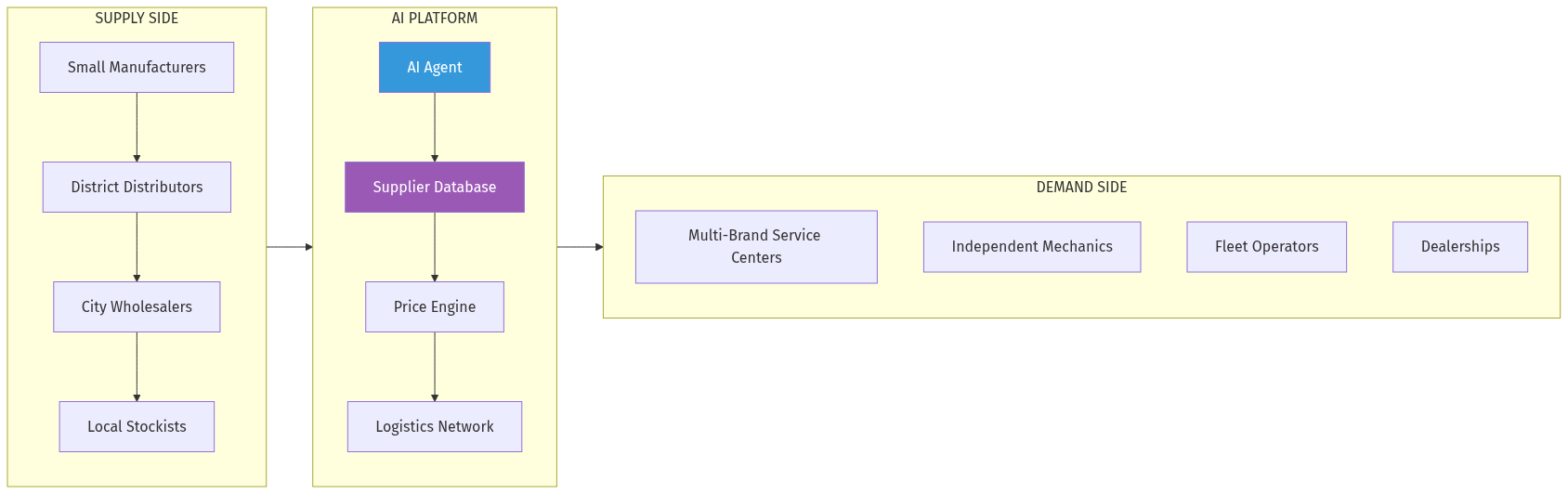
    Process Flow
    Process Flow

    8.

    Development Plan

    PhaseTimelineDeliverables
    MVP8 weeksParts catalog search, supplier onboarding, basic ordering, WhatsApp integration
    V112 weeksAI search, price comparison, logistics integration, payments
    V216 weeksAI negotiation, BNPL, authenticity verification, diagnostic assistant
    V324 weeksMulti-city expansion, EV parts module, B2B fleet management

    Architecture

    System Architecture
    System Architecture

    9.

    Go-To-Market Strategy

    Phase 1: Delhi-NCR Auto Cluster (Months 1-3)

    • Target: 500 independent mechanics in Mayur Vihar, Karol Bagh, Kashmiri Gate markets
    • Acquisition: On-ground sales teams with tablets
    • Hook: Free AI compatibility check (saves 2 hours/day)

    Phase 2: Supplier Network (Months 4-6)

    • Onboard 100+ distributors across categories (brake, suspension, electrical, body)
    • Offer: Free digital catalog + AI sales assistant
    • Viral loop: Mechanics invite their preferred suppliers

    Phase 3: Expansion (Months 7-12)

    • Mumbai, Chennai, Bangalore, Hyderabad
    • Focus on fleet operators (bus companies, logistics fleets)
    • Partnership with oil companies (Castrol, Shell) for co-marketing

    Channel Strategy

  • WhatsApp-First: Mechanics already live on WhatsApp. Build ordering via WhatsApp Business API.
  • Mechanic Associations: Partner with local mechanic unions
  • Parts Exhibitions: Auto Expo, ACMA (Automotive Components Manufacturers Association)
  • OEM Partnerships: Work with Maruti, Hyundai, Tata for authorized parts programa

  • 10.

    Revenue Model

    Primary Revenue Streams

    StreamModelMargin
    Transaction Commission5-8% on GMVHigh volume, low margin
    Premium Listings₹5,000-50,000/month for suppliersHigh margin
    Logistics Markup₹20-100 per orderModerate
    BNPL Interest1.5-2% per monthHigh margin
    Data/AnalyticsMarket intelligence reports for suppliersSubscription

    Unit Economics

    • Average Order Value: ₹8,000-15,000
    • Commission per Order: ₹400-1,200
    • Customer Acquisition Cost: ₹800-1,500
    • Lifetime Value: ₹25,000-40,000
    • LTV:CAC Ratio: 3-4x (healthy)

    11.

    Data Moat Potential

    Proprietary Data Assets

  • Parts Compatibility Graph: First comprehensive mapping of OE numbers to aftermarket alternatives in India
  • Price Intelligence: Real-time pricing across 500+ suppliers = market transparency data
  • Mechanic Behavior: Service patterns, preferred brands, price sensitivity
  • Supplier Performance: Delivery times, quality ratings, return rates
  • Vehicle Fleet Data: Age, make, model distribution by geography
  • Moat Strength: Strong. This data cannot be replicated by incumbents who lack digital transaction history.
    12.

    Why This Fits AIM Ecosystem

    Vertical Integration Potential

    • AIM.in provides discovery layer (buyer intent data)
    • dives.in publishes market intelligence
    • AI Agents handle transaction orchestration

    Synergies

  • WhatsApp Integration: AIM already uses WhatsApp for outreach; mechanics live on WhatsApp
  • UPI Payments: India Stack infrastructure enables instant payments
  • Domain Expertise: Auto parts is a pure B2B play—fits AIM's B2B-first strategy
  • Logistics Partners: Can integrate with local delivery networks
  • Future Expansion

    • EV Parts: Battery, motor, electronics (growing segment)
    • Fleet Management: Maintenance contracts, bulk procurement
    • Insurance: Spare parts claims verification
    • Oxygen: B2B marketplace playbook can replicate to other verticals

    ## Verdict

    Opportunity Score: 8.5/10

    Why This Wins

  • Massive TAM: $85B market with 12% growth
  • Clear Pain: Mechanics lose 2-3 hours daily sourcing parts
  • AI-Native: Deep technical query handling is AI's strength
  • India Advantage: Large mechanic population, WhatsApp familiarity, UPI infrastructure
  • Risks Mitigated

    • Counterfeits: AI image verification + supplier ratings
    • Logistics: Partner with existing distributors as dark stores
    • Trust: Escrow payments, quality guarantees

    Why Incumbents Will Struggle

    • Amazon lacks deep parts compatibility data
    • Boodmo lacks AI negotiation + logistics speed
    • Traditional distributors lack digital DNA

    ## Sources