ResearchTuesday, March 17, 2026

AI-Powered MSME Asset Verification: Solving the $500B Collateral Crisis in Indian B2B Lending

76 million Indian MSMEs need credit. Banks have $500B to lend. The gap? No one can verify what businesses actually own. AI agents can finally solve this.

1.

Executive Summary

India's MSME sector contributes 30% of GDP and employs 110 million people. Yet these businesses receive less than 20% of bank credit despite being the nation's economic backbone. The root cause isn't demand — it's verification.

Banks and NBFCs require collateral verification before lending, but the process is broken: property documents are physical, machinery records are scattered across factories, inventory is invisible, and receivables are untracked. Manual verification costs ₹15,000-50,000 per loan and takes 3-8 weeks.

This article explores how AI-powered asset verification agents can transform MSME lending — by digitizing collateral assessment, automating verification workflows, and building the first comprehensive asset registry for Indian businesses. The opportunity: enable $500B in new MSME credit over the next decade.

2.

Problem Statement

The MSME Credit Gap

The numbers:
  • 76 million registered MSMEs in India
  • $500B estimated credit gap (World Bank)
  • 17% of MSME loan applications approved by banks
  • ₹68-72% interest rates from informal lenders (vs. 10-15% from banks)
  • $89 billion in annual working capital borrowed from informal sources
Who experiences this pain?
  • MSME owners — Need credit for inventory, equipment, growth but can't prove their collateral value
  • Banks & NBFCs — Want to lend but can't verify assets at scale profitably
  • Lenders — Face 40-60% NPAs in MSME portfolio due to poor collateral verification
  • Guarantors — Personal guarantees required but asset valuation is subjective
  • The Verification Crisis

    What's broken in collateral assessment?
    Asset TypeCurrent ProcessProblem
    Commercial PropertySite visits, physical documentsFake titles, disputed boundaries, black money
    MachineryManual inspection, photosOvervalued, hidden liens, dual-pledged
    InventoryStock audits (quarterly)Misreported, quickly liquidated
    ReceivablesManual ledger reviewFictitious invoices, aging manipulation
    VehiclesRC book verificationDuplicate financing, stolen assets
    Gold/AssetsPhysical verificationPledged multiple times
    The verification cost breakdown:
    • Site visits: ₹3,000-8,000 per location
    • Document verification: ₹2,000-5,000 per asset
    • Valuation fees: ₹5,000-25,000 per asset class
    • Legal opinion: ₹10,000-30,000 per property
    • Total per loan: ₹15,000-50,000 (often exceeding margin on small loans)

    3.

    Current Solutions

    CompanyWhat They DoWhy They're Not Solving It
    CreditasDigital collateral verification for gold loansOnly gold, not applicable to MSME machinery/property
    PerfiosBank statement analysis, financial data extractionNo asset verification, only cash flow analysis
    CREDCredit score aggregationConsumer-focused, not business assets
    UpworkAsset verification servicesManual, not AI-powered, expensive
    LendingKartMSME lending with alternative dataStill relies on manual verification for collateral
    NeoGrowthMerchant cash advanceNo collateral verification, uses transaction data only
    Aye FinanceMSME lendingSome asset verification but manual, limited scale

    What's Missing

  • No unified asset registry — Machinery, inventory, property exist in silos
  • No real-time verification — Asset status changes between inspection and disbursal
  • No cross-lender sharing — Same asset pledged to multiple lenders undetected
  • No AI-assisted valuation — Subjective human估值 creates disputes
  • No digital audit trail — Verification claims can't be audited post-disbursal

  • 4.

    Market Opportunity

    The Addressable Market

    SegmentMarket Size (India)Growth
    MSME Credit Gap$500B15% CAGR
    Collateral Verification$4.2B (global)22% CAGR
    MSME Loan Disbursals₹22 trillion (FY25)20% CAGR
    Asset Registry Services$800M (India)28% CAGR

    Why Now

  • UPI infrastructure — India has digital rails for financial transactions
  • GST data — 14 million businesses now have digital transaction history
  • Aadhaar-linked — Digital identity enables remote verification
  • Regulatory push — RBI mandates 20% year-on-year MSME lending growth
  • NBFC crisis — High NPAs (8-12%) force better verification
  • AI maturity — Computer vision, document AI, and fraud detection have reached production readiness
  • The Multiplier Effect

    Every $1 spent on asset verification enables $50-100 in credit flow. If we reduce verification cost by 80% and time by 90%, we unlock:

    • $50B+ in new MSME credit annually
    • 15-20% reduction in MSME NPAs
    • $2-3B in verification service revenues

    5.

    Gaps in the Market

    Gap 1: No Cross-Lender Asset Visibility

    Problem: A machine worth ₹50L can be pledged to 3 different banks. No registry exists. Opportunity: Build first MSME asset registry with real-time pledge status.

    Gap 2: Static Verification

    Problem: Asset verified Monday, sold Tuesday, loan default Wednesday. Opportunity: Continuous monitoring with IoT, satellite, and periodic re-verification.

    Gap 3: Manual Valuation

    Problem: Human appraisers overvalue to win business, undervalue to reduce risk. Opportunity: AI valuation using comparable sales, depreciation models, and market data.

    Gap 4: Document Fraud

    Problem: Fake sale deeds, forged RC books, manipulated invoices. Opportunity: Blockchain-anchored document verification, government database cross-checks.

    Gap 5: Inventory Opacity

    Problem: Stock values fluctuate daily, can't be used as collateral. Opportunity: IoT-enabled inventory tracking, real-time valuation, warehouse integration.

    Gap 6: Receivables Uncertainty

    Problem: Fake invoices, late payments, disputed claims. Opportunity: AI analysis of payment history, customer confirmation, credit insurance integration.
    6.

    AI Disruption Angle

    The Asset Intelligence Agent

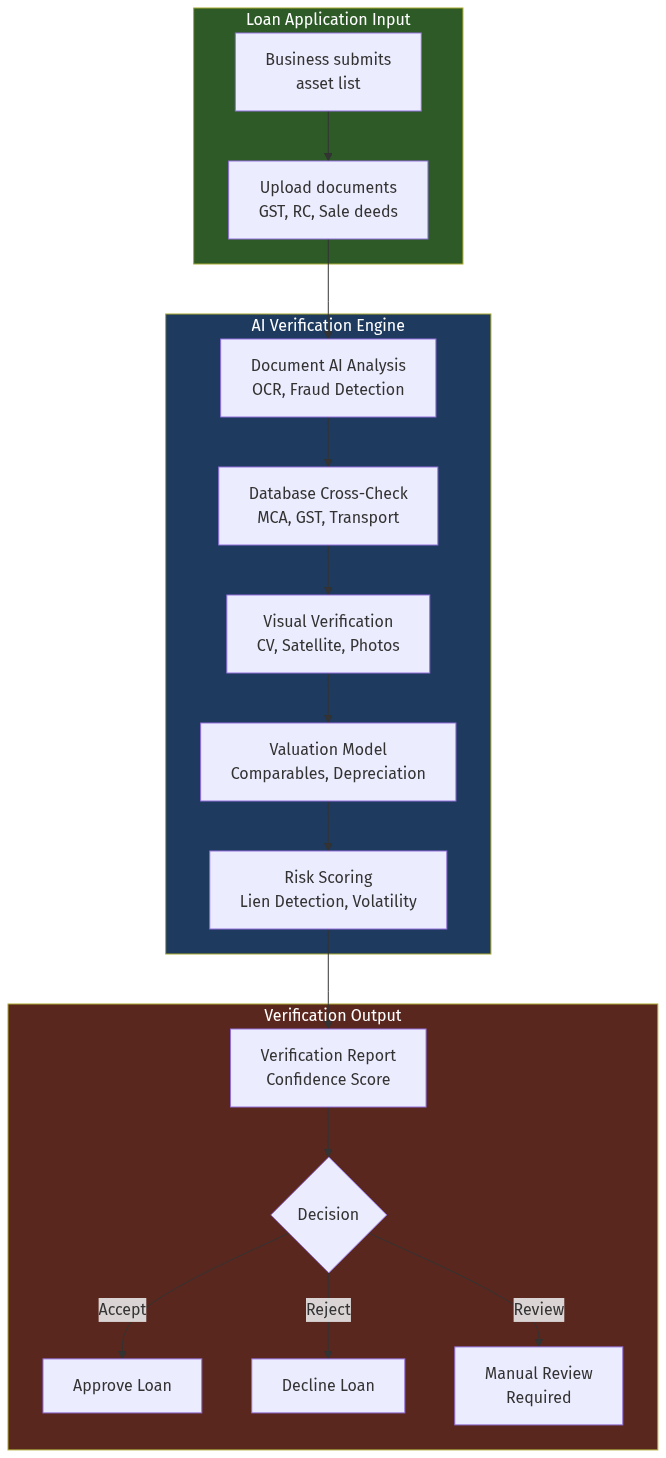
    An AI agent for collateral verification would work as follows:

    ┌─────────────────────────────────────────────────────────────┐
    │                    ASSET VERIFICATION AGENT                  │
    ├─────────────────────────────────────────────────────────────┤
    │  INPUT: Loan application + asset list                       │
    │                                                             │
    │  STEP 1: Document Collection (API + User Upload)          │
    │    → GST returns, bank statements, RC books, sale deeds    │
    │                                                             │
    │  STEP 2: Document AI Analysis                               │
    │    → OCR, fraud detection, date extraction, entity matching │
    │                                                             │
    │  STEP 3: Database Cross-Reference                          │
    │    → MCA, GST, Transport dept, Property registration       │
    │                                                             │
    │  STEP 4: Visual Verification (CV + Satellite)               │
    │    → Site photos, machinery counts, property boundaries     │
    │                                                             │
    │  STEP 5: Valuation Engine                                   │
    │    → Comparable sales, depreciation, market indices          │
    │                                                             │
    │  STEP 6: Risk Scoring                                       │
    │    → Fraud probability, lien detection, value volatility    │
    │                                                             │
    │  OUTPUT: Verification report + Confidence score             │
    │    → Accept / Reject / Further Review                       │
    └─────────────────────────────────────────────────────────────┘
    Asset Verification Flow
    Asset Verification Flow

    Key AI Capabilities

    CapabilityTechnologyAccuracy Target
    Document Fraud DetectionDocument AI + LLM98%
    Property Boundary ExtractionComputer Vision + GIS95%
    Machinery IdentificationObject Detection + Serial Analysis90%
    Valuation ModelingRegression + Market Data±10% of manual
    Lien DetectionDatabase Aggregation99%
    Verification Report GenerationLLMHuman-quality

    How Agents Transform the Workflow

    Before (Manual):
  • Applicant submits physical documents (7 days)
  • Branch visits site, takes photos (3 days)
  • Documents sent to central verification team (5 days)
  • Legal opinion on property (7 days)
  • Valuation report (5 days)
  • Credit committee review (3 days)
  • Total: 30-45 days
  • After (AI Agent):
  • Applicant uploads documents digitally (1 day)
  • AI verifies documents, cross-references databases (2 hours)
  • Remote site verification via video/photos (4 hours)
  • Automated valuation + risk score (1 hour)
  • Credit decision (real-time)
  • Total: 2-5 days

  • 7.

    Product Concept

    Product: MSME AssetVerify

    Core Features:
  • Asset Registry
  • - Businesses register machinery, property, vehicles, inventory - Digital asset cards with photos, documents, valuation history - Unique asset IDs linked to GST/MCA
  • Verification Engine
  • - AI document analysis (sale deeds, RC books, invoices) - Government database integration (MCA, GST, transport, property) - Real-time lien and encumbrance checks
  • Valuation Service
  • - AI-powered valuation for property, machinery, vehicles - Market comparables, depreciation models - Dispute resolution with human review option
  • Continuous Monitoring
  • - Periodic re-verification alerts - Pledge status changes - Asset value fluctuations - Risk alerts for deterioration
  • Verification Marketplace
  • - Certified verifier network (CA, engineers, lawyers) - On-demand physical verification - Video-based site visits

    Revenue Model

    Revenue StreamDescriptionPotential
    Per-Verification Fee₹5,000-25,000 per asset$500M market
    SubscriptionMonthly monitoring, ₹2,000-10,000/mo$200M ARR
    Valuation FeesAI + human hybrid, ₹3,000-15,000$300M market
    Data LicensingAsset data to banks, insurers$100M ARR
    Loan FacilitationReferral fees from lenders$200M

    Target Customers

    • Primary: Banks, NBFCs, and fintech lenders
    • Secondary: MSME businesses (for self-verification)
    • Tertiary: Insurance companies, lease companies

    8.

    Development Plan

    Phase 1: MVP (8-12 weeks)

    • Document upload + AI analysis for property
    • MCA/GST database integration
    • Basic valuation model for commercial property
    • Verification report generation

    Phase 2: V1.0 (16-24 weeks)

    • Machinery verification with CV
    • Vehicle RC verification
    • Lien detection across multiple lenders
    • Bank API integration

    Phase 3: V2.0 (24-36 weeks)

    • Continuous monitoring with periodic re-verification
    • Inventory and receivables verification
    • IoT integration for asset tracking
    • Full verification marketplace

    Phase 4: Scale (Ongoing)

    • Government partnerships
    • Asset registry on blockchain
    • International expansion (SE Asia, Africa)

    9.

    Go-To-Market Strategy

    Channel 1: Bank Partnerships

    • Approach PSU banks (SBI, BOB, PNB) struggling with MSME verification
    • Offer verification as a service, pay-per-verification model
    • Pilot with 2-3 banks, expand based on default reduction data

    Channel 2: NBFC Alliances

    • Target mid-sized NBFCs with high MSME exposure
    • Provide verification for loan originations
    • Share verification costs, benefit from lower NPAs

    Channel 3: Fintech Integration

    • Embed verification into lending platforms
    • API-first product for seamless integration
    • Co-build with 2-3 digital lenders

    Channel 4: MSME Direct

    • Market to businesses needing self-verification for loan applications
    • Self-serve portal with basic verification (₹999-2,999)
    • Upsell to premium verification for major loans

    GTM Timeline

    MonthFocusTarget Customers
    1-3Pilot2-3 NBFCs
    4-6Scale10+ lenders
    7-12ProductDirect MSME
    13+NetworkFull ecosystem
    ---
    10.

    Data Moat Potential

    What Data Accumulates

  • Asset Registry Database
  • - First-mover advantage in MSME asset data - Increases with every verification
  • Valuation Models
  • - Proprietary algorithms improve with more data - Historical valuations for pattern recognition
  • Fraud Detection Patterns
  • - Document fraud fingerprints - Network of related defaulters
  • Verification History
  • - Audit trail of all verifications - Evidence for dispute resolution

    Defensibility

    • Network effects: More verifications → better models → more customers
    • Integration depth: Embeds into lender workflows
    • Regulatory moat: Government partnerships, data licensing
    • Switching costs: Verification history builds over time

    11.

    Why This Fits AIM Ecosystem

    This opportunity aligns with the AIM.in vision:

  • Vertical integration — Asset verification becomes a key data layer for MSME intelligence
  • Marketplace foundation — Asset data enables equipment buy/sell, lease matching
  • Agent workflow — Fits the AI agent orchestration pattern (document → verify → score → act)
  • India-first — Deeply localized to Indian MSME context
  • Network effects — Builds proprietary data that compounds over time
  • Potential integrations:
    • MSME credit scoring agents
    • Equipment buyback marketplace
    • Lease management agents
    • Insurance underwriting agents

    ## Verdict

    Opportunity Score: 8.5/10

    Why High Score

    • Massive market gap ($500B credit need)
    • Clear pain point (verification costs/time)
    • AI-native solution (document AI, CV, database integration)
    • Compounding data moat
    • Multiple revenue streams
    • Regulatory tailwinds

    Risks to Monitor

    • Bank adoption pace (bureaucracy)
    • Data privacy regulations
    • Competition from government (Jan Dhan, credit linked)
    • Fraud sophistication evolution

    Why We Might Be Wrong

    • Banks may build in-house capability
    • Government may create free asset registry
    • Alternative credit (cash flow-based) may reduce collateral need
    • Verification may become commoditized

    What Would Change the Score

    • Increase to 9: Major bank partnership signed
    • Decrease to 7: Government launches free verification service

    ## Sources

    ---