ResearchTuesday, March 17, 2026

AI-Powered B2B Commercial Kitchen Equipment Marketplace: Unlocking India's HoReCa Procurement Revolution

India's HoReCa (Hotels, Restaurants, Catering) sector is a $110+ billion market fragmented across thousands of equipment suppliers, local dealers, and importers. No dominant platform exists for commercial kitchen equipment procurement. This creates a massive opportunity for an AI-agent-powered B2B marketplace that can unify fragmented suppliers, automate reordering, and guarantee quality.

1.

Executive Summary

India's commercial kitchen equipment market is highly fragmented, with suppliers scattered across local markets, WhatsApp groups, and trade fairs. Restaurant owners, hoteliers, and cloud kitchen operators struggle with:

  • No price transparency — Every dealer quotes differently
  • Quality uncertainty — No standardized quality ratings
  • Supply chain opacity — Unknown lead times, fake spares
  • Manual procurement — Phone calls, WhatsApp messages, physical market visits
An AI-powered B2B marketplace can solve this by creating a unified catalog with verified suppliers, AI-driven price comparisons, quality scores, predictive reordering, and automated procurement workflows. The addressable market exceeds $15 billion in equipment transactions annually, with significant repeat purchase potential from consumables, spare parts, and maintenance services.
2.

Problem Statement

The Daily Pain of HoReCa Procurement

A restaurant owner in Bangalore wants to buy 5 commercial gas stoves, 2 walk-in freezer units, and kitchen ventilation system. Today:

  • Search Phase — Calls 5-7 local dealers, asks for quotes on WhatsApp, visits local market (KT Layout, Chickpet)
  • Comparison Phase — Receives 5 different quotes with varying specifications, quality levels, and warranty terms
  • Verification Phase — No way to verify dealer credibility except through personal network
  • Procurement Phase — Negotiates manually, places order, pays advance
  • Delivery Phase — Waits 2-4 weeks for import items, coordinates delivery
  • After-sales Phase — Hopes warranty claims are honored
  • This process repeats for every equipment purchase, every renovation, every expansion.

    Who Experiences This Pain?

    • Cloud kitchen operators — Rapid scaling, frequent equipment needs, tight margins
    • Hotel chains — Multi-location procurement complexity
    • Hospital canteens — Hygiene compliance equipment
    • Hostels & PGs — Bulk cooking equipment
    • Catering companies — Event-based equipment needs
    • Food court operators — Standardized equipment across outlets

    3.

    Current Solutions

    CompanyWhat They DoWhy They're Not Solving It
    ZuperCloud kitchen management softwareFocuses on operations, not equipment procurement
    CookdCommercial kitchen designOne-off projects, not recurring procurement
    RestaurantDepot (US)B2B restaurant suppliesNot in India, no local presence
    IndiaMartGeneral B2B marketplaceKitchen equipment buried among 50k+ categories, no quality verification
    Local dealersDirect supplyFragmented, no standardization, limited reach

    Why Existing Solutions Fail

  • IndiaMart is too broad — Kitchen equipment is a needle in haystack; no category expertise
  • No quality assurance — Anyone can list; no verification process
  • No structured after-sales — Warranty claims are manual
  • No AI capabilities — Can't predict needs, can't auto-reorder
  • No financing — Large equipment purchases require credit

  • 4.

    Market Opportunity

    Market Size

    SegmentEstimated Size (India)
    Commercial kitchen equipment (new)$8-10B annually
    Spare parts & consumables$4-5B annually
    Maintenance & repair services$2-3B annually
    Used equipment marketplace$1-2B annually
    Total Addressable Market$15-20B

    Growth Drivers

    • Cloud kitchen boom — 3,000+ cloud kitchens launched monthly in major cities
    • Restaurant expansion — QSR chains expanding aggressively (Domino's, Burger King, Subway)
    • Hotel construction — 200+ new hotels/year in tier-1 cities
    • Food park development — Government food parks creating bulk demand
    • Professionalization — First-generation restaurant owners demanding better tools

    Why Now

  • Digital adoption spike — WhatsApp Business proliferation normalized B2B digital transactions
  • Trust infrastructure — UPI, escrow payments reduce transaction risk
  • Logistics maturity — Delhivery, Ecom Express enable pan-India delivery
  • AI maturity — LLMs can power procurement agents, chatbots, quality scoring
  • Post-COVID modernization — HoReCa owners prioritizing standardized equipment

  • 5.

    Gaps in the Market

    Gap 1: No Unified Catalog

    Every dealer maintains their own product list. No single source of truth for specifications, prices, availability. A "Bajaj 50L mixer" has 10 different SKUs across dealers with no standardization.

    Gap 2: Quality Opacity

    No objective quality ratings for equipment. Buyers rely on brand reputation or personal experience. Counterfeit/spurious parts are common in certain categories.

    Gap 3: Price Arbitrage

    Same equipment can vary 30-50% between dealers. No tools to compare real prices after accounting for shipping, installation, warranty.

    Gap 4: No Predictive Reordering

    Restaurants run out of consumables (gas, oil, spare parts) and face downtime. No system predicts consumption and auto-reorders.

    Gap 5: Financing Gap

    Equipment costs range from ₹50,000 to ₹50 lakhs. No B2B financing platform specifically for kitchen equipment with flexible EMI options.

    Gap 6: Installation & Service

    After-sales installation, maintenance, repairs are handled by third-party technicians with no standardization. No unified service marketplace.

    Gap 7: Used Equipment Liquidity

    No marketplace for selling used kitchen equipment when restaurants close or upgrade. Huge idle inventory value lost.
    6.

    AI Disruption Angle

    AI Agent Procurement

    The future: Restaurant owner tells AI agent "I need to set up a 500sqft cloud kitchen for biryani, budget 10 lakhs, opening in 30 days."

    AI agent:

  • Generates equipment list based on kitchen size, cuisine type, throughput
  • Queries supplier catalog for each item
  • Compares prices, lead times, warranty, reviews
  • Presents curated options with AI recommendations
  • Handles negotiation, purchase order, payment
  • Tracks delivery, coordinates installation
  • Sets up predictive reordering for consumables
  • Specific AI Applications

    FunctionAI Capability
    Product discoverySemantic search across unstructured supplier catalogs
    Price intelligenceReal-time price monitoring, arbitrage detection
    Quality scoringReview analysis, complaint pattern detection
    Demand forecastingPredict consumable consumption based on order volume
    Chat procurementNatural language ordering via WhatsApp
    Fraud detectionCounterfeit identification from supplier patterns
    Credit assessmentAlternative data scoring for dealer financing
    ---
    7.

    Product Concept

    Name: Kitchen365

    Tagline: India's Commercial Kitchen Procurement Platform

    Key Features

  • Unified Catalog
  • - Curated product database with standardized specifications - Multiple supplier listings per product - Real-time availability and pricing
  • AI Procurement Agent
  • - WhatsApp-native ordering - Natural language queries ("show me under-counter refrigerators under 40k") - Purchase recommendation engine
  • Verified Supplier Network
  • - Background verification of dealers - Quality score based on reviews, complaints, delivery performance - Gold/Silver/Bronze supplier tiers
  • Quality Assurance
  • - Post-delivery inspection integration - Warranty claim tracking - Genuine product verification
  • Finance Integration
  • - EMI calculator - Dealer financing partnerships - Credit for repeat buyers
  • Predictive Reordering
  • - Consumption tracking - Auto-reorder triggers - Stock alerts
  • Service Marketplace
  • - Installation technicians - Maintenance contracts - Repair services

    Target Users

    • Primary: Restaurant owners, cloud kitchen operators, hotel managers
    • Secondary: Hostels, hospitals, corporate canteens, catering companies
    • Tertiary: Equipment dealers, manufacturers (supply side)
    8.

    Development Plan

    PhaseTimelineDeliverables
    Phase 0: Validation4 weeksManual curation of top 50 products, 10 suppliers, WhatsApp ordering pilot
    MVP8 weeksCatalog + supplier profiles + basic search + WhatsApp ordering
    V112 weeksAI agent + quality scores + reviews + price alerts
    V216 weeksFinance integration + predictive reordering + service marketplace
    ScaleOngoingPan-India expansion, manufacturer direct integrations

    MVP Features

  • Product catalog with 500+ SKUs across 20 categories
  • 50+ verified supplier profiles
  • WhatsApp-based inquiry and quote system
  • Basic search and filter
  • Order tracking
  • V1 Features

  • AI chatbot for product discovery
  • Dynamic pricing from multiple suppliers
  • Review and rating system
  • Post-purchase support tickets
  • Comparative analysis tool

  • 9.

    Go-To-Market Strategy

    1. Supplier Acquisition (First 30 days)

    • Target top dealers in Delhi (Azad Market), Mumbai (Kalbadevi), Bangalore (KT Layout)
    • Offer free listing + guaranteed payments via escrow
    • Invite 50 suppliers onboard with zero listing fee

    2. Buyer Acquisition (Months 1-3)

    • Partner with cloud kitchen operators — Approach Zomato, Swiggy cloud kitchen partners
    • Restaurant associations — FHRAI, state restaurant associations
    • Trade shows — Attend Food & Hotel India, IHIC
    • WhatsApp groups — Join existing HoReCa WhatsApp groups, offer value first

    3. Trust Building (Months 2-6)

    • Escrow payments (hold funds until delivery confirmed)
    • Genuine product guarantee
    • Easy returns policy for first-time buyers
    • Video testimonials from early adopters

    4. Scale (Months 6-12)

    • Manufacturer direct partnerships (Bajaj, Vulcan, Lincoln)
    • Tier-2 city expansion
    • Mobile app launch
    • B2B financing partnership

    10.

    Revenue Model

    Revenue StreamDescriptionPotential
    Commission8-15% on supplier transactionsHigh (primary)
    Listing FeesPremium placement for suppliersMedium
    Premium CatalogEnhanced product pages, manufacturer co-brandingMedium
    Finance ReferralRevenue share from financing partnersMedium
    Data/IntelligenceMarket insights reports for suppliersLow (future)
    Service Marketplace10% on installation/repair referralsLow (future)

    Unit Economics

    • Average order value: ₹2-5 lakhs
    • Commission (10%): ₹20,000-50,000 per transaction
    • Customer acquisition cost: ₹3,000-5,000
    • Customer lifetime value: ₹2-4 lakhs (repeat purchases + referrals)

    11.

    Data Moat Potential

    Proprietary Data Accumulation

  • Pricing intelligence — Real-time prices across suppliers creates unmatched price database
  • Quality metrics — Aggregated reviews, complaint patterns, warranty claims
  • Consumption patterns — Predictable reordering cycles for consumables
  • Supplier behavior — Delivery times, negotiation patterns, reliability scores
  • Buyer preferences — Cuisine-specific equipment needs, budget patterns
  • Competitive Moat

    • Network effects: More buyers attract more suppliers, better prices attract more buyers
    • Data moat: Aggregated intelligence becomes difficult to replicate
    • Trust moat: Verified supplier network takes years to build

    12.

    Why This Fits AIM Ecosystem

    Vertical Alignment

    Kitchen365 aligns with AIM.in's mission to structure India's B2B discovery:

  • Domain expertise — Deep vertical focus on HoReCa, not general marketplace
  • Agent integration — AI procurement agent fits AIM's agent orchestration vision
  • WhatsApp-native — Leverages India's dominant B2B communication channel
  • Repeat usage — Consumables and reordering creates stickiness
  • Geographic expansion — Can start in 5 cities, scale pan-India
  • Cross-Sell Opportunities

    • Connect with AIM's restaurant discovery (dine-out)
    • Integrate with POS systems (billing)
    • Food supply marketplace (ingredients)
    • Staffing platform (kitchen staff)

    Revenue Potential

    At 5% market capture (₹1,000 Cr annual GMV):

    • Commission revenue: ₹100 Crores/year
    • With AI agent premium: +30% take rate
    • Potential: ₹130 Crores/year by Year 5
    ---

    13.

    Falsification Analysis

    Pre-Mortem: Why Might This Fail?

    Scenario: Well-funded startup enters this space and fails.
  • Supplier resistance — Dealers don't want price transparency, fear disintermediation
  • Chicken-and-egg — Can't attract buyers without suppliers, can't attract suppliers without buyers
  • Quality chaos — Counterfeit products destroy trust before it's established
  • Low margins — B2B hardware is thin-margin, can't sustain high customer acquisition
  • Capital intensity — Working capital for escrow payments drains cash
  • Competition — IndiaMart/Amazon Business pivots to vertical
  • Mitigations

    RiskMitigation
    Supplier resistanceStart with struggling dealers seeking new channels
    Chicken-and-eggSeed with 50 suppliers, focus on 100 buyers in one city
    Quality chaosAggressive verification, immediate delisting of bad actors
    Low marginsFocus on high-margin categories initially (imported equipment)
    Capital intensityEscrow lite model, don't hold funds
    CompetitionDeep verticalization, AI agent is differentiator
    ---
    14.

    Steelmanning: Why Incumbents Might Win

    Strong Counter-arguments

  • IndiaMart network effects — Already has supplier relationships, traffic, trust
  • Amazon Business scale — Logistics infrastructure, Prime-like speed
  • Zomato/Swiggy vertical integration — Can bundle equipment with food supplies
  • Capital advantage — Can run losses longer, wait for market to mature
  • Government relationships — Can win large hospital/hostel tenders
  • Why We Can Still Win

    • Focus — IndiaMart is generalist; we are HoReCa specialists
    • AI-first — Existing players can't easily replicate AI agent layer
    • Trust — Verification and quality scoring is their weakness
    • Speed — Startup agility vs. corporate bureaucracy

    15.

    Anomaly: What's Strange About This Market

    Observations That Don't Fit

  • $15B market, zero leader — How does such a large vertical have no dominant platform?
  • WhatsApp dominates, yet no platform — B2B transactions happen on WhatsApp but no procurement tool emerged
  • Cloud kitchens boom, equipment pain — Rapid growth segment has acute procurement problems
  • No vertical SaaS for kitchen ops — POS, delivery apps exist but equipment procurement ignored
  • Dealers love WhatsApp, hate transparency — Structural incentive against platformization
  • These anomalies suggest structural barriers (trust, verification complexity) but also massive opportunity for someone who solves them.


    ## Verdict

    Opportunity Score: 8.5/10

    This is one of the highest-potential B2B vertical marketplaces in India. The HoReCa sector is large, growing, and experiencing acute procurement pain. No dominant player exists despite the market size. AI agents can differentiate from legacy marketplaces and create sticky, recurring revenue.

    Key Strengths:
    • Massive TAM (₹15-20B)
    • Clear problem-solution fit
    • Repeat purchase potential (consumables, reordering)
    • WhatsApp-native distribution
    • AI differentiation viable
    Key Risks:
    • Supplier onboarding friction
    • Quality trust establishment
    • Capital for escrow/financing
    Recommendation: Build Kitchen365 as dedicated vertical under AIM. Start with 5 cities, 500 products, 100 suppliers. Prove unit economics before scaling.

    ## Sources


    ## Diagrams

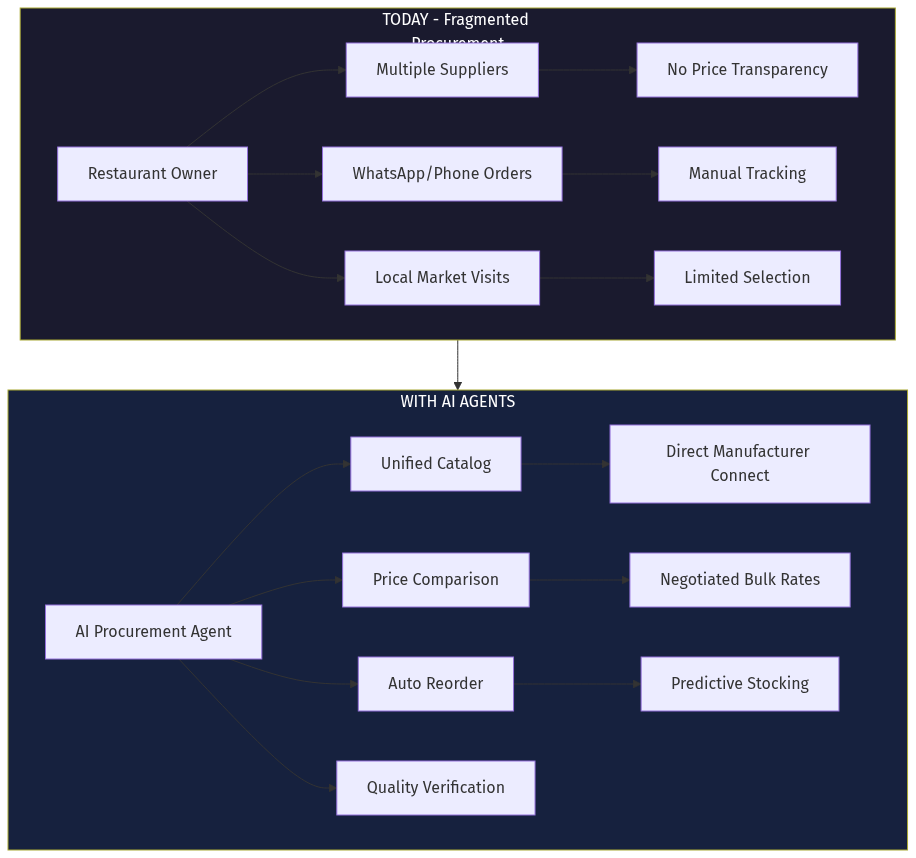
    Current vs Future Procurement Flow

    Procurement Flow
    Procurement Flow

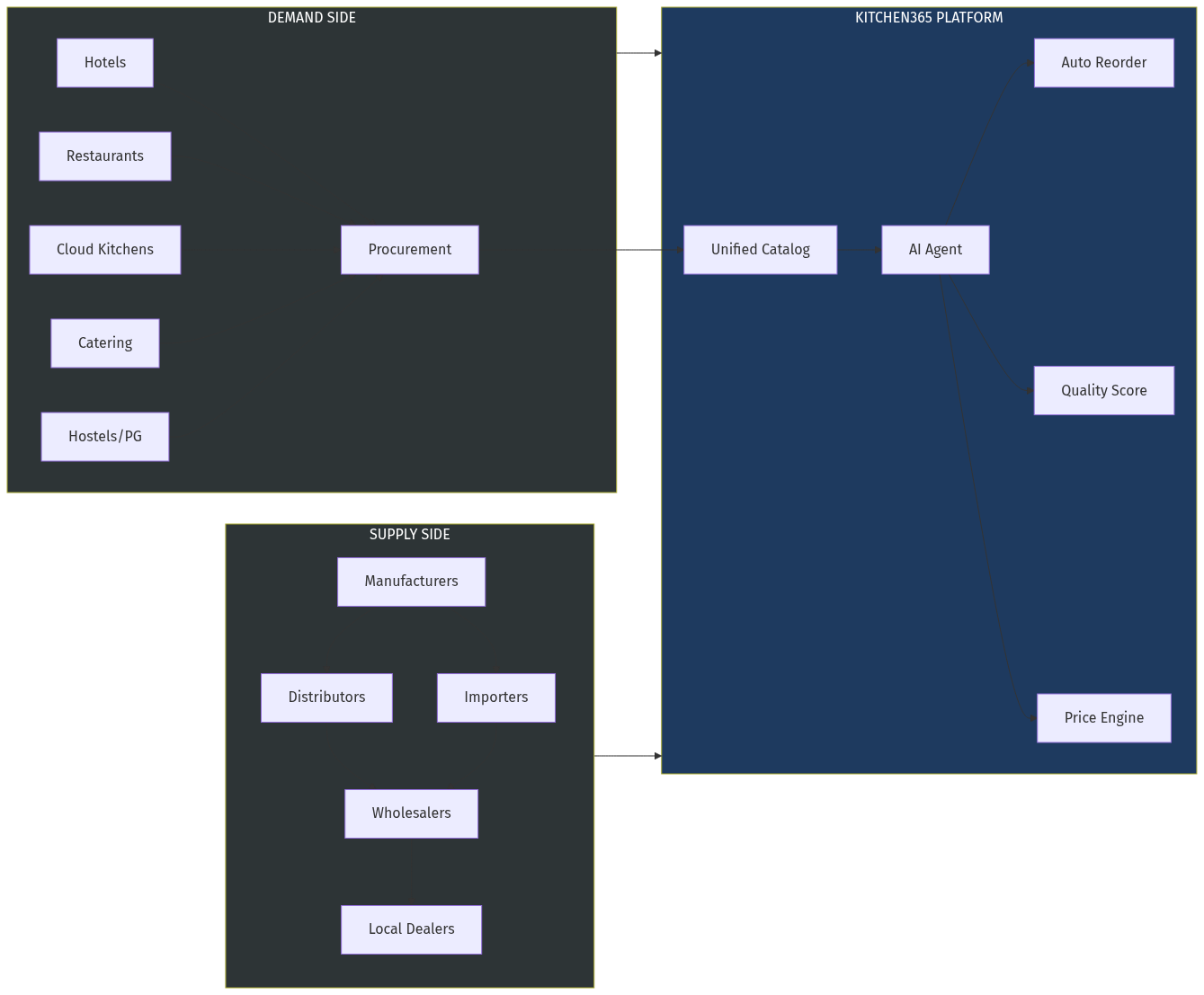
    Platform Ecosystem Architecture

    Ecosystem Architecture
    Ecosystem Architecture