ResearchTuesday, March 17, 2026

AI-Powered B2B Laboratory Equipment & Consumables Marketplace

A deep-dive into how AI agents can transform the $12B global lab supplies market by automating procurement, ensuring quality compliance, and enabling smart reordering for pathology labs, research facilities, and industrial testing centers.

8
Opportunity
Score out of 10
1.

Executive Summary

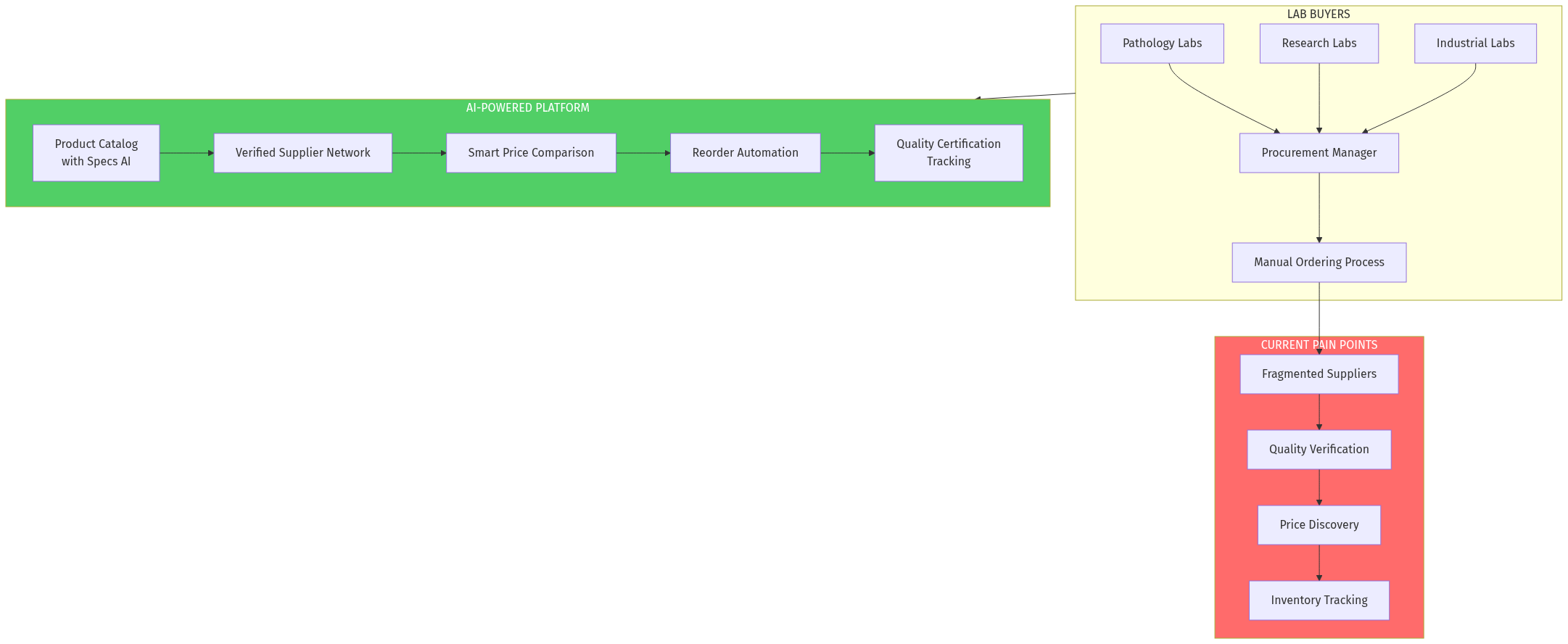
The laboratory equipment and consumables market is highly fragmented, with thousands of suppliers selling products with complex specifications. Pathology labs, research institutions, and industrial testing facilities face significant challenges in procurement: verifying supplier authenticity, comparing prices across distributors, tracking quality certifications, and managing inventory for thousands of SKUs.

This article proposes an AI-powered B2B marketplace that addresses these pain points through product intelligence (AI parsing of technical specifications), verified supplier networks, automated reordering based on consumption patterns, and quality compliance tracking.

Opportunity Score: 8/10
2.

Problem Statement

Who Experiences This Pain?

Buyer TypePain Points
Pathology LabsConstant need for reagents, slides, syringes, gloves; supplier reliability is critical for accurate results
Research LabsSpecialized equipment with complex specs; long procurement cycles delay experiments
Industrial Labs (QA/QC)High-volume consumables; cost optimization critical
Hospital LabsMultiple departments with different needs; inventory management overhead
Educational LabsBudget constraints; need reliable low-cost suppliers

The Core Problems

  • Supplier Fragmentation — Hundreds of distributors, each carrying different brands and products
  • Specification Complexity — Products like reagents have grades (HPLC, ACS, LR), purity levels, storage requirements
  • Quality Verification — Counterfeit or substandard products can invalidate research or affect patient diagnoses
  • Price Opacity — Same product available at 30-50% price variance across suppliers
  • Inventory Chaos — Thousands of SKUs, no system to track consumption and trigger reorders
  • Compliance Burden — Products need certifications (ISO, FDA, CE); tracking expiry dates is manual

  • 3.

    Current Solutions

    CompanyWhat They DoWhy They're Not Solving It
    Lab depotOnline catalog of lab suppliesUS-focused, no AI features, limited supplier verification
    VWR (Avantor)Global lab supplies distributorEnterprise pricing, no SMB focus, no smart reordering
    Fisher ScientificLarge scientific equipment supplierPremium pricing, complex ordering UX
    India-based local distributorsRegional supplyNo online presence, manual ordering, limited catalog
    [Amazon BusinessGeneral B2B suppliesLab-specific category weak, no quality verification

    Gaps Identified

    • No AI-powered specification matching — Buyers can't find "equivalent alternatives" to out-of-stock products
    • No consumption-based auto-reorder — Labs manually track inventory
    • No quality certification tracking — Compliance is manual spreadsheet work
    • No marketplace for Indian SMB labs — Global players ignore this segment
    • No WhatsApp-based ordering — Preferred by Indian lab managers

    4.

    Market Opportunity

    Global Lab Supplies Market

    SegmentMarket SizeNotes
    Lab Equipment$45BInstrumentation, analyzers
    Lab Consumables$28BReagents, plasticware, glassware
    Total Addressable$73BEquipment + Consumables
    Serviceable (India)$3-4BDomestic market

    India-Specific Market

    • Pathology Labs: 100,000+ (including small clinics with labs)
    • Research Institutions: 1,500+ universities with labs
    • Industrial QA/QC: 50,000+ manufacturing units
    • Hospital Labs: 25,000+ hospitals with diagnostic facilities

    Why Now?

  • Digital Transformation — Lab management software adoption increasing
  • Quality Focus — NABL accreditation requirements driving standardization
  • Cost Pressure — Healthcare costs under scrutiny, procurement optimization needed
  • AI Maturity — LLMs can now parse complex chemical/technical specifications
  • WhatsApp Penetration — Indian buyers comfortable with chat-based transactions

  • 5.

    Gaps in the Market

    Gap 1: No "Chemical Equivalent" Search

    When a specific reagent is unavailable, buyers manually research alternatives. AI can match products by:
    • Purity grade
    • Chemical composition
    • Application compatibility
    • Storage requirements

    Gap 2: No Quality Trust Score

    Buyers rely on reputation or trial-and-error. A platform with:
    • Supplier verification (ISO, GMP certifications)
    • Buyer reviews with verification badges
    • Quality incident tracking
    would reduce risk significantly.

    Gap 3: No Smart Inventory Management

    Lab consumables follow predictable consumption patterns. AI can:
    • Monitor usage via integrated lab systems
    • Predict reorder dates
    • Suggest bulk orders for savings

    Gap 4: No SMB-Focused Pricing

    Large distributors target enterprise. Small pathology labs pay premium. A marketplace with:
    • Group purchasing for small labs
    • Competitive bidding from multiple suppliers
    • Transparent volume discounts

    Gap 5: No Integrated Compliance

    Products have:
    • Expiry dates (critical for reagents)
    • Storage conditions (refrigerated, frozen, ambient)
    • Safety data sheets (SDS)
    • Certification requirements
    Manual tracking is error-prone. AI can automate compliance.
    6.

    AI Disruption Angle

    How AI Agents Transform the Workflow

    CURRENT STATE                          FUTURE STATE (WITH AI)
    ─────────────────                      ────────────────────────
    Buyer searches 50 products             AI understands intent:
    manually across suppliers              "Need替代品 for HPLC grade 
                                         acetonitrile, 500ml, lab-grade"
                                         
    Buyer compares prices manually         AI shows:
    across 10 catalogs                     - Price comparison across 20 suppliers
                                         - Alternative products
                                         - Quality score
                                         
    Buyer tracks inventory                 AI monitors usage pattern,
    manually in spreadsheets               auto-generates purchase orders
                                         
    Buyer verifies certifications          AI verifies supplier certifications,
    by emailing suppliers                  flags non-compliant products,
                                          tracks expiry dates

    Specific AI Applications

  • Specification Parsing — LLM extracts key specs from product descriptions, enabling semantic search
  • Supplier Risk Scoring — AI analyzes certifications, reviews, delivery history
  • Price Intelligence — Continuous monitoring of supplier pricing
  • Demand Forecasting — ML models predict consumption based on historical data
  • Chat-Based Ordering — WhatsApp/Telegram bot for quick reordering

  • 7.

    Product Concept

    Platform Features

    FeatureDescription
    Smart CatalogAI-structured product database with specification extraction
    Supplier MarketplaceVerified suppliers with quality scores
    Price ComparisonReal-time pricing across distributors
    Auto-ReorderAI-triggered orders based on consumption
    Compliance TrackerExpiry alerts, certification verification
    WhatsApp OrderingChat-based procurement for lab managers
    Bulk RFQRequest quotes for large orders
    Quality ReviewsVerified buyer reviews

    Target Buyers

  • Small Pathology Labs (primary) — 50-200 tests/day
  • Medium Pathology Chains — 500+ tests/day
  • Research Labs — Universities, R&D centers
  • Industrial QA/QC — Manufacturing quality teams
  • Hospital Labs — Multi-department procurement
  • Target Suppliers

  • Authorized distributors — Brand-certified
  • Regional wholesalers — Local supply
  • Importers — International brands
  • Manufacturers — Direct sales

  • 8.

    Development Plan

    PhaseTimelineDeliverables
    MVP8 weeksProduct catalog (5,000 SKUs), supplier profiles, basic search, WhatsApp ordering
    V112 weeksAI specification matching, price comparison, supplier verification
    V216 weeksAuto-reorder, compliance tracking, analytics dashboard
    V320 weeksBulk RFQ, group purchasing, credit/EMI

    Technical Stack

    • Frontend: Next.js (React)
    • Backend: Node.js / Python
    • Database: PostgreSQL (product data), MongoDB (flexible specs)
    • AI: LLMs for specification parsing, ML for demand forecasting
    • Integrations: WhatsApp Business API, payment gateways

    9.

    Go-To-Market Strategy

    Phase 1: Seed Supply (Weeks 1-4)

  • Recruit 20-30 local lab supply distributors in 2-3 cities
  • Onboard with inventory sync (manual or API)
  • Offer zero-commission for first 6 months
  • Phase 2: Seed Demand (Weeks 5-8)

  • Target 50 small pathology labs via:
  • - Lab equipment exhibitions - Pathology association memberships - WhatsApp groups (lab manager communities)
  • Offer: 10% discount for first order
  • Collect feedback, iterate product
  • Phase 3: Network Effects (Weeks 9-16)

  • More suppliers join (FOMO)
  • More buyers join (selection advantage)
  • Introduce AI features incrementally
  • Phase 4: Scale (Months 5+)

  • Expand to other cities
  • Add categories (equipment, instruments)
  • Introduce premium subscriptions (analytics, auto-reorder)

  • 10.

    Revenue Model

    StreamDescriptionPotential
    Commission5-12% on transactions40% of revenue
    SubscriptionPremium features (analytics, auto-reorder)30% of revenue
    Listing FeesFeatured supplier listings15% of revenue
    Data ServicesMarket intelligence reports10% of revenue
    AdsSupplier promotions5% of revenue

    Unit Economics

    • Average Order Value: ₹50,000-2,00,000
    • Commission: 8% = ₹4,000-16,000 per order
    • Repeat Frequency: Monthly (consumables)
    • Customer LTV: ₹2-5 lakhs (per lab, per year)

    11.

    Data Moat Potential

    Proprietary Data Accumulation

  • Product Database
  • - Specifications, alternatives, compatibility matrix - Hard to replicate; becomes more valuable over time
  • Supplier Performance Data
  • - Delivery times, quality incidents, pricing consistency - Unique insight for buyers
  • Consumption Patterns
  • - Per-lab usage data enables AI predictions - Highly valuable for suppliers
  • Price Intelligence
  • - Historical pricing across suppliers - Enables competitive benchmarking

    Moat Strength: HIGH

    • Network effects (more buyers → more suppliers → more buyers)
    • Data moat (consumption data is hard to replicate)
    • Integration lock-in (auto-reorder systems)

    12.

    Why This Fits AIM Ecosystem

    Vertical Alignment

    AIM PrincipleLab Marketplace Fit
    Underserved verticalLab supplies are fragmented, no dominant player in India
    Repeat purchaseConsumables are recurring (monthly orders)
    Fragmented suppliersThousands of local distributors
    High trustQuality matters → platform trust valuable
    AI-revivableSpecification parsing, auto-reorder, compliance tracking

    Synergies

    • AIM.in — Could integrate as "Lab Supplies" category
    • Domain portfolio — Could acquire labsupply.in, pathology.in, etc.
    • WhatsApp integration — Native to Indian market

    13.

    Mental Models Analysis

    Zeroth Principles

    • Assumption: Labs buy based on brand name.
    • Reality: Labs often don't know alternatives exist. Price and availability drive decisions.
    • Implication: AI-powered alternative matching creates real value.

    Incentive Mapping

    • Suppliers want: predictable demand, consistent margins
    • Buyers want: reliable quality, competitive prices
    • Current system: Suppliers compete on relationships, not efficiency
    • Platform incentive: Optimize matching, reduce friction, take commission

    Falsification (Pre-Mortem)

    Why might 5 well-funded startups fail here?
  • Quality failures — Counterfeit products ruin trust
  • Supplier resistance — Distributors don't want price transparency
  • Low margins — Commission too low to sustain operations
  • Integration complexity — Lab systems are heterogeneous
  • Long sales cycles — Enterprise sales too slow
  • Steelmanning (Why incumbents might win)

    • Avantor/VWR have established relationships
    • Fisher Scientific has logistics advantage
    • Local distributors have speed and relationships
    Counter: They're focused on enterprise. SMB segment is ignored.

    Anomaly Hunting

    • Why isn't there an Amazon for lab supplies in India?
    • Why do labs still order via phone/WhatsApp despite数字化?
    • Why do prices vary so much for identical products?
    Answer: No platform has solved the quality + logistics + AI problem together.

    ## Verdict

    Opportunity Score: 8/10

    Strengths

    • Clear pain point with measurable impact
    • High repeat purchase frequency
    • Significant data moat potential
    • Natural fit for AI (specification parsing, demand forecasting)
    • Untapped in India market

    Risks

    • Supplier onboarding is slow
    • Quality control is challenging
    • Competition from global players possible
    • Regulatory compliance complexity

    Recommendation

    Build MVP focused on one city (e.g., Bangalore or Delhi NCR), 1000 SKUs, 20 suppliers, 50 labs. Prove demand, then expand. The lab supplies market is large enough to support a dedicated vertical, and AI makes this possible where manual efforts failed.

    ## Sources

    ---

    ## Diagram

    Lab Marketplace Flow
    Lab Marketplace Flow
    Figure 1: Current procurement pain points vs AI-powered solution flow