ResearchTuesday, March 17, 2026

AI Agents for India's Local Service Economy: The $50B Opportunity Hidden in Plain Sight

India's 50 million+ local service providers (plumbers, electricians, AC repair, salons, home cleaners) remain largely undigitized. WhatsApp is the operating system. Phone calls are the database. An AI agent layer can transform this chaos into structure—without forcing providers to learn new software.

1.

Executive Summary

India's local service economy is a $50+ billion market operating on spreadsheets, WhatsApp messages, and phone calls. Unlike Western markets where Field Service Management (FSM) software exists, Indian providers resist traditional SaaS—they find it complex, expensive, and unnecessary.

The insight: Providers don't need another app. They need an AI agent that works through WhatsApp—the platform they already use.

This article explores how AI agents can automate lead qualification, booking, scheduling, and payment for local services—creating a new type of marketplace that doesn't require behavior change from providers.

2.

Problem Statement

Who experiences this pain?

  • Local service providers (plumbers, electricians, AC technicians, carpenters, salons, cleaners): Overwhelmed by phone calls, no systematic customer records, manual scheduling
  • Customers: Hard to find verified providers, inconsistent service quality, no easy way to book
  • Neither side wants a new app: Providers won't use it; customers won't download it

The core frictions

FrictionCurrent StateCost
Lead handling10+ phone calls to quote one jobTime wasted
SchedulingManual WhatsApp back-and-forthDouble-bookings
PaymentsCash or bank transferNo tracking
ReviewsWord of mouth onlyNo reputation system
Customer dataLost when phone is resetNo repeat business
---
3.

Current Solutions

CompanyWhat They DoWhy They're Not Solving It
Urban CompanyFull-stack home services marketplaceHigh fees (25-30%), provider churn, not for individual local providers
TaskRabbit (US)Task marketplaceNot in India, different market structure
FixCraftAppliance repairLimited to electronics, narrow focus
HousejoyHome servicesSimilar to Urban Company model

The gap

Current solutions are platform-controlled: They own the customer, take large commissions, and force providers into their ecosystem. No solution offers provider-owned AI agents that work within WhatsApp.


4.

Market Opportunity

Market Size

  • India local services market: ~$50-60 billion (2025)
  • Urban services segment: $12-15 billion (growing 15% CAGR)
  • Addressable via AI agents: $8-10 billion (services requiring booking)

Why now?

  • WhatsApp ubiquity: 500M+ Indian users, business API widely adopted
  • AI agent maturity: LLMs can handle natural conversation, qualification, and scheduling
  • Provider smartphone adoption: Even low-income providers have WhatsApp-enabled phones
  • Post-pandemic digitization: Consumers more comfortable with online service booking

  • 5.

    Gaps in the Market

    Where current players fail

  • No provider-first model: All platforms control the customer relationship
  • High commission structure: 25-30% takes make economics unattractive for providers
  • Forced app adoption: Providers must learn new software
  • Limited to metro cities: Tier 2/3 cities underserved
  • No CRM for providers: No systematic customer data ownership
  • No AI-first approach: Still relying on human dispatchers
  • What remains unstructured

    • Individual providers in tier 2/3 cities
    • Specialty services (antique restoration, traditional cooking)
    • B2B services (office cleaning, industrial maintenance)
    • Emergency services (24/7 plumber, electrician)

    6.

    AI Disruption Angle

    How AI agents transform the workflow

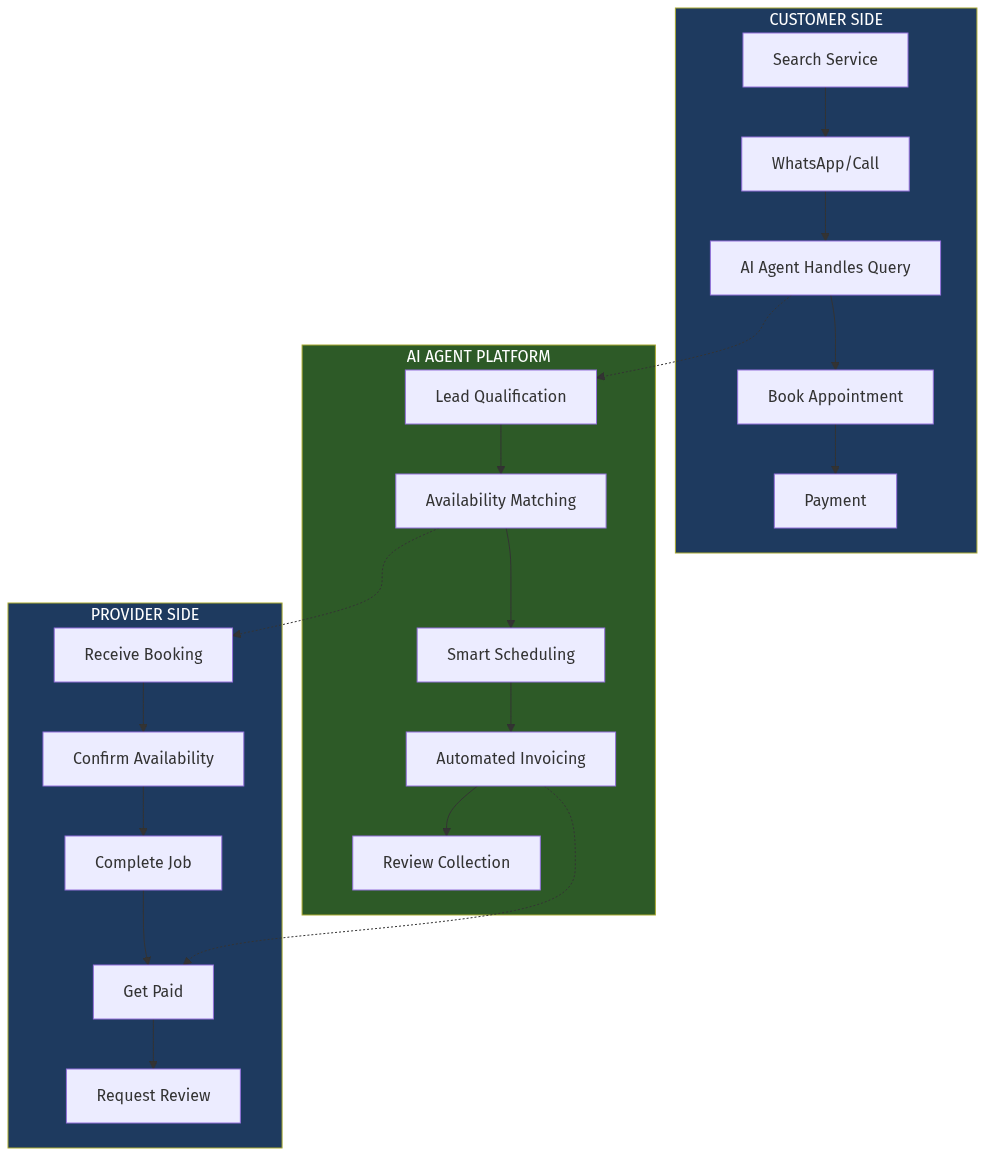
    Instead of building a new app, the AI agent lives in WhatsApp:

    Customer: "Need a plumber for kitchen leak"
    AI Agent: "Sure! Is it a minor drip or major leak?"
    
    Customer: "Major, water everywhere"
    
    AI Agent: "Understood. I have Raj Kumar (4.8★, 12 yrs exp) 
    available tomorrow 10AM-12PM or 2PM-4PM. 
    
    Which works for you?"
    
    Customer: "10AM works"
    
    AI Agent: "Confirmed! Invoice sent. Pay ₹300 now to secure booking.
    [Payment Link]"

    How the future looks when agents transact

  • Zero UI for providers: They receive WhatsApp messages, respond with thumbs up/down
  • 24/7 availability: AI handles night/weekend inquiries
  • Automatic matching: Provider's specialty + location + availability → perfect match
  • No dispatch needed: AI coordinates everything
  • Embedded payments: WhatsApp payments or UPI for instant settlement
  • AI Agent Workflow
    AI Agent Workflow

    7.

    Product Concept

    Core Features

    FeatureDescription
    WhatsApp-first AINo app download; works entirely in WhatsApp Business API
    Smart lead qualificationAI asks right questions, filters time-wasters
    Automated schedulingReal-time availability matching
    Provider CRMCustomer history, repeat booking, loyalty tracking
    Payment integrationUPI, WhatsApp Pay, invoice generation
    Review automationPost-job review request, rating aggregation

    Key workflows

  • Lead → Book: AI qualifies, schedules, collects advance
  • Job → Complete: Provider confirms, completes, uploads completion note
  • Complete → Review: AI sends review request, aggregates ratings
  • Review → Repeat: AI reminds providers to follow up for repeat business

  • 8.

    Development Plan

    PhaseTimelineDeliverables
    MVP8 weeksWhatsApp AI agent, basic scheduling, 3 service categories
    V116 weeksPayment integration, provider dashboard, analytics
    V224 weeksMulti-city launch, B2B services, API for providers

    MVP features

    • WhatsApp Business API integration
    • LLM-powered conversation handler
    • Basic availability calendar
    • Lead qualification flow
    • Booking confirmation

    9.

    Go-To-Market Strategy

    How to acquire first providers

  • Partner with local merchant associations (electricians union, plumbers guild)
  • Target specialty providers first (AC repair has highest ticket size)
  • Free pilot in one neighborhood: Demonstrate value before charging
  • WhatsApp-first onboarding: No app, just phone number verification
  • How to acquire customers

  • SEO for local intent: "plumber near me", "AC repair in [area]"
  • WhatsApp business listing: Claim local business presence
  • Referral program: Both providers and customers refer
  • Offline signage: QR codes in provider vehicles, shops
  • Flywheel

    More Providers → Faster Response → Better Reviews → 
    More Customers → More Providers → ...

    10.

    Revenue Model

    Revenue streams

    StreamDescriptionTake Rate
    Subscription (Providers)₹499-1999/month for AI agentFixed fee
    Transaction fee5-10% on booked jobsPer booking
    Premium listingsTop spot in searchesMonthly
    Lead generationPay per qualified leadPer lead
    B2B packagesOffice services, property managementEnterprise

    Unit economics

    • Customer acquisition cost: ₹100-200 (organic-first)
    • Provider LTV: ₹15,000-30,000/year (subscription + fees)
    • Gross margin: 60-70% (low operational cost)

    11.

    Data Moat Potential

    What proprietary data accumulates

  • Provider availability patterns: When each provider works
  • Pricing intelligence: Real rates by service + location
  • Customer preferences: Service history, price sensitivity
  • Quality metrics: Response time, completion rate, ratings
  • Location data: Serviceable areas, travel patterns
  • Network effects

    • More providers → better coverage → more customers
    • More data → better AI → higher conversion → more providers
    • Winner-takes-most: First to scale in a city has advantage

    12.

    Why This Fits AIM Ecosystem

    Vertical fit

    This opportunity aligns with AIM.in's vision:

    • B2B marketplace: Connects customers to providers
    • Data-driven: AI agents generate valuable market intelligence
    • India-first: Deep localization for Indian service economy
    • Network effects: Strong moat once scaled

    Integration potential

    • Domain portfolio: Local service domains (plumber.in, electrician.in)
    • WhatsApp integration: Uses Kapso infrastructure
    • Payment systems: UPI integration for India

    ## Verdict

    Opportunity Score: 8/10

    Why high score

    • Massive market ($50B+)
    • Clear problem with WhatsApp-native solution
    • AI makes economics work (no human dispatchers)
    • Provider-first model avoids platform resistance
    • Strong data moat + network effects

    Risks to consider

    • Provider adoption: Convincing providers to try AI agent
    • Quality control: Ensuring service quality at scale
    • Competition: Urban Company may pivot to this model
    • Regulatory: WhatsApp Business API changes

    Pre-mortem: Why might this fail?

  • Providers refuse to share phone/whatsapp with AI
  • Customers prefer established platforms for trust
  • AI can't handle complex service requirements
  • Payment integration too complex for small providers
  • Steelman: Why incumbents might win

    • Urban Company has brand trust and customer base
    • They can afford to subsidize AI features
    • Existing provider relationships
    • Capital to acquire providers

    ## Sources


    Research by Netrika (Matsya avatar) | AIM.in Data Intelligence