ResearchMonday, March 16, 2026

AI-Powered B2B Industrial Machinery Servicing Marketplace: Unlocking the $50B Maintenance Economy

India's 30 million commercial buildings, 7 million factories, and thousands of hospitals and warehouses all share one painful problem: finding qualified technicians to service their equipment is a manual, trust-deficient, and expensive process. AI agents that can match machines to certified technicians, source parts, and manage SLAs are about to transform this fragmented $50B market.

8
Opportunity
Score out of 10
1.

Executive Summary

The industrial machinery servicing market in India represents a $50 billion opportunity that remains almost entirely offline and manual. Every factory, warehouse, hospital, commercial building, and data center relies on equipment — and every piece of equipment eventually fails. Yet finding qualified technicians, sourcing authentic parts, and managing service-level agreements remains a WhatsApp-and-phone-driven process.

The Core Problem: Equipment owners don't know who to call. Technicians don't know who's asking. Middlemen (equipment dealers, AMC companies) capture disproportionate margin for minimal value. Data is nonexistent — no history, no warranties tracked, no parts inventory visibility. The AI Opportunity: Build an agentic marketplace where:
  • Equipment owners describe their problem (or AI detects it via IoT)
  • An AI agent identifies the machine model, brand, and likely failure mode
  • The agent matches with certified technicians based on skill, location, availability, and ratings
  • Parts are sourced automatically from distributor inventory
  • Service is scheduled, performed, invoiced, and warranty-tracked — all automated
  • This is not just a marketplace. It's the infrastructure for the industrial maintenance economy.

    2.

    Problem Statement

    The Maintenance Paradox

    India's industrial base is massive:

    • 30 million commercial buildings (offices, warehouses, cold storage)
    • 7 million registered factories (SSI + large-scale)
    • 150,000+ hospitals and nursing homes
    • 10,000+ data centers and telecom towers
    • Countless hotels, restaurants, shopping malls
    Each of these operates equipment that requires periodic maintenance:
    • HVAC systems (AC, refrigeration)
    • Electrical infrastructure (transformers, generators)
    • Production machinery (CNC, packaging, printing)
    • Plumbing and fire safety systems
    • Elevators and escalators
    • Kitchen equipment (commercial kitchens)
    The pain: When something breaks, owners face:
    • Who do I call? — No directory, no ratings, no verified technicians
    • Will they be available? — Most good technicians are booked 2-3 weeks out
    • Will they have parts? — Diagnosis often requires multiple visits
    • What's a fair price? — No pricing transparency
    • Will the work be warranted? — No accountability mechanism

    Why This Market Is Broken

    Zeroth Principles Analysis: The fundamental assumption is that "equipment owners know who services their equipment." This is categorically false for 90% of commercial equipment. The average hospital has 50+ types of equipment from different manufacturers. The average warehouse has HVAC, electrical, plumbing, fire safety, and materials handling equipment — each from different vendors, each with different service requirements.
    Current StateReality
    Service providersFragmented — individual technicians, small shops, dealer service teams
    DiscoveryWord of mouth, WhatsApp groups, Google searches with fake reviews
    VerificationNone — anyone can claim expertise
    PricingArbitrary — 3x variation for same job
    Parts sourcingOwner-dependent — technician says "I'll need X part" and owner must find it
    Warranty trackingManual notebooks, excel sheets, or none
    AccountabilityHe-said-she-said when things go wrong
    Incentive Mapping: Who profits from the status quo?
    • Dealer service teams — Capture AMC contracts by default, often over-service
    • Independent technicians — No incentive to build reputation digitally
    • Parts dealers — Benefit from inefficient sourcing (multiple visits = more parts sold)
    • No one — Even incumbents acknowledge the pain, but no one has built the infrastructure

    3.

    Current Solutions

    CompanyWhat They DoWhy They're Not Solving It
    Serviz (US)Consumer appliance repairConsumer-focused, not B2B; US market only
    Urban Company (India)Home services marketplaceConsumer + limited B2B; no industrial expertise
    GlobsynIndustrial automationERP/system integrator, not marketplace
    Facility management companiesJLL, CBRE, Jones Lang LaSalleEnterprise-focused, expensive, not AI-enabled
    Dealer service teamsOEM warranty serviceOnly for own products, no cross-brand capability
    Local techniciansInformal serviceNo digital footprint, no accountability

    What Current Solutions Miss

  • Cross-brand expertise — No one services across manufacturers
  • Parts visibility — No inventory matching before dispatch
  • Dynamic pricing — Fixed AMC models don't work for variable needs
  • Trust infrastructure — No ratings, no verification, no escrow
  • Data continuity — No machine history, no predictive maintenance

  • 4.

    Market Opportunity

    Market Size

    SegmentIndia Size (Est.)Global Size
    Industrial maintenance services$50B$800B+
    Facility management$25B$1.2T
    Spare parts sourcing$30B$500B
    AMC/Service contracts$8B$150B

    Growth Drivers

  • Infrastructure boom — Every new warehouse, factory, and data center needs maintenance infrastructure
  • Skilled labor shortage — 70% of maintenance technicians are 45+; next generation is not entering the trade
  • Asset optimization — Downtime costs 1-5% of revenue for manufacturers; executives are finally paying attention
  • IoT proliferation — Sensors are now cheap enough to install on most equipment, enabling predictive maintenance
  • Regulatory compliance — Safety and environmental regulations are tightening, requiring documented maintenance
  • Why Now?

    Convergence of four forces:
  • AI reasoning — LLMs can now understand technical manuals, diagnose problems, and match skills
  • WhatsApp ubiquity — Every technician and owner is already on WhatsApp; voice AI can bridge the gap
  • GST infrastructure — Every transaction can be tracked, invoiced, and verified
  • Trust deficit reaching crisis — The problem has gotten bad enough that owners are actively seeking alternatives

  • 5.

    Gaps in the Market

    Using Anomaly Hunting — what's missing that should exist?

    Gap 1: No Technician Identity System

    There's no LinkedIn for industrial technicians. Skills exist in people's heads, not in any searchable database. A CNC machine operator in Pune has no way to prove their expertise to a factory in Bangalore.

    Gap 2: No Parts Availability API

    When a technician is dispatched, they often don't know if the part is available until they arrive. Distributors have no standardized inventory API. This causes repeat visits, extended downtime, and frustrated owners.

    Gap 3: No Dynamic SLA Pricing

    AMC contracts are one-size-fits-all. A factory running 24/7 has different needs than one running 8 hours a day. No system dynamically prices service based on equipment criticality, usage patterns, and historical failure rates.

    Gap 4: No Machine Digital Twin

    Most equipment has no digital record — when it was bought, what maintenance it's had, which parts have been replaced. This makes diagnosis slow and warranty tracking impossible.

    Gap 5: No Cross-Brand Service Network

    Dealer service teams only service their own brands. If a factory has 10 different machine brands, they need 10 different service relationships. No one has built a unified network.
    6.

    AI Disruption Angle

    How AI Agents Transform the Workflow

    Current Flow (Manual):
    Equipment fails → Owner calls known contact OR searches Google → 
    Gets recommendations from WhatsApp group → Calls technician → 
    Technician diagnoses → Returns with parts (or not) → 
    Work performed → Cash payment or invoice → No follow-up
    AI-Agent Flow:
    Equipment fails (or IoT detects anomaly) → Owner messages WhatsApp 
    "AC in warehouse not cooling" → AI Agent: 
      1. Identifies equipment from description + image
      2. Checks warranty status from digital twin
      3. Matches with 3 certified technicians nearby
      4. Checks parts availability with distributor API
      5. Shows owner options with pricing + availability
      6. Owner selects → AI schedules appointment
      7. Technician arrives with parts (already confirmed)
      8. Work performed → Digital invoice + warranty update
      9. AI follows up for review → Rating builds technician reputation

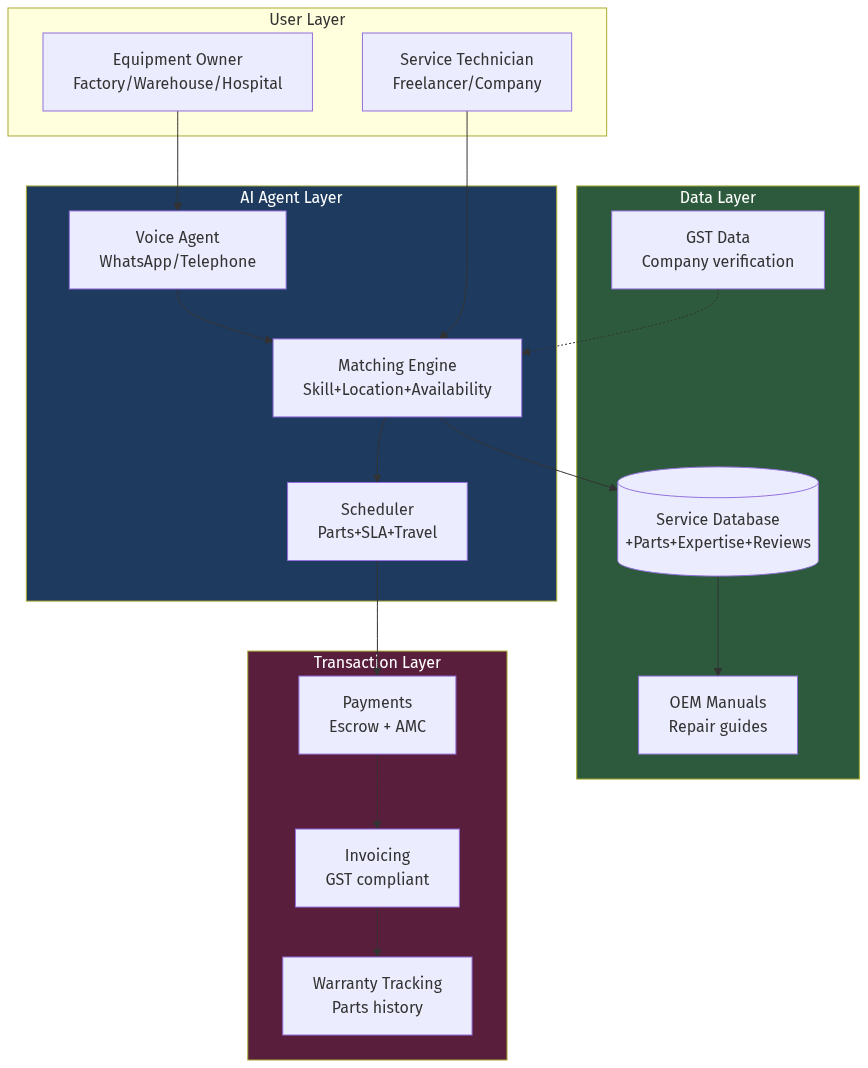
    The Agent Architecture

    System Architecture
    System Architecture

    Key AI Capabilities

  • Voice-first interaction — Most users (especially technicians) prefer WhatsApp voice. Build a voice AI that can:
  • - Understand technical problem descriptions - Speak in local languages (Hindi, Tamil, Telugu, etc.) - Confirm appointments, send reminders
  • Multimodal diagnosis — User sends photo/video of error code or damage. AI:
  • - Identifies machine model from visual (OCR, image recognition) - Maps error codes to likely failure modes - Suggests parts before technician is dispatched
  • Skill matching — Beyond location, match on:
  • - Brand certification (Siemens, ABB, Daikin, etc.) - Machine type experience (HVAC, electrical, mechanical) - Availability (real-time calendar integration) - Historical performance (jobs completed, ratings)
  • Parts intelligence — Partner with major distributors to build:
  • - Real-time inventory API (what's available where) - Part number normalization (100 names for same filter) - Price benchmarking (prevent overcharging)
    7.

    Product Concept

    Product Name Ideas

    • MachineryAI — Clear, descriptive
    • ServiceMitra — Friendly, Indian
    • FixHub — Simple marketplace vibe
    • EquipCare — Enterprise-friendly

    Core Features

    FeatureDescription
    Equipment RegistryDigital twin of all equipment — brand, model, purchase date, warranty, service history
    Technician NetworkVerified technicians with skill tags, certifications, location, availability
    AI Voice AgentWhatsApp-first interface for problem description and scheduling
    Parts MarketplaceReal-time inventory from distributor partners
    Dynamic PricingJob pricing based on complexity, urgency, technician rating
    Escrow PaymentsPayment held until work is verified complete
    Warranty TrackerAutomatic tracking of parts replaced and work performed
    AMC ManagerAutomated renewal, reminder, and service scheduling for annual contracts

    User Journeys

    For Equipment Owner:
  • Register facility (add equipment or AI extracts from GST data)
  • When equipment fails: WhatsApp message or app alert
  • AI diagnoses and presents options
  • Select technician and approve quote
  • Track technician arrival in real-time
  • Verify work completion
  • Payment released, rating submitted
  • For Technician:
  • Register with skills, certifications, location, availability
  • Receive job matches via WhatsApp
  • Accept or decline (with reason)
  • View job details: equipment, problem, parts needed
  • Complete job, upload photos, mark complete
  • Payment credited to wallet
  • Build reputation score

  • 8.

    Development Plan

    Phase 1: MVP (8-12 weeks)

    DeliverableDescription
    Equipment registryBasic CRUD for equipment, manual entry
    Technician directoryProfile pages with skill tags
    WhatsApp botText-based booking flow
    Manual matchingStaff picks technician, not AI
    Basic paymentsUPI/bank transfer after completion

    Phase 2: V1 (12-16 weeks)

    DeliverableDescription
    AI voice agentConversational WhatsApp for problem description
    Skill matchingBasic algorithm for technician-job matching
    Parts lookupIntegration with 2-3 major distributors
    Digital invoicingGST-compliant automatic invoicing
    Rating systemOwner and technician reviews

    Phase 3: V2 (16-24 weeks)

    DeliverableDescription
    Predictive maintenanceIoT integration, failure prediction
    Dynamic pricingML-based job pricing
    Escrow systemPayment held until verification
    AMC automationAuto-renewal, scheduling
    Multi-languageSupport for regional languages
    ---
    9.

    Go-To-Market Strategy

    Target Customer Segments

    SegmentPriorityWhy
    Hospitals/Nursing homesP0High equipment density, regulatory compliance needed, budget available
    Cold storage operatorsP0Equipment critical (spoilage = loss), 24/7 operations
    Manufacturing SMEsP1Cost-sensitive, pain is acute
    Commercial real estateP1Portfolio of buildings, multiple equipment types
    Restaurants/hotelsP2High volume, lower ticket size

    Launch Strategy

    Step 1: Dominate one geography (Pune or Gujarat)
    • High manufacturing density
    • Strong WhatsApp usage
    • Manageable competition
    Step 2: Build technician supply first
    • Recruit 100+ verified technicians
    • Train them on platform usage
    • Give them jobs at subsidized rates initially
    Step 3: Seed demand side
    • Target 50 facilities in Phase 1
    • Offer discounted first job
    • Build reference customers
    Step 4: Network effects kick in
    • More owners → more jobs → more technicians join
    • More technicians → faster resolution → more owners join
    • This is the defensible moat

    Channels

  • Direct sales — Visit facilities, especially hospitals and cold storage
  • WhatsApp marketing — Target facility managers via WhatsApp groups
  • Industry associations — Hospitals (AHPI), Cold Storage (ICFDA), Manufacturing (CII, FIEO)
  • Referral program — Incentivize technicians to bring owners, owners to bring technicians
  • Google Ads — Target "AC repair near me" type queries for commercial

  • 10.

    Revenue Model

    Revenue Streams

    StreamDescriptionTake Rate
    Transaction fee10-15% on each service job12%
    AMC subscriptionMonthly/annual service contracts managed8%
    Parts marketplaceMargin on parts sold through platform5-15%
    Premium listingsTechnicians pay for visibility₹500-2000/mo
    Data insightsSell aggregate maintenance insights to OEMsSubscription
    FinancingEMI for large repairs (partner with NBFC)2-3%

    Unit Economics

    MetricTarget
    Average job value₹3,000-10,000
    Platform take (12%)₹360-1,200 per job
    Cost to acquire owner (CAC)₹2,000-5,000
    Cost to acquire technician₹500-1,000
    Lifetime value (owner)₹30,000-1,00,000/year
    LTV:CAC ratio5:1+

    Scaling Path

  • Pune — 100 owners, 200 technicians → ₹2Cr ARR
  • Maharashtra — 500 owners, 800 technicians → ₹15Cr ARR
  • Pan-India — 5000+ owners, 10000+ technicians → ₹200Cr+ ARR

  • 11.

    Data Moat Potential

    Proprietary Data That Accumulates

    Data TypeValue
    Equipment registryWhat equipment exists where — invaluable to OEMs and parts sellers
    Failure patternsWhich machines fail when, in which environments
    Technician performanceRatings, speed, quality — the "LinkedIn for technicians"
    Parts consumptionWhich parts are replaced on which machines — for inventory planning
    Pricing intelligenceReal market rates for every job type

    Network Effects

    • Owners benefit from more technicians (faster service, better prices)
    • Technicians benefit from more owners (more jobs, steady work)
    • Parts dealers benefit from being in the loop (predictable demand)
    • This creates a flywheel that's hard to replicate

    Defensibility

    • Data: Historical service data is hard to replicate
    • Network: Both sides of the marketplace need each other
    • Trust: Ratings and reputation take years to build
    • AI: Better matching as more data accumulates

    12.

    Why This Fits AIM Ecosystem

    This opportunity aligns with AIM's core thesis:

  • B2B marketplace — AIM's bread and butter
  • Verticalized — Deep domain expertise, not horizontal play
  • India-focused — Leverages local market knowledge
  • AI-native — Not a "wrapping" of existing process, but redesigned for agents
  • WhatsApp-first — Matches user behavior in India
  • Data moat — Proprietary equipment and technician data
  • Integration with AIM Infrastructure

    • Domain potential: machineryservicing.in, fixhub.in, servicemitra.in
    • Voice agent: Leverage Sarvam AI for regional language support
    • Payment gateway: Razorpay for escrow and instant payouts
    • WhatsApp: Kapso for conversational interface

    13.

    Risks and Challenges

    Pre-Mortem: Why Might This Fail?

  • Chicken-and-egg problem — No owners = no technicians, no technicians = no owners
  • Trust building — Getting owners to trust unknown technicians
  • Quality control — Bad jobs damage platform reputation
  • Technician churn — Good technicians get direct customers and leave
  • Parts dependency — Can't deliver without parts availability
  • Regulatory — Licensing requirements for certain equipment types
  • Steelmanning: Why Might Incumbents Win?

  • Dealer networks — OEM dealers have existing relationships
  • Facility management giants — JLL, CBRE could add this to their offering
  • Urban Company — Could expand from homes to commercial
  • Amazon/Google — Could add local services to their marketplace
  • Mitigations

  • Seed supply first — Give technicians steady work before worrying about demand
  • Escrow — Payment protection for owners
  • Ratings transparency — Let the market decide, show everything
  • Technician stickiness — Better tools, steady jobs, wallet earnings
  • Parts partnerships — Exclusive inventory agreements

  • ## Verdict

    Opportunity Score: 8/10

    This is one of the most actionable B2B marketplace opportunities in India right now:

    ✅ Massive market ($50B+) ✅ Acute pain (equipment downtime = revenue loss) ✅ Fragmented supply (no dominant player) ✅ AI-native (voice, matching, scheduling, invoicing) ✅ WhatsApp-first (matches user behavior) ✅ Data moat (equipment + technician data) ✅ Network effects (flywheel defensibility)

    ⚠️ Execution hard (chicken-egg, trust, quality) ⚠️ Regulatory complexity (safety, licensing) ⚠️ Regional language support needed

    Recommendation: Build. Start with one city, one equipment category (HVAC is easiest), prove the model, then expand. The window is open — no major player has claimed this yet.

    ## Sources