ResearchMonday, March 16, 2026

AI-Powered B2B Industrial Waste Management Marketplace: India's $12B Opportunity

India's 1.5+ million factories generate 70+ million tonnes of hazardous waste annually, yet 80% of waste management still relies on phone calls, personal networks, and manual paperwork. An AI-powered marketplace connecting factories with certified waste handlers—while automating compliance—could capture a $12B market while solving India's growing environmental crisis.

1.

Executive Summary

India's industrial waste management market is at an inflection point. Stricter environmental regulations (Plastic Waste Management Rules 2026, E-Waste Rules, Hazardous Waste Rules), growing ESG pressures from global buyers, and the push toward a circular economy are creating unprecedented demand for professional waste management services.

The Opportunity: Build an AI-powered B2B industrial waste management marketplace that digitizes the $12 billion annual waste management market in India—connecting factories with certified recyclers, TSDF (Treatment, Storage, and Disposal Facility) operators, and waste transporters through intelligent matching, transparent pricing, and automated compliance workflows. Why Now:
  • Regulatory crackdowns intensifying (CPCB enforcement up 300% since 2024)
  • Global ESG requirements forcing Indian exporters to document waste handling
  • 70% of waste handlers are unorganized—digital transformation is inevitable
  • AI can solve the information asymmetry that keeps this market fragmented
2.

Problem Statement

The Industrial Waste Crisis

Zeroth Principles Analysis: The fundamental assumption in waste management is that factories "know how" to dispose of waste responsibly. In reality:
  • Information asymmetry: Factories don't know which certified handlers exist
  • Price opacity: No standard pricing—every deal is negotiated separately
  • Compliance burden: Manual paperwork for manifests, returns, and regulatory filings
  • Trust deficit: Many handlers dump illegally—factories face liability
  • No visibility: Once waste leaves the factory, tracking stops

Who Experiences This Pain?

SegmentPain Points
Manufacturing SMEs (90% of factories)Can't afford compliance officer, don't know regulations
Large industriesManaging multiple vendors, complex compliance requirements
Export-oriented manufacturersESG documentation required by global buyers
Waste handlersNo direct factory access, rely on middlemen
TSDF operatorsEmpty capacity during off-season, no demand forecasting

Current "Solutions"

CompanyWhat They DoWhy They're Not Solving It
Mahindra InterplexE-waste recyclingEnterprise-focused, limited SME access
TOSH (Samsung)E-waste collectionBrand-focused, not open marketplace
Saahas Zero WasteWaste management consultingHigh-touch service, not scalable
Local scrap dealersInformal waste collectionIllegal dumping common, no compliance
WhatsApp groupsInformal tradingNo standardization, no trust, no compliance
---
3.

Market Opportunity

Market Size

  • India Industrial Waste Management: $12B annually
  • Hazardous Waste: 70+ million tonnes/year
  • E-Waste: 2.3 million tonnes/year (3rd largest globally)
  • Plastic Waste: 3.4 million tonnes/year
  • Market Growth: 15% CAGR through 2030

Growth Drivers

  • Regulatory Crackdown: CPCB enforcing stricter compliance, heavy penalties
  • ESG Requirements: Global buyers requiring documented waste handling
  • Extended Producer Responsibility (EPR): Brands must manage end-of-life
  • Circular Economy Push: Government promoting recycling over disposal
  • Export Compliance: Customs requiring waste management documentation
  • Why This Opportunity Exists NOW

    Incentive Mapping: The current fragmented state benefits:
    • Unorganized waste collectors (control information, avoid compliance)
    • Middlemen (take 20-30% margin for simple introductions)
    • Some regulators (status quo is easier to manage)
    What's Changing:
    • Fines increased 10x under updated Hazardous Waste Rules
    • Exporters losing orders due to missing waste documentation
    • Corporate ESG commitments require verified waste handling
    • Young factory managers are digitally native, want online solutions

    4.

    Gaps in the Market

    Where Current Players Fail

    GapDescription
    No MarketplaceNo platform connecting factories to verified handlers
    Pricing OpacityNo standard rates—factories overpay or accept dumping
    Compliance BurdenManual manifest tracking, paper-based returns
    No Rating SystemNo way to verify handler track record
    Fragmented LogisticsNo integrated pickup, transport, disposal tracking
    SME ExclusionEnterprise solutions too expensive for SMEs

    Anomaly Hunting: What's Strange?

    • Gap in digital: Waste management is one of the last B2B sectors to go online
    • Missing middle: No mid-market player between enterprise consultants and scrap dealers
    • No data: No aggregate data on waste generation, flows, or pricing
    • Compliance theater: Many factories "comply" by paper but don't actually track waste

    5.

    AI Disruption Angle

    How AI Transforms the Workflow

    Current State (Manual):
    Factory → Calls 5 handlers → Negotiates price → Paper manifest → 
    Hope handler is certified → No tracking → Manual compliance filing
    Future State (AI Agents):
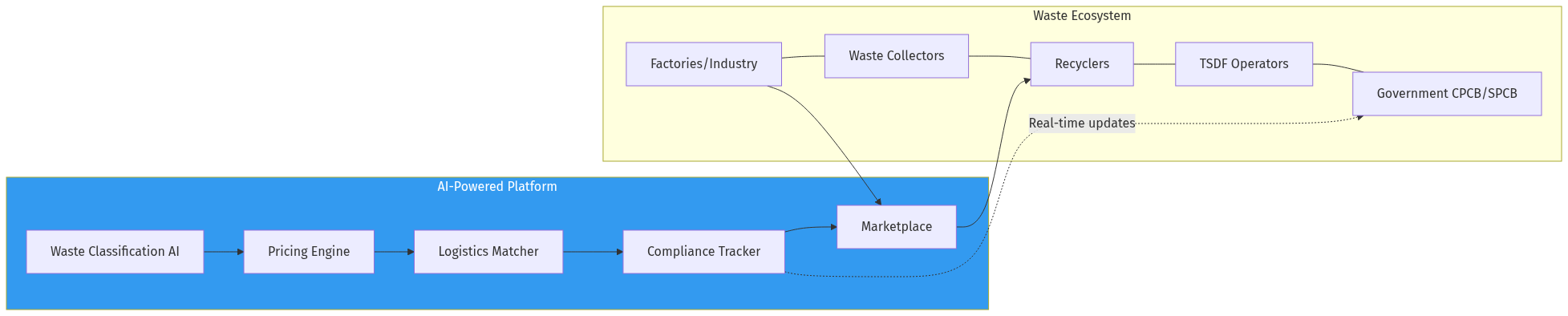
    Factory → Uploads waste details to platform → 
    AI classifies waste type + estimates volume → 
    Platform shows certified handlers with ratings + pricing →
    AI negotiates/bids → Digital manifest generated →
    GPS-tracked pickup → Real-time disposal verification →
    Auto-compliance filing → ESG report generated

    Key AI Capabilities

  • Waste Classification Engine: AI analyzes waste composition from descriptions/photos
  • Price Discovery: ML models predict fair pricing based on waste type, volume, location
  • Handler Matching: Match factories with certified handlers based on capacity, location, ratings
  • Compliance Automation: Auto-generate manifests, track returns, file with SPCB
  • Fraud Detection: Identify red flags (handler routing to unverified facilities)
  • Demand Forecasting: Help TSDF operators predict demand, optimize capacity

  • 6.

    Product Concept

    Platform Features

    FeatureDescription
    Waste CatalogFactories list waste types (hazardous, e-waste, plastic, metal, etc.)
    Handler DirectoryVerified recyclers, TSDF operators, transporters with ratings
    AI PricingTransparent, dynamic pricing based on waste characteristics
    Digital ManifestsElectronic generation, tracking, and storage of regulatory documents
    GPS TrackingReal-time visibility from pickup to final disposal
    Compliance DashboardUnified view of all regulatory requirements and filings
    ESG ReportingAutomated reports for corporate sustainability requirements
    Payment IntegrationEscrow payments, release on verified disposal confirmation

    User Flows

    Factory Flow:
  • Register factory + waste profile
  • List waste for pickup (type, volume, location)
  • Receive quotes from certified handlers
  • Select handler + pay into escrow
  • Track pickup and disposal in real-time
  • Download compliance reports
  • Handler Flow:
  • Register as certified handler (upload licenses)
  • Receive match notifications for nearby waste
  • Submit quotes
  • Complete pickup + upload disposal proof
  • Get paid after verification

  • 7.

    Development Plan

    PhaseTimelineDeliverables
    MVP8 weeksWaste catalog, handler directory, basic matching, manual compliance
    V112 weeksAI pricing, digital manifests, GPS tracking, payment integration
    V216 weeksCompliance automation, ESG reporting, handler verification AI
    Scale24 weeksNational coverage, partnerships with TSDF operators, enterprise features

    Technical Architecture

    Architecture Diagram
    Architecture Diagram
    Core Components:
    • User App (React): Factory and handler interfaces
    • Admin Dashboard: Verification, compliance monitoring, analytics
    • Matching Engine (Python/ML): AI-based handler matching
    • Compliance Service: Integration with CPCB/SPCB APIs
    • Payment Escrow: Razorpay or similar integration

    8.

    Go-To-Market Strategy

    Phase 1: Initial Traction (Months 1-3)

  • Target: Industrial zones in Gujarat (chemical hub), Maharashtra (manufacturing), Tamil Nadu (textiles)
  • Focus: 50-100 factories, 20+ verified handlers
  • Channels:
  • - Direct sales through industry associations (AIAI, CII) - Referral from compliance consultants - Partnership with waste equipment suppliers

    Phase 2: Market Expansion (Months 4-6)

  • Expand to NCR, Karnataka, West Bengal
  • Onboard TSDF operators as anchor handlers
  • Launch compliance dashboard as lead magnet
  • Phase 3: Scale (Months 7-12)

  • Integrate with government compliance portals
  • Partner with EPR aggregators (brands need waste credits)
  • Add financial services (waste-as-a-service financing)
  • GTM Tactics

    TacticRationale
    Free compliance auditDemonstrate value, identify waste volume
    Handler guaranteeFactory pays only after verified disposal
    ESG report bundleCompelling for export-oriented manufacturers
    Referral programLeverage existing handler networks
    ---
    9.

    Revenue Model

    Revenue Streams

    StreamModelPotential
    Transaction Fee3-5% on waste handledPrimary revenue
    Subscription₹5K-50K/month for compliance dashboardEnterprise accounts
    Premium ListingsHandlers pay for featured placementSecondary revenue
    EPR CreditsFacilitate producer responsibility tradingFuture revenue
    Data ProductsWaste market intelligence reportsB2B data revenue

    Unit Economics

    • Average transaction value: ₹2-5 lakhs
    • Platform fee (3%): ₹6K-15K per transaction
    • Customer acquisition cost: ₹10-15K (targeting factories with ₹50K+ monthly waste)
    • Lifetime value: ₹2-5 lakhs (recurring monthly transactions)

    10.

    Data Moat Potential

    Proprietary Data Accumulation

    Data TypeValue
    Waste Generation PatternsUnique insight into industrial waste flows
    Pricing IntelligenceReal-time market rates for different waste types
    Handler PerformanceTrack record data for verification
    Compliance HistoryRegulatory compliance database
    Regional Waste MapsFirst-mover advantage in waste intelligence

    Competitive Moat

    • Network effects: More factories attract more handlers, better matching
    • Compliance data: Switching cost for compliance tracking
    • Trust infrastructure: Ratings and verification build over time
    • Government relationships: Partnership with CPCB/SPCB creates barriers

    11.

    Why This Fits AIM Ecosystem

    Vertical Alignment

    This marketplace aligns with AIM's core thesis:

    • Fragmented market: Thousands of small handlers, no dominant player
    • Offline-heavy: 80% of transactions are phone/WhatsApp based
    • High-trust: Compliance and certification create entry barriers
    • Recurring: Waste is generated continuously, not one-time

    Cross-Selling Opportunities

    AIM VerticalSynergy
    Chemical SourcingChemical waste often follows raw material procurement
    Equipment RentalEquipment generates waste (oils, solvents)
    Lead GenerationEnvironmental consultants need waste services
    Procurement AgentsWaste is part of overall procurement

    Domain Portfolio Fit

    • waste.market, waste management .in
    • recycling .in, hazmat .in
    • circular economy .in

    12.

    Risk Assessment

    Pre-Mortem: Why Might This Fail?

    RiskLikelihoodMitigation
    Regulatory captureMediumPartner with regulators, don't fight them
    Illegal dumpingHighVerification, GPS tracking, liability insurance
    Handler resistanceMediumAggregate demand first, handlers will come
    Price warMediumFocus on compliance value, not just price
    SME adoptionHighSimplify product, offer free compliance tools

    Steelmanning: Why Might Incumbents Win?

    • Existing relationships: Big handlers have factory relationships
    • Compliance expertise: Deep regulatory knowledge
    • Capital: Can afford to undercut prices
    • Government ties: Long-standing regulator relationships
    Defense: Focus on technology and trust infrastructure—incumbents are slow to digitize, and factories increasingly demand transparency.

    ## Verdict

    Opportunity Score: 8/10

    This is a genuine market opportunity with strong tailwinds:

    • Regulatory pressure is real and increasing
    • ESG requirements are creating new demand
    • The market is fragmented with no dominant player
    • AI can solve matching, pricing, and compliance problems
    The Catch: Waste management is relationship-driven and trust-heavy. Success requires building credibility with both factories and handlers. The regulatory complexity is a barrier to entry—but once navigated, creates competitive moat.

    Recommendation: Start in one industrial corridor (Gujarat chemical belt) with 100 factories and 30 verified handlers. Prove the model, then expand. The $12B market is big enough to build a substantial business.

    ## Sources