ResearchSunday, March 15, 2026

AI-Powered Government Tender Intelligence: The $500B Opportunity in India's Public Procurement

Every year, the Indian government spends over $500 billion on public procurement through thousands of tenders across central ministries, state governments, PSUs, and local bodies. Yet 95% of SMBs never bid because they can't find relevant opportunities or navigate the complex documentation. This platform solves both.

1.

Executive Summary

India's government procurement market represents over $500 billion annually, distributed across central government ministries, 28 state governments, 800+ PSUs, and thousands of municipal bodies. Yet this market remains largely inaccessible to the 63 million SMBs that could potentially supply to the government.

The core problem isn't demand—government agencies actively seek suppliers. The problem is supply-side discovery and friction. Finding relevant tenders requires monitoring 500+ portals manually. Understanding eligibility criteria takes hours of document parsing. Preparing bids demands specialized knowledge that most SMBs lack.

This article proposes an AI-powered Tender Intelligence Platform that automates the entire tender discovery-to-submission workflow: from continuous monitoring across all government portals, through intelligent eligibility matching, to auto-generated bid documentation.

2.

Problem Statement

The Discovery Problem

Government tenders in India are fragmented across:

  • GeM Portal (Government e-Marketplace) — central procurement
  • State tender portals — 28 separate systems, each with different formats
  • PSU e-procurement — BHEL, NTPC, ONGC, SAIL, each with proprietary systems
  • E-governance portals — district-level and municipal tenders
  • Central procurement — DGS&D, Miniratna/PSU tenders
No single source aggregates all opportunities. SMBs must manually check dozens of portals, often missing deadlines or discovering opportunities too late.

The Eligibility Problem

Each tender has complex eligibility criteria:

  • Turnover requirements (minimum annual revenue)
  • Past experience (similar project completion)
  • Technical certifications (ISO, quality marks)
  • Registration requirements (GST, PAN, sector-specific licenses)
  • Geographic restrictions (state-specific, MSME preferences)
SMBs spend 20-40 hours per tender just determining if they're eligible.

The Documentation Problem

Government tenders require extensive documentation:

  • Technical bids (company profile, capabilities, team)
  • Financial bids (price quotations, cost breakdowns)
  • Compliance declarations
  • Past performance certificates
  • Tax compliance proofs
Most SMBs lack dedicated bid departments. They either skip opportunities or hire expensive consultants.

The Timeline Problem

Government tender timelines are notoriously compressed:

  • Average time from tender release to bid submission: 15-30 days
  • Critical documents often require 2-3 weeks to prepare
  • Last-minute corrections or clarifications add pressure
Missing a deadline means waiting for the next tender—often 6-12 months.
3.

Current Solutions

CompanyWhat They DoWhy They're Not Solving It
TenderTigerManual tender tracking serviceExpensive subscriptions ($50k+/year); no automation; relies on human research
BidAssistTender database aggregationBasic keyword matching only; no AI matching; poor coverage of state portals
GeM PortalGovernment procurement marketplaceSearchable but unfriendly; no proactive matching; overwhelming for SMBs
IndiaBIXSome tender listingsIncomplete coverage; outdated information; no bid preparation support
The Gap: No solution combines comprehensive discovery + intelligent matching + automated bid preparation at SMB-accessible pricing.
4.

Market Opportunity

Market Size

  • Total Government Procurement (India): ~$500 billion annually
  • Tender-based Procurement: ~$200 billion (40% of total)
  • SMB Addressable Share: ~$30-40 billion (15-20% of tender market)
  • Serviceable Market (SMBs seeking government contracts): ~$2-3 billion

Growth Drivers

  • Digital India Push: Government mandate for end-to-end digital tendering
  • GeM Expansion: GeM portal growing 40%+ YoY, adding more categories
  • MSME Focus: Government priority on MSME procurement (25% mandate)
  • Transparency Requirements: RTI-driven digitization of tender processes
  • Post-COVID Automation: Accelerated move to online submissions
  • Why Now

  • LLM Maturity: AI can now understand complex tender documents, extract eligibility criteria, and generate compliance documents
  • API Proliferation: Government portals are increasingly opening APIs
  • WhatsApp Penetration: 500M+ users in India—perfect channel for alerts
  • SMB Awareness: Post-GeM, more SMBs know government contracts exist but need help accessing

  • 5.

    Gaps in the Market

    Gap 1: Intelligent Matching

    Current solutions use keyword search. The platform should use semantic AI to match:

    • Company capabilities to tender requirements
    • Past project experience to technical criteria
    • Geographic presence to location requirements
    • Financial capacity to turnover thresholds
    Why it exists: Keyword matching can't handle the nuance in tender language ("similar works" vs "related supplies" vs "services incident to").

    Gap 2: Proactive Alerts

    SMBs shouldn't search for tenders. They should receive WhatsApp alerts when matching opportunities appear.

    Why it exists: Existing services email PDF digests—SMBs don't check email regularly but check WhatsApp 20+ times daily.

    Gap 3: Document Automation

    95% of bid documents are templated. AI can auto-generate:
    • Company profile from CRM data
    • Financial statements from accounting software
    • Compliance declarations from stored certificates
    Why it exists: Previous AI couldn't handle government document formats. LLMs now can.

    Gap 4: Eligibility Confidence

    Before applying, SMBs want to know: "What's my probability of winning?"

    Why it exists: No existing service analyzes competitive landscape or provides scoring.

    Gap 5: End-to-End Submission

    Most services stop at "here's the tender." The platform should handle submission directly.

    Why it exists: Integration complexity with government portals. New Gen-AI tools make this feasible now.
    6.

    AI Disruption Angle

    How AI Transforms the Workflow

    Current (Manual) Flow:
  • Manually check 50+ portals daily
  • Read each tender document (PDF, 20-100 pages)
  • Determine eligibility (hours of analysis)
  • Gather documents (days of coordination)
  • Prepare bid (week of work)
  • Submit (often at last minute)
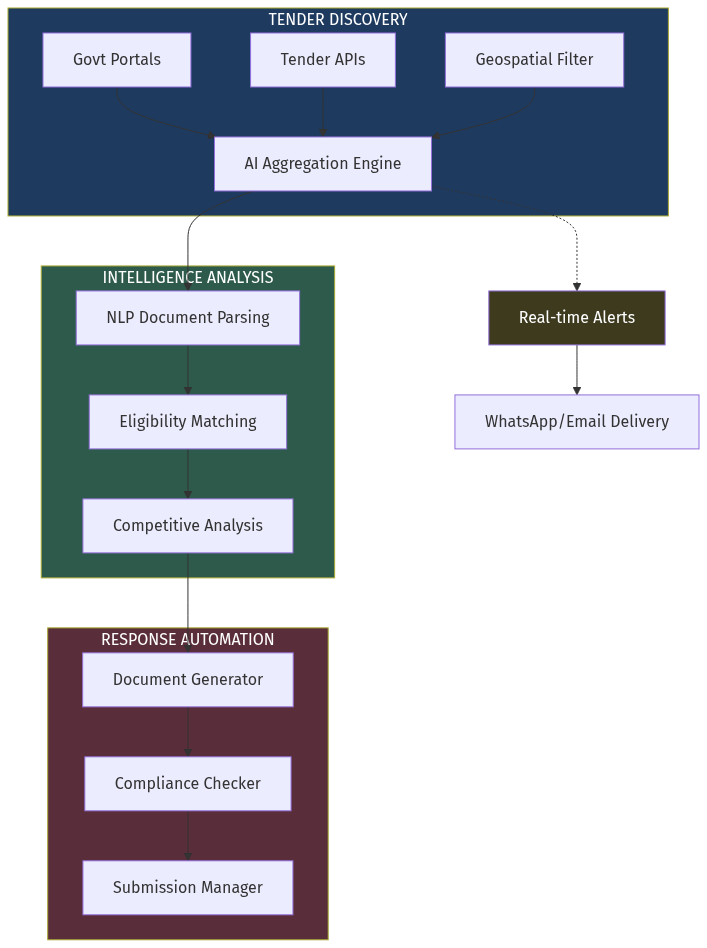
  • AI-Agent Flow:
  • AI agents continuously scrape/parse all tender sources
  • NLP extracts requirements → matches against company profile
  • Eligibility scoring done in seconds
  • Document generator creates draft from templates + company data
  • Compliance checker validates completeness
  • AI suggests optimal pricing based on competitive analysis
  • Submission via API integration or guided interface
  • The Agent Architecture

    Architecture Diagram
    Architecture Diagram

    Future: Agent-to-Agent Tendering

    In 3-5 years, AI agents will transact directly:

    • Government AI issues tender with machine-readable requirements
    • Supplier AI submits auto-generated bids
    • Smart contracts handle evaluation and award
    • Post-award, AI agents manage delivery, invoicing, payment
    This is already happening in pilot programs. Early movers build the data moat.


    7.

    Product Concept

    Core Features

    1. Tender Discovery Engine
    • Continuous monitoring of 500+ government portals
    • Real-time ingestion of new tenders
    • Deduplication and normalization
    • API-first architecture for adding new sources
    2. AI Matching System
    • Company profile: capabilities, certifications, past projects, financials
    • Tender requirements: technical specs, eligibility, documentation
    • Semantic matching with confidence scores
    • Proactive alerts via WhatsApp/Email
    3. Eligibility Analyzer
    • Rule-based + ML hybrid approach
    • Automated check against:
    - Turnover thresholds - Experience requirements - Certification validity - Registration status
    • Gap analysis: what's missing, how to address
    4. Document Generator
    • Template library for all tender types
    • Auto-population from company database
    • Version control and audit trail
    • Digital signature integration
    5. Pricing Intelligence
    • Historical analysis of winning bids
    • Competitive benchmarking
    • Cost modeling for margin optimization
    • Scenario planning
    6. Submission Manager
    • Direct API submission where available
    • Guided submission for portal-based systems
    • Deadline tracking and reminders
    • Submission receipts and acknowledgments

    User Experience

  • Onboarding: Company profile setup (industry, capabilities, certifications, financials)
  • Daily: Receive WhatsApp alert with "3 new tenders matching your profile"
  • Evaluate: One-click eligibility score, competitive analysis
  • Prepare: Auto-generated documents with AI suggestions
  • Submit: Guided submission or auto-submit
  • Track: Real-time bid status, award notifications

  • 8.

    Development Plan

    PhaseTimelineDeliverables
    MVP8 weeksGeM portal integration; basic keyword matching; email alerts; manual bid download
    V112 weeksMulti-portal aggregation; AI semantic matching; WhatsApp alerts; document templates
    V216 weeksEligibility scoring; document automation; pricing intelligence; submission support
    V320 weeksDirect API submissions; competitive agent network; predictive analytics

    Technical Architecture

    • Backend: Node.js + Python (for ML/NLP)
    • Database: PostgreSQL (structured data) + Pinecone (semantic search)
    • AI: GPT-4 / Claude for document understanding; custom models for matching
    • Infrastructure: AWS India region (compliance)
    • Integrations: Government portal APIs where available; browser automation where not

    Key Milestones

  • Month 2: 1,000 SMBs on waitlist, 10 portal integrations
  • Month 4: 100 paying customers, 50 portal integrations
  • Month 6: 500 customers, first submission automation
  • Month 9: 2,000 customers, competitive intelligence feature
  • Month 12: 5,000 customers, Series A readiness

  • 9.

    Go-To-Market Strategy

    Target Customer Segments

  • Primary: SMBs seeking government contracts (manufacturers, service providers)
  • Secondary: Consultants/agencies managing multiple client tenders
  • Tertiary: Large enterprises monitoring competitive landscape
  • Acquisition Channels

    1. WhatsApp-First Marketing
    • Targeted WhatsApp broadcasts to business directories
    • Partner with WhatsApp business solution providers
    • Viral loop: "Invite 3 companies, get 3 months free"
    2. Industry Associations
    • Partner with CII, FICCI, ASSOCHAM, local chambers
    • Sponsored events, workshops on government tendering
    • White papers and training content
    3. GeM Seller Community
    • GeM has 1M+ registered sellers
    • Target GeM sellers not winning bids
    • "Win more on GeM" positioning
    4. Digital Marketing
    • SEO: "government tender", "how to apply for government contracts"
    • Google Ads: high-intent keywords ($5-15 CPC)
    • LinkedIn: targeting procurement managers
    5. Consultant Partnerships
    • Train existing tender consultants
    • White-label for consulting firms
    • Revenue share for referrals

    Pricing Strategy

    TierPriceFeatures
    Starter₹2,999/month5 portal alerts, email only, basic matching
    Professional₹9,999/monthAll portals, WhatsApp alerts, document templates, eligibility scoring
    Enterprise₹29,999/monthFull automation, API access, dedicated support, submission assistance
    Early Bird: First 500 customers at 50% discount (₹1,499/month)
    10.

    Revenue Model

    Primary Revenue Streams

  • Subscription Revenue — Monthly/annual subscriptions (80% of revenue)
  • Transaction Fees — Per-submission fees for automated bidding (15% of revenue)
  • Premium Services — Dedicated bid writers, legal review (5% of revenue)
  • Unit Economics

    • CAC: ₹3,000-5,000 (digital channels)
    • LTV: ₹1.5-2 lakhs (36-month customer lifetime)
    • LTV:CAC Ratio: 30-40x (highly profitable at scale)

    Projections (36 months)

    YearCustomersARR
    Year 12,000₹3 crore
    Year 28,000₹15 crore
    Year 325,000₹50 crore
    ---
    11.

    Data Moat Potential

    Proprietary Data Accumulation

  • Tender Database — Historical tenders, outcomes, winning bidders
  • Pricing Intelligence — Winning bid prices across categories
  • Company Capabilities — Matched profiles of active bidders
  • Success Patterns — What wins bids in each category
  • Network Effects

    • More SMBs → more tender data → better matching → more SMBs
    • Consultant network → premium content → higher retention
    • Government relationships → API access → harder for competitors

    Defensibility

    • Government portal integration is complex (years to build)
    • Data moat compounds over time
    • Switching cost: all documents and history stored

    12.

    Why This Fits AIM Ecosystem

    Vertical Alignment

    • AIM.in focuses on B2B discovery and decision-making
    • Government tender intelligence is the ultimate B2B decision: "Should we bid?"
    • Complements existing verticals (suppliers, manufacturers)

    Distribution Leverage

    • Existing domain portfolio (5,000+ domains) can include tender-focused content sites
    • WhatsApp integration aligns with AIM's communication strategy
    • Can cross-sell to existing AIM B2B database

    Agent Integration

    • Future: AI agents directly bidding on behalf of companies
    • The platform becomes the "procurement agent" layer
    • Aligns with AIM's agent-first philosophy

    Expansion Paths

  • Tender Financing: Financial products based on awarded contracts
  • Government Vendor Credit: Credit scoring for government suppliers
  • Supply Chain Financing: Factoring for government receivables
  • Contractor Management: Post-award project management

  • ## Verdict

    Opportunity Score: 8.5/10

    Strengths

    • Massive Market: $500B government procurement, 63M SMBs潜在
    • Clear Pain: Discovery and documentation are universally complained about
    • AI-Native Solution: LLMs finally make this technically feasible
    • India-Specific: Global players won't compete here (complexity, localization)
    • Data Moat: First-mover accumulates proprietary intelligence

    Risks & Mitigations

    RiskProbabilityImpactMitigation
    Government portal changesMediumHighAPI-first architecture, browser automation fallback
    Competition from incumbentsMediumMediumFocus on SMBs, AI-first experience
    Pricing pressureLowMediumBuild data moat before commoditization
    Regulatory changesLowMediumDiversify across central + state + PSU

    Why SMBs Will Pay

    • Average tender value: ₹50 lakhs - ₹10 crores
    • Success fee (even 2%) = ₹1-20 lakhs per win
    • Subscription cost = ₹1.5 lakhs/year
    • ROI clear: win one tender = 10x+ annual subscription

    Bottom Line

    This is a classically fragmented, underserved B2B market ready for AI transformation. The window is now—LLMs can handle government document complexity, and government digitization is creating the infrastructure. First-mover advantage compounds dramatically in this market.


    ## Sources