ResearchSunday, March 15, 2026

AI-Powered B2B Restaurant Supply Chain Platform

A unified digital marketplace connecting restaurants with verified suppliers, wholesalers, and farmers—replacing fragmented WhatsApp orders with AI agents that automate procurement, quality verification, and logistics.

1.

Executive Summary

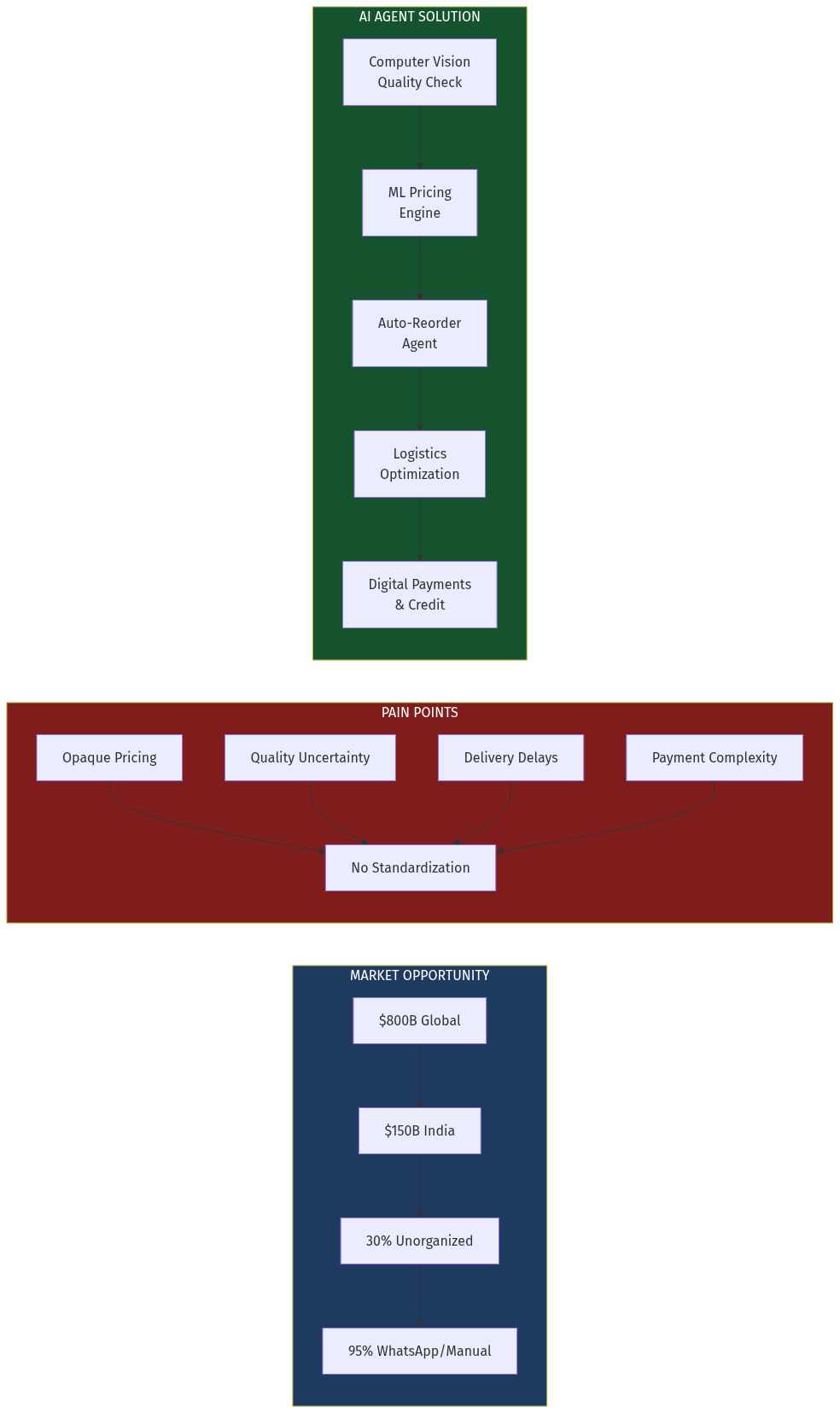
India's restaurant industry is a $150 billion market, but 95% of procurement still happens via phone calls and WhatsApp messages. Restaurants juggle 10-15 different suppliers for vegetables, groceries, spices, packaging, and beverages. Prices fluctuate daily, quality is subjective, deliveries are unreliable, and payments are manual.

This creates a massive opportunity for an AI-powered B2B supply chain platform that:

  • Acts as a single procurement dashboard for restaurant owners
  • Uses computer vision for AI quality verification
  • Employs ML models for dynamic pricing and demand forecasting
  • Automates reordering based on inventory levels
  • Provides embedded financing for suppliers
---

2.

Problem Statement

The Daily Procurement Chaos

For Restaurants:
  • Supplier Fragmentation: Managing 10-15 vendors for different categories
  • Price Opacity: No way to compare real-time prices across suppliers
  • Quality Uncertainty: Can't verify produce quality until delivery
  • Manual Ordering: Spending 1-2 hours daily on phone/WhatsApp orders
  • Payment Complexity: Multiple payment modes, delayed settlements
For Suppliers:
  • Customer Acquisition: Relying on manual outreach and referrals
  • Payment Delays: 30-90 day payment cycles from restaurants
  • Demand Uncertainty: No visibility into customer demand patterns
  • Inventory Waste: Overstocking due to unpredictable orders
For the Market:
  • 30% Unorganized: Highly fragmented with no dominant player
  • 95% Offline: WhatsApp and phone-based transactions
  • Zero Standardization: No quality grades, no pricing benchmarks
  • Trust Deficit: No escrow, no quality guarantees

3.

Current Solutions

CompanyWhat They DoWhy They're Not Solving It
Zomato HyperpureB2B supplies for restaurantsOnly in select cities, narrow product range
Flipkart WholesaleB2B grocery marketplaceConsumer-focused, not restaurant-specific
JioMart PartnerB2B groceryGeneralist, no restaurant features
UdaanB2B marketplaceFull-stack, not focused on F&B
[WhatsApp GroupsInformal orderingManual, no AI, no standardization
Gap Analysis: No platform combines AI quality verification, automated reordering, dynamic pricing, and embedded finance specifically for restaurants.
4.

Market Opportunity

Market Size

  • Global Restaurant Supply Chain: $800+ billion
  • India Restaurant Market: $150 billion (2025)
  • B2B Food Service Distribution: $45 billion
  • Addressable Market (India): $12-15 billion

Growth Drivers

  • Quick Service Restaurants (QSR): 25% CAGR growth
  • Cloud Kitchens: 35% annual growth
  • Restaurant Digitization: UPI payments, GST compliance
  • Food Safety Regulations: Increasing quality standards
  • Labor Costs: Automation replacing manual procurement

Why Now

  • UPI Adoption: 10 billion monthly transactions enabling digital payments
  • GST Compliance: Formalization creating tax incentives for digitization
  • Restaurant Tech Maturity: POS, accounting, delivery stacks exist
  • AI Affordability: Computer vision and NLP costs dropped 80% in 3 years
  • WhatsApp Saturation: Pain is visible—everyone complains about procurement

  • 5.

    Gaps in the Market

    Technology Gaps

    • No Quality Standardization: No universal grading for vegetables, spices, packaging
    • No Real-Time Pricing: Prices change daily but no transparent APIs
    • No Inventory Integration: Restaurant POS doesn't connect to suppliers

    Operational Gaps

    • Manual Order Placement: Still phone/WhatsApp for 95% of orders
    • No Demand Forecasting: Suppliers guess, restaurants over-order
    • Fragmented Logistics: Each supplier has own delivery network

    Financial Gaps

    • No Embedded Credit: Suppliers extend credit, restaurants pay late
    • No Digital Invoicing: 70% still paper-based
    • No Analytics: No spend analysis, no category optimization

    6.

    AI Disruption Angle

    Computer Vision Quality Check

    • Receive Verification: AI analyzes photos of produce at supplier warehouse
    • Delivery Verification: Restaurant photos verify quality matches order
    • Grading Automation: ML models grade quality (A/B/C) with 95% accuracy
    • Spoilage Detection: Predict shelf-life based on visual analysis

    NLP Order Management

    • Voice-to-Order: WhatsApp voice notes converted to orders
    • Natural Language: "Order 5kg onions, 2kg tomatoes for tomorrow"
    • Conversation Context: Agent remembers preferences, allergies, brands

    Demand Forecasting

    • Historical Analysis: ML predicts weekly demand by day/season/event
    • Weather Integration: Adjusts for rain/heat affecting consumption
    • Event Detection: Auto-detects festivals, local events, holidays
    • Waste Reduction: 20-30% reduction in food waste through prediction

    Dynamic Pricing Engine

    • Real-Time Market Prices: APIs from APMC mandis, wholesale markets
    • Supplier Competition: Multiple suppliers bid on restaurant orders
    • Price Alerts: Notify when prices drop below threshold

    Autonomous Reordering

    • Inventory Integration: Connect to restaurant POS/ERP
    • Auto-Reorder Rules: Agent places orders based on stock levels
    • Approval Workflow: Restaurant confirms before execution
    • Learning: Agent improves based on acceptance rates

    7.

    Product Concept

    For Restaurants (Buyer Side)

    Dashboard Features:
    • Unified catalog across 50+ categories
    • Real-time price comparison
    • One-click reorder from history
    • Quality rating system
    • Spend analytics and insights
    • AI recommendations
    AI Agent Features:
    • "Hey, we're running low on tomatoes, should I place an order?"
    • "Prices are up 20% this week, want to wait?"
    • "Your regular supplier is out of stock, here's an alternative"

    For Suppliers (Seller Side)

    Platform Features:
    • Digital storefront with catalog management
    • Order management and fulfillment
    • Digital invoicing
    • Payment reconciliation
    • Customer analytics
    AI Agent Features:
    • "Good news! Restaurant X wants to order 50kg weekly"
    • "Your prices are 10% above market, consider adjusting"
    • "Demand forecast shows 30% increase next week"

    For Logistics Partners

    Integration Features:
    • API for order routing
    • Real-time tracking
    • Delivery confirmation
    • Proof of delivery with photos

    8.

    Development Plan

    PhaseTimelineDeliverables
    MVP8 weeksRestaurant dashboard, 3 pilot suppliers, WhatsApp ordering, manual quality check
    V112 weeksComputer vision quality check, supplier app, basic ML pricing, 50 suppliers
    V216 weeksAI auto-reorder, demand forecasting, embedded credit, 200+ suppliers
    V320 weeksVoice AI ordering, full logistics integration, pan-India expansion

    Technical Stack

    • Frontend: React Native (mobile-first for restaurant owners)
    • Backend: Node.js + Python (ML)
    • Computer Vision: Custom ML models + Scale AI annotation
    • Payments: Razorpay + UPI integration
    • WhatsApp: Kapso API for conversational ordering

    9.

    Go-To-Market Strategy

    Phase 1: Kolkata/Hyderabad Pilot

  • Target: 50 cloud kitchens and small restaurants
  • Acquisition: Direct sales team, trade shows, restaurant associations
  • Supplier Recruitment: Target wholesale markets (Kolkata: Bagri Market, Hyderabad: Gaddi Annaram)
  • Incentives: 0% commission for first 3 months, free delivery
  • Phase 2: City Expansion

  • Grow to 500 restaurants in pilot city
  • Add 200+ suppliers across categories
  • Referral program: Restaurants refer suppliers, suppliers refer restaurants
  • Restaurant association partnerships
  • Phase 3: National Scale

  • Expand to 10 cities in Year 2
  • Tier 2 city penetration
  • Enterprise features: Chain restaurants, hotel groups
  • White-label platform: For large restaurant groups
  • Acquisition Costs

    • Customer Acquisition Cost (CAC): ₹3,000-5,000 per restaurant
    • Supplier Acquisition Cost: ₹1,000-2,000 per supplier
    • Target LTV:CAC Ratio: 5:1

    10.

    Revenue Model

    Commission-Based (Primary)

    • Restaurant Commission: 2-5% on GMV
    • Supplier Commission: 1-3% on GMV
    • Target Take Rate: 4-6% blended

    Value-Added Services

    • Premium Listings: Suppliers pay for visibility - ₹5,000/month
    • AI Insights: Demand reports, pricing intelligence - ₹2,000/month
    • Quality Certification: AI-verified quality badge - ₹3,000/month

    Embedded Finance

    • Supplier Credit: 2% monthly interest on advances
    • Restaurant Pay Later: 1.5% convenience fee
    • Payment Gateway: 0.5% on transactions

    Logistics

    • Delivery Fee: ₹50-100 per order (pass-through)
    • Express Delivery: Premium pricing for urgent orders

    Projected Revenue (Year 3)

    • GMV: ₹500 Crore
    • Commission: ₹25 Crore
    • Finance: ₹5 Crore
    • Total Revenue: ₹30+ Crore

    11.

    Data Moat Potential

    Proprietary Data Accumulation

    • Pricing Data: Daily prices across 500+ SKUs in 10 cities
    • Demand Patterns: Historical order data by restaurant, day, season
    • Supplier Performance: Delivery times, quality ratings, fill rates
    • Restaurant Preferences: Brand affinities, quantity patterns, price sensitivity
    • Quality Baselines: ML-trained models for produce grading

    Network Effects

    • More Restaurants → Better Pricing: Aggregate demand creates leverage
    • More Suppliers → Better Selection: Competition improves quality/price
    • More Data → Better AI: Models improve with scale

    Moat Durability

    • Switching Costs: Historical orders, preferences, AI learning
    • Data Advantage: 2+ years of pricing/demand data
    • Supplier Relationships: Exclusive contracts with quality suppliers

    12.

    Why This Fits AIM Ecosystem

    Vertical Alignment

    • AIM.in Mission: "Help buyers DECIDE"—this platform helps restaurants decide suppliers
    • Domain Fit: B2B marketplace + workflow automation + AI agents
    • India Focus: Deeply localized, WhatsApp-native, UPI-powered

    Synergies

    • Domain Portfolio: Restaurant-related domains (cloudkitchen.in, tiffinservice.in, etc.)
    • WhatsApp Integration: Built on existing Kapso infrastructure
    • Data Network: Can integrate with dom.to for supplier intelligence

    Expansion Path

  • Start: Restaurant procurement → Move to: Hotel procurement → Expand to: Hospital, Office canteens

  • ## Verdict

    Opportunity Score: 8.5/10

    This is a massive, urgent, and solvable problem. The time is right because:

  • Pain is visible and documented (everyone complains about WhatsApp ordering)
  • Technology is affordable (CV, NLP, UPI all mature)
  • Market is unorganized (no dominant player)
  • AI agents can truly automate (not just digitize)
  • Risk Factors:
    • Supplier adoption may be slow (legacy mindsets)
    • Quality verification at scale is challenging
    • Thin margins require high GMV
    Recommendation: Build in Kolkata/Hyderabad first, prove unit economics, then scale. Target cloud kitchens and QSRs as early adopters—they have the most pain and highest digital readiness.

    ## Sources

    ---

    Market Opportunity
    Market Opportunity
    Supply Chain Flow
    Supply Chain Flow
