ResearchSunday, March 15, 2026

AI-Powered B2B Hotel & Restaurant Equipment Procurement: India's $40B Opportunity

India's hospitality sector is booming, yet hotel and restaurant owners still procure equipment through WhatsApp messages, phone calls, and fragmented local suppliers. An AI-powered procurement platform can automate supplier discovery, negotiation, and fulfillment—capturing a massive underserved market.

8
Opportunity
Score out of 10
1.

Executive Summary

India's hospitality industry—worth $50+ billion—is growing at 15%+ annually, driven by tourism, business travel, and the rapid expansion of quick-service restaurants. Yet the equipment procurement process remains stuck in the past: owners WhatsApp multiple suppliers, manually compare quotes, negotiate orally, and track deliveries through follow-up calls.

This creates a massive opportunity for an AI-powered B2B equipment procurement platform that:

  • Understands technical specifications (kitchen equipment, furniture, linen, amenities)
  • Matches requirements to vetted suppliers
  • Auto-negotiates pricing based on volume and history
  • Handles the entire order-to-delivery workflow
  • Learns preferences over time to become a "procurement brain" for each customer
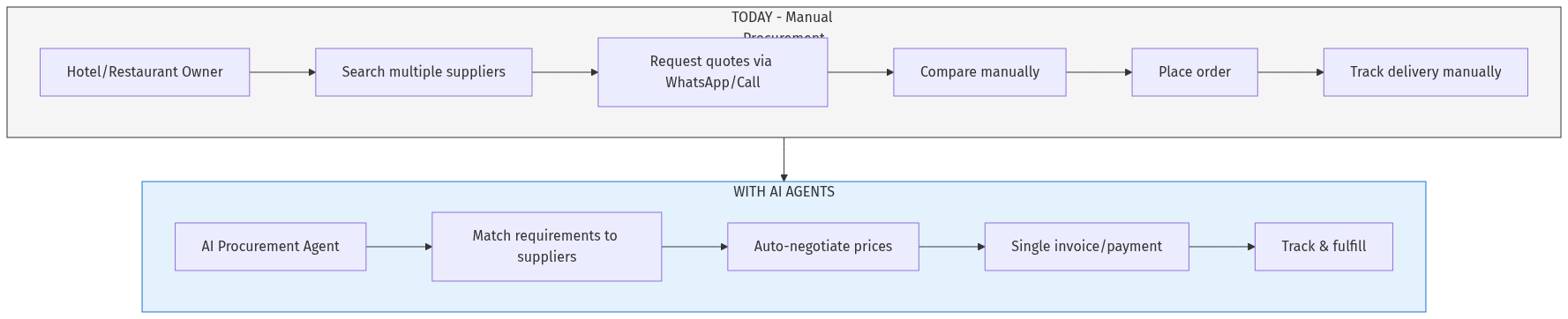
The market is highly fragmented (10,000+ suppliers nationally), transaction values are high ($5K-500K per order), and repeat purchase frequency is strong (renovations, new outlets, replacements).


2.

Problem Statement

The Pain is Quantifiable

  • $40B+ addressable market — Hotel & restaurant equipment procurement in India
  • 80%+ offline — Most purchases happen via phone calls, WhatsApp, or in-person visits
  • 3-4 weeks average procurement cycle — From requirement to delivery
  • 20-30% price variance — Same equipment from different suppliers varies wildly
  • No standardization — Every supplier has different product names, specifications

Who Experiences This Pain?

  • Hotel owners — Opening new properties or renovating existing ones need 50+ equipment categories
  • Restaurant chains — Scaling outlets requires consistent procurement across vendors
  • Catering companies — Event-based needs with tight timelines
  • Cafe/QLTC operators — Smaller tickets but high frequency
  • Hospitality management companies — Multi-property procurement complexity
  • Current Workflows Are Broken

  • Owner identifies equipment need (e.g., "need 10 commercial ovens for new restaurant")
  • WhatsApp group or Google search for suppliers
  • Call 5-10 suppliers, request quotes
  • Manually compare specs and prices (often apples-to-oranges)
  • Negotiate (often orally, no paper trail)
  • Place order, pay advance
  • Follow up for delivery status
  • Handle discrepancies or returns manually
  • This process repeats for every equipment category—and there are 50+ categories in a typical hotel.


    3.

    Current Solutions

    CompanyWhat They DoWhy They're Not Solving It
    IndiaMartGeneral B2B marketplaceNot hospitality-specific, no procurement workflow
    TradeIndiaProduct listingsNo AI matching, no post-order support
    HotelogixProperty management (PMS)Focuses on operations, not procurement
    UniDesign (formerly LimeLight)Hotel furnitureLimited categories, enterprise only
    Local dealer networksCategory-specific salesFragmented, no tech, relationship-based

    The Gaps

  • No product intelligence — Can't understand "commercial convection oven 6-deck" vs "baking oven"
  • No supplier vetting — Quality is a gamble
  • No negotiation automation — Price discovery is manual
  • No order tracking — Delivery status is a black box
  • No post-sales service — Warranties, repairs, replacements are manual
  • No recurring purchase memory — Every order starts from scratch

  • 4.

    Market Opportunity

    Market Size

    • India hospitality market: $50B+ (growing 15% CAGR)
    • Equipment procurement: ~$40B (80% of setup costs)
    • Online share: <5% (massive room for digitisation)
    • Average hotel setup: ₹5-50Cr (equipment is 40-60%)
    • Average restaurant setup: ₹5-50L (equipment is 30-50%)

    Why Now

  • GST has normalised — Tax complexity reduced, making pan-India sourcing viable
  • Hospitality growth surge — Modi government pushing tourism, new hotels opening weekly
  • Restaurant explosion — QSR chains expanding aggressively (Zomato/Swiggy backing cloud kitchens)
  • MSMEs going digital — UPI, GST filing normalised online business for small players
  • AI cost plummeting — NLP can now understand technical specifications cheaply
  • Target Segments

    SegmentAvg Order ValueFrequencyPriority
    5-star hotels₹5-50CrOngoingHigh LTV
    Business hotels₹50L-5CrPeriodicHigh LTV
    Restaurant chains₹10L-1CrFrequentHigh volume
    Standalone restaurants₹5-50LOne-time + repeatHigh volume
    Cafes/QLTC₹1-10LFrequentMedium
    ---
    5.

    Gaps in the Market

    Gap 1: Product Specification Intelligence

    No platform understands that "food warmer" and "hot holding cabinet" and "buffet server" might be the same or different products. AI can normalize specifications.

    Gap 2: Supplier Discovery for Niche Products

    Looking for "commercial ice cream display counter 6-feet"? Google returns 100 pages of results with no quality signal. AI can match to vetted suppliers by specialty.

    Gap 3: Price Transparency

    Same product from Supplier A vs Supplier B can differ by 30%. No platform shows historical pricing or benchmarks.

    Gap 4: Post-Order Handholding

    After order placement, it's a black box. No tracking, no escalation, no warranty management.

    Gap 5: Recurring Procurement Memory

    When a hotel opens its second property, it should know what equipment worked at Property 1. No platform remembers.

    Gap 6: Installation & Service

    Equipment often needs installation, training, and annual servicing. No platform manages the full lifecycle.
    6.

    AI Disruption Angle

    How AI Transforms Procurement

    1. Natural Language Requirement Understanding User: "I need kitchen equipment for a 100-seat restaurant" AI: Converts to 47 specific items with specs, quantities, price ranges 2. Intelligent Supplier Matching AI matches requirements to supplier specialties, past performance, location, and pricing history 3. Automated Negotiation AI negotiates with multiple suppliers simultaneously, leveraging volume commitments 4. Specification Normalization AI understands "6-deck convection oven" = "commercial bakery oven 6-deck" = "Rational combi oven equivalent" 5. Predictive Replenishment AI remembers when equipment was purchased, predicts replacement, proactively suggests 6. Voice-Enabled Procurement Owner WhatsApp voice note: "Need 50 dinner plates for terrace restaurant" AI converts to order, confirms via WhatsApp

    The Future: Autonomous Procurement

    In 3-5 years, AI agents will:

    • Monitor equipment health via IoT
    • Auto-order consumables before stockout
    • Negotiate renewals automatically
    • Handle warranty claims without human intervention
    ---

    7.

    Product Concept

    Core Features

  • AI Product Search — Natural language + specification-based search
  • Supplier Marketplace — Vetted suppliers with ratings, specialties, certifications
  • Request for Quote (RFQ) — One request, multiple quotes, AI-ranked
  • Order Management — Single dashboard for all orders, all suppliers
  • Delivery Tracking — Real-time status, photo proofs, issue escalation
  • Invoice & Payment — Unified invoicing, multiple payment options
  • Warranty Management — Auto-tracking, claim initiation, service scheduling
  • Procurement Assistant — WhatsApp bot for quick orders, status queries
  • User Flow

  • Sign up — Hotel/restaurant owner or procurement manager
  • Add requirements — Text, voice (WhatsApp), or select from templates
  • AI processes — Converts to specs, matches suppliers, requests quotes
  • Review — Compare quotes (price, delivery, warranty, ratings)
  • Order — Single click or customize
  • Track — Dashboard + WhatsApp updates
  • Receive — Photo proof, installation support
  • Service — Warranty claims, reorders
  • Technical Architecture

    Architecture Diagram
    Architecture Diagram

    8.

    Development Plan

    PhaseTimelineDeliverables
    Phase 0: Discovery4 weeksSupplier interviews (50), requirement mapping, category selection
    Phase 1: MVP8 weeksProduct catalog (top 20 categories), supplier onboarding (100), RFQ workflow
    Phase 2: V18 weeksAI search, WhatsApp integration, order tracking, payments
    Phase 3: Scale12 weeksFull catalog (100+ categories), 1000+ suppliers, nationwide logistics
    Phase 4: IntelligenceOngoingAI negotiation, predictive ordering, IoT integration

    Key Categories to Launch

    PriorityCategoryExample ProductsSupplier Count (India)
    P0Kitchen equipmentOvens, fryers, refrigeration2000+
    P0Restaurant furnitureTables, chairs, booths5000+
    P0KitchenwareCookware, utensils, serveware3000+
    P1Linen & textilesBedsheets, towels, curtains2000+
    P1Room amenitiesToiletries, minibars, TVs1500+
    P2HVACAir conditioners, air purifiers1000+
    P2LightingLobby, room, outdoor1500+
    ---
    9.

    Go-To-Market Strategy

    1. Land in a Cluster

    Start with hotel/restaurant dense regions:
    • Delhi-NCR — Maximum hotel density, aggressive expansion
    • Mumbai — Hotel + restaurant hub
    • Bangalore — QSR explosion, tech-savvy buyers
    • Goa — Resort-heavy, seasonal demand
    • Hyderabad — Emerging hospitality hub

    2. Partner, Don't Just Sell

    • Hotel associations — FHRAI (Federation of Hotel & Restaurant Associations of India)
    • Restaurant associations — NRAI (National Restaurant Association of India)
    • Industry events — FHRAI annual, Restaurant India expo
    • Chamber of commerce — Local business networks

    3. Capture Supply First

    • Visit industrial areas (e.g., Mayapuri, Delhi for kitchen equipment)
    • Onboard 50 suppliers in Phase 1
    • Give suppliers free listings, paidFeatured placement

    4. Free-to-Paid Conversion

    • Free: Product search, supplier discovery
    • ₹5,000-25,000/year: RFQ credits, order management, tracking
    • Commission: 3-8% on orders (from supplier or buyer, or both)

    5. WhatsApp-First

    • India's preferred business channel
    • WhatsApp business number for orders
    • WhatsApp status updates for delivery
    • Voice note orders for non-technical users

    10.

    Revenue Model

    Revenue StreamDescriptionPotential
    Commission3-8% on order valueHigh (primary)
    SubscriptionSaaS tools for buyersMedium
    Listing feesSupplier premium placementLow-Medium
    Lead generationQualified leads to suppliersLow
    FinancingEMI/loan facilitationHigh (future)
    LogisticsLast-mile deliveryMedium

    Unit Economics

    • Average order value: ₹5L
    • Commission (5%): ₹25,000/order
    • Customer acquisition cost: ₹10,000-15,000
    • LTV: ₹2-5L (3-5 orders per year per customer)
    • Payback period: 6-12 months

    11.

    Data Moat Potential

    Proprietary Data That Accumulates

  • Product specification database — Normalized specs across 100+ categories
  • Supplier performance metrics — Delivery time, quality, pricing history
  • Buyer preferences — Brands, price points, delivery requirements
  • Price benchmarks — Real transaction data across categories
  • Relationship mapping — Who supplies to whom, at what terms
  • Defensible Moats

    • Network effects — More buyers → more suppliers → better prices → more buyers
    • Switching cost — Historical orders, preferences, supplier relationships
    • Data advantage — Pricing intelligence improves with every transaction

    12.

    Why This Fits AIM Ecosystem

    This platform can become a key vertical under AIM.in:

  • Domain relevance — B2B marketplace + AI agents = AIM's core thesis
  • Supplier discovery — Complements existing domain intelligence
  • Geographic expansion — India-first, then东南亚, then global
  • Cross-sell opportunity — Hotel owners need everything: staffing, marketing, supplies
  • Data value — Real transaction data for market intelligence
  • Potential Acquisition/Partnerships

    • IndiaMart/TradeIndia — Would acquire for hospitality vertical
    • Zomato/Swiggy — Would partner for restaurant setup services
    • Hotel chains — Would use for procurement (OYO, Lemon Tree)
    • Banks/NBFCs — Would finance equipment purchases

    ## Verdict

    Opportunity Score: 8/10

    Why High Score

    • Massive market — $40B+ addressable, <5% online
    • Clear pain — Manual, fragmented, relationship-based
    • AI-native — Specification understanding, matching, negotiation
    • Recurring revenue — Renovation, expansion, replacement cycles
    • Data moat — Transaction data compounds over time
    • WhatsApp fit — India's business communication channel

    Risk Factors

    • Supply-side chicken-and-egg — Need suppliers before buyers, buyers before suppliers
    • High ticket complexity — Long sales cycles, relationship selling
    • Category depth — 100+ categories is hard to build simultaneously
    • Quality trust — Equipment quality is hard to verify online

    Recommended Approach

  • Start narrow — 3 categories, 1 city, 100 suppliers
  • Deep before wide — Perfect experience before expansion
  • Supplier-first — Give suppliers value before demanding exclusivity
  • Land and expand — One hotel chain → full procurement → chain #2
  • Steelmanning the Opposing Case

    Why incumbents might win:
    • IndiaMart/TradeIndia add hospitality vertical (easy for them)
    • Big dealers go direct-to-consumer with their own apps
    • Hotel groups build internal procurement (Tata, ITC have scale)
    Counter: Incumbents lack AI-native specification understanding. Specialty beats generalist in complex procurement.

    ## Sources