ResearchSunday, March 15, 2026

AI-Powered B2B Debt Collection & Receivables Management: India's $150B Opportunity

India's MSMEs lose billions annually to delayed payments. Traditional collection agencies are fragmented, manual, and often abusive. AI agents can automate the entire receivables lifecycle—while preserving customer relationships.

1.

Executive Summary

India's MSME sector—over 63 million enterprises—faces a $150+ billion working capital gap caused by delayed payments. The average payment delay in India is 65-90 days, compared to 30-45 days in developed markets. Yet debt collection remains dominated by aggressive call centers, fragmented local agencies, and manual follow-ups that destroy supplier relationships.

This creates a massive opportunity for AI-powered receivables management: a platform that automates payment nudges, enables intelligent negotiations, predicts default probability, and handles the entire collections lifecycle—without human aggression.

2.

Problem Statement

The Pain is Real and Quantifiable

  • $150B+ locked in delayed payments — Indian MSMEs have an estimated $150-200 billion trapped in outstanding invoices
  • 65-90 day average DSO (Days Sales Outstanding) — nearly double the global average
  • 67% of B2B transactions are credit-based — most sales happen on 30-90 day credit terms
  • High collection costs — traditional agencies charge 15-25% of recovered amount
  • Relationship destruction — aggressive collection calls permanently damage supplier-buyer relationships

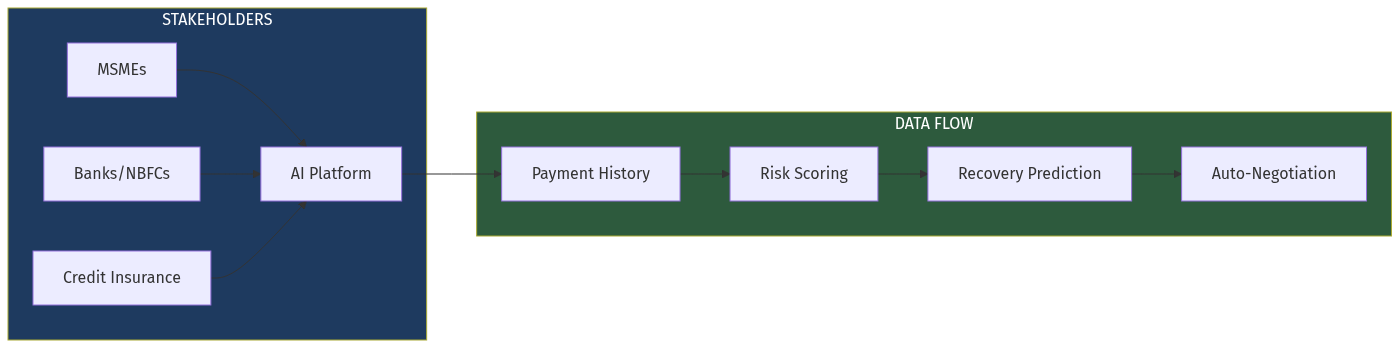
Who Experiences This Pain?

  • MSMEs — Small manufacturers, traders, and service providers who lack bargaining power
  • Large corporate buyers — They exploit payment terms, holding onto working capital
  • Banks/NBFCs — Working capital loans secured by receivables are hard to track
  • Credit insurance companies — Struggle to assess real-time default risk

  • 3.

    Current Solutions

    CompanyWhat They DoWhy They're Not Solving It
    CreditasMSME lending against invoicesFocuses on lending, not collection
    KredXInvoice discountingOnly solves cash flow, not prevention
    AurusB2B paymentsEnterprise-focused, not SMB
    Traditional collection agenciesManual debt recoveryFragmented, aggressive, no tech
    CA/Chartered Accountant firmsManual follow-upsExpensive, inconsistent

    The Gap

    • No intelligent pre-emptive nudges — Current systems react after default, not before
    • No relationship-preserving automation — Agencies prioritize recovery over retention
    • No predictive scoring — No real-time visibility into which invoices will go bad
    • No self-service reconciliation — Buyers have no easy way to dispute or set up payment plans

    4.

    Market Opportunity

    Market Size

    • India B2B payments: $800B+ annually
    • Addressable receivables management market: $4-6B
    • Collection agency market: $2-3B (fragmented, unorganized)

    Growth Drivers

    • UPI/IMPS penetration — Digital payments make auto-debit feasible
    • GST ecosystem — Comprehensive invoice data available
    • MSME formalization — More businesses on GST = more structured data
    • RBI push for trade receivable discounting — Government encouraging ecosystem

    Why Now?

  • Data availability — GSTN, bank statements, UPI transactions create rich payment data
  • LLM capabilities — AI can have natural conversations that preserve relationships
  • Cost economics — AI agents cost 1/10th of human call centers
  • Regulatory tailwinds — RBI and government pushing for MSME cash flow relief

  • 5.

    Gaps in the Market

  • No pre-emptive intelligence — Systems don't predict which invoices will default
  • One-size-fits-all follow-up — No personalized communication cadence
  • No dispute resolution — Buyers can't easily flag issues or negotiate
  • No payment plan automation — Manual renegotiation is expensive
  • No relationship scoring — No visibility into payment behavior patterns
  • No integration with accounting software — Tally, QuickBooks, Zoho Books don't connect
  • No co-lending integration — Banks can't factor in real-time collections for loan decisions

  • 6.

    AI Disruption Angle

    How AI Transforms the Workflow

    Pre-Delinquency (Before due date):
    • AI analyzes payment patterns, GST filings, bank statements
    • Predictive scoring: Which invoices will default?
    • Smart nudges: Personalized reminders via WhatsApp/Email/SMS
    • Dynamic discount offers: Early payment incentives auto-triggered
    Early Delinquency (1-30 days overdue):
    • AI chatbot handles inquiries: "Why is the invoice disputed?"
    • Dispute classification: Quality issues, duplicate invoice, cash flow
    • Auto-escalation rules based on buyer history
    Late Delinquency (30-90 days):
    • AI negotiates payment plans via WhatsApp
    • Personality-matched communication (aggressive vs. relationship-focused buyers)
    • Auto-reconciliation with accounting software
    Recovery (90+ days):
    • Probability-weighted recovery strategies
    • Legal notice generation (automated but legally vetted)
    • Handoff to human agencies only for high-value cases

    The Future: Agents That Transact

    Imagine AI agents that:

    • Negotiate payment terms autonomously
    • Execute auto-debit on due dates
    • File legal notices automatically
    • Secure buy-now-pay-later arrangements
    ---

    7.

    Product Concept

    Core Features

    FeatureDescription
    Invoice IntelligenceAuto-import from GST, Tally, accounting software
    Payment PredictionML model predicts default probability
    Smart NudgesPersonalized WhatsApp/Email reminders
    Chatbot ResolutionsAI handles disputes and questions
    Payment PlansAuto-negotiate and execute EMIs
    Legal AutomationGenerate notices, file on platform
    DashboardReal-time receivables health
    API for LendersIntegrate with banks for loan decisions

    User Flow

  • Upload invoices (manual CSV or API from accounting software)
  • AI assigns risk scores to each invoice
  • Automated follow-up cadence kicks in before due date
  • Buyer can self-serve: view invoices, dispute, request payment plan
  • Payment received → auto-reconciliation
  • Unrecovered → escalate to legal or collection agency

  • 8.

    Development Plan

    PhaseTimelineDeliverables
    MVP8 weeksInvoice upload, basic WhatsApp reminders, simple dashboard
    V112 weeksPayment prediction, dispute chatbot, payment plans
    V216 weeksLegal automation, bank API integrations, credit scoring
    Scale24 weeksMulti-language, PAN-India, NBFC partnerships

    Technical Stack

    • Backend: Node.js/PostgreSQL
    • AI: OpenAI/Gemini for NLP, custom ML models for prediction
    • Communication: WhatsApp Business API, email
    • Integrations: Tally, QuickBooks, Zoho Books, GST API

    9.

    Go-To-Market Strategy

    Phase 1: Seed with Accounting Partners

    • Partner with Tally resellers and CA networks
    • Offer free invoicing integration → paid collection features

    Phase 2: Vertical Focus

    • Target: Manufacturing, pharma, wholesale—sectors with long payment cycles
    • Offer: Industry-specific nudges and communication templates

    Phase 3: Lender Integration

    • Pitch to NBFCs: "We reduce your loan default risk"
    • White-label the platform for banks

    Phase 4: Network Effects

    • Buyers on platform → suppliers join → more data → better predictions

    Pricing

    • SaaS model: 0.5-1% of managed invoice value
    • Recovery fee: 5-10% of recovered amount (vs. 15-25% traditional)

    10.

    Revenue Model

    StreamDescription
    SubscriptionSaaS fee based on invoice volume
    Recovery fee5-10% of successfully recovered amounts
    Lending referralCommission from NBFC partners
    Data licensingAnonymized payment behavior data
    Legal servicesCommission on automated legal collections

    Unit Economics

    • Customer acquisition cost: Rs 50,000-100,000 per enterprise
    • Lifetime value: Rs 2-5 lakhs (based on invoice volume)
    • Payback period: 6-12 months

    11.

    Data Moat Potential

    Proprietary Data That Accumulates

  • Payment behavior patterns — Unique to each buyer
  • Industry benchmarks — Average DSO by sector
  • Dispute taxonomies — Common reasons for non-payment
  • Recovery effectiveness — What communication styles work
  • Credit risk signals — GST anomalies, bank statement patterns
  • Defensible Moat

    • More invoices managed → better ML predictions
    • Network effects: buyers on platform = more supplier adoption
    • Integration depth with accounting software = switching costs

    12.

    Why This Fits AIM Ecosystem

    This opportunity aligns perfectly with AIM's B2B focus:

  • Vertical fit: Receivables management is a vertical workflow—perfect for AIM
  • Data moat: Can leverage GST/corporate data from AIM's existing infrastructure
  • Network effects: Integrates with AIM's domain portfolio (supplier networks)
  • India-first: Designed for Indian payment ecosystems (UPI, GST)
  • AI-native: Core value proposition is AI automation—no legacy to retrofit
  • Potential as AIM Vertical

    • Could launch as AIM Receivables
    • Target: 100,000 MSMEs in 2 years
    • Build: Data network effect with GST/invoice data

    ## Verdict

    Opportunity Score: 8.5/10

    Why High Score

    • Massive market pain ($150B+ locked)
    • Clear value proposition (15-25% → 5-10% recovery fee)
    • Strong defensibility (data moat, network effects)
    • AI-native (no legacy tech to replace)
    • Government tailwinds (MSME cash flow relief priority)

    Risks to Consider

    • Trust building: MSMEs hesitate to share financial data
    • Regulatory complexity: Debt collection has legal constraints
    • Buyer resistance: Large corporates may ignore AI nudges
    • Competition: Banks and fintechs may enter

    Steelmanning the Opposition

    Large NBFCs and banks have advantages:
    • Existing customer relationships
    • Can bundle with lending products
    • Regulatory expertise
    Mitigation: Focus on SMBs that banks ignore, and on relationship-preservation (banks don't care about supplier relationships—only recovery).

    ## Sources

    • Inc42: MSME Finance Report 2025
    • RBI: MSME Credit Data
    • GSTN: Invoice Data Statistics
    • Creditas Website
    • KredX Website
    ---

    Architecture
    Architecture
    Stakeholder Flow
    Stakeholder Flow