ResearchSaturday, March 14, 2026

AI-Powered MSME Compliance Automation: India's Next Big B2B Opportunity

India's 63+ million micro, small, and medium enterprises (MSMEs) face a compliance burden that kills more businesses than competition. GST filings, labor law compliance, tax deductions, EPF/ESI payments, and annual returns create a constant drain on entrepreneur time. Most MSMEs either burn cash on chartered accountants or face penalties for non-compliance. This creates a massive opportunity for AI-powered compliance automation—a market ripe for disruption.

1.

Executive Summary

India's MSME sector contributes 30% of GDP and employs 110 million people. Yet 85% of these businesses struggle with regulatory compliance. The average MSME owner spends 15-20 hours monthly on compliance tasks that could be automated. Current solutions are either expensive CA firms (₹5,000-50,000/year) or basic software that requires manual data entry.

AI can transform this market by building agents that:

  • Automatically fetch transaction data from GSTN, bank accounts, and accounting software
  • Generate and file returns with zero manual intervention
  • Predict compliance risks before they become penalties
  • Provide real-time compliance health scores
Market Potential: ₹45,000 crore (~$5.4B) addressable market in India alone.


2.

Problem Statement

The Compliance Tax on MSMEs

India's regulatory framework for MSMEs includes:

Compliance AreaFrequencyPenalty for Non-Compliance
GST FilingMonthly/Quarterly18% interest + late fee
TDS ReturnsQuarterly1-3% per month
EPF/ESIMonthlyUp to 36% employer contribution as penalty
Professional TaxAnnual/SemiannualVaries by state
Income TaxAnnualInterest + penalty
ROC FilingsAnnual₹100-500/day

Who Experiences This Pain?

  • First-generation entrepreneurs (70% of new MSMEs) who don't understand compliance
  • Small manufacturers in states like Gujarat, Maharashtra, Tamil Nadu with complex labor laws
  • Trading businesses dealing with interstate GST
  • Service providers juggling multiple client TDS requirements
  • E-commerce sellers managing inventory across Amazon, Flipkart, Meesho with different tax implications

The Fundamental Axiom to Question

Everyone assumes "compliance is complex and requires human CA expertise." But this is a legacy assumption from pre-digital India. With GSTN APIs, bank statement scraping, and AI document processing, 80% of compliance work can be fully automated.


3.

Current Solutions

CompanyWhat They DoWhy They're Not Solving It
ClearTaxTax filing platformConsumer-focused, not MSME-specific
TallyAccounting softwareManual filing still required
KhatabookBusiness accountingNo compliance automation
Zoho BooksSMB accountingComplex, enterprise-oriented
MSME Government PortalUdyam registrationOne-time only, no ongoing compliance

The Gap

No Indian SaaS company offers:

  • End-to-end automation from data fetch to filing
  • Proactive penalty prevention (predictive alerts)
  • Multi-state compliance (labor laws vary by state)
  • Affordable pricing (CA firms are the only option below ₹5,000/year)

  • 4.

    Market Opportunity

    Market Size

    • India MSME Compliance Market: ₹45,000 crore (~$5.4B)
    - GST compliance services: ₹18,000 crore - Tax advisory: ₹12,000 crore - Labor law compliance: ₹8,000 crore - ROC/regulatory: ₹7,000 crore
    • Global B2B Compliance Automation: $18B (growing 22% CAGR)

    Growth Drivers

  • GST 2.0: New return filing system enabling more automated data flows
  • Digital India Push: Government mandating online compliance for smaller businesses
  • E-invoicing Expansion: Mandated for businesses above ₹5 crore, expanding to smaller tiers
  • Credit Access: Banks increasingly requiring compliant businesses for loans
  • Insurance Mandates: Group insurance for employees requiring compliance proof
  • Why Now

    The convergence of three factors makes this the perfect time:

  • API Access: GSTN, EPFO, ESIC, and bank APIs are now accessible
  • AI Maturity: LLMs can understand tax law and generate accurate filings
  • Founder Pain: First-generation MSME founders are now tech-savvy enough to adopt SaaS

  • 5.

    Gaps in the Market

    Where Current Players Fail

  • Data Entry Still Required
  • - Existing software requires manual upload of invoices, bills - AI can scrape and categorize automatically
  • No Proactive Intelligence
  • - No system alerts you that you're about to miss a deadline - No prediction of cash flow impact from upcoming tax payments
  • State-Level Labor Laws Ignored
  • - Most platforms focus only on GST - 28 states = 28 different labor law interpretations
  • One-Size-Fits-All
  • - Manufacturing needs differ from trading, which differs from services - No vertical-specific compliance agents
  • No Integration with Business Decisions
  • - Compliance data should inform pricing, inventory, hiring decisions - Current tools treat compliance as isolated administrative work
    6.

    AI Disruption Angle

    How AI Agents Transform Compliance

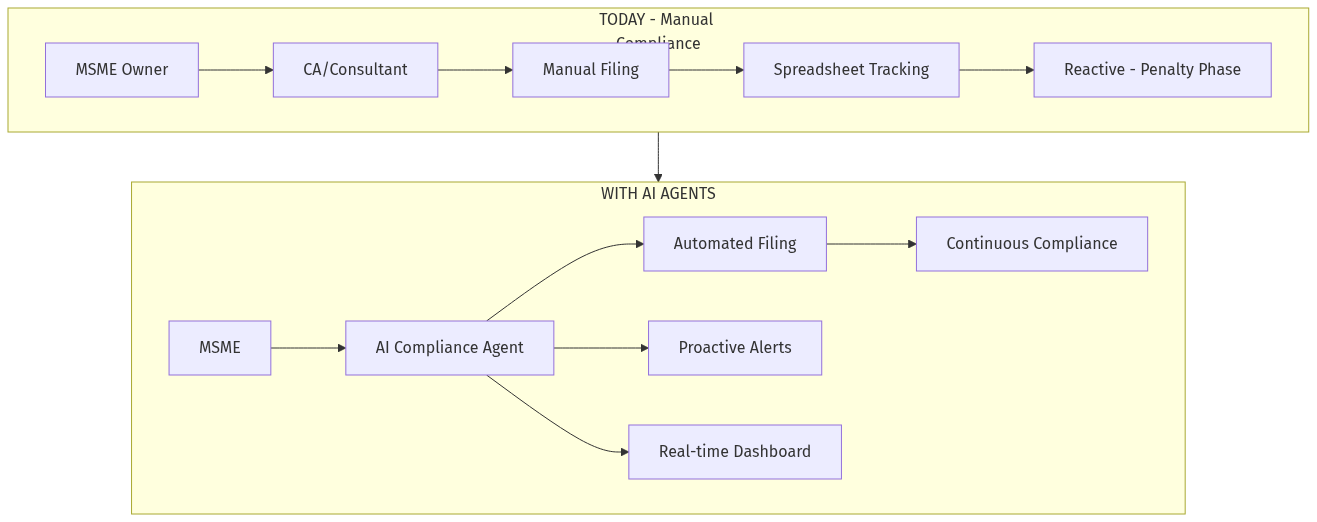
    Current State:
    MSME → CA/Manual → Excel/Software → Filing → Penalty/Reassurance
    Future with AI Agents:
    MSME → AI Agent (continuous) → Auto-filing → Compliance Health Score → Business Intelligence

    The AI Compliance Agent Architecture

    Compliance Flow
    Compliance Flow

    Key AI Capabilities

  • Document Intelligence
  • - OCR for invoices, bills, contracts - Auto-categorization using NLP - Anomaly detection for duplicate/fraudulent entries
  • Regulatory Reasoning
  • - LLM fine-tuned on Indian tax law - Handles GST rate changes, exemption notifications - State-specific labor law interpretation
  • Predictive Analytics
  • - Cash flow forecasting based on tax calendar - Penalty risk scoring - Compliance health scoring
  • Autonomous Filing
  • - Direct API integration with GSTN, EPFO, ESIC - Digital signature automation - Audit trail generation
    7.

    Product Concept

    Core Product: ComplianceMate (or similar)

    Tier 1: Compliance Monitor (Free)
    • Dashboard showing compliance health score
    • Deadline alerts via WhatsApp
    • Basic GST lookup
    Tier 2: Compliance Automator (₹499-999/month)
    • Auto-fetch GST data via API
    • Return preparation and review
    • TDS tracking
    • Basic health score + alerts
    Tier 3: Compliance Agent (₹2,000-5,000/month)
    • Full auto-filing
    • EPF/ESI compliance
    • Labor law compliance (state-specific)
    • Dedicated compliance manager (AI + human hybrid)

    Key Features

  • Bank Statement Sync - Auto-categorize transactions, detect tax-relevant entries
  • GST Auto-Reconciliation - Match invoices with GSTR-2A/2B automatically
  • Tax Calendar - Visual timeline of all compliance deadlines
  • Penalty Predictor - "If you don't file by X, penalty will be ₹Y"
  • Expert Chat - AI-powered Q&A with tax law knowledge base
  • User Flow

  • Onboarding (5 minutes)
  • - Connect GSTN account (via API) - Connect bank account (via CAMS, BankBazaar, or Yodlee) - Select business type (manufacturing/trading/services) - Add employee details for labor compliance
  • Continuous Operation
  • - Agent monitors all data sources daily - Generates compliance tasks automatically - Files returns with approval workflow - Sends WhatsApp alerts for approvals needed
  • Quarterly Review
  • - AI generates compliance report - Compares with industry benchmarks - Suggests tax optimization opportunities
    8.

    Development Plan

    PhaseTimelineDeliverables
    MVP8 weeksGST filing automation, basic dashboard, WhatsApp alerts
    V112 weeksEPF/ESI integration, bank sync, health scoring
    V216 weeksState-specific labor laws, AI advisor, API marketplace
    Scale24 weeksEnterprise features, accounting integrations, loan marketplace

    Technical Stack

    • Backend: Node.js + Python (for AI/ML)
    • Database: PostgreSQL + Redis
    • AI: Fine-tuned Llama/Claude for tax law reasoning
    • Integrations: GSTN API, Bank APIs (Yodlee/CAMS), EPFO/ESIC portals
    • Notifications: WhatsApp Business API (Kapso), SMS, Email

    Team Requirements

    • 2 Full-stack developers
    • 1 AI/ML engineer (tax law fine-tuning)
    • 1 Product manager (domain expert)
    • 1 CA consultant (part-time, for compliance verification)

    9.

    Go-To-Market Strategy

    Phase 1: Digital-First SMBs (Months 1-3)

    Target: E-commerce sellers, D2C brands, tech-enabled service providers Channels:
  • SEO + Content: "GST filing for Amazon sellers", "MSME compliance checklist"
  • WhatsApp Marketing: Target business owners in seller groups
  • Partner with Marketplaces: Amazon, Flipkart seller meetups
  • Pricing: ₹499/month (accessible to validate product)

    Phase 2: Traditional MSMEs (Months 4-8)

    Target: Small manufacturers, traders, local businesses Channels:
  • CA/CA Firm Partnerships: White-label or referral model
  • Industry Associations: SIDBI, MSME chambers, local Vitti Samaj
  • Trade Shows: MSME exhibitions, business summits
  • Pricing: ₹1,500-2,000/month

    Phase 3: Enterprise MSME (Months 9-12)

    Target: Mid-market businesses with 50+ employees Channels:
  • Direct Sales: Dedicated sales team for ₹5,000+ monthly contracts
  • ERP Integrations: Tally, Marg, Busy partnerships
  • Banking Partnerships: Embed compliance in loan products
  • Pricing: ₹5,000-15,000/month
    10.

    Revenue Model

    Primary Revenue Streams

  • Subscription Revenue (70% of revenue)
  • - Monthly/annual SaaS subscriptions - Tiered pricing: Free → ₹499 → ₹1,500 → ₹5,000+
  • Filing Fees (15% of revenue)
  • - Per-return filing fees for GST, TDS - Optional add-on for auto-filing
  • Value-Add Services (15% of revenue)
  • - CA consultation credits - Loan marketplace referral fees - Insurance product referrals

    Unit Economics

    MetricTarget
    CAC₹2,000-5,000
    LTV₹24,000-60,000
    LTV:CAC Ratio5-10x
    Gross Margin70-80%
    Payback Period6-12 months
    ---
    11.

    Data Moat Potential

    Proprietary Data Assets

  • Compliance Patterns Database
  • - What MSMEs struggle with (by industry, location, size) - Seasonal compliance patterns - Common errors and how to fix them
  • Tax Law Q&A Knowledge Base
  • - Fine-tuned LLM on Indian tax precedents - State-specific labor law variations
  • Business Health Intelligence
  • - Anonymized compliance data reveals business health - Predictive models for business failure/growth - Credit scoring enhancement for lenders
  • Integration Network Effects
  • - More integrations → better data → smarter AI → more users - Switching costs become insurmountable over time
    12.

    Why This Fits AIM Ecosystem

    This opportunity aligns perfectly with AIM's vision:

  • Vertical Fit: MSME compliance is a perfect vertical for AIM's agent framework
  • Domain Expansion: Complements existing procurement/ordering agents
  • India Focus: Specifically Indian market, not a global play
  • Revenue Model: Recurring subscriptions, high retention potential
  • Network Effects: Can integrate with AIM's marketplace agents
  • Potential Integration Points

    • With Procurement Agents: Auto-check compliance before vendor payments
    • With Lending Agents: Provide compliance health scores for loan eligibility
    • With Accounting Agents: Two-way sync with existing accounting software
    • With Domain Portfolio: compliance.ai, msme.in, gst.in domains

    ## Verdict

    Opportunity Score: 8.5/10

    Why High Score

    • Massive market: 63M+ MSMEs in India
    • Clear pain: Compliance is expensive, time-consuming, and penalty-laden
    • AI-ready: Regulatory data is structured, APIs are accessible
    • Timing right: Digital adoption + first-gen founders + government push

    Risks & Mitigations

    RiskProbabilityImpactMitigation
    API access changesMediumHighBuild hybrid human+AI model
    CA oppositionMediumMediumPartner, don't replace CAs
    Regulatory changesHighLowBuild adaptable AI architecture
    Competition from big techLowHighFocus on MSME-specific features

    Steelmanning (Why Incumbents Might Win)

  • Tally/ClearTax have brand trust - MSME owners hesitate to try new compliance tools
  • Government portals may offer free compliance - Already happening with GSTN
  • CA network is deeply entrenched - Relationship-based, not product-based
  • Response: Focus on automation efficiency. If AI can save 15 hours/month at ₹1,000 cost vs. CA at ₹5,000, economics win regardless of trust.

    ## Sources