ResearchSaturday, March 14, 2026

AI-Powered Third-Party Risk Management (TPRM) Platform: The $12B Market Opportunity

Every major data breach in 2025 involved a third-party vendor. Yet 78% of Indian companies still manage vendor risk via spreadsheets. AI can reduce vendor assessment time from 3 months to 3 days while continuously monitoring 10,000+ vendors in real-time.

1.

Executive Summary

Third-Party Risk Management (TPRM) has become a board-level concern following a wave of high-profile supply chain breaches. The average enterprise works with 1,200+ third-party vendors, yet most Indian companies lack the resources to properly assess and monitor this expanding attack surface.

This presents a massive opportunity for an AI-powered TPRM platform that can:

  • Automate vendor risk assessments using public data + AI analysis
  • Provide continuous monitoring instead of point-in-time assessments
  • Generate actionable risk scores in hours, not months
  • Scale to monitor thousands of vendors simultaneously
The global TPRM market is $12 billion and growing at 22% CAGR. In India, the opportunity is driven by:
  • RBI cybersecurity guidelines requiring vendor risk management
  • Data Protection Act (DPDP Act) compliance requirements
  • Increasing outsourcing to IT/ITES vendors

---

2.

Problem Statement

The Vendor Risk Crisis

Modern enterprises depend on hundreds of vendors for:

  • IT Services: Cloud providers, SaaS tools, IT support
  • Business Operations: Payroll, HR, facilities
  • Supply Chain: Manufacturers, logistics, distributors
  • Financial Services: Banks, payment processors, insurers
Each vendor is a potential entry point for:
  • Data breaches ( vendor accesses your data)
  • Operational disruption ( vendor goes down)
  • Regulatory non-compliance ( vendor doesn't meet standards)
  • Financial fraud ( vendor misuses funds)

Current Pain Points

Pain PointImpact
3-6 month assessment cycleVendors onboarded before risks identified
Manual questionnaire processes40+ hour effort per vendor, mostly busywork
Point-in-time assessmentsRisk changes between annual reviews go unnoticed
No visibility into sub-vendorsFourth-party risks invisible
Inconsistent scoringDifferent assessors give different ratings
Compliance fragmentationMultiple frameworks (SOC2, ISO, GDPR) = multiple efforts

Who Experiences This Pain?

  • CISOs: Can't get board visibility into vendor risks
  • Procurement teams: Forced to accept unknown vendors due to speed pressure
  • Compliance officers: Drowning in questionnaire responses
  • Legal teams: Can't track contractual risk clauses
  • Finance: Can't assess vendor financial viability

3.

Current Solutions

Global TPRM Platforms

CompanyWhat They DoWhy They're Not Solving It
SecurityScorecardSecurity ratings, external scanningUS-centric, expensive, limited Indian data
UpGuardSecurity ratings, data leak detectionSMB focus, limited continuous monitoring
RiskReconSecurity ratings, dependency mappingLimited Indian market coverage
ProcessUnityTPRM software, questionnairesHeavy manual process, enterprise only
OneTrustGRC platform, includes TPRMComplex, expensive, not AI-native

What's Missing in India

  • No Indian-specific risk data: Global tools don't track Indian companies well
  • Manual questionnaire dependency: Still relies on vendors self-reporting
  • No continuous monitoring: Annual assessments miss in-year changes
  • Poor integration: Doesn't work with Indian compliance frameworks
  • Cost prohibitive: Global tools pricing is 10x what Indian SMBs can pay
  • No vernacular support: Hindi/Tamil/Telugu vendor communications missing

  • 4.

    Market Opportunity

    Market Size

    SegmentGlobalIndiaGrowth
    Enterprise TPRM$8.2B$400M20% CAGR
    SMB TPRM$2.1B$150M35% CAGR
    Supply Chain Risk$1.7B$80M28% CAGR
    Total$12B$630M22% CAGR

    Why Now

  • RBI Guidelines: Banks must assess third-party IT risks (2024 guidelines)
  • DPDP Act: Data processors require vendor compliance documentation
  • Supply Chain Attacks: SolarWinds, MOVEit breaches drove awareness
  • Remote Work Expansion: Attack surface expanded dramatically
  • AI Readiness: LLMs can now analyze unstructured risk data at scale
  • Indian Startup Growth: 100+ Indian unicorns need vendor risk programs

  • 5.

    Gaps in the Market

    Using Anomaly Hunting analysis:

    GapWhy It ExistsOpportunity
    No Indian SMB coverageGlobal tools ignore <$10M revenue companies5M+ Indian SMBs need affordable TPRM
    Continuous monitoring absentToo expensive to maintainAI can automate at 1/10th cost
    Fourth-party visibilityToo complex to map sub-vendorsAI can auto-discover via public data
    Automated evidence collectionManual document collectionAI can fetch certs, reports automatically
    Real-time alertingNo integration with threat feedsAI can correlate with live threat intelligence
    Indian compliance alignmentGlobal tools don't map to local regulationsBuild for RBI, SEBI, DPDP requirements
    ---
    6.

    AI Disruption Angle

    How AI Transforms TPRM

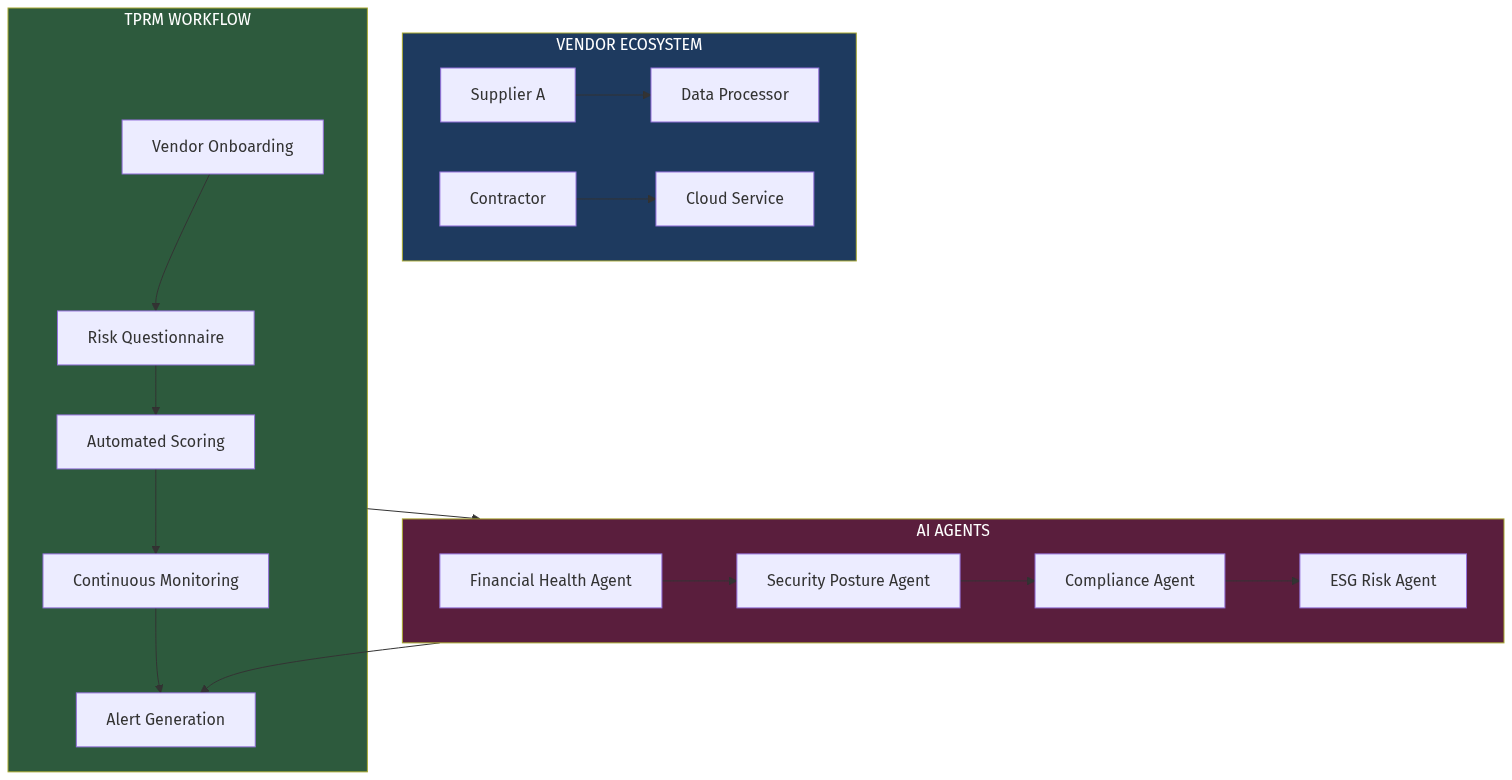
    TPRM Architecture
    TPRM Architecture

    #### Key AI Capabilities

  • Automated Risk Discovery
  • - Scrape 50+ public data sources for vendor information - Parse financial filings, news, social media - Identify adverse media and legal issues - Map ownership structures and connections
  • Intelligent Risk Scoring
  • - Train models on historical breach data - Weight risk factors by industry and geography - Generate consistent 0-100 scores - Explain scoring rationale in plain English
  • Continuous Monitoring
  • - Monitor for changes in real-time - Alert on new risk indicators - Track remediation progress automatically - Update scores dynamically
  • Questionnaire Automation
  • - Use AI to generate intelligent questionnaires - Analyze responses for inconsistencies - Auto-score based on response quality - Reduce 40-hour assessment to 4-hour oversight
  • Fourth-Party Mapping
  • - Discover vendor dependencies automatically - Map supply chain networks - Identify concentration risks - Model cascade failure scenarios
    7.

    Product Concept

    Core Features

    FeatureDescription
    Vendor RegistryCentral database of all vendors with risk profiles
    Risk ScoringAI-generated scores updated continuously
    Assessment WorkflowAutomated questionnaires with AI analysis
    Threat IntelligenceReal-time alerts on vendor-related threats
    Compliance MappingMap risks to SOC2, ISO, RBI, DPDP requirements
    Remediation TrackingTrack vendor fixes to completion
    ReportingBoard-ready reports with drill-downs
    API IntegrationsConnect with ERP, GRC, and ticketing systems

    User Flow: Vendor Onboarding

    TPRM Workflow
    TPRM Workflow
  • Procurement requests new vendor
  • System auto-discovers vendor from public data
  • AI generates initial risk score
  • If score < threshold, automated questionnaire triggered
  • AI analyzes questionnaire responses
  • Risk report generated with recommendations
  • Approval workflow with appropriate stakeholders
  • Ongoing monitoring enabled

  • 8.

    Development Plan

    PhaseTimelineDeliverables
    MVP8 weeksVendor registry, basic risk scoring, 10 data sources
    V112 weeksQuestionnaire automation, continuous monitoring, API integrations
    V216 weeksFourth-party mapping, compliance framework mapping, mobile app
    Scale24 weeks100+ data sources, custom ML models, enterprise features

    Technical Architecture

    ┌─────────────────────────────────────────────────────────────┐
    │                    PLATFORM ARCHITECTURE                      │
    ├─────────────────────────────────────────────────────────────┤
    │                                                              │
    │  ┌──────────────┐   ┌──────────────┐   ┌──────────────┐  │
    │  │ Next.js      │   │ Python/       │   │ External     │  │
    │  │ Frontend     │◀─▶│ FastAPI       │◀─▶│ Data Sources │  │
    │  │              │   │ Backend       │   │              │  │
    │  └──────────────┘   └──────────────┘   └──────────────┘  │
    │         │                  │                   │            │
    │         ▼                  ▼                   ▼            │
    │  ┌─────────────────────────────────────────────────────┐   │
    │  │              PostgreSQL + Redis                       │   │
    │  │  • Vendors  • Risk Scores  • Assessments             │   │
    │  │  • Alerts   • Integrations • Audit Logs              │   │
    │  └─────────────────────────────────────────────────────┘   │
    │         │                  │                   │            │
    │         ▼                  ▼                   ▼            │
    │  ┌─────────────────────────────────────────────────────┐   │
    │  │              AI/ML Services                          │   │
    │  │  • Risk Scoring Model (XGBoost)                      │   │
    │  │  • NLP Parser (Financials, News)                     │   │
    │  │  • Questionnaire Analyzer (LLM)                      │   │
    │  │  • Threat Intelligence Correlator                    │   │
    │  └─────────────────────────────────────────────────────┘   │
    │                                                              │
    └─────────────────────────────────────────────────────────────┘

    9.

    Go-To-Market Strategy

    Phase 1: Beachhead (Months 1-4)

    • Target: 50 mid-sized companies (500-5000 employees)
    • Vertical: IT services, BFSI, healthcare
    • Channels: CISOs LinkedIn, cybersecurity conferences
    • Pricing: ₹5-15L/year (1/5th of global tools)
    • Why: Reference customers, product feedback

    Phase 2: SMB Expansion (Months 4-8)

    • Target: 500 SMBs (100-500 employees)
    • Vertical: Any industry with vendor dependencies
    • Channels: Partner with IT service providers, consultants
    • Pricing: ₹50K-2L/year (self-serve)
    • Why: Large market, lower sales cost

    Phase 3: Enterprise (Months 8-14)

    • Target: 50 large enterprises
    • Vertical: Banks, NBFCs, large manufacturers
    • Channels: Direct sales, system integrators
    • Pricing: ₹25-100L/year (custom)
    • Why: Higher revenue, reference accounts

    Phase 4: Platform Ecosystem (Months 14-24)

    • Launch: Marketplace for assessors, consultants
    • Integrations: SAP, Oracle, ServiceNow, Jira
    • Certification: Partner with auditors for integrated assessments

    10.

    Revenue Model

    Revenue Streams

    StreamModelPotential
    SaaS SubscriptionPer-vendor/per-seat pricing$2,000-100,000/year
    Risk ReportsOn-demand deep-dive reports$500-5,000/report
    Assessment ServicesOutsourced vendor assessments$1,000-10,000/assessment
    API AccessData feeds for enterprises$10,000-100,000/year
    Consulting ReferralPartner revenue share15-20% of deal

    Unit Economics

    MetricConservativeOptimistic
    CAC (enterprise)₹8L₹5L
    CAC (SMB)₹1.5L₹80K
    LTV (enterprise)₹40L₹60L
    LTV (SMB)₹6L₹10L
    LTV:CAC (enterprise)5x12x
    LTV:CAC (SMB)4x12.5x
    ---
    11.

    Data Moat Potential

    Proprietary Data Assets

  • Indian Vendor Risk Database
  • - 500K+ vendor profiles - Unique in India - Value: Only comprehensive Indian vendor data
  • Risk Scoring Models
  • - Trained on Indian breach data - Custom weights for local risk factors - Value: Predictive accuracy improves over time
  • Assessment Templates
  • - Built for Indian compliance frameworks - Mapped to RBI, SEBI, DPDP requirements - Value: Pre-built compliance workflows
  • Remediation Playbooks
  • - Industry-specific fix recommendations - Cost/impact analysis - Value: Guide vendor improvements
    12.

    Why This Fits AIM Ecosystem

    This platform aligns with AIM's vision:

  • B2B Focus: Direct fit with AIM's B2B marketplace strategy
  • Data Intelligence: Leverages Netrika's research capabilities
  • Trust Layer: Complements Bhavya's WhatsApp commerce with verified vendors
  • Geographic Focus: Indian-specific data and compliance
  • Potential Integration Points

    • AIM.in: Vendor discovery + reviews + risk scores
    • WhatsApp Commerce: Verified vendor directory for B2B transactions
    • Domain Portfolio: vendorrisk.in, tprm.in, supplychainrisk.in

    ## Verdict

    Opportunity Score: 8/10

    Strengths

    • Large and growing market ($12B global, $630M India)
    • Clear pain point with willing enterprise buyers
    • AI provides genuine differentiation vs. manual processes
    • Strong data moat potential
    • Recurring revenue SaaS model

    Risks

    • Enterprise sales cycles are long (6-12 months)
    • Global players may expand to India
    • Need specialized talent (security + ML)
    • Regulatory uncertainty (DPDP implementation)

    Why 8/10

    TPRM is a genuine, growing market with clear buyer pain. The opportunity to build India-specific data and compliance features gives a local advantage. The key is execution - building trust with CISOs while demonstrating measurable risk reduction. This is a "slow but steady" business that compounds over time.

    ## Sources