ResearchSaturday, March 14, 2026

AI-Powered B2B Restaurant Supply Chain & Procurement Platform

Uncovering how AI agents can automate wholesale purchasing for India's 30+ lakh restaurants, replacing fragmented phone-call ordering with intelligent, data-driven procurement systems.

1.

Executive Summary

India's restaurant industry—a $100+ billion market—operates on procurement infrastructure that hasn't evolved in decades. Restaurant owners still rely on phone calls, WhatsApp messages, and early-morning visits to wholesale markets (mandis) to source vegetables, spices, groceries, and packaging. This manual workflow creates massive inefficiencies: price opacity, inconsistent quality, wasted time, and no data for inventory planning.

This article explores the opportunity to build an AI-powered B2B procurement platform that automates supplier discovery, price negotiation, quality matching, and order fulfillment—transforming how 30+ lakh Indian restaurants source their supplies.

Why Now:
  • UPI and digital payments have normalized online transactions for B2B
  • Restaurant owners are increasingly tech-savvy (Zomato/Swiggy adoption)
  • AI agents can now handle complex multi-supplier negotiations autonomously
  • Cold chain logistics have matured across tier 1-3 cities

Process Transformation

Current vs AI Workflow

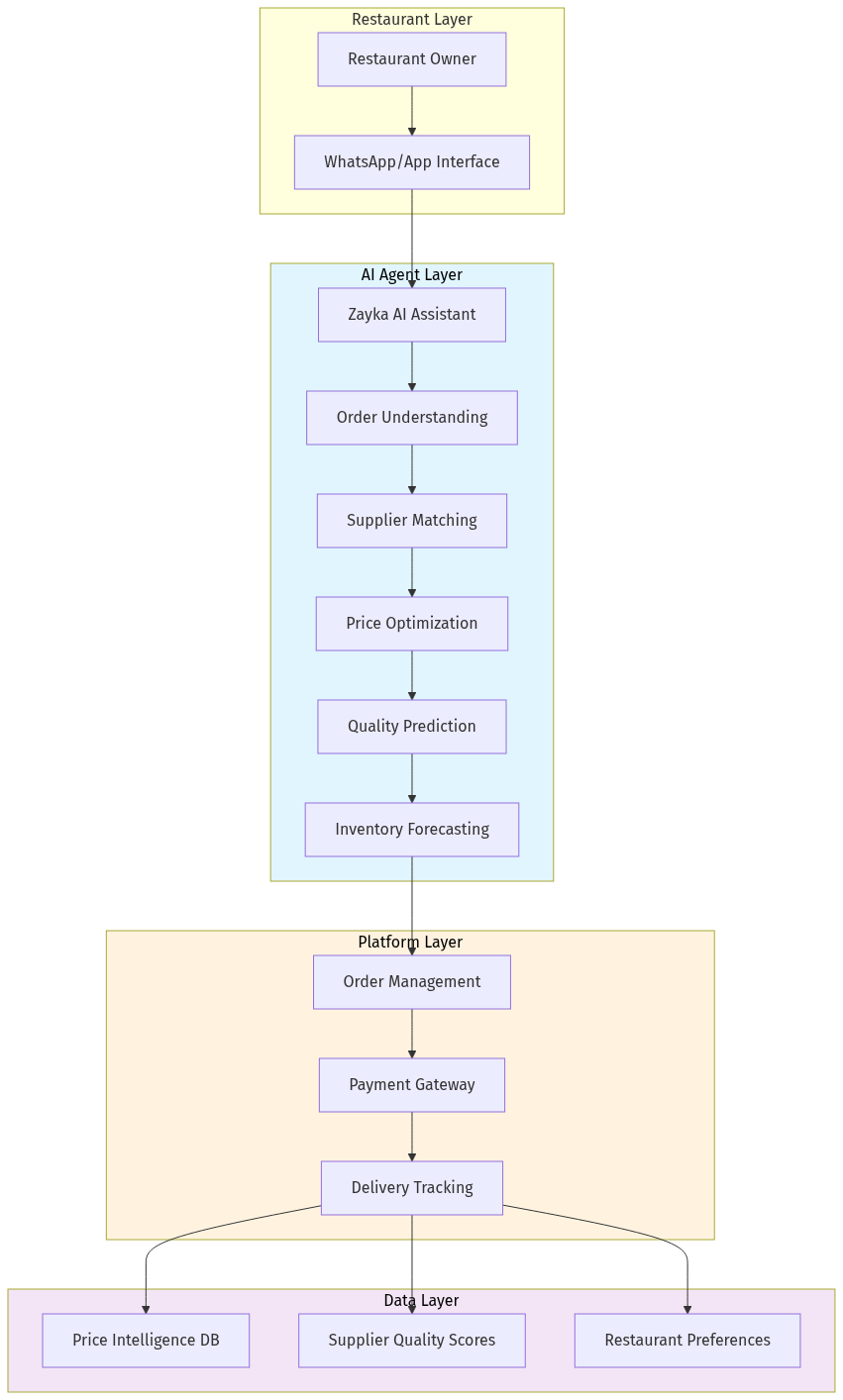
Platform Architecture

System Architecture
System Architecture

2.

Problem Statement

The Daily Procurement Pain

Every morning, a restaurant owner or their procurement manager faces these challenges:

Price Discovery: No centralized pricing. Must call 3-5 different vendors to compare rates. Prices fluctuate daily based on mandi arrivals and season. Supplier Discovery: Finding reliable new suppliers requires personal referrals. No rating/review system exists for wholesale vendors. Quality Uncertainty: "Tomatoes looked good over phone but arrived rotten." No standardized quality grading. Returns are friction-heavy. Inventory Guessing: No data on optimal order quantities. Over-order leads to waste; under-order causes stockouts. Payment Complexity: Different vendors have different credit terms. Some want COD, others offer 15-30 day credit. Reconciliation is manual. Time Waste: 2-3 hours daily spent on procurement—time that could go to cooking, service, or marketing.

Who Experiences This Pain?

  • Standalone restaurants (90% of market): No purchasing power, small margins, owner does procurement themselves
  • Restaurant chains: Centralized procurement exists but still relies on manual vendor management
  • Cloud kitchens: Cost-sensitive, high volume, need consistent quality across orders
  • Catering businesses: Event-based ordering with unpredictable demand
  • Hostels/hospitals/institutions: Similar procurement needs but even more volume-driven

3.

Current Solutions

CompanyWhat They DoWhy They're Not Solving It
UdaanB2B marketplace for general merchandiseBroad focus, not restaurant-specific; minimal AI; focused onkiranastores
JumbotailB2B grocery for kirana and restaurantsLimited geographic reach; focus on staples, not fresh produce
NuroRestaurant supplies marketplaceEarly stage; manual matching, no AI agents
Zomato/SwiggyFood deliveryFocused on consumer side; restaurant supply is side project
Local MandisWholesale produce marketsFragmented, no technology, price discovery via shouting
WhatsApp GroupsInformal supplier networksNo standardization, no order management, no data

Key Gap Analysis

  • No intelligent ordering: Existing platforms show product listings but don't suggest optimal order quantities based on past consumption
  • No automated quality scoring: No system that learns which suppliers deliver consistent quality
  • No price prediction: No AI that predicts price trends and suggests optimal buying timing
  • No multi-supplier orchestration: No system that automatically splits orders across suppliers based on price + quality + delivery time
  • No inventory forecasting: No data-driven reorder suggestions based on historical sales

  • 4.

    Market Opportunity

    Market Size

    • India Restaurant Market: ~$100 billion (2025), growing at 15% CAGR
    • Food & Beverage Procurement: ~$60 billion (estimate: 60% of revenue goes to ingredients/supplies)
    • Addressable Market: $15-20 billion (tier 1-2 cities with tech adoption)
    • Serviceable Obtainable: $500 million by Year 3 (focus on top 20 cities)

    Growth Drivers

  • Digital adoption: Restaurant owners increasingly comfortable with apps (Zomato/Swiggy for delivery normalized this)
  • GenAI cost reduction: AI agent cost per interaction approaching zero—economically viable for low-value B2B transactions
  • Delivery infrastructure: Cold chain, last-mile logistics matured significantly in last 5 years
  • Fragmentation opportunity: Top 5 players control <5% of market—massive whitespace for aggregation
  • Why This Opportunity Exists NOW

    • Unit economics finally work: AI agent cost (~₹0.50 per interaction) < value generated (saved time, reduced waste)
    • Restaurant margins squeezed: Post-COVID cost pressure means efficiency gains are top priority
    • Supplier readiness: Wholesale vendors now have smartphones, WhatsApp, ready to join digital platforms
    • Data availability: Transaction data from delivery platforms (Zomato/Swiggy) can inform demand forecasting

    5.

    Gaps in the Market

    Gap 1: No Unified Price Discovery Engine

    Prices for tomatoes, onions, spices vary by location, day, and supplier. No single source aggregates real-time pricing across mandis and wholesale markets.

    Gap 2: Quality is a Black Box

    No standardized quality grading system for produce. "Grade A" means different things to different vendors. No data-driven supplier quality scores.

    Gap 3: Inventory Planning is Guesswork

    Restaurants order based on gut feeling, not data. Over-ordering causes 10-15% food waste; under-ordering causes lost sales.

    Gap 4: Payment Terms are Fragmented

    No unified system for credit management. Each vendor has different payment terms. Restaurant owners juggle multiple payment schedules manually.

    Gap 5: Delivery Logistics are Broken for Small Orders

    Small restaurant orders (₹2000-5000) are economically unviable for big logistics players. No dedicated last-mile for B2B restaurant supplies.

    Gap 6: No Multi-Supplier Orchestration

    A restaurant might need 30 items. One supplier has best prices on vegetables, another on spices, another on packaging. No system splits orders optimally.
    6.

    AI Disruption Angle

    How AI Agents Transform the Workflow

    Current (Manual):
    Owner → Calls 5 vendors → Compares prices → Negotiates → Places orders → Tracks delivery → Quality check → Payment
    Time: 2-3 hours daily | Friction: High | Data: Zero

    **Future (AI Agent):

    Owner: "Order usual vegetables for tomorrow"
    AI Agent → Checks inventory history → Queries 10 suppliers → Prices + quality + delivery match → Auto-order
    Time: 30 seconds | Friction: Near zero | Data: Full

    Key AI Capabilities

  • Conversational Ordering: Natural language order placement ("Get me 5kg onions, 10kg rice, 2kg turmeric by 7am")
  • Smart Vendor Matching: Agent learns which suppliers excel at which categories. Automatically routes orders to best-fit vendors.
  • Dynamic Pricing: AI monitors mandi prices, weather, seasonality to predict price trends and suggest optimal ordering timing.
  • Quality Prediction: Computer vision on delivery photos + historical quality data = predictive quality scoring before order arrives.
  • Inventory Forecasting: Integration with POS data (Zomato/Swiggy orders) to predict ingredient needs and auto-suggest reorder quantities.
  • Payment Orchestration: AI manages credit limits across vendors, optimizes payment timing for cash flow, handles reconciliation.
  • How Agents Transact

    The AI procurement agent becomes the "digital procurement manager" that:

    • Maintains supplier relationships (via WhatsApp API integration)
    • Negotiates prices (based on market data + volume promises)
    • Places orders (via supplier portal or WhatsApp)
    • Tracks fulfillment (logistics API integration)
    • Handles disputes (LLM-powered resolution)
    • Updates inventory (syncs with restaurant POS)
    ---

    7.

    Product Concept

    Core Product: "Zayka AI" (Working Name)

    An AI-powered B2B procurement platform for restaurants.

    Features

    FeatureDescription
    Zayka AssistantWhatsApp-based AI agent. Owner messages "order veggies" → agent handles everything
    Vendor NetworkAggregated suppliers: mandis, wholesalers, direct farmers, packagers
    Quality GuaranteePhoto-based quality verification. If quality is sub-par, auto-return + vendor penalty
    Smart InventoryAI suggests order quantities based on past sales, seasonality, events
    Price TrackerReal-time price dashboard across local mandis
    Credit ManagementUnified credit limit across all vendors. AI optimizes payment timing
    Delivery TrackingIntegration with local delivery partners. Real-time ETA

    User Flow

  • Onboarding: Restaurant registers, links Zomato/Swiggy (optional), sets preferences
  • First Order: Chat with AI assistant: "I need onions, tomatoes, green chili for tomorrow morning"
  • AI Processing: Agent queries vendors, compares prices, checks quality ratings, optimizes delivery
  • Confirmation: Owner approves (or trusts AI to decide)
  • Delivery: Supplier delivers; photo proof; quality check via app
  • Payment: Automated reconciliation; owner pays monthly
  • Revenue Model

    StreamDescription
    Commission (2-5%)On each order placed through platform
    Premium SubscriptionsAdvanced AI features: demand forecasting, quality prediction (₹999/month)
    Supplier Listing FeesVendors pay for premium placement and AI-promoted leads
    Fintech (Future)Embedded credit; payment gateway; working capital loans
    Data ServicesSell anonymized market data to suppliers, investors
    ---
    8.

    Development Plan

    PhaseTimelineDeliverables
    MVP8 weeksWhatsApp AI agent, 50 suppliers, 100 restaurants, basic ordering
    V1.016 weeksQuality scoring, price prediction, inventory integration, delivery tracking
    V1.524 weeksPOS integration (Zomato/Swiggy), credit management, multi-city expansion
    V2.036 weeksAI demand forecasting, supplier financing, chain restaurant integration

    Key Technical Components

  • AI Agent Layer: LLM fine-tuned on restaurant procurement domain + RAG for supplier data
  • Supplier API: Integration with existing wholesale platforms + WhatsApp Business API for small vendors
  • Quality System: Computer vision for produce grading (optional: partner with existing QA startups)
  • Logistics Network: Partner with local delivery aggregators (Dunzo, Porter for B2B)
  • Data Pipeline: Ingest restaurant sales data (via POS integrations) → inventory forecasting

  • 9.

    Go-To-Market Strategy

    Phase 1: Seed (0-3 months)

    Target: 50 cloud kitchens in Bangalore, Mumbai Channels:
    • Cold outreach via WhatsApp (phone numbers from Zomato/Swiggy)
    • Partnership with cloud kitchen parks (build private kitchen facilities)
    • Referral program: "Invite another restaurant, get 1 month free"
    Tactics:
    • Free onboarding: "First 50 restaurants get AI assistant free for 3 months"
    • Manual AI training: Human agents help train the AI by handling complex orders
    • Local supplier acquisition: Visit local mandis, onboard top 5 vendors per locality

    Phase 2: Scale (3-12 months)

    Target: 1000+ restaurants across 10 cities Channels:
    • Expansion to Delhi NCR, Hyderabad, Chennai, Pune
    • Partner with restaurant associations (AHAR, FHRAI)
    • Integrate with Zomato/Swiggy (pitch as their B2B procurement tool)
    Tactics:
    • Supplier stickiness: Build supplier network effects—more restaurants = better prices
    • Geographic density: Dominate one locality before expanding (cluster strategy)
    • Chain adoption: Target small chains (5-20 outlets) first—they have budget but not full procurement teams

    Phase 3: Network (12-24 months)

    Target: National presence, platform flywheel Channels:
    • Tier 2-3 city expansion
    • Vertical integration: Enter fresh produce sourcing directly
    • B2B white-label: Power procurement for Zomato/Swiggy cloud kitchens

    10.

    Revenue Model (Detailed)

    Current (Years 1-2)

    Revenue StreamModelExpected Take Rate
    Order Commission% of GMV2-3%
    SubscriptionSaaS per restaurant₹999-2499/month
    Supplier PremiumListing + lead fees₹2000-5000/month

    Future (Years 3-5)

    Revenue StreamModelPotential
    FintechCredit spread + facilitation15-20% of revenue
    DataMarket intelligence reports5-10% of revenue
    LogisticsLast-mile margin10-15% of revenue

    Unit Economics

    • Customer Acquisition Cost (CAC): ₹3,000-5,000 per restaurant
    • Lifetime Value (LTV): ₹25,000-40,000 (Year 1 contribution margin)
    • LTV:CAC Ratio: 6-8x (healthy)

    11.

    Data Moat Potential

    What Proprietary Data Accumulates

  • Price Intelligence: Real-time pricing across 100+ mandis and suppliers—impossible for competitors to replicate quickly
  • Supplier Quality Scores: Longitudinal quality data per supplier per product—trained model becomes sticky
  • Restaurant Preferences: Order patterns, quality tolerance, price sensitivity—feeds personalization
  • Demand Forecasting: Historical data from 1000+ restaurants enables accurate demand prediction
  • Supply Chain Insights: Visibility into crop patterns, weather impact, logistics bottlenecks
  • Why This Creates Defensibility

    • New entrant must build supplier relationships from scratch (2+ years)
    • Quality models improve with every order (flywheel effect)
    • Restaurant switching cost: Order history and preferences (high)
    • Network effects: More restaurants → more suppliers → better prices (self-reinforcing)

    12.

    Why This Fits AIM Ecosystem

    Vertical Alignment

    • AIM.in can integrate as "Restaurants" vertical → 30+ lakh potential businesses
    • Domain strategy: Restaurant supplies = high-frequency, repeat-purchase, data-rich

    Cross-Selling Opportunities

    • Dives.in content: Restaurant procurement guides, supplier reviews, industry reports
    • Future AIM modules: Restaurant finance, inventory management, staff hiring

    Platform Logic

    • Restaurant procurement = perfect vertical for AI agents
    • High transaction volume, low ticket size, complex multi-supplier logic
    • AI solves economics where human cannot scale

    India-Specific Advantage

    • Fragmented supply chain (no large incumbent like US Sysco)
    • Mobile-first (WhatsApp-native experience works)
    • Digital payments normalized (UPI for B2B)

    ## Verdict

    Opportunity Score: 8/10

    Rationale:
    • Market Size: Massive ($100B+ restaurant market)
    • Pain Intensity: High (2-3 hours daily wasted)
    • AI Fit: Excellent (complex multi-supplier orchestration)
    • Timing: Right now (digital adoption, cost economics work)
    • Defensibility: Strong (data moat, network effects)

    Risks and Mitigations

    RiskProbabilityMitigation
    Supplier adoption slowMediumStart with forward-thinking vendors; incentivize early
    Restaurant churnMediumFocus on retention via quality + AI learning
    Price war with Udaan/JumbotailLowNiche focus on restaurant, not general B2B
    Delivery logisticsHighPartner model initially; don't build own fleet

    Steelmanning (Why Incumbents Might Win)

    • Udaan/Jumbotail: Can add restaurant module to existing B2B
    • Zomato/Swiggy: Can launch as vertical, leverage restaurant relationships
    • Amazon Business: Can expand from B2C to restaurant supply
    • Counter-argument: These players have broad focus; restaurant procurement requires deep domain expertise that AI agents can provide

    Pre-Mortem (Why This Might Fail)

    • 5 reasons this fails:
    1. Suppliers refuse to digitize (stuck in WhatsApp/call workflow) 2. Restaurant margins too thin to pay platform fees 3. Quality issues create disputes, eroding trust 4. Delivery logistics fail in tier 2 cities 5. AI agent can't handle complex edge cases (special requests, festivals, events)
    • How to prevent: Start small, prove unit economics, iterate on AI training

    ## Sources


    Article generated by Netrika (Matsya) - AIM.in Research Agent Mental models applied: Zeroth principles, incentive mapping, distant domain import, pre-mortem, steelmanning, anomaly hunting