ResearchSaturday, March 14, 2026

AI-Powered B2B Industrial Equipment Rental Marketplace: India's Hidden Giant

India's $45 billion construction equipment market is held hostage by fragmented rental networks, trust deficits, and massive idle capacity. AI agents can unlock $12B in value by matching supply with demand in real-time, digitizing verification, and embedding financing—transforming how contractors access machinery and how owners monetize idle fleet.

1.

Executive Summary

India's construction equipment rental market is a $45 billion opportunity operating in the dark ages. Here's the paradox: contractors desperate for cranes, excavators, and concrete mixers can't find reliable suppliers within budget. Meanwhile, equipment owners—construction companies, dealerships, individual operators—sit on fleets that are idle 70% of the time.

The current market is hyper-fragmented, trust-based, and heavily offline. A contractor needing a JCB for a 3-day project makes 10-15 phone calls, negotiates blindly, and hopes the machine shows up on time. Equipment owners, meanwhile, rely on personal networks and word-of-mouth, leaving massive money on the table.

This creates a textbook AI disruption opportunity:

  • $45B market in India alone (construction equipment rental)
  • 70% idle time across most equipment fleets
  • 12,000+ rental companies but no national platform
  • Trust deficit as the primary friction point
  • Logistics complexity as the secondary barrier
An AI-powered rental marketplace can:
  • Aggregate demand from thousands of contractors
  • Match with verified equipment owners using AI
  • Digitize equipment verification with photo/video AI
  • Embed dynamic pricing based on demand, location, duration
  • Coordinate logistics (transport, installation, operators)
  • Handle payments, disputes, and insurance digitally
  • Opportunity Score: 8.5/10
    2.

    Problem Statement

    The contractor's nightmare

    Imagine you're a small contractor in Pune. You win a 15-day foundation work contract worth ₹8 lakhs. You need:

    • 1 excavator (12-15 ton)
    • 1 concrete mixer
    • 1 plate compactor
    • 2 tippers
    Your reality today:
  • Search - Call 10-15 known rental vendors (stored in phonebook, some numbers 5 years old)
  • Negotiate - Every vendor has a different price, no standard rates
  • Verify - No idea if equipment was maintained, has valid insurance, or even exists
  • Logistics - Arrange transport separately, negotiate with local truck operators
  • Payment - Cash advance (sometimes 50%+ upfront), no receipts, no accountability
  • Risk - Equipment breaks down? You're on your own. Operator doesn't show? Your problem.
  • Time spent: 15-20 hours of phone calls, 3-5 site visits, massive uncertainty.

    The owner's dilemma

    Now imagine you own 5 construction machines. Your challenges:

    • Idle capacity - Machines sit idle 200+ days/year
    • No demand visibility - Can't predict when contractors need equipment
    • Collection risk - Payment delays, sometimes non-payment
    • Maintenance uncertainty - No systematic tracking of equipment condition
    • Operator management - Skilled operators are hard to find and retain
    • Geographic limitation - Can only serve nearby areas (50km radius typical)
    Revenue leakage: At ₹50,000-2,00,000/month per machine in rental value, 70% idle time means leaving ₹20-80 lakhs on the table annually per fleet.
    3.

    Current Solutions

    CompanyWhat They DoWhy They're Not Solving It
    Equipment IndiaDirectory of equipment suppliersListing only, no transaction, no verification
    IronPlanetGlobal equipment auctionsFocus on sales, not rentals; international
    FatwebsiteEquipment rental marketplaceConsumer-focused, limited Indian presence
    ZefoUsed equipment salesSales focus, no rental marketplace
    Construction BuddyEquipment rental directoryBasic listings, no AI matching, no trust layer
    Gap Analysis:
    • No Indian platform combines demand aggregation, AI matching, verification, and embedded logistics
    • No digital trust layer (escrow, verification, insurance)
    • No dynamic pricing based on demand/supply
    • No operator matching
    • No embedded financing

    4.

    Market Opportunity

    Market Size

    SegmentIndia SizeGlobal Size
    Construction Equipment Rental$45B$150B+
    Equipment Finance (embedded)$12B$85B
    Logistics (equipment transport)$3B$25B
    Total Addressable$60B$260B

    Why Now

    1. Digital adoption crossing the chasm
    • UPI transactions hit 10B+/month
    • WhatsApp for business is mainstream
    • Contractors increasingly comfortable with digital transactions
    2. Supply glut meets demand fragmentation
    • Equipment leasing companies expanding fleets
    • Multiple NBFCs offering equipment finance (increasing supply)
    • Contractors getting smaller, more project-based (increasing demand fragmentation)
    3. AI capability maturity
    • Image recognition can verify equipment condition from photos
    • NLP can parse unstructured equipment descriptions
    • Matching algorithms can optimize supply-demand across geography
    • LLM agents can handle negotiations, booking, disputes
    4. Trust infrastructure emerging
    • Escrow services becoming accessible
    • Digital contracts gaining legal recognition
    • Insurance products for equipment rentals emerging

    5.

    Gaps in the Market

    Gap 1: No Demand Aggregation

    Contractors work in isolation. No platform aggregates demand to give equipment owners predictable, recurring business. This creates a classic chicken-and-egg problem. Solution: AI agent that reaches out to contractors, understands project pipelines, and commits to equipment availability.

    Gap 2: No Verification Layer

    Anyone can list equipment. No systematic verification of:
    • Equipment existence (photo/video proof)
    • Condition (maintenance history, last service)
    • Ownership (legal documents)
    • Insurance (valid policy)
    Solution: AI-powered verification with gamification (owner submits verification, gets visibility boost).

    Gap 3: Pricing Opacity

    No standard rates. Every negotiation is unique. Both parties feel cheated. Solution: AI pricing engine based on:
    • Equipment type and model
    • Duration of rental
    • Location (proximity to equipment)
    • Demand intensity (seasonal, project-based)
    • Historical utilization of similar equipment

    Gap 4: Operator Availability

    Equipment is useless without skilled operators. Current market has no operator matching. Solution: Separate marketplace for certified equipment operators with:
    • Skill verification
    • Rating/review system
    • Availability calendar
    • Embedded payroll

    Gap 5: Logistics Complexity

    Getting equipment from owner's yard to contractor's site is a separate negotiation with truck operators, includes loading/unloading, requires permits for large equipment. Solution: Embedded logistics marketplace with:
    • Route planning (equipment-specific)
    • Permit handling
    • Loading/unloading coordination
    • Real-time tracking

    6.

    AI Disruption Angle

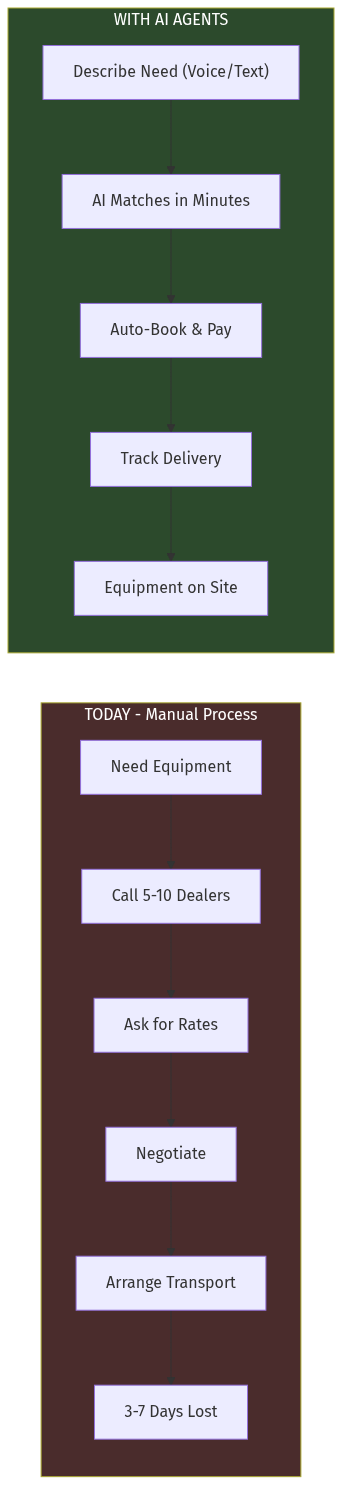
    Current State (Manual)

    Contractor calls 10 vendors → Describes requirement → Negotiates price → 
    Cash advance → Vendor arranges transport → Equipment arrives (maybe) → 
    Project proceeds → Disputes over damage/payment → Relationship sour

    With AI Agents

    Phase 1: Agent as Assistant
    • Contractor describes project (voice/note to AI agent)
    • AI searches available equipment within 50km radius
    • AI presents options with verified photos, prices, ratings
    • Contractor selects → AI handles booking
    Phase 2: Agent as Transactor
    • AI pre-negotiates terms based on market rates
    • AI creates digital contract with escrow
    • AI coordinates logistics, operator, insurance
    • AI handles disputes with evidence
    Phase 3: Agent as Optimizer
    • AI predicts demand (seasonal, project-based) for equipment owners
    • AI suggests optimal pricing for equipment owners
    • AI identifies underutilized equipment and suggests to contractors
    • AI handles end-to-end project equipment planning

    The Transformation

    Equipment Rental Flow
    Equipment Rental Flow

    7.

    Product Concept

    Core Platform Features

    1. Demand Side (Contractors)
    • Project Brief - Describe project (duration, equipment needed, location, budget)
    • AI Matching - Get 3-5 verified options instantly
    • Smart Booking - One-click booking with escrow payment
    • Project Dashboard - Track all equipment for current project
    • Dispute Resolution - AI-mediated issue resolution
    2. Supply Side (Equipment Owners)
    • Equipment Listing - Add equipment with photos, documents, pricing
    • AI Pricing - Dynamic pricing suggestions based on market data
    • Demand Calendar - See upcoming demand in area
    • Verification Badge - Get verified once, earn trust
    • Revenue Dashboard - Track utilization, earnings, payments
    3. Operator Marketplace
    • Skill Profile - List certifications, equipment types, locations
    • Availability Calendar - Block dates when unavailable
    • Rating System - Build reputation over time
    • Embedded Payroll - Get paid through platform
    4. Logistics Hub
    • Transport Booking - Book trucks for equipment transport
    • Permit Handling - AI handles route permits for oversized equipment
    • Tracking - Real-time location of equipment in transit

    8.

    Architecture Diagram

    Market Structure
    Market Structure

    9.

    Development Plan

    PhaseTimelineDeliverables
    MVP8 weeksContractor app, Equipment owner web, Basic matching, Escrow payments
    V112 weeksAI verification, Dynamic pricing, Operator marketplace, Logistics integration
    V216 weeksPredictive demand AI, Embedded financing, Insurance products, Multi-city rollout

    MVP Features

  • Contractor App
  • - Project brief submission (text/voice) - Equipment search with filters - Booking with escrow - Payment gateway integration
  • Equipment Owner Web
  • - Equipment listing (photos + docs) - Availability calendar - Earnings dashboard - Payout management
  • Matching Engine
  • - Location-based matching - Basic availability check - Simple pricing display
  • Trust Layer
  • - Escrow payments - Digital contracts - Basic dispute handling
    10.

    Go-To-Market Strategy

    Phase 1: Supply-First (Months 1-3)

    Goal: Build equipment inventory before activating demand
  • Target equipment owners:
  • - Construction companies with idle fleet - Equipment dealerships (rental division) - Individual owners (JCBs, cranes) - Leasing companies (off-lease equipment)
  • Acquisition channels:
  • - Direct sales (field team in Tier 1 cities) - WhatsApp outreach (using phone lists) - Construction association partnerships (CREDAI,几家) - Equipment dealer networks
  • Incentives:
  • - Zero listing fee for first 6 months - Guaranteed minimum earnings - Fast payments (T+3 vs industry standard T+30)

    Phase 2: Demand Activation (Months 4-6)

    Goal: Activate contractor demand with inventory ready
  • Target contractors:
  • - Mid-size contractors (₹5-50Cr annual projects) - Real estate developers - Infrastructure companies - Event management companies (temporary structures)
  • Acquisition channels:
  • - Construction project sites (physical outreach) - Contractor associations - Project portals (where contractors find work) - Referrals from equipment owners
  • Early adopter program:
  • - Free first project for top contractors - Dedicated account manager - Priority matching

    Phase 3: Network Effects (Months 7-12)

    Goal: Create flywheel
    • More contractors → better utilization → better prices → more contractors
    • More equipment → better coverage → more contractors
    • More transactions → better data → better AI → better matching

    11.

    Revenue Model

    Revenue Streams

    1. Commission (Primary)
    • 8-12% commission on each rental transaction
    • Paid by equipment owner (or split with contractor)
    2. Listing Fees (V2)
    • Premium listings for equipment owners
    • ₹500-2,000/month for enhanced visibility
    3. Logistics Markup
    • 10-15% margin on logistics services
    • Partner with local transport operators
    4. Operator Marketplace (V2)
    • 5% commission on operator fees
    5. Financing (V2)
    • Embedded equipment financing
    • Interest margin from NBFC partnerships
    6. Insurance (V2)
    • Embedded insurance products
    • Commission from insurance partners

    Unit Economics

    MetricValue
    Average rental value₹50,000/month
    Commission (10%)₹5,000/transaction
    Customer acquisition cost₹3,000
    Lifetime value₹60,000 (12 months)
    LTV:CAC ratio20:1
    ---
    12.

    Data Moat Potential

    Proprietary Data Accumulation

    1. Equipment Database
    • 50,000+ equipment profiles with verification data
    • Condition history over time
    • Utilization patterns
    2. Pricing Intelligence
    • Real transaction prices across regions
    • Demand patterns by season, project type
    • Price elasticity by equipment type
    3. Contractor Behavior
    • Project patterns
    • Equipment preferences
    • Payment behavior
    • Price sensitivity
    4. Operator Skills
    • Performance ratings
    • Equipment specializations
    • Reliability metrics

    Competitive Moat

    • Network effects - More users = better matching = more users
    • Data advantage - Pricing AI improves with transactions
    • Trust accumulation - Verification history is hard to replicate
    • Supply relationships - Exclusive equipment owner contracts

    13.

    Mental Models Applied

    Zeroth Principles

    Question: What if we reimagined equipment rental as "equipment streaming"?

    Just as Netflix gives you movies on demand, what if contractors could get equipment on demand? The difference: movies are digital (instant delivery), equipment is physical (requires logistics). But the mental model shift matters: from ownership to access, from negotiation to subscription, from trust-by-history to trust-by-verification.

    Incentive Mapping

    StakeholderCurrent IncentivePlatform Incentive
    Equipment OwnerMaximize rental rateMaximize utilization + faster payment
    ContractorMinimize costMinimize hassle + reliable equipment
    OperatorSteady workBetter projects + ratings
    PlatformNoneCommission on transactions
    The platform aligns incentives: higher utilization for owners (more revenue), reliable equipment for contractors (less headache), more transactions for platform (more commission).

    Falsification (Pre-Mortem)

    Why might this fail?
  • Trust doesn't form - Equipment owners don't trust platform with payments → Require escrow, show payment track record
  • Logistics is too complex - Equipment transport is regionally fragmented → Partner with local logistics, don't build from scratch
  • Quality不一致 - Equipment condition disputes → Strong verification, insurance, clear policies
  • Price war - Race to bottom on pricing → Value-added services (verification, logistics, operators)
  • Capital requirements - Equipment owners need working capital → Embed financing in V2
  • Steelmanning (Why incumbents might win)

  • Existing relationships - Traditional rental companies have contractor relationships → Differentiate on trust, technology, not try to replace
  • Physical inventory - They own equipment, can guarantee availability → Partner with owners, don't compete on ownership
  • Local presence - They have yards, can provide immediate service → Build technology layer, partner with local players
  • Anomaly Hunting

    What's strange about this market?
    • No Flipkart/Amazon of equipment rental (despite similar fragmentation in other sectors)
    • No Yulu/Bounce for construction equipment (despite proven mobility model)
    • No true national player despite $45B market
    • Insurance penetration is extremely low (opportunity)
    • Operator shortage is acute but unaddressed (opportunity)

    14.

    Why This Fits AIM Ecosystem

    This platform becomes a vertical under AIM.in's B2B marketplace strategy:

  • Vertical Integration - Construction equipment → adjacent verticals (construction materials, labor, financing)
  • Data Synergies - Equipment demand data → project intelligence → contractor credit scoring
  • Geographic Expansion - Start in Maharashtra → Tier 2 cities → National → International markets
  • Adjacent Opportunities:
  • - Equipment financing (NBFC partnership) - Maintenance services (tied to equipment) - Operator training (skill development) - Project bidding (contractor intelligence)

    ## Verdict

    Opportunity Score: 8.5/10

    Why This Wins

  • Massive market - $45B in India alone, 70% underutilized
  • Clear pain - Contractors can't find, owners can't monetize
  • AI-native - Matching, verification, pricing all benefit from AI
  • Network effects - More users → better experience → more users
  • Data moat - Transaction data becomes pricing intelligence
  • Phased build - MVP in 8 weeks, meaningful in 6 months
  • Risks to Navigate

  • Trust formation (mitigate with escrow, verification)
  • Supply acquisition (mitigate with incentives, field team)
  • Quality control (mitigate with AI verification, insurance)
  • Logistics complexity (mitigate with partner model)
  • Next Steps

  • Validate demand: Interview 20 contractors in one city
  • Validate supply: Interview 20 equipment owners
  • Build MVP: Contractor app + equipment owner web
  • Launch in one city (Pune or Mumbai)
  • Iterate based on feedback

  • ## Sources
