ResearchFriday, March 13, 2026

AI-Powered B2B Restaurant & Hospitality Supply Marketplace: The $120B Opportunity in India's Food Service Industry

India's 8 million+ restaurants, hotels, cloud kitchens, and catering businesses face a $120 billion procurement problem. 90% of supplies are still ordered via phone calls, WhatsApp messages, and manual market visits. AI agents can automate this entire workflow — from price discovery to automated reordering.

1.

Executive Summary

India's food service industry is undergoing a massive transformation. With over 8 million registered eating establishments, the market for restaurant and hospitality supplies exceeds $120 billion annually. Yet this massive market remains stubbornly analog — most procurement happens through phone calls, WhatsApp messages, and personal visits to wholesale markets.

This creates a monumental opportunity for an AI-agent-driven marketplace that can:

  • Automate price discovery across thousands of suppliers
  • Handle repeat orders intelligently
  • Manage inventory predictions
  • Negotiate bulk pricing
  • Ensure quality compliance
The future of this market belongs to platforms that can act as autonomous procurement agents, not just static marketplaces.


2.

Problem Statement

The Daily Pain of Restaurant Procurement

Every restaurant, hotel, and cloud kitchen faces the same procurement challenges:

  • Time-Consuming Ordering — Owners or managers spend 1-2 hours daily just placing orders by phone
  • No Price Transparency — Prices vary wildly between suppliers, and there's no easy way to compare
  • Quality Inconsistency — No systematic way to rate or track supplier quality
  • Inventory Waste — Over-ordering leads to spoilage; under-ordering means lost sales
  • Payment Complexity — Multiple suppliers, different payment terms, manual reconciliation
  • Delivery Chaos — No unified tracking, multiple delivery windows, coordination overhead
  • Who Experiences This Pain?

    • Small Restaurants (₹5-25L monthly turnover): Owner handles procurement personally — no dedicated staff
    • Mid-Size Restaurants & Hotels: Manager or purchase head spends significant time on procurement
    • Cloud Kitchens: High order volumes, multiple brands, complex ingredient requirements
    • Catering Companies: Large events requirebulk sourcing with tight timelines
    • Hospital Chains: Centralized procurement needs across multiple locations

    3.

    Current Solutions

    PlatformWhat They DoWhy They're Not Solving It
    ZomatoFood delivery primarilyNot focused on B2B supplies
    Swiggy InstamartQuick commerce for consumersLimited B2B, not structured for restaurants
    Jiomart B2BGeneral B2B groceryNot specialized for restaurant needs
    IndiaMARTGeneral B2B marketplaceNot restaurant-specific, no AI features
    Cheflab B2BIngredients supplierSingle supplier, not marketplace
    Bulk GuruBulk restaurant suppliesLimited supplier network, no AI

    Market Gaps

    • No AI-powered price discovery — Current platforms show static prices
    • No intelligent reordering — No system learns usage patterns
    • No supplier quality scoring — No aggregated reviews/ratings
    • No automated inventory sync — Manual tracking still required
    • No real-time availability — Stockouts discovered after ordering
    • No credit/financing integration — Payment terms handled offline

    4.

    Market Opportunity

    Market Size

    • India Food Service Market: $120+ billion (2026)
    • Restaurant Supplies Segment: $45-50 billion
    • Hotel Supplies Segment: $30+ billion
    • Catering & Cloud Kitchens: $15-20 billion
    • Growth Rate: 15-18% CAGR through 2030

    Why Now

  • Post-Pandemic Digital Adoption — Restaurant owners who resisted technology are now comfortable with digital ordering
  • Cloud Kitchen Explosion — 50,000+ cloud kitchens in India, all needing efficient supply chains
  • Margin Pressure — Thin margins mean every efficiency gain matters
  • WhatsApp Penetration — 400M+ users, already how most ordering happens — perfect foundation for AI agents
  • UPI for B2B — Unified payments enabling easier transactions

  • 5.

    Gaps in the Market

    Where Current Players Fail

  • Static Marketplace Model
  • - Traditional platforms list products; buyers still need to find, compare, negotiate - No proactive assistance or automation
  • No Vertical Specialization
  • - General B2B platforms don't understand restaurant-specific needs (freshness, quality, timing) - No understanding of menu-specific ingredients
  • No Intelligent Automation
  • - No usage pattern learning - No predictive ordering - No automated reordering for recurring needs
  • No Quality Assurance
  • - No systematic quality rating system - No freshness guarantees - No return/refund automation
  • Fragmented Supplier Ecosystem
  • - No single platform aggregates all supplier categories - Restaurants need 20-50+ suppliers for different categories
    6.

    AI Disruption Angle

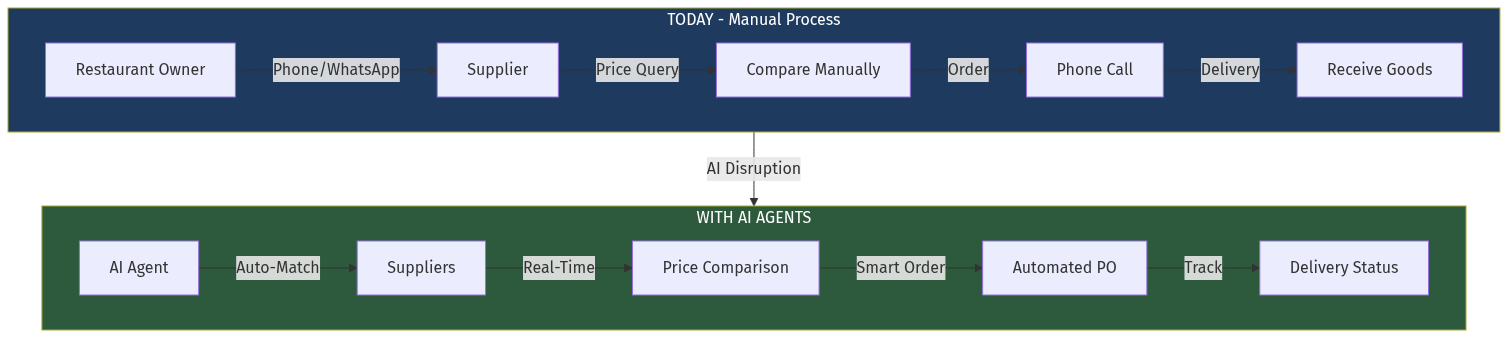
    How AI Agents Transform the Workflow

    The key insight: Restaurants don't want another marketplace. They want a procurement assistant.

    An AI agent can:

  • Learn Usage Patterns
  • - Analyze order history, seasonality, menu changes - Predict what needs to be ordered and when
  • Auto-Order Based on Triggers
  • - Reorder staples automatically when inventory dips - Account for upcoming events/holidays
  • Negotiate on Behalf
  • - Aggregate demand for volume discounts - Compare prices in real-time across suppliers
  • Handle All Communication
  • - Send WhatsApp messages to suppliers - Confirm orders, track deliveries - Handle disputes and returns
  • Ensure Quality
  • - Aggregate reviews from other restaurants - Flag suppliers with quality issues - Automate replacements for quality problems

    The AI Agent Workflow

    ┌─────────────────────────────────────────────────────────────┐
    │                    AI Procurement Agent                       │
    ├─────────────────────────────────────────────────────────────┤
    │  1. Monitor Inventory ←→ Restaurant POS/Manual Input       │
    │  2. Check Prices ←→ Multiple Supplier APIs                  │
    │  3. Compare Quality ←→ Review Aggregation                   │
    │  4. Place Order ←→ WhatsApp/API to Supplier                 │
    │  5. Track Delivery ←→ Logistics Integration                 │
    │  6. Confirm Quality ←→ Restaurant Feedback                  │
    │  7. Process Payment ←→ UPI/Bank Integration                 │
    │  8. Update Records ←→ Accounting Integration                │
    └─────────────────────────────────────────────────────────────┘

    7.

    Product Concept

    Core Features

  • Smart Catalog
  • - Curated product listings for restaurant needs - Categories: Fresh Produce, Dry Stores, Packaging, Equipment, Cleaning - Real-time availability and pricing
  • AI Procurement Agent
  • - "Order my weekly vegetables" — Natural language ordering - Learns preferences, suggests alternatives - Handles all supplier communication
  • Supplier Network
  • - Onboard local suppliers + national distributors - Verification and quality scoring - Multi-channel ordering (API, WhatsApp)
  • Quality Assurance
  • - Post-delivery rating system - Freshness guarantees with automatic returns - Supplier performance analytics
  • Financial Suite
  • - Credit lines for trusted buyers - Automated invoicing - Payment reconciliation

    User Journey

    Restaurant Onboarding → Set Up Catalog → AI Learns Patterns → 
    Auto-Reorder → Delivery → Quality Check → Payment → Repeat

    8.

    Development Plan

    PhaseTimelineDeliverables
    MVP8 weeksSupplier onboarding, basic catalog, manual ordering, WhatsApp integration
    V112 weeksAI agent for repeat orders, basic inventory tracking, supplier ratings
    V216 weeksPredictive ordering, UPI payments, quality guarantees, analytics
    ScaleOngoingMulti-city expansion, financing, POS integration

    Technical Stack

    • Frontend: Next.js + React
    • Backend: Node.js + PostgreSQL
    • AI: OpenAI/Gemini for NLP, custom models for predictions
    • Communication: WhatsApp Business API
    • Payments: Razorpay + UPI

    9.

    Go-To-Market Strategy

    Phase 1: Ground Zero (Months 1-3)

  • Select 2-3 Neighborhoods
  • - Start with food hubs: FC Road (Pune), MG Road (Delhi), JP Nagar (Bangalore) - High restaurant density = network effects
  • Onboard 50 Restaurants
  • - Free onboarding, discounted first orders - Dedicated support for adoption
  • Onboard 20-30 Local Suppliers
  • - Manual supplier onboarding initially - Prove demand before aggressive supplier acquisition
  • Word of Mouth
  • - Free for early adopters - Referral incentives: "Invite 3 restaurants, get 1 month free"

    Phase 2: Prove Scale (Months 4-8)

  • Expand to 5-10 More Neighborhoods
  • - Replicate playbook from Phase 1
  • Launch AI Features
  • - Position as "Your Procurement Assistant" - Highlight time savings: "Save 10 hours/week"
  • Supplier Competition
  • - More suppliers = better prices = more value for restaurants

    Phase 3: City Expansion (Months 9-18)

  • Multi-City Rollout
  • - Mumbai, Bangalore, Chennai, Hyderabad
  • Enterprise Features
  • - Hotel chains, restaurant groups - API integrations, custom SLAs
  • Financial Products
  • - Credit lines - Invoice factoring
    10.

    Revenue Model

    Primary Revenue Streams

  • Commission on Orders
  • - 8-15% commission from suppliers - Tiered based on category (fresh produce: 8%, packaging: 15%)
  • Subscription for Restaurants
  • - ₹2,000-10,000/month for AI features - Basic tier: ordering; Pro tier: AI agent; Enterprise: full automation
  • Advertising & Featured Listings
  • - Suppliers pay for visibility - Featured products, promoted categories
  • Financial Services
  • - Interest on credit extended - Payment processing fees (1-2%)
  • Data & Analytics
  • - Market intelligence reports for suppliers - Demand forecasting sold to producers

    Unit Economics

    MetricTarget
    Customer Acquisition Cost₹3,000-5,000
    Lifetime Value₹50,000-1,50,000
    Gross Margin15-25%
    Payback Period6-9 months
    ---
    11.

    Data Moat Potential

    Proprietary Data Accumulation

  • Pricing Intelligence
  • - Real-time prices across suppliers - Seasonal pricing patterns - Demand elasticity data
  • Supplier Performance
  • - Quality ratings over time - Delivery reliability scores - Price competitiveness history
  • Restaurant Preferences
  • - Product preferences - Quality thresholds - Price sensitivity
  • Consumption Patterns
  • - Category-level usage - Seasonality data - Event-based spikes

    This data becomes increasingly valuable:

    • For Restaurants: Better AI predictions
    • For Suppliers: Demand forecasting, inventory planning
    • For New Entrants: Significant barriers to replicate
    ---

    12.

    Why This Fits AIM Ecosystem

    Vertical Integration with AIM.in

    This marketplace can become a key vertical under AIM.in:

  • Domain Alignment
  • - B2B marketplace focus ✓ - India-focused ✓ - Underserved market ✓
  • AI Agent Integration
  • - Natural fit with AIM's AI agent vision - WhatsApp-first approach aligns with India usage
  • Data Network Effects
  • - More restaurants → more suppliers → better prices → more restaurants
  • Adjacent Opportunities
  • - Equipment rental for restaurants - Staffing (kitchen staff, servers) - Real estate for cloud kitchens - Insurance for F&B businesses

    Long-Term Vision

    The platform can evolve into:

    • Restaurant OS: Beyond supplies to encompass all restaurant operations
    • Supply Chain Controller: End-to-end visibility from farm to table
    • Financial Super-App: All B2B payments for the food service industry
    ---

    13.

    Risk Assessment (Pre-Mortem)

    Why This Might Fail

  • Chicken-and-Egg Problem
  • - Need both restaurants AND suppliers simultaneously - Mitigation: Start with one side, subsidize heavily
  • Local Supplier Resistance
  • - Traditional suppliers may resist digital transformation - Mitigation: Partner, don't disrupt; make them part of the solution
  • Margin Pressure
  • - Low margins in supplies business - Mitigation: Subscription + financial services for unit economics
  • Quality Control Challenges
  • - Perishable goods = high return rates - Mitigation: Strong quality guarantee, automated returns
  • Competition from incumbents
  • - Zomato/Swiggy may expand into B2B - Mitigation: Focus on depth, specialization, AI-first approach

    Steelmanning the Competition

    Why incumbents might win:
    • Zomato/Swiggy have restaurant relationships
    • IndiaMART has supplier network
    • Reliance can subsidize losses
    Our defense:
    • Vertical specialization
    • AI-first (not AI-added)
    • Superior unit economics through automation

    14.

    Mental Models Applied

    Zeroth Principles

    • Question: "Why do restaurants still order by phone in 2026?"
    • Answer: Existing platforms aren't solving the actual problem — they provide catalogs, not procurement assistance

    Incentive Mapping

    • Suppliers: Want predictable demand, not necessarily more customers
    • Restaurants: Want time savings, quality assurance, best prices
    • Current platforms: Take listing fees, don't care about transaction success

    Distant Domain Import

    • Amazon's FBA: Inventory and fulfillment handled by platform
    • Doordash Drive: Restaurant-centric delivery
    • Notion: AI-first productivity

    Anomaly Hunting

    • Strange: WhatsApp is the primary ordering channel, but no platform leverages this
    • Missing: No "AI procurement assistant" for restaurants despite massive market

    ## Verdict

    Opportunity Score: 8.5/10

    Strengths

    • Massive, growing market ($120B+)
    • Clear problem with no dominant solution
    • Perfect for AI agent intervention
    • Strong network effects potential
    • Multiple revenue streams

    Challenges

    • Chicken-and-egg dynamics
    • Quality control for perishables
    • Low-margin business model
    • Competition risk

    Recommendation

    This is a strong vertical for AIM.in to pursue. The key differentiator must be AI-first, not AI-added — the platform should feel like having a procurement manager, not using a website.

    The ideal approach:

  • Start in one city, one neighborhood
  • Build supplier network first
  • Launch with basic ordering, then add AI
  • Prove unit economics before scaling
  • This can become a $1B+ business if executed well.


    ## Sources

    ---

    Process Flow
    Process Flow