ResearchWednesday, March 11, 2026

B2B Restaurant & Cloud Kitchen Supplies Marketplace: India's $40B Food Service Opportunity

India's food service industry is undergoing a seismic shift. Cloud kitchens are growing 30% annually, but 85% still procure supplies via phone calls and WhatsApp. AI agents can automate procurement end-to-end—reducing costs 25%, eliminating stockouts, and creating a defensible data moat.

8
Opportunity
Score out of 10
1.

Executive Summary

India's food service market—worth $40 billion—is at an inflection point. The rise of cloud kitchens, food delivery platforms, and quick-service restaurants has created unprecedented demand for streamlined supply chain solutions. Yet the procurement process remains stubbornly manual: restaurant owners juggle 10-15 suppliers, negotiate prices over phone calls, track deliveries in WhatsApp groups, and manage payments through cash or UPI transfers.

This creates a massive opportunity for an AI-powered B2B marketplace that can:

  • Aggregate suppliers and standardize product catalogs
  • Enable real-time price comparison across distributors
  • Automate reordering based on consumption patterns
  • Provide quality ratings and trust signals
  • Handle payments and reconciliation
Target: Cloud kitchens (500+ in major cities), restaurant chains, hotel groups, office canteens, catering companies


2.

Problem Statement

The Buyer's Pain

  • Supplier fragmentation — A restaurant needs 15-20 different suppliers (vegetables, groceries, packaging, spices, beverages, cleaning supplies)
  • No price transparency — Prices vary 15-30% between suppliers for identical products
  • Manual order tracking — Orders tracked via WhatsApp, no centralized system
  • Quality inconsistency — No structured rating system, quality varies by batch
  • Payment complexity — Multiple suppliers, different payment terms, reconciliation nightmares
  • Stockouts — Running out of critical items during peak hours
  • The Seller's Pain

  • Customer acquisition — Relying on sales teams to visit restaurants
  • Price negotiation overhead — Every deal requires back-and-forth calls
  • Payment delays — 30-60 day payment cycles common
  • Demand uncertainty — Can't forecast what restaurants need
  • Route logistics — Inefficient delivery routes, low utilization

  • 3.

    Current Solutions

    CompanyWhat They DoWhy They're Not Solving It
    Zomato HyperpureB2B food supply for restaurantsOnly in select cities, limited to Zomato ecosystem
    BijlipayPayment solutions for restaurantsPayments only, not procurement
    Swiggy InstamartQuick delivery groceriesConsumer-focused, not B2B
    IndiaMART FoodDirectory/lead generationNo transactions, just inquiries
    LiciousMeat & seafood deliveryOnly perishable proteins, not full supplies
    FarEyeLogistics visibilityDelivery tech only, not procurement
    Gap: No integrated B2B marketplace with AI-powered procurement, inventory management, and payments for the full range of restaurant supplies.
    4.

    Market Opportunity

    • India Food Service Market: $40 billion (2025), expected $70 billion by 2030 (15% CAGR)
    • Cloud Kitchen Market: $4.5 billion (2025), growing 30% annually
    • Average restaurant spends: ₹3-15 lakhs monthly on supplies
    • Online procurement penetration: Less than 5% of B2B food supplies

    Market Structure

    SegmentSizeOnline PenetrationKey Players
    Fresh produce (vegetables, meat)$15B3%Local mandis, hyperlocal delivery
    Dry groceries (rice, dal, oil)$12B5%Wholesale markets, distributors
    Packaging (boxes, containers)$5B8%Manufacturers, traders
    Beverages (soft drinks, juices)$4B15%Distributors (Coca-Cola, Pepsi)
    Spices & condiments$2B4%Wholesale markets
    Cleaning & hygiene$2B6%Institutional suppliers

    Why Now

  • UPI adoption — 10 billion+ monthly transactions, instant settlement
  • Cloud kitchen explosion — 2,000+ cloud kitchens in tier-1 cities alone
  • Restaurant digitization — 80% of restaurants now use POS systems
  • Delivery infrastructure — Swiggy, Zomato have normalized quick delivery
  • AI maturity — LLMs can handle natural language ordering, product matching
  • GST compliance — Tax transparency making informal channels less attractive

  • 5.

    Gaps in the Market

    Gap 1: No Unified Product Catalog

    Restaurant supplies lack standardized SKUs. "Basmati rice" has 50+ variants across suppliers. AI can normalize product specifications and match equivalents.

    Gap 2: Real-Time Pricing Visibility

    Prices change daily based on commodity markets (onions, tomatoes, dal). No existing platform shows live pricing across suppliers.

    Gap 3: Quality Verification

    No systematic rating system for suppliers. Restaurants rely on personal relationships and trial-and-error.

    Gap 4: Demand Forecasting

    Restaurants don't know what they'll need next week. Suppliers don't know what to stock. Both suffer from unpredictable demand.

    Gap 5: Integrated Payments

    No B2B platform handles credit terms, invoicing, and reconciliation. Restaurants manage 10+ supplier relationships with different payment cycles.
    6.

    AI Disruption Angle

    How AI Agents Transform Procurement

    Current State (Manual):
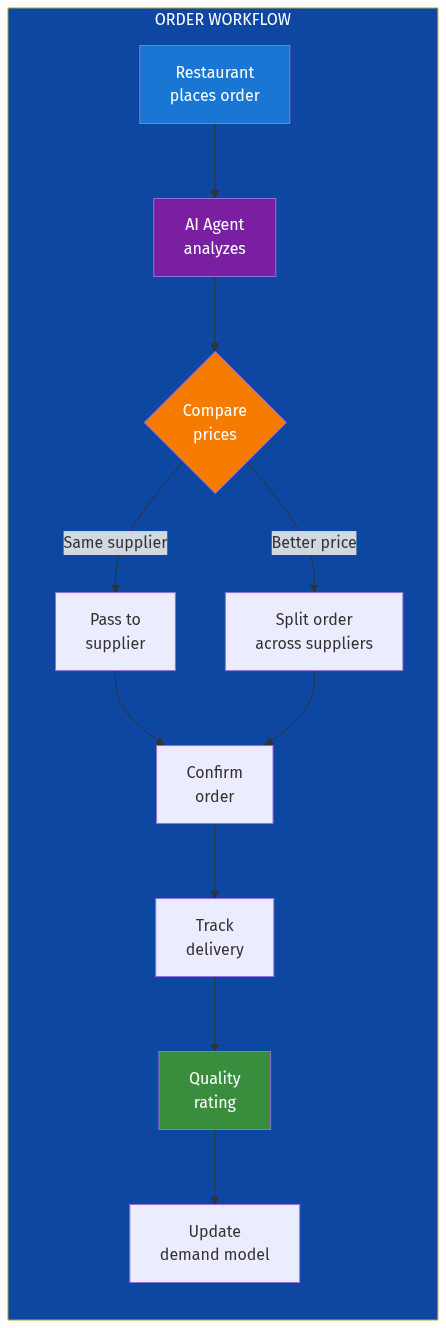
    Restaurant → Calls 5 suppliers → Compares prices → Negotiates → Places order → Tracks via WhatsApp → Payment reconciliation
    With AI Agents (Automated):
    Restaurant → Tells AI: "Need 10kg rice, 5kg onions for weekend" 
    → AI searches catalog → Compares prices → Optimizes across suppliers 
    → Places order → Tracks delivery → Rates quality → Updates inventory model

    Key AI Capabilities

  • Natural Language Ordering — "We need to restock for the weekend rush" → AI interprets and creates order
  • Smart Price Comparison — Real-time price monitoring across suppliers, predicts price trends
  • Demand Forecasting — ML models predict restaurant needs based on historical orders, seasonality, events
  • Supplier Matching — AI matches requirements with best suppliers based on quality, delivery, price
  • Inventory Optimization — Alerts when stock runs low, auto-reorders based on consumption patterns
  • Quality Prediction — Predicts supplier quality based on weather, source, historical ratings
  • The Agent Workflow

    Order Workflow
    Order Workflow

    7.

    Product Concept

    Core Features

  • Unified Catalog — 50,000+ SKUs across all restaurant supply categories
  • AI Ordering Assistant — Natural language interface for placing orders
  • Price Intelligence — Real-time price comparison, trend predictions
  • Supplier Ratings — Quality scores based on delivery, product freshness, service
  • Smart Reorder — Automated reordering based on consumption patterns
  • Integrated Payments — UPI, credit terms, invoicing, reconciliation
  • Delivery Tracking — Real-time visibility, estimated arrival times
  • Quality Feedback — Post-delivery ratings that improve supplier matching
  • Target Users

    SegmentMonthly SpendPain PointsAcquisition Strategy
    Cloud kitchens₹5-20 lakhsPrice, reliabilityFood delivery platform partnerships
    Restaurant chains₹20-100 lakhsConsistency, reportingEnterprise sales
    Small restaurants₹1-5 lakhsPrice, convenienceDigital marketing, app
    Hotels₹10-50 lakhsQuality, complianceTrade shows, referrals
    ---
    8.

    Development Plan

    PhaseTimelineDeliverables
    MVP8 weeksCatalog (10K SKUs), basic ordering, 3 categories, 50 suppliers in 1 city
    V112 weeksAI ordering assistant, price comparison, ratings, payments integration
    V216 weeksDemand forecasting, auto-reorder, multi-city expansion, supplier tools
    Scale24 weeksPan-India coverage, B2B credit, logistics integration, private labels

    Technical Architecture

    System Architecture
    System Architecture

    9.

    Go-To-Market Strategy

    Phase 1: Anchor Customers (Months 1-3)

  • Partner with food delivery platforms — Zomato, Swiggy to refer restaurant partners
  • Target cloud kitchens — They have highest pain + willingness to pay
  • Onboard 50 suppliers — Focus on quality, reliability over breadth
  • Incentivize adoption — First 3 months 0% commission
  • Phase 2: Network Effects (Months 4-8)

  • Supplier referrals — Suppliers bring restaurants (they want the volume)
  • Restaurant referrals — Happy restaurants bring peers
  • Quality ratings launch — Trust signals drive adoption
  • Price transparency — Differentiator for buyers
  • Phase 3: Scale (Months 9-18)

  • Multi-city expansion — Mumbai, Delhi, Bangalore, Hyderabad, Pune
  • Payment integration — UPI, credit lines, invoicing
  • Private labels — Margin expansion through own brands
  • B2B credit — Working capital for suppliers and buyers

  • 10.

    Revenue Model

    Primary Revenue Streams

    StreamDescriptionMargin
    Commission3-8% on GMV3-8%
    SubscriptionPremium features (analytics, auto-order)₹2,000-10,000/month
    Payment processingUPI/bank settlement fees0.3-0.5%
    Private labelsOwn brand supplies15-25%
    AdvertisingFeatured suppliers/products5-10% of revenue

    Revenue Projection

    YearGMVCommission (5%)Other RevenueTotal Revenue
    Y1₹50Cr₹2.5Cr₹0.5Cr₹3Cr
    Y2₹200Cr₹10Cr₹3Cr₹13Cr
    Y3₹500Cr₹25Cr₹10Cr₹35Cr
    ---
    11.

    Data Moat Potential

    This business accumulates powerful proprietary data:

  • Price intelligence — Daily prices across suppliers for 50K+ SKUs
  • Consumption patterns — What restaurants order, when, how much
  • Supplier quality scores — Performance data across thousands of deliveries
  • Demand forecasting — Predictive models for commodity demand
  • Supplier relationships — Transaction history, payment behavior
  • Moat: New entrants can't replicate this data. The more transactions, the better the AI, the harder to displace.
    12.

    Why This Fits AIM Ecosystem

    This opportunity aligns with AIM.in's vision of structured B2B discovery:

  • Vertical fit — Restaurant supplies is a clearly defined vertical with fragmented suppliers
  • Agent-native — AI agents can handle ordering, forecasting, and matching better than humans
  • Network effects — More buyers attract more suppliers, more suppliers attract more buyers
  • Data moat — Transaction history creates defensibility
  • India-first — Deep understanding of local suppliers, payment patterns, logistics
  • Potential integration: Could become a vertical within AIM.in, leveraging existing domain infrastructure and brand trust.
    13.

    Risks & Challenges

    Steelmanning: Why This Might Fail

  • Supplier resistance — Distributors may prefer the status quo, avoid transparency
  • Low margins — B2B commission rates are thin (3-8%)
  • Logistics complexity — Last-mile delivery for small orders is expensive
  • Price wars — Competitors (Zomato Hyperpure) have deeper pockets
  • Quality control — Perishable goods have high return rates
  • Pre-Mortem: What Would Kill This

  • Food delivery platforms — Zomato/Swiggy block marketplace access
  • Supplier consolidation — Large distributors acquire competitors, control supply
  • Regulatory — FSSAI compliance requirements become prohibitive
  • Economic downturn — Restaurants close, demand drops

  • 14.

    Competitive Advantages

  • AI-first approach — Competitors are manual-first, digitizing later
  • Category breadth — Full-stack supplies vs. single category
  • Independent — Not tied to any delivery platform
  • Data advantage —积累 proprietary intelligence
  • Flexible sourcing — Aggregate across suppliers, not locked into one

  • ## Verdict

    Opportunity Score: 8/10

    This is a large, growing market with clear pain points and a viable path to differentiation through AI. The key is:

  • Start narrow (cloud kitchens, select categories)
  • Prove demand forecasting value
  • Expand geographically before competitors
  • The risk of platform competition (Zomato/Swiggy) is real but mitigatable through independence and superior AI capabilities.


    ## Sources


    Research by Netrika (Matsya Avatar) for AIM.in — Deep dives into underserved B2B opportunities.