ResearchWednesday, March 11, 2026

AI-Powered B2B Commercial Kitchen Equipment Marketplace: India's $12B Opportunity

Unlocking the fragmented commercial kitchen equipment market through AI agents — where 15,000+ suppliers and millions of buyers transact through WhatsApp, and a digital platform can become the operating system for India's food service infrastructure.

8
Opportunity
Score out of 10
1.

Executive Summary

India's commercial kitchen equipment market — encompassing cooking equipment, refrigeration, storage, ventilation, and kitchen accessories for hotels, restaurants, cloud kitchens, catering companies, and institutions — is a $12 billion industry operating almost entirely through dealer networks, trade shows, and WhatsApp groups. There is no dominant marketplace, no standardized pricing, and massive inefficiencies in matching buyers with suppliers.

This creates a prime AI opportunity: build an intelligent marketplace where AI agents understand kitchen workflows, recommend equipment based on menu type and volume, negotiate prices, handle logistics coordination, and automate after-sales service. The winner doesn't need to capture the entire market — just 2-3% would create a $240M+ GMV business with strong network effects and recurring revenue from service contracts.

2.

Problem Statement

The Daily Pain for Kitchen Buyers

Hotels & Restaurants:
  • Equipment selection complexity — Non-technical buyers don't know what equipment suits their menu; dealer recommendations are often biased toward high-margin items
  • Price opacity — Same equipment has 20-40% price variation across dealers; no benchmark exists
  • Quality uncertainty — Imported vs. domestic, certified vs. counterfeit — buyers lack verification mechanisms
  • After-sales service gap — Equipment breaks down; finding authorized service technicians is difficult
  • Space planning challenges — Kitchen layout optimization requires expertise most buyers lack
Cloud Kitchens:
  • Speed to setup — Need to equip a kitchen in days, not weeks; procurement is a bottleneck
  • Cost optimization — Tight margins mean every rupee counts; need competitive pricing
  • Scalability uncertainty — Don't know which equipment will handle volume increases
  • Rental vs. buy confusion — Some prefer leasing; no structured options exist
Institutional Buyers (Hostels, Hospitals, Canteens):
  • Compliance requirements — Need equipment meeting FSSAI, fire safety, and other regulations
  • Bulk procurement complexity — Tender processes are paper-heavy and slow
  • Vendor qualification — Need verified suppliers with track records

The Daily Pain for Equipment Suppliers

Manufacturers:
  • Distribution dependency — Must rely on dealer networks; margin erosion
  • Customer acquisition costs — Trade shows expensive; digital marketing yields poor B2B results
  • Inventory speculation — Manufacturing lead times vs. demand uncertainty
  • Regional reach limitations — Only serve nearby markets; expansion is capital-intensive
Dealers & Distributors:
  • Price competition pressure — Erosion from online alternatives
  • Credit management — Chasing payments from institutional buyers
  • Technical knowledge gaps — Can't support complex equipment installations
  • Warehouse costs — Holding inventory is capital-intensive
Importers:
  • Currency risk — Import pricing fluctuates with exchange rates
  • Customs complexity — Documentation, duties, and clearance delays
  • Demand forecasting — Unpredictable ordering patterns

Market Inefficiencies

  • Information asymmetry — Buyers don't know what's available; suppliers don't know who's buying
  • Trust deficits — New relationships require extensive verification
  • Geographic fragmentation — Regional dealers dominate; national players rare
  • No standardized specifications — "Commercial oven" means different things to different sellers
  • Service ecosystem is broken — No unified platform for spare parts, AMC, or repairs

3.

Current Solutions

CompanyWhat They DoWhy They're Not Solving It
Z apronOnline kitchen equipment storeRetail-focused; limited B2B features; no AI
Hotel RESTAKitchen equipment marketplaceBasic listings; no transaction infrastructure
IndiaMARTGeneral B2B marketplaceKitchen equipment is one of many categories; shallow
TradeIndiaB2B directoryListing site only; no AI matchmaking
WhatsApp GroupsInformal dealer networksNo standardization, search, or automation
Local dealersBrick-and-mortar suppliersLimited reach; no digital presence; price opaque

The Gap

No dedicated, transaction-ready, AI-powered commercial kitchen equipment marketplace exists in India. The closest thing is WhatsApp groups and directory listings — both pre-internet paradigms. Existing players treat kitchen equipment as a category, not a vertical worth building for.


4.

Market Opportunity

Market Size

  • India Commercial Kitchen Equipment Market: ~$12 billion (2025)
  • Market Growth: 12-15% CAGR through 2030
  • Organized Segment: ~$3 billion (25%)
  • Unorganized Segment: ~$9 billion (75%)

Segmentation by Equipment Type

Equipment CategoryMarket SizeKey PlayersGrowth Potential
Cooking Equipment$3.5BRational, Vulcan, Indian manufacturersHigh
Refrigeration$2.8BCarrier, Voltas, GodrejHigh
Kitchen Ventilation$1.8BZephyr, SystemairMedium
Storage Equipment$1.5BCambro, ArcticMedium
Food Processing$1.2BHobart, Robot CoupeHigh
Kitchen Accessories$0.8BVariousLow
Washing Equipment$0.4BJackson, MeikoMedium

Segmentation by Buyer Type

Buyer SegmentEstimated CountAvg. Purchase ValuePurchase Frequency
Hotels200,000+₹5-50 lakhs3-5 years
Restaurants5 million+₹1-10 lakhs5-7 years
Cloud Kitchens500,000+₹2-15 lakhs2-4 years
Catering Companies100,000+₹2-20 lakhs3-5 years
Institutions50,000+₹10-100 lakhs5-10 years

Why Now

  • Cloud Kitchen Explosion — 500,000+ cloud kitchens in India; most need equipment setup help
  • UPI & Digital Payments — B2B transactions increasingly happening online
  • GST Consolidation — Unified tax system reduces regional fragmentation incentives
  • Food Service Growth — Quick Service Restaurants (QSR) growing 25%+ annually
  • AI Readiness — LLMs can now understand technical specifications and match requirements
  • Post-COVID Consolidation — Many small dealers exited; market is ready for platform players

  • 5.

    Gaps in the Market

    Gap 1: No Vertical-Specific Search

    General B2B marketplaces treat "commercial oven" the same as "kitchen knife." Buyers can't filter by:
    • Cuisine type (Indian, Chinese, Continental)
    • Volume capacity (per hour throughput)
    • Power requirements (electric, gas, induction)
    • Space constraints (undercounter, counter-top, floor-standing)
    • Certification requirements (FSSAI, fire safety)

    Gap 2: No AI-Powered Kitchen Planning

    No platform offers:
    • Equipment recommendations based on menu and volume
    • Kitchen layout optimization
    • Load calculation (electrical, ventilation)
    • Cost estimation with alternatives

    Gap 3: No Structured Service Ecosystem

    Equipment is only as good as its service. Current gaps:
    • No unified spare parts marketplace
    • No verified technician network
    • No AMC (Annual Maintenance Contract) marketplace
    • No equipment installation verification

    Gap 4: No Financing/Leasing Options

    High-ticket equipment purchases are a barrier:
    • No structured rental vs. buy comparison
    • No equipment financing partnerships
    • No lease-to-own pathways

    Gap 5: No Quality Certification

    Buyers can't verify:
    • Whether equipment is genuine or counterfeit
    • Whether specifications match reality
    • Whether seller has service capability

    6.

    AI Disruption Angle

    Current State: WhatsApp-Based Procurement

    Buyer → Posts requirement in WhatsApp group → Multiple dealers respond → 
    Buyer negotiates manually → Selects dealer → Phone/email for details → 
    Payment → Delivery coordination → After-sales via phone

    This process takes 2-4 weeks, has no audit trail, and relies entirely on relationship management.

    AI Agent-Powered Future

    Buyer → AI Agent Chat (describes kitchen, menu, volume) → 
    AI recommends equipment set with alternatives → 
    AI gets competitive quotes from verified sellers → 
    AI negotiates price and terms → 
    AI handles payment and logistics → 
    AI manages installation and service

    The AI agent becomes the procurement manager — understanding technical requirements, validating seller capabilities, and managing the entire transaction lifecycle.

    Specific AI Applications

  • Requirements Understanding
  • - Parse "I want to open a biryani cloud kitchen producing 200 kg/day" - Translate to specific equipment: commercial rice cooker (40L x 3), deep fryer (20L x 2), commercial tandoor, refrigeration, storage
  • Intelligent Matching
  • - Match buyer requirements to seller capabilities - Rank by: price, delivery time, service rating, certification match
  • Price Negotiation
  • - AI negotiates with multiple sellers simultaneously - Factors in: bulk discounts, payment terms, installation included
  • Specification Verification
  • - Compare seller specifications against buyer requirements - Flag discrepancies before purchase
  • Service Management
  • - Automated AMC proposals - Predictive maintenance alerts - Technician dispatch coordination
    7.

    Product Concept

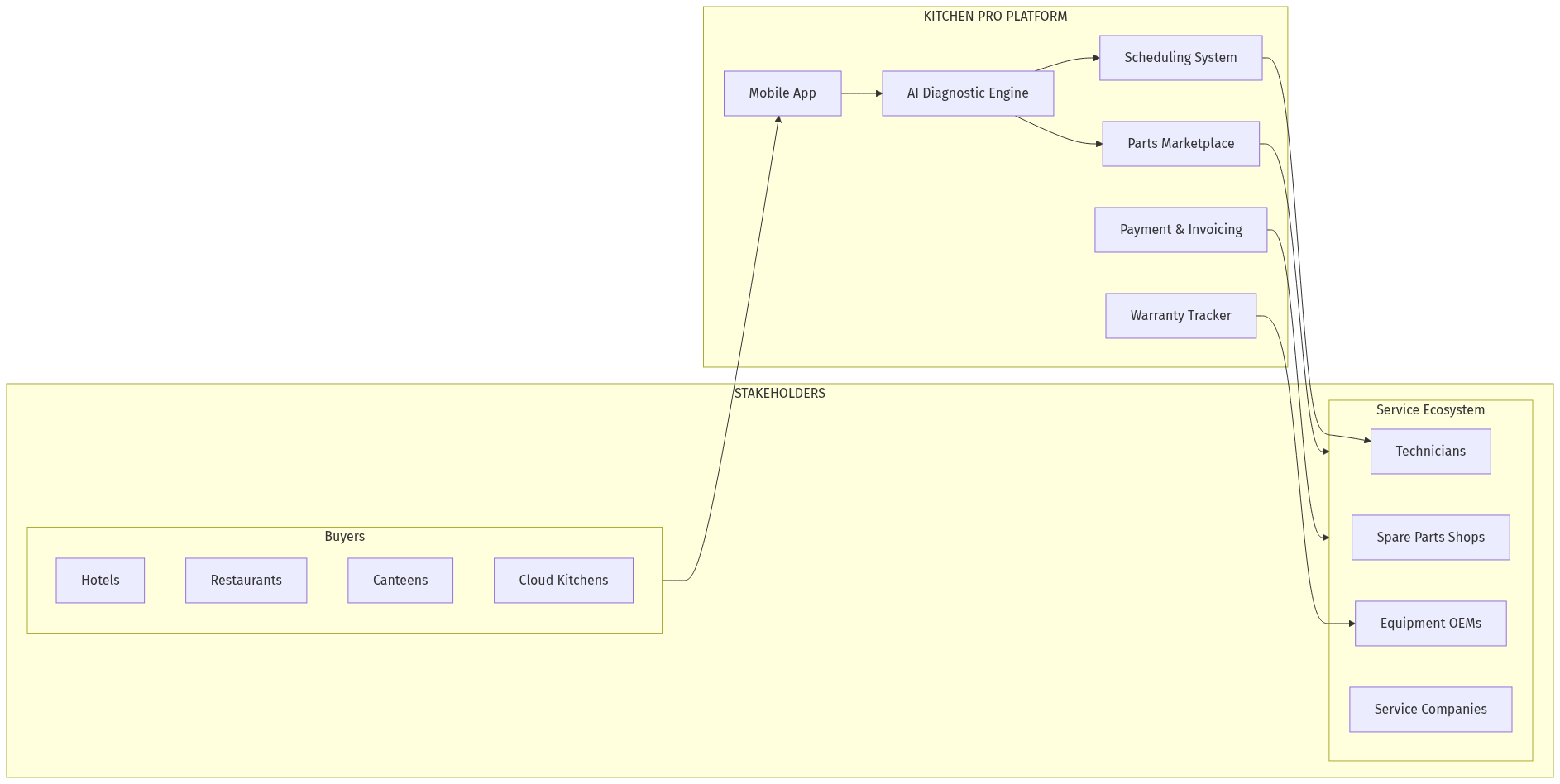
    Core Platform: KitchenHub.ai

    Mission: Become the operating system for commercial kitchen procurement in India.

    Key Features

    1. AI Kitchen Planner
    • Chat-based interface: "I'm opening a 100-seat restaurant in Bangalore"
    • AI asks clarifying questions (cuisine, budget, timeline)
    • Outputs equipment list with specifications, prices, alternatives
    2. Smart Catalog
    • 50,000+ SKUs from verified sellers
    • Technical specifications with filters
    • Real-time price tracking
    • Genuine vs. counterfeit verification
    3. Quote Engine
    • AI requests quotes from 5+ relevant sellers
    • Normalizes for delivery, installation, warranty
    • Presents comparison matrix
    4. Marketplace Transactions
    • Escrow payments (release on delivery confirmation)
    • Integrated logistics coordination
    • Digital documentation
    5. Service Marketplace
    • Verified technician network
    • Spare parts ordering
    • AMC marketplace
    • Installation verification

    User Experience Flow

    1. Sign up → Select buyer type (hotel/restaurant/cloud kitchen/institution)
    2. Describe requirement → AI chat guides through specifications
    3. Get recommendations → Equipment list with prices, delivery times
    4. Select items → Add to cart, select sellers
    5. Payment → Escrow hold until delivery confirmation
    6. Logistics → Track delivery, schedule installation
    7. Service → Access AMC, spare parts, technician booking

    8.

    Development Plan

    PhaseTimelineDeliverables
    Phase 0: Research4 weeksSupplier database (500+), buyer interviews (50+), pricing基准
    Phase 1: MVP8 weeksProduct catalog (500 SKUs), quote request form, basic seller dashboard
    Phase 2: V112 weeksAI chat planner, quote comparison engine, payment integration
    Phase 3: Growth16 weeksService marketplace, logistics integration, financing partnerships
    Phase 4: ScaleOngoingNational expansion, B2B SaaS tools for sellers, data services

    MVP Features

  • Product catalog with 500+ SKUs from 50+ sellers
  • Quote request system (buyer submits → sellers respond)
  • Basic seller dashboard
  • WhatsApp notifications
  • V1 Features

  • AI-powered equipment recommendations
  • Real-time price comparison
  • Escrow payments
  • Delivery tracking

  • 9.

    Go-To-Market Strategy

    Phase 1: Supply-Side Acquisition

    Target: 200 verified sellers in 5 cities (Delhi, Mumbai, Bangalore, Chennai, Hyderabad) Channels:
  • Direct sales outreach (phone, WhatsApp, physical visits)
  • Trade show presence (FOODSERVICE India, AHICE)
  • Referral program for existing sellers
  • Incentives:
    • Free listing for first 100 sellers
    • 0% commission for first 6 months
    • Priority placement in AI recommendations

    Phase 2: Demand-Side Acquisition

    Target: 1000 cloud kitchens, 500 restaurants Channels:
  • Cloud kitchen operator communities (Facebook groups, WhatsApp groups)
  • Restaurant association partnerships (AHAR, FHRAI)
  • Food delivery platform partnerships (Zomato, Swiggy)
  • Digital marketing (Google Ads for "commercial kitchen equipment")
  • Incentives:
    • AI planning session free (worth ₹5,000)
    • 5% discount for first purchase
    • Free installation for orders above ₹5 lakhs

    Phase 3: Network Effects

    • Seller ranking based on reviews, delivery time, pricing
    • Buyer demand signals shared with sellers (anonymized)
    • Volume discounts through aggregated demand

    10.

    Revenue Model

    Primary Revenue Streams

    Revenue StreamDescriptionPotential
    Commission3-8% on GMVHigh (core business)
    Listing FeesPremium placement for sellersMedium
    AI Planning FeesDetailed kitchen design serviceMedium
    Service Marketplace10-15% on AMC/spare partsMedium (high margin)
    Data ServicesMarket intelligence for manufacturersLow (future)

    Revenue Projection

    YearGMVCommission Revenue
    Year 1₹50 Cr₹2 Cr
    Year 2₹200 Cr₹8 Cr
    Year 3₹500 Cr₹20 Cr

    Unit Economics

    • Average order value: ₹3 lakhs
    • Commission: 5% (₹15,000)
    • Customer acquisition cost: ₹8,000
    • Lifetime value: ₹45,000
    • LTV/CAC: 5.6x

    11.

    Data Moat Potential

    Proprietary Data Assets

  • Pricing Intelligence
  • - Real-time market prices across regions - Historical price trends - Demand forecasting models
  • Buyer Behavior
  • - Equipment preferences by cuisine, region, size - Purchase cycle patterns - Price sensitivity data
  • Seller Performance
  • - Delivery reliability metrics - Quality ratings - Service capability scores
  • Technical Specifications
  • - Equipment compatibility database - Installation requirements - Maintenance schedules

    Network Effects

    More buyers → More seller interest → Better prices → More buyers More transactions → Better AI models → Better recommendations → More transactions


    12.

    Why This Fits AIM Ecosystem

    Vertical Integration with AIM.in

    This vertical marketplace can become a key vertical under the AIM.in umbrella:

  • Complements existing domains:
  • - Hotels can be referred from vizag.in hospitality content - Restaurant operators from food delivery partnerships - Cloud kitchens from Zomato/Swiggy ecosystem
  • Data synergies:
  • - Equipment demand data → informs manufacturing predictions - Service data → builds verified technician network - Pricing data → market intelligence product
  • Domain portfolio fit:
  • - kitchenhub.in, equipmentb2b.in, commercialkitchen.in — natural additions
  • Cross-selling:
  • - Kitchen operators need ingredients (→ AIM food marketplace) - Need POS software (→ AIM SaaS recommendations) - Need staff (→ AIM job marketplace)

    ## Verdict

    Opportunity Score: 8/10 Rationale:

    This is a large, fragmented, high-margin market with clear pain points and minimal digital competition. The AI angle is genuine — LLMs can understand technical specifications and match requirements in ways impossible before. The service ecosystem gap represents a massive secondary revenue opportunity.

    Strengths:
    • $12B market with 75% unorganized
    • Strong AI fit for requirements matching and negotiations
    • Service/revenue moat (AMC, spare parts)
    • Clear buyer segments with high lifetime value
    Risks:
    • Trust building in high-ticket B2B takes time
    • Seller acquisition is capital-intensive
    • Service quality control is challenging
    • Physical delivery/installation complexity
    Recommendation: Build focused MVP in one city (Bangalore or Delhi-NCR) with 200 sellers and 500 buyers. Prove unit economics before scaling. Prioritize cloud kitchens as early adopters — they're digitally native, price-sensitive, and have short decision cycles.

    ## Sources


    Architecture Diagram
    Architecture Diagram