ResearchWednesday, March 11, 2026

AI-Driven B2B Packaging Materials Marketplace: Unlocking a $80B Opportunity

India's packaging industry is at an inflection point. With e-commerce growing 25% annually and manufacturing reshoring accelerating, the fragmented packaging materials market is ripe for an AI agent-led transformation.

1.

Executive Summary

India's packaging materials market (\~$80 billion in 2025) is highly fragmented, with over 500,000 small and medium manufacturers struggling to reach buyers while millions of businesses face opaque pricing and unreliable suppliers. This creates a massive opportunity for an AI-powered B2B marketplace that matches buyer requirements with certified suppliers, automates price discovery, and enables seamless transactions through AI agents.

The opportunity is compelling because: (1) the market is extremely fragmented with no dominant player, (2) price discovery remains highly opaque, (3) quality assurance is a persistent pain point, and (4) AI agents can automate the entire procurement workflow end-to-end.


2.

Problem Statement

The Buyer's Pain:

Every business that ships products faces the same headache: finding the right packaging at the right price. A mid-sized e-commerce company might need 50 different SKUs —corrugated boxes, bubble wrap, courier bags, tape, inserts — across multiple suppliers. The process involves:

  • Supplier Discovery: Relying on local dealers and word-of-mouth
  • Price Discovery: Calling 5-10 suppliers for quotes, often receiving wildly different prices
  • Quality Assessment: No standardized quality ratings or certifications
  • Logistics: Coordinating deliveries from multiple scattered suppliers
  • Payments: Negotiating credit terms individually with each supplier
The Supplier's Struggle:

On the other side, hundreds of thousands of MSME packaging manufacturers operate at low utilization (often 40-60%) because they can't find buyers beyond their immediate geography. They lack marketing capabilities, pricing intelligence, and the tech infrastructure to compete with larger players.

The Systemic Inefficiency:

This market operates on information asymmetry. Local dealers mark up prices 30-50% above manufacturing cost. Buyers have no way to verify they're getting competitive rates. The entire workflow — from requirement identification to order placement — remains manual, phone-based, and relationship-dependent.


3.

Current Solutions

CompanyWhat They DoWhy They're Not Solving It
Packaging IndiaDirectory of packaging suppliersBasic listings, no transaction capability, no AI
IndiaMART PackagingGeneral B2B marketplace with packaging categoryBroad marketplace, no vertical expertise, poor buyer experience
VerpackCustom packaging for e-commerceFocuses on custom design, not commodity packaging
Local DealersTraditional distributionFragmented, price opaque, no tech layer
Gap Analysis:
  • No platform provides real-time price discovery across suppliers
  • No standardized quality certifications or ratings system
  • No AI-powered requirement matching
  • No automated procurement workflow
  • No integrated logistics or payment solutions

4.

Market Opportunity

Market Size

  • India Packaging Market: $80-85 billion (2025), expected to reach $140 billion by 2030
  • E-commerce Packaging: $12 billion (fastest growing segment)
  • Industrial Packaging: $25 billion
  • Food & Pharma Packaging: $18 billion

Growth Drivers

  • E-commerce Growth: 25%+ annual growth in online retail creating sustained packaging demand
  • Manufacturing Shift: PLI schemes driving new manufacturing capacity
  • Sustainability Push: Regulatory pressure for eco-friendly packaging creating category shift
  • MSME Formalization: GST and Udyam registration driving B2B digitization

Why Now

  • Digital Adoption: MSME digital literacy has crossed the threshold
  • Payment Infrastructure: UPI and digital payments are ubiquitous
  • Logistics Network: Delhivery, Ecom Express, and others have created national infrastructure
  • AI Maturity: Large language models can now understand packaging specifications and match requirements
  • Trust Infrastructure: Aadhaar-based identity and GST verification enable supplier authentication

  • 5.

    Gaps in the Market

    Gap 1: No Price Transparency

    Buyers cannot compare real-time prices across suppliers. A 3-layer corrugated box can range from $0.30 to $0.80 depending on supplier and order volume — with no way to verify reasonableness.

    Gap 2: Fragmented Quality Standards

    No standardized quality ratings exist. Buyers must rely on samples and trust. Counterfeit or substandard materials cause significant losses (especially in pharma and food packaging).

    Gap 3: Geographic Constraints

    Buyers default to local suppliers due to logistics cost assumptions. A better supplier 500 km away might offer 30% better pricing but remains undiscovered.

    Gap 4: No AI-Assisted Procurement

    The entire requirement specification process is manual. Buyers struggle to articulate technical specifications (GSM, flute type, dimensions, material grade).

    Gap 5: Inventory Financing

    SMEs face working capital constraints. No platform offers integrated credit or inventory financing based on purchase history.
    6.

    AI Disruption Angle

    How AI Agents Transform the Workflow

    1. Intelligent Requirement Parsing

    Buyers describe needs in natural language: "I need 1000 boxes for shipping cosmetics, each holding 200ml bottles, need good cushioning, should arrive in 7 days."

    AI agents translate this to technical specifications:

    • Box dimensions: calculated from bottle size
    • Material: 3-ply corrugated, E-flute minimum
    • Printing: 4-color offset for branding
    • Cushioning: die-cut inserts or bubble wrap
    2. Supplier Matching & Ranking

    AI matches requirements against supplier capabilities:

    • Manufacturing capacity and lead times
    • Material certifications (FSSC 22000, ISO 9001)
    • Historical performance ratings
    • Proximity and logistics economics
    3. Automated Price Discovery

    Instead of requesting quotes from 10 suppliers, AI simultaneously queries all matching suppliers, normalizes quotes based on specifications, and presents a ranked comparison with price benchmarking.

    4. Quality Verification

    AI cross-references supplier claims with:

    • Government certification databases
    • Buyer review sentiment analysis
    • Quality complaint patterns
    • Third-party lab testing history
    5. Order Execution

    AI handles the entire workflow:

    • PO generation and approval
    • Payment orchestration
    • Production tracking
    • Delivery coordination
    • Quality verification post-delivery

    The Agent Transaction Model

    When AI agents handle procurement end-to-end, the transaction becomes programmatic. The AI doesn't just find suppliers — it negotiates, executes, and verifies. This is fundamentally different from a search marketplace.

    7.

    Product Concept

    Core Platform: PackFlow AI

    Buyer Interface:
  • Natural Language Search: Describe packaging needs conversationally
  • AI Specification Assistant: Chatbot helps define technical requirements
  • Smart Matching: AI recommends suppliers based on requirements, history, and preferences
  • Price Benchmarking: Real-time comparison against market rates
  • Order Dashboard: Track all orders, deliveries, and payments
  • AI Reorder Agent: Automatically replenishes when inventory runs low
  • Supplier Interface:
  • AI Lead Qualification: Only receive RFQs that match capabilities
  • Dynamic Pricing Tool: Real-time pricing based on capacity utilization
  • Production Planning: AI forecasts demand to optimize production
  • Quality Score: Track and improve ratings
  • Finance Dashboard: Access credit based on platform transaction history
  • Key Features

    FeatureDescription
    SpecGen AIConverts natural language to technical packaging specifications
    PriceWatchReal-time market pricing for all packaging categories
    QualityScoreSupplier rating based on reviews, certifications, and complaints
    PackBotAI agent that handles reordering automatically
    LogisticsHubIntegrated shipping with rate comparison
    CreditLineWorking capital credit based on purchase history
    ---
    8.

    Development Plan

    PhaseTimelineDeliverables
    MVP8 weeksSupplier directory, basic search, quote request form
    V112 weeksAI matching, price benchmarking, supplier ratings
    V216 weeksAI agent ordering, integrated payments, logistics
    V320 weeksCredit financing, quality certification, API for ERP

    MVP Features

    • Supplier database with 5,000+ verified manufacturers
    • Category-based search (boxes, bags, wraps, labels)
    • Quote request workflow
    • Basic supplier ratings

    V1 Features

    • AI-powered requirement matching
    • Real-time price discovery
    • Supplier quality scoring algorithm
    • Mobile app for buyers and suppliers

    V2 Features

    • PackBot: Autonomous reorder agent
    • Integrated payments via UPI/Razorpay
    • Logistics integration (Delhivery, FedEx)
    • Automated invoicing

    9.

    Go-To-Market Strategy

    Phase 1: Supply-Side Acquisition

    Target: MSME packaging manufacturers in 5 key clusters
    • Maharashtra (Mumbai, Pune)
    • Tamil Nadu (Chennai, Coimbatore)
    • Gujarat (Ahmedabad, Surat)
    • Haryana (Faridabad, Gurgaon)
    • Uttar Pradesh (Noida, Ghaziabad)
    Strategy:
  • Offline Outreach: Visit industrial areas, trade shows (PackPlus, FABTECH)
  • Digital Acquisition: SEO for "packaging supplier" keywords, Google Ads
  • Channel Partners: Partner with packaging machinery sellers, raw material suppliers
  • Referral Program: Incentivize existing suppliers to bring peers
  • Phase 2: Buyer Acquisition

    Target Segments:
  • E-commerce D2C Brands: High volume, repeat orders, price-sensitive
  • Manufacturing Companies: Industrial packaging, consistent needs
  • Agri/Food Processors: Seasonal demand, quality compliance critical
  • Pharma Companies: High-margin, strict quality requirements
  • Strategy:
  • Founder Network: Leverage Vizag Startups / TiE connections
  • Industry Associations: EMA, ACMA, FIEO
  • Content Marketing: Educational content on packaging cost optimization
  • Free Trial: First order at no platform fee
  • Phase 3: Network Effects

    • More buyers → better pricing from suppliers (volume leverage)
    • More suppliers → better selection for buyers
    • More transactions → richer data for AI recommendations

    10.

    Revenue Model

    Revenue Streams

    StreamDescriptionPotential
    Transaction Fee2-5% commission on ordersHigh (primary)
    Listing FeePremium placement for suppliersMedium
    Premium SearchFeatured supplier placementMedium
    Data ServicesMarket intelligence reportsLow (future)
    Finance CommissionCredit facilitation feeMedium (V3)
    Quality CertificationThird-party verification serviceLow (future)

    Unit Economics

    • Average Order Value: $2,000
    • Platform Fee (3%): $60 per order
    • Customer Acquisition Cost: $150 (targeting 20% conversion)
    • LTV: $3,600 (6 orders/year average)
    • LTV/CAC: 24x

    11.

    Data Moat Potential

    Proprietary Data Accumulation

    Over time, the platform accumulates:
  • Pricing Intelligence: Real transaction prices across categories, regions, volumes
  • Supplier Performance: Quality ratings, delivery reliability, defect rates
  • Demand Forecasting: Seasonal patterns, category trends, geographic demand
  • Buyer Preferences: Price elasticity, quality sensitivity, loyalty patterns
  • Competitive Moat

    The more transactions on the platform, the better the AI recommendations. This creates a defensible moat:

    • New entrants cannot replicate transaction history
    • AI improves with scale (better matching, pricing)
    • Network effects compound over time
    ---

    12.

    Why This Fits AIM Ecosystem

    Vertical Integration

    Packaging materials procurement connects to multiple existing AIM verticals:

    • Industrial MRO: Packaging is often procured alongside maintenance supplies
    • Manufacturing Supply Chain: Packaging is a critical input for manufacturers
    • E-commerce Enablement: Direct fit with D2C brands AIM could serve

    Domain Intelligence

    This aligns with AIM's mission to build vertical-specific AI agents:

    • Packaging specifications require domain expertise
    • Quality standards vary by end-use (food-grade vs. industrial)
    • AI agents can learn from transaction patterns

    Expansion Path

    Packaging marketplace → adjacent verticals:

  • Raw Materials: Paper, plastic resin, aluminum foil
  • Packaging Machinery: Used equipment marketplace
  • Labeling & Printing: Print-on-demand services
  • Logistics: Packaged freight comparison

  • ## Verdict

    Opportunity Score: 8.5/10 Rationale:

    This is a high-potential B2B vertical that combines:

    • Massive market size ($80B+ India)
    • Severe fragmentation (no dominant player)
    • Clear pain points (price opacity, quality uncertainty)
    • AI-native disruption potential (automated matching, ordering)
    • Strong defensibility (network effects, data moat)
    Risk Factors:
    • Supplier onboarding is slow and manual
    • Quality standardization is challenging
    • Logistics complexity for bulk orders
    • Trust building with both sides of marketplace
    Recommendation: This opportunity is well-suited for the AIM ecosystem. The vertical can launch as a focused marketplace, then layer in AI agents for automated procurement. Key success factors: (1) aggressive supplier acquisition in 3-4 clusters, (2) strong quality verification system, and (3) compelling buyer value proposition around price transparency.


    ## Diagrams

    Current vs AI-Agent Enabled Workflow

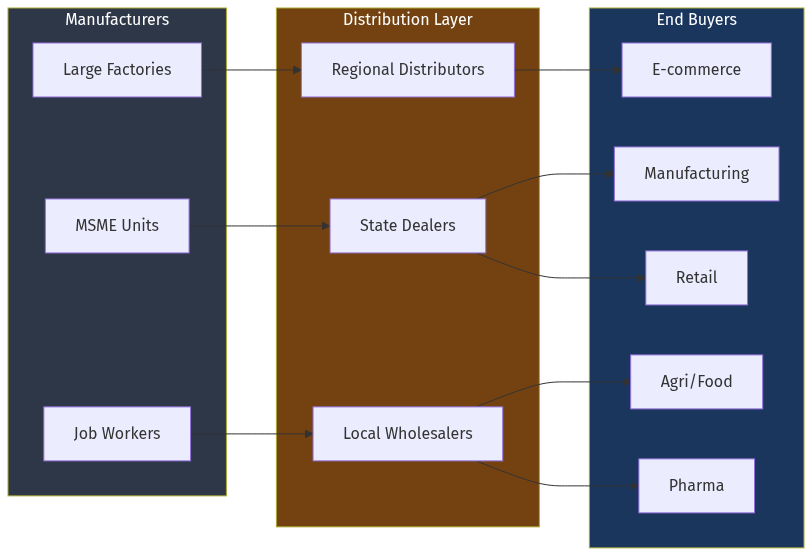
    Packaging Market Flow
    Packaging Market Flow

    Supply Chain Structure

    Packaging Supply Chain
    Packaging Supply Chain

    ## Sources