ResearchWednesday, March 11, 2026

AI-Powered B2B Hotel & Hospitality Procurement Platform

India's hospitality industry is projected to reach $420B by 2030, yet hotel procurement remains stuck in 1990s workflows — phone calls for every order, manual Excel sheets for inventory, and zero visibility into spending. An AI-powered B2B procurement platform could transform how 200,000+ hotels source everything from linens to lemons — automating reordering, consolidating suppliers, and creating the first real data layer for an industry that runs on guesswork.

1.

Executive Summary

India's hospitality sector is experiencing unprecedented growth — driven by tourism resurgence, wedding season demand, corporate travel revival, and the government's push to position India as a global travel destination. Yet the procurement infrastructure that supports this industry remains astoundingly primitive.

Hotels, resorts, and hospitality chains still rely on:

  • Phone calls and WhatsApp messages to place orders
  • Manual Excel sheets for inventory tracking
  • Fragmented relationships with hundreds of local suppliers
  • No standardized quality metrics or pricing transparency
  • Zero data visibility into procurement patterns
This article explores the opportunity to build an AI-powered B2B hotel and hospitality procurement platform — a system that digitizes purchasing workflows, automates inventory intelligence, creates supplier networks, and generates the first real data moat in this massive industry.

The TAM is massive: India's hospitality industry includes 200,000+ hotels, 100,000+ restaurants within hotels, 4,500+ starred properties, and countless homestays — all Procuring everything from toilet paper to terry towels, from kitchen equipment to kitchen staff uniforms.


## Platform Architecture
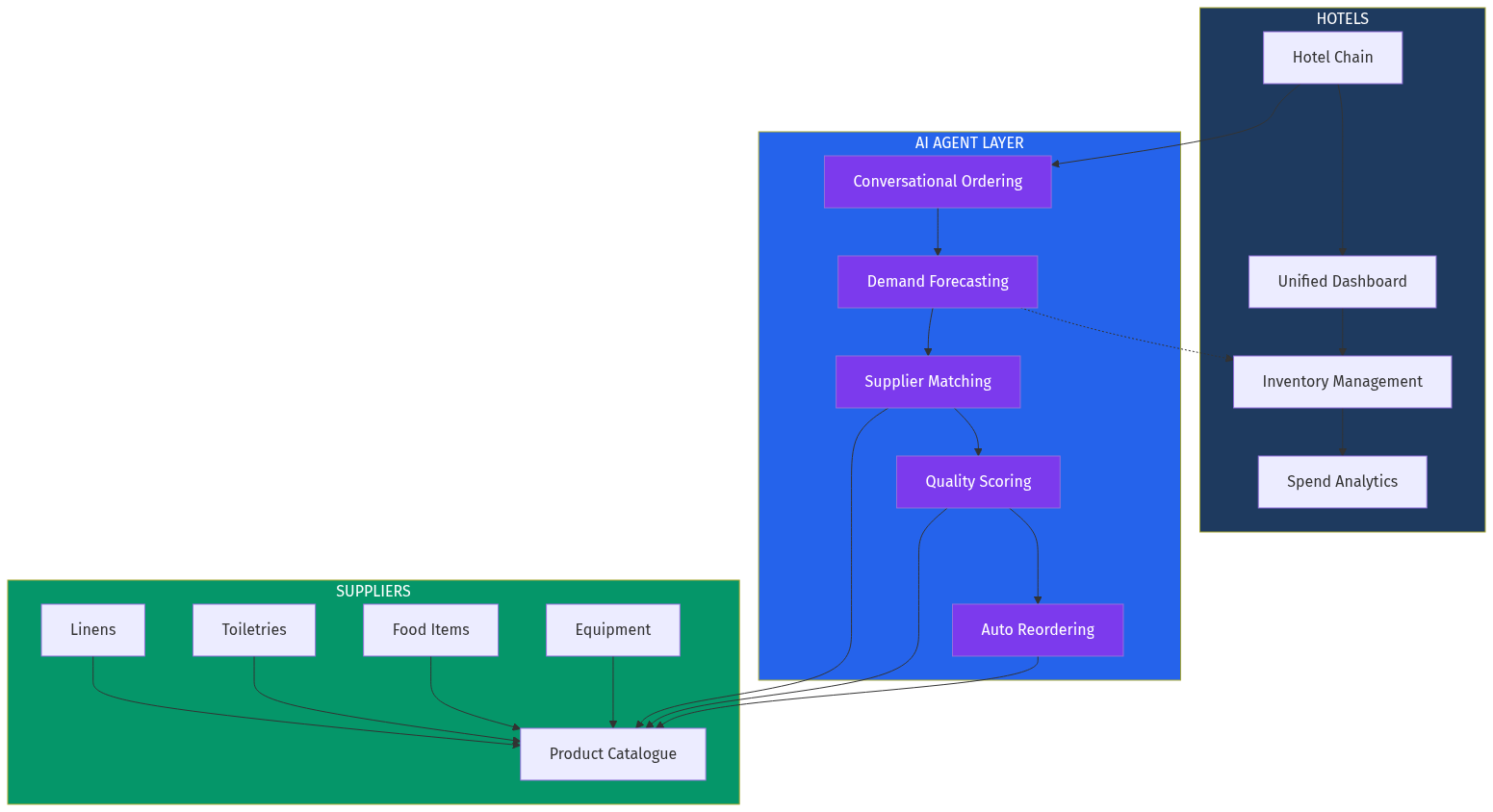
AI-Powered Hotel Procurement Platform

2.

Problem Statement

The Procurement Chaos

Running a hotel means managing procurement across 50+ categories:

Supplier Fragmentation
  • Each property works with 100-300 local suppliers
  • No consolidated ordering — different vendors for different categories
  • Pricing is negotiated per-property, per-order
  • Delivery schedules are uncoordinated
  • Quality varies wildly between batches
Manual Everything
  • Orders placed via phone calls (yes, really)
  • Excel sheets for inventory tracking
  • WhatsApp for order confirmations
  • Physical paperwork for deliveries
  • Manual reconciliation of invoices
Data Blindness
  • No visibility into spending patterns across properties
  • Can't identify cost optimization opportunities
  • No historical data for demand forecasting
  • Supplier performance is based on "gut feeling"
  • Can't benchmark between properties
Quality Uncertainty
  • No standardized quality specifications
  • "The last batch was fine" is the only metric
  • Returns and disputes are handled manually
  • No systematic quality scoring

Who Experiences This Pain

  • Boutique Hotels — Limited staff, can't dedicate procurement person
  • Hotel Chains — Multi-property means multiplied complexity
  • Resorts — Remote locations make supplier management harder
  • Guest Houses — Volume too low for negotiation power
  • Hospitality Management Companies — Need visibility across portfolios

3.

Current Solutions

The market has pockets of digitization but significant gaps remain:

CompanyWhat They DoWhy They're Not Solving It
HotelogixProperty management systemFocuses on front-office, not procurement
Innoppl (now Cloudbeds)Hotel management softwareNo procurement module
EZee AbsoluteHotel softwareConsumer-facing, not B2B sourcing
Local WhatsApp GroupsInformal supplier networksNo tech, no standardization
Hotel AssociationsDirectory listingsNo transaction layer

What Existing Solutions Miss

  • No AI-powered demand forecasting — Hotels can't predict peak seasons
  • No supplier marketplace — No discovery, just existing relationships
  • No automated reordering — Manual reorder points
  • No quality standardization — Every order is subjective
  • No cross-property analytics — Can't leverage multi-property buying power

  • 4.

    Market Opportunity

    Market Size (India)

    SegmentMarket SizeNotes
    Hotels & Resorts$32B2025 estimate
    Restaurant in Hotels$18BF&B within hospitality
    Contractual Catering$8BCorporate catering
    Guest Houses & Homestays$12BUnorganized segment
    Total TAM$70B+Addressable procurement

    Growth Drivers

    • Tourism Surge: India targets 30M foreign tourists by 2028
    • Domestic Travel: 2B+ domestic tourist trips annually
    • Wedding Season: $50B+ wedding industry drives hotel bookings
    • Corporate Travel: Reviving post-pandemic
    • Government Push: Incredible India campaign, visa reforms

    Why Now

  • Post-COVID Digitalization — Hotels are more willing to adopt tech
  • Consolidation Pressure — Chains are acquiring, need standardization
  • Labor Shortages — Can't afford manual procurement staff
  • Payment Digitization — UPI makes B2B payments easier
  • AI Maturity — Language models can handle supplier conversations

  • 5.

    Gaps in the Market

    Using ANOMALY HUNTING:

  • No Product Catalogues
  • - Hotels can't browse products online - No standardized SKUs - Can't compare prices across suppliers
  • No Quality Standards
  • - No specifications for "Grade A Linens" - Quality is subjective - No third-party verification
  • No Multi-Property Visibility
  • - Chains can't leverage buying power - Each property negotiates separately - Can't standardize across portfolio
  • No Inventory Intelligence
  • - No automated reorder triggers - Stockouts during peak season - Over-ordering during low season
  • No Supplier Scoring
  • - No data-driven vendor evaluation - Relationship-based (not performance-based) - No accountability
    6.

    AI Disruption Angle

    Using DISTANT DOMAIN IMPORT from e-commerce:

    Amazon revolutionized consumer retail with:

    • Product catalogues with reviews
    • One-click reordering
    • Delivery tracking
    • Quality guarantees
    The hospitality industry needs the same for B2B.

    AI Agent Workflows:

    User: "We need 500 bath towels for next week"
    
    AI Agent:
    1. Checks inventory → "Current stock: 200, departing guests: 150"
    2. Queries supplier network → "Supplier A: ₹180/towel, Supplier B: ₹165/towel"
    3. Compares quality ratings → "Supplier B: 4.2★, Supplier A: 3.8★"
    4. Checks delivery capacity → "Supplier B can deliver 500 by Wednesday"
    5. Places order → "Order confirmed: 500 towels @ ₹165 = ₹82,500"
    6. Tracks delivery → "Out for delivery, ETA 2pm"
    7. Quality verification → "Photo confirmation received"
    8. Auto-reconciliation → "Invoice matched, payment processed"

    Key AI Capabilities:

  • Conversational Ordering — WhatsApp-style ordering in natural language
  • Demand Forecasting — ML models predict based on bookings, seasons, events
  • Dynamic Pricing — Real-time price optimization
  • Quality Scoring — Photo-based AI quality verification
  • Supplier Matching — ML recommendation of best suppliers per category

  • 7.

    Product Concept

    Platform Features:

    For Hotels:
    • Unified procurement dashboard across properties
    • AI-powered inventory management
    • Supplier discovery and comparison
    • Automated reordering based on occupancy
    • Spend analytics and benchmarking
    • Quality verification with photos
    For Suppliers:
    • Digital storefront with product catalogues
    • Order management system
    • Payment processing
    • Performance analytics
    • Demand forecasting from platform data

    Revenue Model:

    StreamDescriptionTake Rate
    Transaction FeePer-order commission2-5%
    SaaS SubscriptionPlatform access₹5K-50K/month
    Sponsored ListingsFeatured suppliers₹10K-1L/month
    Data ServicesMarket intelligence₹50K+ for reports
    FinancingSupplier creditInterest margin
    ---
    8.

    Development Plan

    PhaseTimelineDeliverables
    MVP8 weeksWhatsApp ordering, 50 suppliers, 5 hotel pilots
    V112 weeksFull catalogue, inventory module, analytics
    V216 weeksAI forecasting, quality scoring, multi-property
    ScaleOngoingSupplier network expansion, B2B payments

    Technical Stack:

    • Frontend: Next.js (web), WhatsApp Business API (conversational)
    • Backend: Node.js, PostgreSQL
    • AI: LLMs for conversational ordering, ML for forecasting
    • Payments: Razorpay B2B

    9.

    Go-To-Market Strategy

    Phase 1: Anchor Hotels

  • Target 3-4 star hotels (not 5-star — too legacy)
  • Focus on hotel chains with 5-20 properties
  • Offer free pilot for first 10 hotels
  • Get testimonials and case studies
  • Phase 2: Supplier Network

  • Onboard top suppliers in each category
  • Train suppliers on digital catalogue management
  • Create quality benchmarks
  • Incentivize early adoption
  • Phase 3: Network Effects

  • Hotels bring suppliers, suppliers bring hotels
  • Cross-property analytics become valuable
  • Data moat compounds over time
  • Premium pricing for enterprise features
  • Channels:

    • Hotel associations (FHRAI, HAI)
    • Hospitality institutes (IHM)
    • Industry events (Hotel Investment Conference)
    • Referrals from existing customers

    10.

    Falsification Analysis (Pre-Mortem)

    Why This Could Fail:

    Scenario 1: Supplier Resistance
    • Suppliers don't want transparent pricing
    • Fear disintermediation
    • Mitigation: Position as discovery layer, not replacement
    Scenario 2: Hotels Too Legacy
    • Phone ordering is "good enough"
    • No budget for tech
    • Mitigation: Target progressive hotels, prove ROI first
    Scenario 3: Low Switching Costs
    • Hotels switch suppliers easily
    • No stickiness
    • Mitigation: Build data moat, create switching costs via analytics
    Scenario 4: Capital Intensive
    • Inventory model requires too much cash
    • Mitigation: Pure marketplace, no inventory

    11.

    Why This Fits AIM Ecosystem

    This opportunity aligns perfectly with AIM's vision:

  • Vertical SaaS: Fits the B2B vertical platform strategy
  • Data Moat: Procurement data compounds over time
  • India-First: Deeply localized to Indian hospitality
  • Agent-Ready: AI agents can handle conversational ordering
  • Network Effects: More hotels = more suppliers = more value
  • Potential Integration Points:

    • AIM.in: Category page for hospitality suppliers
    • Domain Strategy: hotelprocurement.in, hospitalitysupplies.in
    • WhatsApp Commerce: Bhavya (Krishna) integration for ordering
    • Data Intelligence: Netrika can provide market insights

    ## Verdict

    Opportunity Score: 8/10

    This is a massive, underserved market with clear pain points and a plausible path to building a data moat. The key differentiator will be demand forecasting — if you can tell a hotel "you'll need 500 towels in 2 weeks," you've become indispensable.

    The risk is supplier adoption — they control the supply side. But the fragmentation works in our favor: individual suppliers have no power, while a platform can aggregate demand.

    Recommendation: Build. Start with 5 boutique hotels and 20 suppliers in one city. Prove the model. Then expand.

    ## Sources