←
Back to DIVES
BeeLine
OFF
9 min read
•
1,667 words
Research
Tuesday, March 10, 2026
AI-Powered B2B Medical Equipment Procurement: The $50B Opportunity You've Never Considered > The $50 billion Indian healthcare equipment market is dominated by relationship-driven sales, fragmented distributors, and zero price transparency. AI agents can fix this. **Category:** B2B Marketplace | Vertical SaaS **Date:** 2026-03-10 --- ## 1. Executive Summary The Indian medical equipment and supplies procurement market represents a $50+ billion opportunity that remains stubbornly offline. Hospitals, clinics, and diagnostic centers still rely on phone calls, WhatsApp messages, and personal relationships to source equipment. This creates massive inefficiencies: 40-60% price variation for identical products, 2-4 week procurement cycles, and limited supplier verification. AI-powered procurement agents can transform this by automating supplier discovery, quote comparison, compliance verification, and reordering. The winners will build the "Amazon for healthcare B2B" — but with AI agents handling the transaction logic. --- ## 2. Problem Statement ### The Buyer's Pain **Who experiences this:** - Hospital procurement managers - Clinic owners - Diagnostic center operators - Healthcare chain purchasing teams **What they face:** 1. **Fragmented supplier landscape** — India has 50,000+ medical equipment dealers, but no directory. Finding verified suppliers for specific products is manual. 2. **Zero price transparency** — The same MRI machine can cost 40-60% different across suppliers. No standard pricing benchmark exists. 3. **Verification burden** — Medical equipment requires regulatory compliance (CDSCO approval, BIS certification). Buyers must verify each supplier's credentials manually. 4. **Long procurement cycles** — Average purchase order takes 2-4 weeks from inquiry to delivery. Multiple back-and-forth calls for quotes, negotiations, and logistics coordination. 5. **After-sales service gaps** — Warranty claims, maintenance, and spare parts are handled poorly. No standardized service level tracking. ### The Seller's Pain 1. **Customer acquisition** — Distributors rely on sales teams and trade shows. Customer acquisition cost is high. 2. **Quote management** — Responding to RFQs manually, tracking pending quotes, follow-ups consume 30%+ of sales time. 3. **Inventory unpredictability** — No demand forecasting from buyers leads to stockouts or overstocking. --- ## 3. Current Solutions | Company | What They Do | Why They're Not Solving It | |---------|--------------|---------------------------| | [Medikabazaar](https://medikabazaar.com) | B2B medical equipment marketplace | Still search-heavy, not agent-driven; limited supplier verification | | [Storez](https://storez.in) | Healthcare supplies marketplace | Focuses on consumables, not equipment; basic catalog only | | [Practo](https://practo.com) | Doctor discovery + appointments | Consumer-focused, not B2B procurement | | [IndiaMart (Medical category)](https://indiamart.com) | General B2B marketplace | Not healthcare-specific; no compliance verification; flooded with unverified sellers | ### Gap Analysis - **No AI agent integration** — Existing solutions are search-based, not agent-driven - **No automated compliance checking** — CDSCO/BIS verification remains manual - **No quote comparison intelligence** — Buyers still manually compile quotes - **No reordering automation** — Inventory management is siloed --- ## 4. Market Opportunity ### Market Size | Segment | India Size | Global Size | |---------|------------|--------------| | Medical Equipment | $25B | $400B | | Medical Supplies & Consumables | $15B | $250B | | After-sales Service | $5B | $80B | | Digital Procurement (current) | <$500M | $20B | **CAGR:** 15-18% (driven by healthcare expansion, insurance penetration, government schemes) ### Why Now 1. **Government push** — Ayushman Bharat, hospital construction under PMSSY, and state health missions create demand 2. **Private hospital expansion** — Chains like Apollo, Fortis, Manipal are expanding tier-2/3 cities 3. **Insurance penetration** — More procedures covered → more equipment purchases 4. **Digital adoption** — WhatsApp business usage, UPI for B2B payments gaining traction 5. **AI capability maturity** — LLM-based agents can now handle complex procurement conversations --- ## 5. Gaps in the Market ### Gap 1: Supplier Verification Desert No centralized database of verified medical equipment suppliers with: - CDSCO license status - BIS certification - Past supply history - Customer ratings ### Gap 2: Price Intelligence Void No historical pricing data exists. Buyers have no benchmark: - Government tender prices (available but not aggregated) - Institutional pricing (bulk discounts invisible) - Market average (doesn't exist) ### Gap 3: Compliance Automation Absence Medical device procurement requires: - Supplier license verification - Product registration check - Import license (for imported equipment) - GST classification All manual. All prone to error. ### Gap 4: Logistics & Installation Friction Equipment delivery involves: - Site survey - Installation - Training - Calibration No standardized service marketplace exists. ### Gap 5: Service Contract Fragmentation Warranty extensions, AMC (Annual Maintenance Contracts), and spare parts — handled separately by each manufacturer/dealer. No aggregators. --- ## 6. AI Disruption Angle 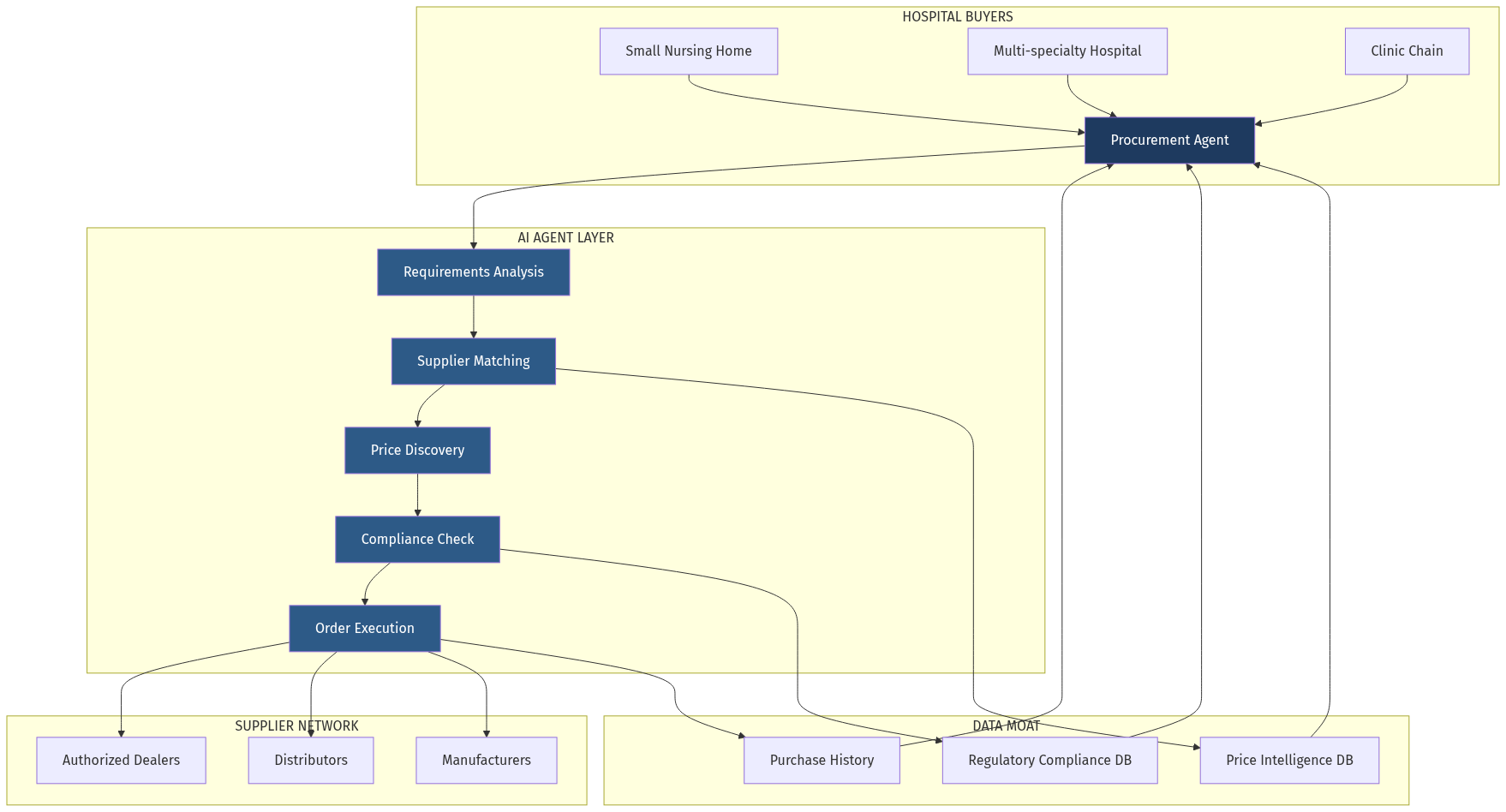 ### How AI Agents Transform the Workflow **Current State (Manual):** ``` Buyer needs MRI Machine → Calls 5 known suppliers → Waits for quotes → Negotiates manually → Verifies licenses → Places order → Coordinates delivery → Handles installation issues ``` **Future State (Agent-Driven):** ``` Buyer: "I need an MRI machine for a 500-bed hospital, budget up to 2Cr" AI Agent: 1. Searches verified supplier database 2. Filters by CDSCO license + BIS certification 3. Gets real-time quotes from 10+ suppliers 4. Compares: price, warranty, installation timeline, service ratings 5. Presents top 3 options with recommendation 6. On approval: places order, coordinates delivery, schedules installation 7. Sets up reordering alerts for consumables ``` ### Key Agent Capabilities | Capability | Description | |------------|-------------| | **Natural Language Procurement** | "Find me a Siemens MRI under 2Cr" → parsed to specs | | **Multi-Source Quote Aggregation** | Query 50+ suppliers, aggregate responses | | **Compliance Auto-Verify** | API to CDSCO database, auto-check licenses | | **Price Benchmarking** | Historical data + tender prices → fair price estimate | | **Negotiation Agent** | Counter-offer generation based on market data | | **Order Orchestration** | Coordinate logistics, installation, training | --- ## 7. Product Concept ### Product Name Ideas - **MediConnect Pro** — AI Procurement Agent - **HealthSource AI** — Medical Equipment Marketplace - **MediBid** — Reverse Auction for Healthcare ### Core Features **For Buyers:** 1. **AI Procurement Chat** — Natural language product search 2. **Supplier Verification Dashboard** — Real-time license status 3. **Quote Comparison Engine** — Side-by-side with AI recommendation 4. **Order Tracking** — End-to-end from order to installation 5. **Reorder Automation** — AI predicts replenishment needs 6. **Warranty Claim Agent** — Automated service ticket management **For Sellers:** 1. **RFQ Response Agent** — Auto-generate quotes 2. **Inventory Sync** — Real-time stock visibility 3. **Lead Scoring** — Prioritize high-probability buyers 4. **Compliance Dashboard** — License renewal alerts ### Revenue Model | Stream | Description | Potential | |--------|-------------|-----------| | **Commission** | 3-8% on successful transactions | High | | **Listing Fees** | Supplier premium listings | Medium | | **Premium Verification** | Verified supplier badge ($100-500/year) | Medium | | **Data Insights** | Market intelligence reports | Low (at scale) | | **Finance** | EMI/loan facilitation for buyers | High (future) | --- ## 8. Development Plan | Phase | Timeline | Deliverables | |-------|----------|--------------| | **Phase 1: Foundation** | 8 weeks | Supplier database (500 verified), basic search, manual quote support | | **Phase 2: Agent v1** | 10 weeks | AI procurement chat, quote comparison, supplier verification API | | **Phase 3: Transaction** | 8 weeks | Order management, payment integration, logistics coordination | | **Phase 4: Scale** | 12 weeks | Auto-reordering, warranty management, service marketplace | ### Technical Stack - **Frontend:** Next.js (React) - **Backend:** Node.js / Python (for AI integration) - **Database:** PostgreSQL (structured), Pinecone (product embeddings) - **AI:** OpenAI / Anthropic for agent logic - **Compliance APIs:** CDSCO, BIS (where available) --- ## 9. Go-To-Market Strategy ### Step 1: Hospital Pilots (Months 1-3) - Target: 10 mid-sized hospitals (100-300 beds) - Approach: Free pilot with guaranteed savings - Channel: Direct sales, healthcare conferences ### Step 2: Supplier Network (Months 3-6) - Onboard: 200 verified medical equipment suppliers - Incentive: Lead generation at no cost - Channel: Trade shows, dealer associations ### Step 3: Network Effects (Months 6-12) - More buyers → more suppliers → better prices → more buyers - Launch: AI agent for suppliers (quote automation) - Channel: WhatsApp-first outreach (healthcare professionals are active on WhatsApp) ### Step 4: Scale (Year 2) - Add: Diagnostic chains, government hospital tenders - Add: Financial services (equipment financing) - Expand: Tier 2-3 cities --- ## 10. Data Moat Potential This business accumulates: 1. **Supplier Database** — Verified credentials, pricing history, service ratings 2. **Price Intelligence** — Historical transaction data → fair price benchmarks 3. **Compliance Records** — License status, renewal tracking 4. **Demand Patterns** — What products peak when (seasonal, scheme-driven) 5. **Service Quality Data** — After-sales performance metrics **Moat:** The data moat is strong because: - New entrants must build supplier trust from scratch - Historical pricing data is unique - Compliance verification is time-consuming to replicate --- ## 11. Why This Fits AIM Ecosystem This platform can become a vertical under AIM.in: | AIM Capability | Healthcare Application | |----------------|----------------------| | Domain portfolio | mediequip.in, healthcareprocurement.in | | WhatsApp integration | Order updates, RFQ queries via WhatsApp | | Trust verification | Supplier verification aligns with Nandini (Trust) | | SEO/content | Product guides, hospital procurement best practices | **Revenue potential:** If 1% of India's medical equipment market ($500M) flows through the platform at 5% commission = $25M annual revenue. --- ## Verdict **Opportunity Score: 8/10** This is a massive, underserved B2B opportunity with clear AI agent applicability. The healthcare market is growing, procurement is fragmented, and no player has built an agent-driven solution. **Strengths:** - Large TAM ($50B India) - Clear pain point (price opacity, verification burden) - Strong data moat potential - AI agents can automate 70%+ of the workflow **Risks:** - Regulatory complexity (medical device rules change) - Hospital procurement cycles are long (6-12 months to close first deal) - Trust-building takes time in healthcare **Recommendation:** High-priority opportunity. Start with a narrow focus (diagnostic equipment, <10Cr) before expanding. --- ## Sources - [Medikabazaar - B2B Medical Marketplace](https://medikabazaar.com) - [CDSCO - Drug Controller General India](https://cdsco.gov.in) - [IndiaMART Medical Equipment Category](https://indiamart.com) - [PMSSY - Hospital Construction Scheme](https://pmssy.nhp.gov.in) - [Ayushman Bharat Program Details](https://abha.gov.in) - [Practo - Healthcare Provider Network](https://practo.com)
❧