ResearchFriday, March 6, 2026

AI-Powered Industrial Energy Management & Carbon Credits Marketplace

India's manufacturing sector consumes 30%+ of total electricity but operates with 40-60% inefficiency. AI-driven energy optimization combined with carbon credit monetization creates a compelling ROI story for plant managers while enabling India's climate commitments.

1.

Executive Summary

India's industrial energy sector stands at an inflection point. With DISCOM losses exceeding ₹90,000 crore annually, renewable penetration targets of 50% by 2030, and emerging carbon credit markets, there's unprecedented opportunity for AI-powered energy management platforms that simultaneously reduce costs and generate new revenue streams through carbon credits.

This article proposes an AI-powered industrial energy management and carbon credits marketplace — a platform that combines real-time energy monitoring, predictive optimization, demand response orchestration, and carbon credit generation into a unified offering for manufacturing plants across India.

Opportunity Score: 8.5/10
2.

Problem Statement

The Energy Inefficiency Crisis

Indian manufacturing faces a paradox: electricity costs consume 15-30% of operational expenditure (opex), yet most plants operate with minimal visibility into their actual consumption patterns.

Key pain points:

  • No real-time visibility — Most plants rely on monthly bills, missing daily/hourly waste
  • Reactive rather than predictive — Maintenance failures cause peak demand spikes
  • No demand response participation — Plants miss revenue opportunities by not participating in grid balancing
  • Carbon compliance burden — Emerging regulations require emissions tracking most plants can't handle
  • Renewable integration challenges — Solar/wind adoption increases complexity without smart management
  • The Carbon Market Gap

    India's carbon credit market is nascent but growing:

    • PAT (Perform, Achieve, Trade) scheme covers 900+ designated consumers
    • GGR (Global Green Rating) for buildings gaining traction
    • PLI schemes increasingly tied to sustainability metrics
    Yet no unified platform exists to help manufacturers:
    • Measure baseline emissions accurately
    • Identify reduction opportunities
    • Monetize verified credits
    • Navigate complex registry requirements
    ---

    3.

    Current Solutions

    CompanyWhat They DoWhy They're Not Solving It
    EnergysisEnergy auditing and consultingManual processes, no AI, limited scale
    Upto 60Energy efficiency consultingEnterprise focus, expensive, not SMB-friendly
    ZenatixIoT-based energy monitoringHardware-focused, limited analytics depth
    SmartenUtility management SaaSFocused on billing, not optimization or carbon
    KlarEnergy analyticsLimited India presence, enterprise pricing
    ** carbon.ioCarbon accountingGlobal focus, not India-specific registry integration

    Gap Analysis

    What's Missing:
    • Unified energy + carbon platform
    • AI-driven predictive optimization (not just monitoring)
    • Seamless carbon credit marketplace integration
    • SMB-friendly pricing (sub-₹50k/month)
    • India-specific DISCOM and power exchange integrations

    4.

    Market Opportunity

    Market Size

    • India industrial energy market: ₹18 lakh crore (~$215B) annually
    • Energy efficiency market: ₹45,000 crore (~$5.4B), growing 15% CAGR
    • Carbon credits (India): ~₹5,000 crore potential by 2030
    • Demand response market: ₹8,000 crore by 2028

    Why Now

  • Regulatory pressure — BEE (Bureau of Energy Efficiency) tightening PAT targets
  • Cost inflation — Electricity costs up 20-30% in 2 years
  • Carbon market maturation — India Energy Exchange (IEX) launching carbon contracts
  • IoT commoditization — Smart meters and sensors now affordable
  • AI accessibility — Edge AI makes on-premise processing viable

  • 5.

    Gaps in the Market

    Gap 1: No Unified Energy-Carbon Platform

    Current solutions either do energy monitoring OR carbon accounting — never both. Manufacturers want one vendor for everything.

    Gap 2: SMB Exclusion

    Existing solutions target large enterprises (₹1cr+ annual energy spend). 80% of Indian manufacturing — mid-market and SMEs — are unserved.

    Gap 3: Passive vs. Active

    Most solutions show dashboards. None actively optimize or transact on the plant's behalf.

    Gap 4: Carbon Credit Complexity

    Verra, Gold Standard, and India-specific registries are incomprehensible to plant managers. No guided pathway exists.

    Gap 5: No Passive Revenue

    Plants don't realize they can earn money through demand response, carbon credits, and renewable energy certificates (RECs). No platform monetizes these opportunities.
    6.

    AI Disruption Angle

    How AI Transforms the Workflow

    Phase 1: Visibility (Months 1-3)
    • IoT sensors → ML models → consumption patterns
    • Anomaly detection flags waste in real-time
    Phase 2: Optimization (Months 4-6)
    • Predictive load balancing across equipment
    • Peak shaving through intelligent scheduling
    • Demand response signal processing
    Phase 3: Monetization (Months 7-12)
    • Automatic carbon credit generation from verified reductions
    • Demand response bid submission to power exchanges
    • REC trading optimization

    The AI Agent Advantage

    Future state: Autonomous energy agent per plant

    • Negotiates with grid in real-time
    • Buys power when prices low, sells when high
    • Generates and trades carbon credits autonomously
    • Files compliance reports without human intervention
    ---

    7.

    Product Concept

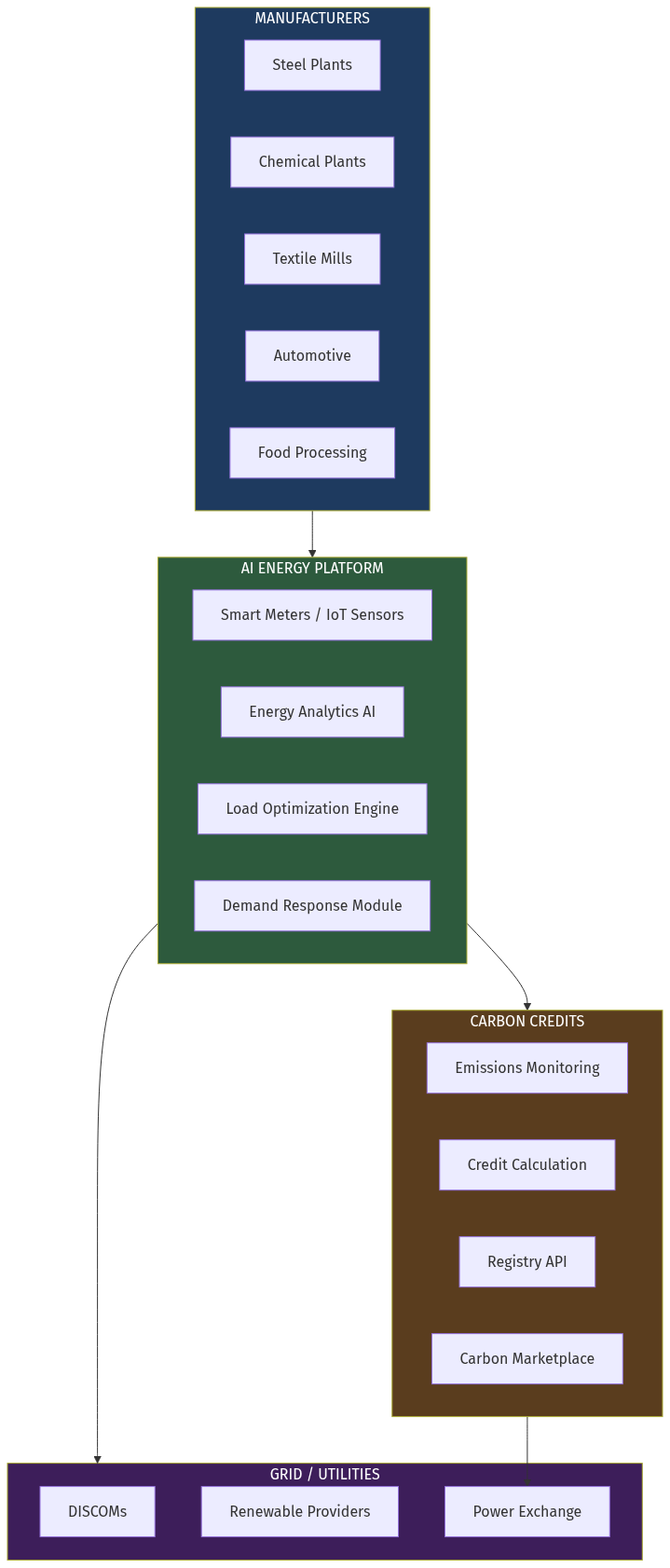
    Platform Architecture

    Architecture Diagram
    Architecture Diagram

    Core Features

    FeatureDescription
    Smart Meter IntegrationSupport for Indian make meters, modbus/TCP protocols
    Equipment Level TrackingSub-metering for major loads (motors, boilers, HVAC)
    AI Demand Forecasting24-72 hour load prediction with weather overlay
    Peak shaving automationAutomatic load shedding of non-critical equipment
    Carbon calculatorGHG Protocol-aligned emissions computation
    Credit marketplaceSingle interface to list/bid carbon credits
    Demand response portalOne-click registration for DR programs
    Compliance automationBEE PAT reporting, state pollution board filings

    Target Plants

    • Tier 1: 500+ kW connected load, ₹5cr+ annual energy (1,500 plants)
    • Tier 2: 100-500 kW connected load, ₹1-5cr annual (15,000 plants)
    • Tier 3: 50-100 kW, ₹50L-1cr annual (50,000+ plants)

    8.

    Development Plan

    PhaseTimelineDeliverables
    MVP8 weeksMeter integration, basic dashboard, anomaly alerts
    V116 weeksAI optimization engine, demand response integration
    V224 weeksCarbon credit module, marketplace integration
    Scale36 weeksMulti-plant orchestration, API ecosystem

    Technical Stack

    • Edge: Raspberry Pi / industrial PLC for on-premise processing
    • Cloud: AWS India region, Kubernetes cluster
    • ML: PyTorch, MLflow for model training
    • Integrations: IEX API, BEE portal, Verra API

    9.

    Go-To-Market Strategy

    Phase 1: Anchor Customers (Months 1-3)

    • Target: 5-10 plants in one industrial corridor (e.g., Gujarat, Maharashtra)
    • Approach: Free pilot in exchange for case study + testimonial
    • Channels: Direct sales, industry associations (CII, FICCI)

    Phase 2: Network Effects (Months 4-8)

    • Add demand response aggregation — plants that join together get better rates
    • Partner with ESCOs (Energy Service Companies) for turnkey installations
    • Offer carbon credit revenue share — plant pays nothing upfront

    Phase 3: Marketplace (Months 9-12)

    • Launch carbon credit marketplace with verified buyers (corporates, exchanges)
    • Add demand response auction platform
    • Enable REC trading

    Pricing Model

    TierMonthly FeeRevenue Share
    SMB (Tier 3)₹25,0005% carbon revenue
    Mid-market (Tier 2)₹75,0008% carbon revenue
    Enterprise (Tier 1)₹2,00,000+10% carbon revenue
    ---
    10.

    Revenue Model

    Primary Revenue Streams

  • SaaS Subscription — ₹15-50L annual per plant (tiered)
  • Carbon Credit Commission — 10% of transaction value
  • Demand Response Payments — ₹5-15 per kW per event
  • Consulting Upsell — Energy audits, carbon verification
  • Unit Economics

    • CAC: ₹3-5L per customer (sales + installation)
    • LTV: ₹25-40L over 5-year relationship
    • Payback: 8-12 months
    • Gross Margin: 70%+ at scale

    11.

    Data Moat Potential

    Proprietary Data Accumulation

    • Energy consumption patterns — 15-minute granularity across thousands of plants
    • Equipment efficiency benchmarks — Compare similar plants by sector/size
    • Grid behavior models — Predictable demand response performance
    • Carbon baselines — Defensible position for credit verification

    Moat Strength

    Strong — Energy data is plant-specific and cumulative. A new entrant would need years to build comparable datasets. Integration with BEE, IEX, and carbon registries creates switching costs.
    12.

    Why This Fits AIM Ecosystem

    This platform aligns perfectly with AIM.in's vision:

  • Vertical integration — Could become the "energy" vertical under AIM's B2B marketplace
  • Domain expertise — Leverages existing AIM assets (RCC pipes database, industrial contacts)
  • Data network effects — More plants = better benchmarks = stronger AI
  • Complements existing — B2B procurement agents could integrate with energy optimization
  • Potential Synergies

    • Procurement agents negotiate better energy contracts
    • Equipment rental marketplace ties into power requirements
    • Industrial safety platform shares plant access

    ## Verdict

    Opportunity Score: 8.5/10

    This is a rare combination of:

    • Large addressable market (₹18 lakh crore)
    • Clear pain point (40-60% energy inefficiency)
    • Regulatory tailwind (carbon markets, PAT scheme)
    • AI-native solution (impossible without ML)
    • Defensible data moat (cumulative plant data)

    Risk Assessment (Pre-Mortem)

    RiskLikelihoodMitigation
    DISCOM data access blockedMediumPartner with state nodal agencies
    Carbon market regulations changeMediumBuild for multiple standards (Verra, Gold Standard, India)
    Hardware dependencyLowUse commodity IoT, avoid proprietary hardware
    Large enterprise competitionMediumFocus on underserved SMB segment

    Steelmanning (Why Incumbents Might Win)

    Energy giants (Tata Power, Adani) could build similar platforms:

    • Advantage: Existing plant relationships, capital
    • Disadvantage: Slow innovation, not AI-native, unlikely to serve SMBs
    • Our edge: Speed, SMB focus, AI-first approach
    ---

    ## Sources