AI-Powered B2B Hotel & Restaurant Procurement Marketplace
India's hospitality industry is undergoing a quiet revolution. While guests book rooms on apps, back-of-house procurement still runs on phone calls, WhatsApp messages, and handwritten lists. A $50B+ market remains stubbornly offline—presenting a massive opportunity for AI-enabled vertical platforms.
1.
Executive Summary
The Indian hotel and restaurant procurement market—valued at over $50 billion annually—operates almost entirely through manual, fragmented workflows. Hotel managers, chefs, and purchase managers spend 10-15 hours weekly just placing orders, comparing prices, and chasing deliveries.
This creates a prime opportunity for an AI-powered B2B procurement platform that combines:
Structured supplier marketplace with verified vendors
AI ordering agents that automate reordering based on consumption patterns
Quality assurance through AI-powered inspection scoring
Predictive pricing to optimize purchase timing
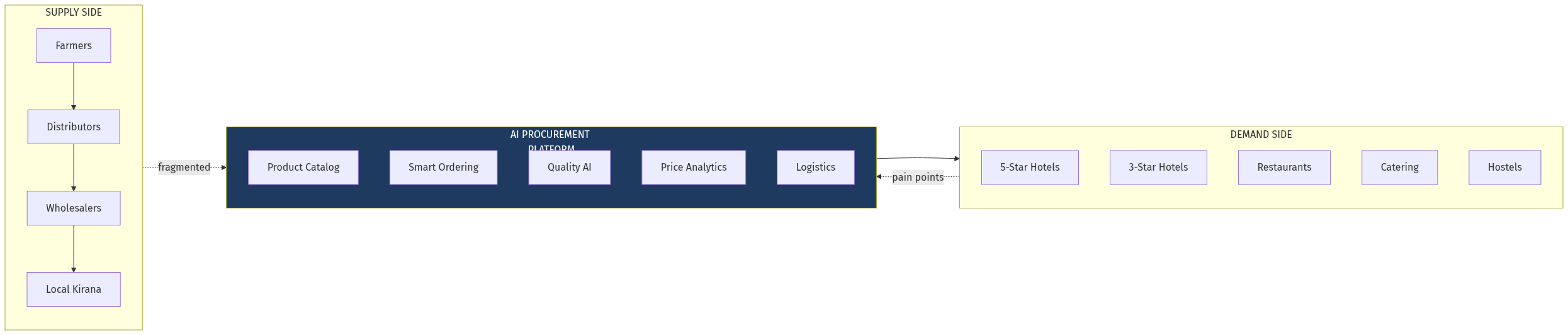
The platform acts as a two-sided marketplace: hotels on one side, food suppliers (farmers, distributors, wholesalers, cold chain) on the other. Network effects are powerful—more hotels attract more suppliers, better prices, and richer data for AI features.
2.
Problem Statement
The Daily Chaos of Hotel Procurement
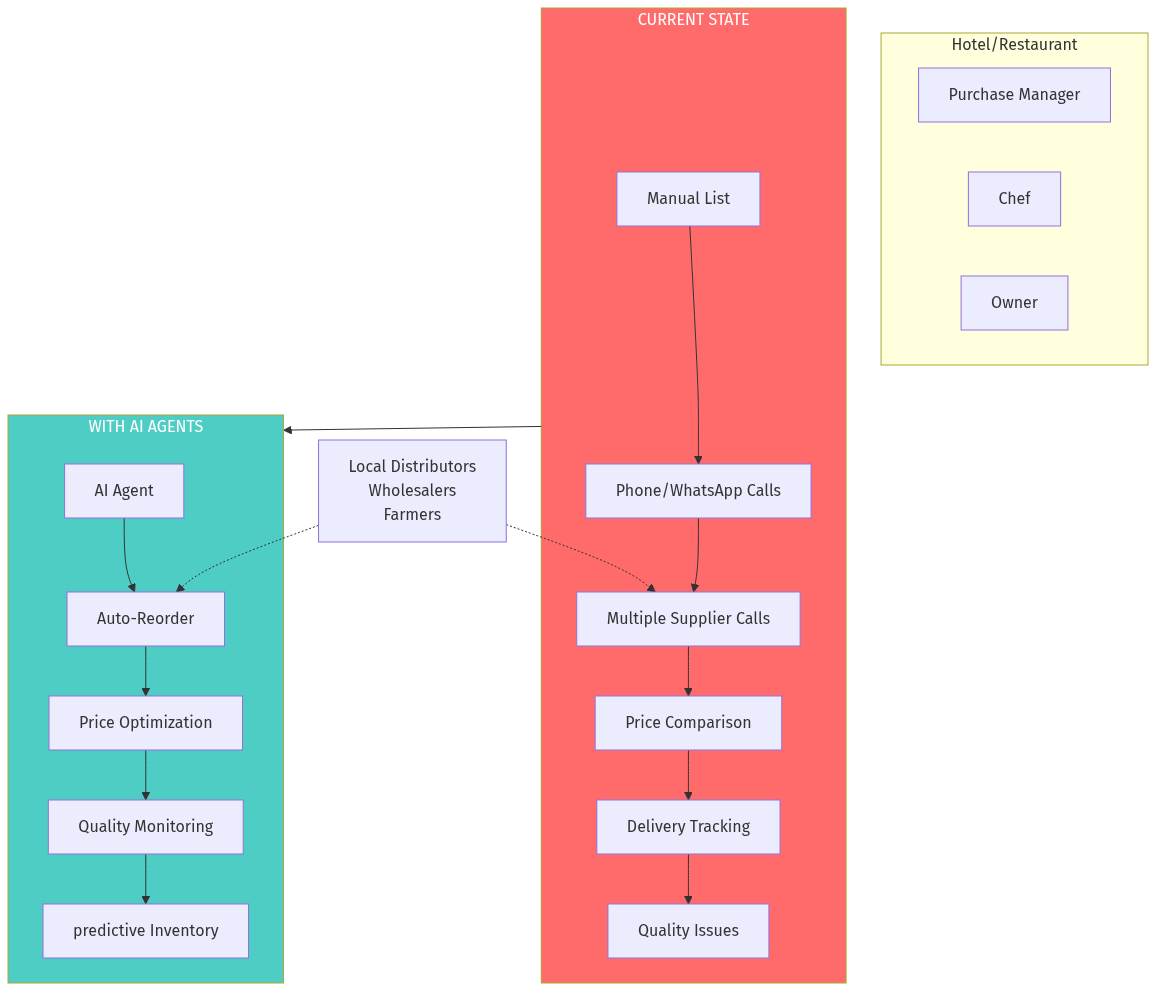
In a typical 100-room hotel, the procurement process looks like this:
Morning inventory check (6:00 AM) – Chef walks the store, notes what's running low
Manual list creation – Written on paper or WhatsApp
Supplier calls – Call 3-5 different vendors for prices
Price negotiation – Haggle, often with the same vendors daily
Order placement – Confirm via phone, hope nothing gets missed
Delivery waiting – No real tracking, staff wastes time waiting
Quality inspection – Visual check when delivery arrives, often disappointed
Time wasted: 10-15 hours/week per purchase manager
Quality issues: 20-30% of deliveries have problems (wrong quantity, below-standard quality)
Price opacity: No systematic way to know if you're getting the best rate
Who Experiences This Pain
5-star hotels – Have purchasing departments but still manual, high staff turnover
3-star and boutique hotels – Owner-manager does purchasing, no expertise
Restaurants – Even more fragmented, daily fresh produce needs
Catering companies – Large orders, complex logistics
Hostels and guesthouses – Smallest segment, most price-sensitive
Expensive, international focus, not India-relevant
Market Gap Analysis
No verticalized platform – Generalist B2B marketplaces don't understand hotel-specific needs (room service vs. restaurant vs. banquet)
No AI ordering – No platform learns consumption patterns and auto-generates orders
No quality scoring – No systematic way to rate suppliers beyond personal relationships
No integrated payments – Cash on delivery dominates, no credit facilities
No predictive analytics – Hotels can't plan procurement around events, seasons, pricing cycles
4.
Market Opportunity
Market Size
India hospitality market: $50-55 billion annually (2025)
Food & beverage procurement: ~35% of hotel costs = $17-19 billion
Restaurant food costs: 28-35% of revenue = $25-30 billion
Total addressable market: $42-49 billion
Growth Drivers
Tourism growth – India targets 20 million tourists by 2025
Restaurant boom – 15%+ annual growth in QSR and casual dining
GST rationalization – Input tax credits make formal procurement more attractive
Digital adoption – UPI payments, WhatsApp business usage rising
Labor shortage – Automation becoming necessary, not optional
Why Now
The timing is right because:
COVID forced digital adoption – Hotels learned to manage remotely
UPI infrastructure – Real-time payments at scale
Supplier smartphone adoption – Even local kiranas use WhatsApp Business
AI maturity – Language models can handle complex procurement conversations in Hinglish
5.
Gaps in the Market
Gap 1: No Structured Supplier Network
Suppliers are fragmented across:
Direct farmers – Best prices, inconsistent quality
Commission agents – Middlemen, 10-15% take
Wholesalers – Bulk, but minimum order quantities
Specialty distributors – Imported items, high margins
A platform needs to unify this fragmented supply into a searchable, ratable marketplace.
Gap 2: No Intelligent Reordering
Hotels order the same items daily/weekly. But:
No system learns consumption patterns
No auto-generation of purchase orders
No alerts for price spikes or supplier issues
AI Opportunity: Train models on historical consumption, integrate with property management systems (PMS), predict what needs ordering before it runs out.
Gap 3: Quality is Subjective
"Bad tomatoes" means different things to different people. No systematic quality scoring means:
Hotels can't build supplier trust scores
Good suppliers can't differentiate themselves
Bad suppliers persist through relationships
AI Opportunity: Photo-based quality verification, standardized scoring, verified reviews.
Gap 4: No Credit/Financing
Hotels run on thin margins and delayed payments:
Suppliers demand cash on delivery
Hotels need 30-60 day credit
No platform provides embedded finance
AI Opportunity: Credit scoring based on payment behavior, invoice factoring, supply chain finance.
Gap 5: Events & Seasonality
Hotels need to scale procurement rapidly for:
Festivals (Diwali, Christmas, Eid)
Local events (trade shows, weddings)
Tourist seasons (beach destinations, hill stations)
No system predicts these needs or helps hotels prepare.
6.
AI Disruption Angle
The AI Procurement Agent
The platform's core innovation is an AI Procurement Agent that acts as an intelligent purchasing assistant:
User: "What do I need to order today?"

AI Agent: "Based on your inventory and upcoming reservations (120
check-ins this weekend), here are recommended orders:

🥬 Vegetables: ₹8,500 (up 20% due to weekend demand)
   - Tomatoes 20kg @ ₹45/kg (supplier A rated 4.5★)
   - Onions 15kg @ ₹35/kg (supplier B rated 4.2★)
   - Green chilies 5kg @ ₹80/kg (supplier C rated 4.7★)

🍗 Proteins: ₹15,200
   - Chicken 50kg @ ₹180/kg (frozen, best rate)
   - Paneer 10kg @ ₹280/kg (fresh, delivery Friday)

📦 Total: ₹23,700

Shall I proceed with these orders?"
How AI Transforms Each Step
Step
Current State
With AI Agents
Inventory check
Manual walk-through
IoT sensors + AI image recognition
Order creation
Manual list
AI auto-generates from consumption patterns
Supplier selection
Phone calls
AI recommends based on price, quality, delivery
Price negotiation
Manual haggling
AI analyzes market prices, suggests optimal timing
Quality check
Visual inspection
AI scores from photos, builds supplier reputation
Payment
Cash on delivery
AI-managed credit terms, automated reconciliation
Agent-to-Agent Transactions
The ultimate vision: AI agents negotiating with AI agents
Hotel AI Agent: "I need 50kg tomatoes by 6 AM. Best price?"

Supplier AI Agent: "₹45/kg if delivered by 5 AM. ₹42/kg if
delivery window is 6-8 AM."

Hotel AI Agent: "5:30 AM works. Confirm order #1247?"

Supplier AI Agent: "Confirmed. Will dispatch from [location].
ETA tracking: 45 minutes."
Network effects: More hotels → more suppliers → better prices → more hotels
Data advantage: Historical data trains better AI models
Supplier relationships: Hard for competitors to replicate
Switching costs: Hotels build ordering history, preferences, AI learns their patterns
12.
Why This Fits AIM Ecosystem
Vertical Integration with AIM.in
This procurement platform could become a key vertical under the AIM ecosystem:
Domain ownership: Every hotel needs suppliers → massive TAM
Data collection: Procurement data reveals business health
Cross-selling: Hotel operators need domains, marketing, staffing
Trust building: Proven supplier relationships transfer to other B2B contexts
Potential Synergies
AIM Asset
Synergy
Domain portfolio
Hotels need web presence, booking engines
Marketing tools
Guest engagement, review management
Lead generation
New hotel acquisitions
Voice AI
Concierge services, room service orders
Exit Potential
Acquisition: By OYO, MakeMyTrip, or Swiggy (restaurant vertical)
IPO: If market leader reaches $100M+ GMV
Expansion: Replicate model for hospitals, corporate cafeterias, event management
13.
Mental Model Analysis
Zeroth Principles
What are we really solving?
Not "hotel procurement." The fundamental problem is: buyers and sellers can't find each other efficiently, and the transaction is full of friction.
If we started from scratch: We'd build a system where hotels say "I need X, Y, Z" and suppliers say "I have X, Y, Z at price P" and the system matches them intelligently.
Incentive Mapping
Stakeholder
Current Incentive
Platform Incentive
Hotel
Minimize cost, ensure quality
Better prices, less effort
Supplier
Maximize margin, minimize hassle
Guaranteed orders, predictable demand
Purchase manager
Avoid blame for bad decisions
Transparent, documented choices
Key insight: Hotels' purchase managers often resist new systems because they fear blame for any issues. The platform must make decisions attributable—showing why AI suggested X supplier.
Falsification (Pre-Mortem)
Why might this fail?
Chicken-and-egg: Can't get suppliers without hotels, can't get hotels without suppliers
- Mitigation: Start in one city, dominate before expanding
Price transparency kills margins: Suppliers resist showing real prices
- Mitigation: Position as value-add, not cost expose
Quality is unobservable: Can't verify quality online
- Mitigation: Photo verification, reputation systems
Hotels prefer relationships: They trust their current suppliers
- Mitigation: Let AI supplement, not replace, relationships
Steelmanning (Why Incumbents Might Win)
Existing B2B marketplaces (Jumbotail, Waycool) could add hotel features
Hotel chains might build internal procurement systems
Zomato/Swiggy could expand from restaurant delivery to ingredients
Traditional suppliers could digitize and disintermediate
Second-Order Consequences
If this succeeds:
Supplier consolidation: Better suppliers grow, bad ones exit
Price discovery: Real-time market pricing becomes available
Finance integration: Embedded credit becomes standard
AI agency: Procurement agents become autonomous
---
## Verdict
Opportunity Score: 8.5/10
This is a massive, fragmented market with clear pain points and emerging tailwinds. The AI angle isn't incremental—it's transformative, turning a manual, relationship-driven process into an intelligent, data-powered one.
Key Strengths:
Large TAM ($50B+)
Strong network effects
Clear value proposition for both sides
AI provides genuine differentiation
Recurring usage (daily/weekly orders)
Key Risks:
Chicken-and-egg startup challenge
Supplier quality control
Price sensitivity
Competition from well-funded players
Recommendation: This is a "must-build" opportunity for AIM. The question isn't whether someone will solve this—it's who. Building now means:
Dominating the market before Jumbotail/Waycool pivot