ResearchFriday, March 6, 2026

AI-Powered Hospital Procurement: The $50B Opportunity in Medical Supply Chain Automation

India's hospital procurement is broken. 90% of hospitals still rely on phone calls, WhatsApp messages, and Excel sheets to manage medical supplies. AI agents can transform this $50B market by automating vendor discovery, price negotiation, and inventory management.

1.

Executive Summary

India's hospital and healthcare procurement market is a $50+ billion industry operating on 1990s-era processes. Most hospitals—mid-sized and small in particular—still manage medical supplies through manualApp groups phone calls, Whats, and spreadsheets. This creates massive inefficiencies: price opacity, inventory stockouts, vendor mismanagement, and compliance failures.

AI agents can fundamentally transform this workflow. By acting as intelligent procurement assistants, they can automate vendor discovery, negotiate prices in real-time, predict inventory needs, and ensure regulatory compliance—all while learning from every transaction to improve hospital margins over time.

This article explores why hospital procurement is ripe for AI disruption, who the current players are, what gaps remain, and how a vertical AI platform could capture significant market share in India's healthcare infrastructure boom.

2.

Problem Statement

The Daily Reality of Hospital Procurement

A typical mid-sized hospital in India (50-200 beds) procures thousands of items daily:

  • Medical consumables (syringes, gloves, bandages, IV sets)
  • Pharmaceuticals (both scheduled and OTC drugs)
  • Surgical equipment and instruments
  • Hospital furniture and fixtures
  • Maintenance and repair parts
  • Cleaning and sanitation supplies
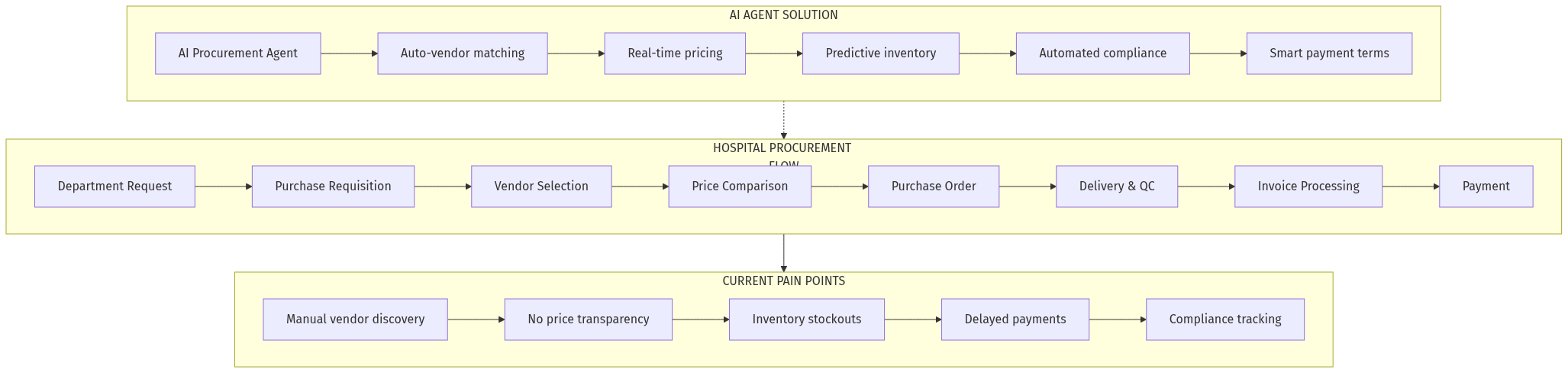
Current workflow pain points:

  • Vendor Discovery is Manual — Hospital procurement managers spend hours calling vendors, asking for quotes, and comparing prices. New vendors are discovered through word-of-mouth or trade shows.
  • No Price Transparency — The same medical supply can vary 30-50% between vendors. There's no centralized pricing benchmark.
  • Inventory Stockouts Cause Crises — Hospitals frequently run out of critical supplies because there's no predictive analytics. Emergency purchases command premium prices.
  • Compliance is a Nightmare — Medical supplies require batch tracking, expiry monitoring, and regulatory compliance (Drugs & Cosmetics Act, CDSCO regulations). Most hospitals manage this on paper or Excel.
  • Payment Chaos — Small vendors often wait 60-90 days for payment. Good vendors stop supplying; hospitals lose trust.
  • No Data-Driven Decisions — Procurement decisions are based on intuition, not data. Which vendor is most reliable? Which product has the best margin?
  • Who Experiences This Pain?

    • Mid-sized private hospitals (50-200 beds) — Most underserved, no dedicated procurement teams
    • Nursing homes and clinics — Completely manual, no bargaining power
    • Government hospitals — PLSSS tender processes are notoriously slow and opaque
    • Diagnostic chains — Need consistent supply across multiple locations
    • Small pharma retailers — Also struggle with procurement efficiency

    3.

    Current Solutions

    CompanyWhat They DoWhy They're Not Solving It
    MedikabazaarB2B medical supplies marketplaceFocuses on catalog; no AI procurement agent
    ShopmedsOnline pharmacy B2BRetail-focused, not hospital procurement
    MedplusPharma retail chainBackward integration only
    Ayu HealthHospital network with suppliesNetwork-only, doesn't serve external hospitals
    PharmEasyConsumer pharma marketplaceConsumer focus, not B2B hospital procurement

    What's Missing

    • AI-powered procurement agents that negotiate on behalf of hospitals
    • Predictive inventory that warns of stockouts before they happen
    • Real-time price benchmarking across vendors
    • Automated compliance tracking for regulated medical supplies
    • Smart payment terms that optimize vendor relationships

    4.

    Market Opportunity

    Market Size

    • India Hospital Procurement Market: $50+ billion annually (2026)
    • Global Medical Supply Chain: $200+ billion
    • Healthcare IT Spending in India: $15 billion (2026), growing 15% CAGR

    Growth Drivers

  • Healthcare Infrastructure Boom — India adding 1 million+ hospital beds by 2025
  • Insurance Penetration — Ayushman Bharat and private insurance driving volume
  • Quality mandates — NABH accreditation requires better documentation
  • Digital health push — Government promoting digital health records and procurement
  • Post-COVID awareness — Supply chain resilience is now a board-level concern
  • Why Now

  • WhatsApp proliferation — Every vendor and hospital is already on WhatsApp—perfect for AI agent integration
  • UPI infrastructure — Real-time payments enable new business models
  • Language models — Can handle multilingual procurement conversations (Hindi, Tamil, Telugu, etc.)
  • Trust building — COVID proved supply chain fragility; hospitals are ready for change

  • 5.

    Gaps in the Market

    Gap 1: No Intelligent Vendor Matching

    When a hospital needs 500 units of a specific syringe type, there's no system that automatically matches them to qualified vendors based on price, location, delivery time, and reliability.

    Gap 2: Price Opacity Across Regions

    The same product can cost 40% differently in tier-2 cities vs. metros. No platform provides real-time regional price benchmarking.

    Gap 3: Predictive Inventory

    Most hospitals order reactively—when they run out. AI can predict usage patterns and suggest orders before stockouts, while optimizing for bulk discounts.

    Gap 4: Compliance Automation

    Batch-level traceability, expiry tracking, and regulatory compliance documentation are manual and error-prone. One wrong batch can cause regulatory action.

    Gap 5: Vendor Financial Health

    Hospitals don't know if a vendor is about to close. AI can monitor financial signals and flag risky vendors before they disappear.

    Gap 6: Cross-Hospital Buying Power

    Individual hospitals have no bargaining power. A platform that aggregates demand across hospitals can negotiate 20-30% better pricing.
    6.

    AI Disruption Angle

    How AI Agents Transform Hospital Procurement

    The AI Procurement Agent acts as a virtual procurement manager:
  • Natural Language Request — Hospital staff sends a WhatsApp message: "Need 1000 units of 3ml syringes by next Tuesday." Agent understands the request.
  • Vendor Intelligence — Agent queries its database of vetted vendors, checks real-time pricing, delivery capabilities, and past performance.
  • Smart Negotiation — Agent negotiates with multiple vendors simultaneously, presenting the hospital with optimal options.
  • Order Execution — Agent places the order, tracks delivery, and handles documentation.
  • Post-Delivery Analysis — Agent validates quality, tracks payment terms, and builds vendor performance profiles for future recommendations.
  • Workflow Transformation

    Before AI:
    Hospital Need → Phone/WhatsApp → Vendor Discovery (manual)
    → Price Quote (wait 2-3 days) → Compare → Negotiate → Order
    → Delivery → QC → Invoice → Payment (60-90 days)
    After AI:
    Hospital Need → AI Agent → Instant Vendor Match + Price
    → One-click Order → Automated Tracking → Payment Optimization

    The Moat: Learning from Every Transaction

    Every order teaches the AI about:

    • Which vendors deliver on time
    • Which products have consistent quality
    • Which hospitals use what, and when
    • Price elasticity by region and volume
    • Optimal payment terms that balance cash flow and vendor relationships
    This data compound creates an unbeatable advantage over time.


    7.

    Product Concept

    Core Features

  • AI Procurement Chatbot — WhatsApp-based interface for placing orders, checking status, and resolving issues
  • Vendor Network — Verified vendor database with capabilities, certifications, pricing, and performance history
  • Price Intelligence — Real-time benchmarking across vendors, regions, and volumes
  • Predictive Inventory — AI forecasts usage and suggests reordering points
  • Compliance Engine — Automated batch tracking, expiry alerts, and regulatory documentation
  • Smart Payments — Integrated payment gateway with dynamic discounting for early payment
  • Analytics Dashboard — Spend analysis, vendor performance, savings reports
  • User Flow

  • Onboarding — Hospital registers, uploads current vendor list, sets procurement policies
  • Request — Staff sends request via WhatsApp or dashboard
  • Matching — AI matches to 3-5 vendors based on criteria
  • Approval — Manager approves with one tap
  • Execution — AI places order, tracks delivery
  • Settlement — Payment processed per terms
  • Revenue Model

    • Commission: 3-8% on successful transactions (passed to hospital or vendor)
    • SaaS Subscription: ₹10,000-50,000/month for advanced features (analytics, predictive inventory)
    • Premium Listings: Vendors pay for featured placement and AI highlighting
    • Data Services: Anonymized market intelligence sold to manufacturers

    8.

    Development Plan

    PhaseTimelineDeliverables
    MVP8 weeksWhatsApp chatbot, 50 vetted vendors, basic ordering, manual QC
    V112 weeksPrice intelligence, vendor ratings, payment integration, analytics
    V216 weeksPredictive inventory, compliance engine, multi-hospital aggregation
    ScaleOngoingRegional expansion, manufacturer integrations, AI refinements

    Technical Stack

    • Frontend: React + Next.js (dashboard), WhatsApp Business API (interface)
    • Backend: Node.js + Python (AI/ML)
    • Database: PostgreSQL + Redis
    • AI: LangChain + OpenAI/Gemini for NLP, custom ML models for predictions
    • Payments: Razorpay + UPI

    9.

    Go-To-Market Strategy

    Phase 1: Hospital Clusters (Months 1-3)

  • Target 20 hospitals in one city (e.g., Hyderabad or Pune)
  • Partner with medical associations (AHPI, IMA chapters)
  • Offer free pilot for 3 months in exchange for feedback
  • Leverage existing vendor relationships — bring their own vendors onto platform
  • Phase 2: Network Effects (Months 4-8)

  • Demonstrate savings — Show 10-15% average savings per hospital
  • Launch group buying — Aggregate demand for common items
  • Add hospital clusters — Expand to 5-10 cities
  • Onboard manufacturers — Direct factory relationships for better pricing
  • Phase 3: Platform Dominance (Months 9-18)

  • AI agent refinement — Continuous learning from transactions
  • Government tenders — Target state and central government hospitals
  • Insurance integration — Partner with TPAs and insurance companies
  • Expand to diagnostics — Labs, imaging centers, dental chains
  • Acquisition Channels

    • Medical trade shows (Medicall, Hospital Build)
    • Doctor association conferences
    • LinkedIn targeted ads for hospital administrators
    • Referral program for existing hospital customers

    10.

    Why This Fits AIM Ecosystem

    This platform aligns perfectly with AIM's vision:

  • Vertical Focus — Hospital procurement is a clearly defined vertical with distinct workflows
  • Data Moat — Transaction data compounds into powerful AI insights
  • B2B Marketplace — Matches AIM's core competency in B2B platforms
  • Offline-to-Online — The market is highly offline, perfect for AI agent bridge
  • High-Trust — Healthcare requires trust; AI can build reputation systems
  • Recurring Revenue — Hospitals need supplies continuously—high LTV
  • Potential as AIM Vertical

    Could become AIM.health — the definitive hospital procurement platform in India, then expanding to:

    • Medical equipment rental
    • Healthcare staff augmentation
    • Hospital waste management
    • Insurance claims processing
    ---

    ## Verdict

    Opportunity Score: 8.5/10 Rationale:
    • Massive market ($50B+) with severe fragmentation
    • Clear pain points that AI can solve
    • Network effects create defensibility
    • India-specific opportunity (infrastructure boom, WhatsApp penetration)
    • Recurring revenue model with high LTV
    Risks:
    • Healthcare regulations are complex
    • Trust building takes time
    • Vendor adoption may be slow
    • Competition from established B2B players
    Recommendation: This is a high-potential opportunity that should be explored. The ideal entry point is to start with a narrow category (e.g., medical consumables) in one city, prove the model, then expand. The key differentiator is the AI agent—make it the primary interface, not just a feature.

    ## Sources

    Procurement Flow Diagram
    Procurement Flow Diagram