ResearchFriday, March 6, 2026

AI-Powered B2B Industrial Safety Equipment Marketplace

India's workplace safety equipment market is highly fragmented, compliance-heavy, and ripe for AI disruption. A verticalized marketplace connecting buyers with verified suppliers, augmented by intelligent compliance checking and automated procurement agents, represents a $2.8B opportunity.

8
Opportunity
Score out of 10
1.

Executive Summary

The Indian industrial safety equipment market—valued at $2.8 billion—is undergoing a tectonic shift. Regulatory enforcement is tightening, manufacturing clusters are expanding, and corporate ESG commitments are driving unprecedented procurement volume. Yet 80% of transactions still happen offline through fragmented dealer networks.

This creates a massive opportunity for an AI-powered B2B marketplace that:

  • Digitizes the fragmented supplier base
  • Automates compliance verification against Indian safety standards
  • Enables intelligent inventory monitoring and auto-replenishment
  • Provides transparent pricing for a traditionally opaque market
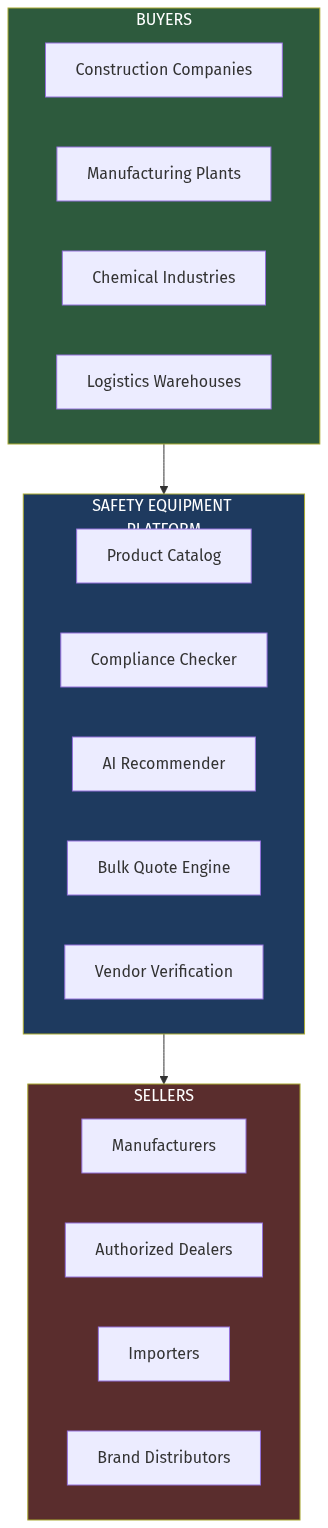
The marketplace would serve as the digital backbone for India's workplace safety ecosystem.


2.

Problem Statement

The Buyer's Pain

Fragmented Supply Chain Indian manufacturing plants and construction companies source safety equipment from hundreds of local dealers, each carrying limited inventory. A single plant needs 50+ SKUs across categories—helmets, gloves, eye protection, respiratory gear, fall arrest equipment—from multiple suppliers. Compliance Complexity The Directorate General of Factory Advice Service (DGFASLI) mandates specific equipment for different hazard types. Buyers struggle to:
  • Verify if equipment meets IS/ISO standards
  • Track certification validity
  • Ensure proper PPE selection for specific hazards
Opaque Pricing Dealer markups vary 30-200% across regions. No price transparency forces buyers to manually negotiate every transaction. Inventory Management Burden Safety equipment is often treated as an afterthought—stockouts cause work stoppages, while overstocking ties up capital.

The Seller's Pain

Limited Reach Manufacturers rely on regional dealer networks. Breaking into new markets requires significant distribution investment. Payment Delays B2B safety equipment sales involve 30-90 day payment cycles, creating working capital stress. Counterfeit Risk Fake ISI-marked products flood the market, damaging brand reputation.
3.

Current Solutions

CompanyWhat They DoWhy They're Not Solving It
UdyogiMajor Indian PPE manufacturer with dealer networkB2C-focused, no marketplace platform
3M IndiaGlobal brand via authorized distributorsPremium pricing, limited product range
SafetyStoreOnline safety equipment retailB2C-focused, no bulk/enterprise features
IndiaMart (Safety Category)General B2B marketplaceNo compliance verification, no structured catalog
GeekayIndustrial safety equipment manufacturerSingle-brand, limited categories

Key Gap Analysis

  • No vertical-specific marketplace — General B2B platforms (IndiaMart, TradeIndia) lack safety equipment expertise
  • No compliance automation — No platform verifies IS/ISO certifications in real-time
  • No AI procurement — No intelligent inventory monitoring or auto-reorder capabilities
  • No quality assurance — No third-party verification to combat counterfeit products

  • 4.

    Market Opportunity

    Market Size

    • Global Workplace Safety Equipment Market: $58.7 billion (2025)
    • India Market: $2.8 billion (estimated 2025)
    • CAGR: 8.5% through 2030

    Growth Drivers

    Regulatory Enforcement The new Occupational Safety, Health and Working Conditions Code (OSHCode 2020) mandates employers provide appropriate PPE. Enforcement is ramping up across states. Manufacturing Expansion PLI schemes are driving new factory construction across Gujarat, Tamil Nadu, Maharashtra, and Telangana—each requiring safety equipment procurement. ESG & Insurance Requirements Corporate buyers increasingly require documented safety compliance for:
    • Insurance coverage
    • ESG ratings
    • Export certifications
    • Corporate audits
    Infrastructure Boom Government infrastructure spend ($1.7 trillion) drives demand across construction, railways, and metro projects.
    5.

    Gaps in the Market

    Gap 1: No Structured Product Database

    Safety equipment categories are poorly structured online. A buyer cannot easily find "Class A Fall Arrest Harness with IS 3521 certification" across multiple sellers.

    Gap 2: Certification Verification is Manual

    Buyers must separately verify ISI marks, test certificates, and manufacturer credentials—often via phone calls and PDFs.

    Gap 3: No Bulk Pricing Transparency

    Volume discounts are negotiated privately. Buyers have no benchmark for fair pricing.

    Gap 4: No Integrated Inventory Visibility

    Suppliers don't show real-time stock. Buyers face backorders without warning.

    Gap 5:碎片化的供应商网络

    Tier 2-3 cities have limited access to branded safety equipment. Dealers in these regions markup prices 50%+ due to supply scarcity.
    6.

    AI Disruption Angle

    Intelligent Catalog Management

    AI-powered product classification automatically maps supplier SKUs to standardized categories (IS 13877 for Helmets, IS 15242 for Eye Protection, etc.), creating a unified catalog across thousands of sellers.

    Compliance Automation

    Computer vision can verify certification marks on product images. NLP can parse test certificates and auto-populate compliance profiles. The system flags non-compliant products automatically.

    AI Procurement Agents

    For enterprise buyers, AI agents can:
    • Monitor inventory levels via integration with ERP
    • Auto-trigger reorder when stock hits threshold
    • Negotiate with multiple suppliers simultaneously
    • Verify compliance before purchase approval

    Price Intelligence

    Aggregate transaction data creates real-time pricing benchmarks, eliminating information asymmetry.

    Counterfeit Detection

    Image analysis compares product photos against manufacturer reference images to detect counterfeits at point of listing.
    7.

    Product Concept

    Platform Features

    For Buyers:
  • Unified Catalog — Search across 500+ verified suppliers
  • Compliance Filter — Filter by IS/ISO standards, hazard type, industry
  • Bulk Quote Engine — Get quotes from 5+ suppliers in one click
  • AI Recommender — "Based on your industry and hazard profile, we recommend..."
  • Inventory Dashboard — Track spend, usage patterns, reorder points
  • Document Vault — Store SDS (Safety Data Sheets), test certificates
  • For Sellers:
  • Digital Catalog Management — Upload products with certification docs
  • Lead Generation — Receive qualified inquiries matching their products
  • Payment Protection — Escrow-style payments reduce bad debt
  • Logistics Integration — Fulfillment support for smaller sellers
  • Brand Protection — Anti-counterfeit verification tools
  • Revenue Model

    StreamDescriptionPotential
    Commission3-8% on transactionsHigh
    SubscriptionPremium features for buyers ($99-999/mo)Medium
    Listing FeesFeatured placement for sellersMedium
    Data ServicesCompliance reports, market intelligenceLow
    FinancingB2B BNPL via partner NBFCsHigh (future)
    ---
    8.

    Development Plan

    PhaseTimelineDeliverables
    MVP8 weeksProduct catalog (50 suppliers), basic search, inquiry form
    V116 weeksCompliance verification, bulk quotes, seller dashboard
    V224 weeksAI recommendations, inventory integration, payments
    V336 weeksAI procurement agents, BNPL, ERP integrations

    MVP Features

    • Web + mobile responsive platform
    • Product categorization (10 categories, 100 subcategories)
    • Supplier verification (basic documents)
    • Search with filters
    • Inquiry management system
    • Basic analytics dashboard

    9.

    Go-To-Market Strategy

    Phase 1: Supply Seeding (Weeks 1-4)

  • Partner with 50 Tier 1-2 manufacturers/dealers in Gujarat (chemical corridor) and Maharashtra (manufacturing belt)
  • Offer free listings + guaranteed payments within 7 days
  • Onboard via dedicated account manager (not self-serve yet)
  • Phase 2: Demand Acquisition (Weeks 5-12)

  • Target mid-sized manufacturers (100-1000 employees) in Gujarat, Maharashtra, Tamil Nadu
  • Offer first 3 months free for buyers who provide verified purchase history
  • Attend trade shows (Industrial Safety Summit, ACETECH)
  • LinkedIn outreach to EHS (Environment, Health, Safety) managers
  • Phase 3: Network Effects (Weeks 13-24)

  • Enable supplier bidding on buyer inquiries (marketplace dynamics)
  • Launch AI recommendations based on industry profiles
  • Introduce subscription plans for buyers wanting advanced features

  • 10.

    Revenue Model Detail

    Transaction Commission

    • Standard: 5% on GMV
    • Bulk (>₹10L order): 3%
    • Premium brands: 7%

    Buyer Subscriptions

    PlanPriceFeatures
    Starter₹5,000/mo10 inquiries, basic search
    Professional₹25,000/moUnlimited inquiries, AI recommendations, analytics
    EnterpriseCustomDedicated account manager, API access, ERP integration

    Seller Subscriptions

    PlanPriceFeatures
    BasicFree50 products, basic analytics
    Growth₹10,000/moUnlimited products, featured listings, priority support
    Premium₹50,000/mo+ BNPL access, dedicated sales support
    ---
    11.

    Data Moat Potential

    Proprietary Datasets

    Compliance Database As the platform processes certifications, it builds the first structured database of Indian safety equipment compliance—IS mark verification, test certificate tracking, manufacturer certification status. Pricing Intelligence Transaction data creates the first real-time price index for industrial safety equipment in India. Usage Patterns Buyer purchase history reveals industry-specific consumption patterns—valuable for forecasting and recommendations.

    Network Effects

    More buyers → more supplier demand → better prices → more buyers. The marketplace naturally consolidates over time.


    12.

    Why This Fits AIM Ecosystem

    Vertical Integration

    Safety equipment procurement connects to existing AIM verticals:
    • Construction materials — Every construction site needs safety gear
    • Industrial machinery — Machine operators require PPE
    • Chemicals — Hazmat environments need specialized protection

    Data Pipeline

    Procurement data flows into AIM's B2B intelligence network, enriching company profiles with supply chain insights.

    Agent Opportunity

    AI procurement agents for repetitive safety equipment orders represent the first step toward autonomous B2B purchasing.

    ## Verdict

    Opportunity Score: 8/10

    Strengths

    • Large, growing market ($2.8B India)
    • Highly fragmented supply—digitization value clear
    • Compliance complexity creates moat
    • Clear AI enhancement path (cataloging, verification, procurement)
    • Multiple revenue streams

    Risks

    • Trust building takes time in B2B safety
    • Large incumbents (3M, Udyogi) may launch competing platforms
    • Compliance regulations vary by state
    • Need significant supply-side seeding investment

    Recommendation

    This is a high-potential vertical that should be built. Start with MVP focused on Gujarat chemical/manufacturing corridor, prove supply-demand dynamics, then expand. Next Steps:
  • Map top 100 safety equipment suppliers in Gujarat
  • Interview 20 EHS managers about procurement pain points
  • Build MVP with 50 seeded suppliers
  • Launch buyer acquisition in Surat-Ahmedabad industrial cluster

  • ## Sources

    Architecture Diagram
    Architecture Diagram

    Procurement Flow
    Procurement Flow
