ResearchFriday, March 6, 2026

AI-Powered B2B Equipment Financing Marketplace

An AI agent-driven platform that instantly matches SMEs with equipment lenders, automating credit assessment, documentation, and approval—solving the $50B+ MSME financing gap in India.

1.

Executive Summary

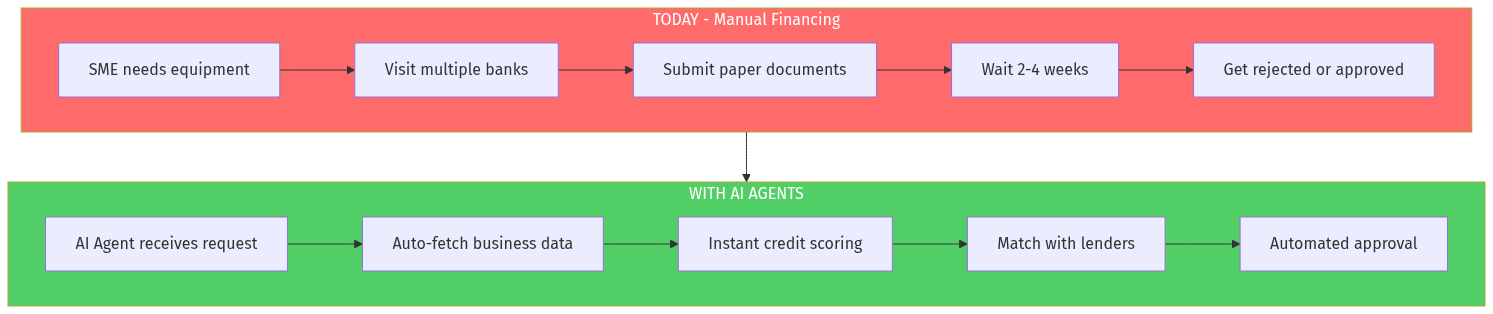
India's 63 million micro, small, and medium enterprises (MSMEs) face a $50+ billion financing gap. Equipment financing—a critical enabler for business growth—remains stuck in manual, paper-heavy processes with 40%+ rejection rates and 2-4 week turnaround times.

This article proposes an AI-powered B2B equipment financing marketplace that automates the entire lending workflow: from instant credit scoring using alternative data, to matching SMEs with the right lenders, to automated document processing and near-instant approval.

Opportunity Score: 8.5/10
2.

Problem Statement

The MSME Financing Crisis

India's MSME sector contributes 30% of GDP and employs 110 million people. Yet, despite government initiatives like MUDRA loans and Credit Guarantee Fund Trust, access to credit remains the top constraint for MSME growth.

Key Pain Points:
  • Manual Documentation Overload - SMEs must submit bank statements, tax returns, GST returns, equipment quotes, business registration documents—often 20+ pages per application
  • Slow Approval Cycles - Traditional equipment financing takes 2-4 weeks for initial response, 4-8 weeks for final approval
  • High Rejection Rates - 40-50% of MSME equipment financing applications are rejected, often due to insufficient credit history or documentation issues
  • No Optimal Matching - SMEs don't know which lender suits their profile. They apply to multiple banks, getting rejected repeatedly—damaging their credit score
  • Fragmented Lender Network - 30+ banks, 50+ NBFCs, and hundreds of equipment finance companies compete—but SMEs have no efficient way to identify the right match
  • Collateral Requirements - Traditional lenders require property or equipment as collateral, excluding 70%+ of MSMEs
  • Who Experiences This Pain?

    • Manufacturing SMEs needing CNC machines, industrial boilers, packaging equipment
    • Restaurant/HO.RE.CA owners needing commercial kitchen equipment, HVAC
    • Healthcare providers needing diagnostic equipment, hospital furniture
    • Construction contractors needing excavators, cranes, concrete mixers
    • Logistics companies needing trucks, forklifts, warehouse equipment

    3.

    Current Solutions

    CompanyWhat They DoWhy They're Not Solving It
    CreditasNBFC focused on MSME secured loansManual underwriting, slow turnaround
    LendingKartDigital MSME lending platformLimited equipment financing specialization
    Aye FinanceMSME lender with group lendingFocus on working capital, not equipment
    MUDRA BankGovernment loan schemeGateway only, no matching intelligence
    BankBazaarComparison platformManual application, no AI underwriting

    Market Gaps Identified

  • No AI-powered credit scoring using alternative data (GST, bank transactions, equipment utilization)
  • No instant pre-approval - all processes still require manual review
  • No lender-SME matching intelligence - SMEs apply blindly
  • No equipment-specific financing products - generic MSME loans
  • No automated documentation - still requires physical document submission

  • 4.

    Market Opportunity

    Market Size

    • India Equipment Finance Market: $45-50 billion (2025)
    • MSME Credit Gap: $50+ billion
    • Annual Growth Rate: 15-18% CAGR

    Why Now?

  • UPI Revolution Has Digitalized MSME Payments - 70%+ of B2B transactions now digital, creating rich transaction data
  • GST Ecosystem Provides Transparency - Monthly GST returns create verifiable business performance data
  • Government Push for MSME Credit - Emergency Credit Line Guarantee Scheme (ECLGS) added $40B+ in guarantees
  • NBFC Digitization - All major NBFCs have APIs, enabling automated lending
  • AI/ML Maturity - Credit scoring models can now use alternative data for thin-file customers
  • WhatsApp Penetration - 400M+ users, enabling chat-based financing journeys
  • Target Segments

    SegmentEquipment TypeAvg Ticket SizeFinancing Need
    ManufacturingCNC, injection molding₹10-50 lakhHigh
    RestaurantsKitchen, HVAC₹2-20 lakhMedium
    HealthcareDiagnostic equipment₹5-30 lakhHigh
    ConstructionExcavators, cranes₹20-100 lakhVery High
    LogisticsTrucks, forklifts₹10-75 lakhHigh
    ---
    5.

    Gaps in the Market

    Critical Gaps (Anomaly Hunting)

  • No "Equipment Financing CRM" for SMEs - SMEs have no way to track application status across lenders
  • No used equipment financing - 80% of equipment purchased in India is used, but no lender specializes in used equipment financing
  • No revenue-based financing for equipment - Instead of EMI, charge % of revenue—aligns repayment with equipment-generated income
  • No equipment-as-collateral without title - Equipment can be tracked via IoT, eliminating need for title documents
  • No financing bundled with maintenance - Equipment breaks = business stops. No bundled offerings
  • No cross-border equipment financing - Importing equipment? No unified platform for domestic + import financing
  • Incentive Mapping (Why Status Quo Persists)

    • Banks prefer corporate loans over MSME (lower risk, higher ticket)
    • NBFCs chase high-yield segments, ignore thin-file MSMEs
    • Equipment dealers profit from cash purchases (no financing discount)
    • Accountants/CA agents earn referral fees from specific lenders, creating bias

    6.

    AI Disruption Angle

    How AI Agents Transform Equipment Financing

    Workflow Diagram
    Workflow Diagram

    #### Stage 1: Intelligent Intake (AI Agent)

    • Chat-based application via WhatsApp/Slack
    • Voice-to-text for semi-literate entrepreneurs
    • OCR document extraction from uploaded documents
    • Auto-fill from GSTIN, PAN, bank account data
    #### Stage 2: Alternative Credit Scoring
    • GST return analysis - Revenue trends, tax compliance, supplier diversity
    • Bank statement analysis - Cash flow patterns, operating expenses, seasonality
    • Equipment utilization proxies - Electricity bills, Google Maps foot traffic, UPI transaction volume
    • Social proof - Google reviews, LinkedIn business connections, supplier references
    • Psychometric scoring - Response patterns, consistency of data
    #### Stage 3: Smart Lender Matching
    • Multi-lender API integration - Submit to 10+ lenders with single application
    • Real-time eligibility check - Before full application, check likely approval
    • Optimal match ranking - Sort by interest rate, approval probability, processing time
    • Portfolio optimization - For lenders, AI optimizes loan portfolio mix
    #### Stage 4: Automated Underwriting
    • Rule engine - Apply lender-specific criteria automatically
    • ML risk model - Predict default probability using 100+ signals
    • Fraud detection - Identity verification, document forgery detection
    • Collateral valuation - IoT device + market data for equipment valuation
    #### Stage 5: Instant Disbursement
    • Digital loan agreement - E-sign with Aadhaar validation
    • Escrow automation - Funds released to equipment supplier on delivery confirmation
    • IoT tracking - Equipment with GPS enables "pay-as-you-use" financing

    Future: Agent-to-Agent (A2A) Financing

    The ultimate vision: AI agents negotiating with AI agents.

    • SME's business agent negotiates with lender's risk agent
    • Equipment supplier's agent coordinates delivery with financier
    • Automated KYC, compliance, and settlement
    • Target: From 4-week approval to 4-minute approval

    7.

    Product Concept

    Platform: EquipFlow.ai

    Core Features:
  • Smart Application Assistant
  • - WhatsApp/Slack bot for application - Document upload with auto-extraction - Real-time application tracking - Push notifications for status updates
  • Credit Intelligence Engine
  • - Alternative data scoring (GST, bank, UPI) - Real-time credit bureau integration - Custom scorecards by equipment type - Fraud detection pipeline
  • Lender Marketplace
  • - 50+ lender API integrations - Dynamic eligibility matching - Reverse auction for best rates - Automated application submission
  • Digital Underwriting
  • - AI-powered risk assessment - Automated document verification - Instant approval for qualified applicants - Hybrid human-AI review for complex cases
  • Disbursement & Tracking
  • - E-sign loan agreements - Escrow-based disbursement to suppliers - IoT equipment tracking (optional) - Repayment automation via NACH

    User Flow

    SME → WhatsApp Bot → Submit GSTIN/PAN → AI Scoring → 
    Lender Matching → Select Offer → E-Sign → 
    Supplier Notified → Equipment Delivered → Repayment via UPI/NACH

    8.

    Development Plan

    PhaseTimelineDeliverables
    MVP8 weeksWhatsApp bot, GST/Bank statement analysis, 5 lender integrations, basic matching
    V112 weeksCredit scoring engine, 20+ lenders, IoT tracking integration, NACH automation
    V216 weeksA2A protocol implementation, revenue-based financing, used equipment module
    Scale24 weeks100+ lender network, cross-border financing, equipment marketplace

    Technical Stack

    • Frontend: React + WhatsApp Business API
    • Backend: Node.js + Python (ML)
    • Credit Engine: Python scikit-learn + TensorFlow
    • Data: GST API, Bank APIs (Plaid equivalent), CIBIL
    • Payments: NACH, UPI, Escrow

    9.

    Go-To-Market Strategy

    Phase 1: Supplier Partnerships (Month 1-3)

  • Partner with equipment dealers - Those without financing options lose 30% of sales
  • Co-branded financing offers - Dealer promotes "Instant Approval" at point of sale
  • Revenue share - 0.5-1% of financed amount to dealer
  • Phase 2: Digital Acquisition (Month 3-6)

  • SEO for "equipment financing [city]" - High-intent keywords
  • Google Ads - Target SME equipment queries
  • WhatsApp marketing - Reach SME owners directly
  • CA/Accountant partnerships - They recommend financing to clients
  • Phase 3: Lender Enablement (Month 6-12)

  • API-first approach - Make it easy for lenders to integrate
  • Portfolio dashboard - Lenders see pipeline, performance
  • Performance guarantees - AI underwriting with skin-in-the-game
  • Phase 4: Ecosystem Expansion

  • Government scheme integration - MUDRA, ECLGS, state schemes
  • Insurance bundling - Equipment + business interruption insurance
  • Maintenance contracts - Bundled service agreements

  • 10.

    Revenue Model

    Primary Revenue Streams

  • Lender Referral Fee
  • - 0.5-2% of financed amount - Paid by lender on successful disbursement - Example: ₹10 lakh loan × 1% = ₹10,000 referral
  • Processing Fee
  • - 0.25-0.5% from SME - Charged on approved loans - Example: ₹10 lakh × 0.5% = ₹5,000 processing
  • Interest Rate Differential
  • - Offer SME rate + margin to platform - Example: 12% to SME, 11% to lender, 1% platform margin
  • Data/Intelligence Services
  • - Credit reports to lenders (B2B) - Market insights to equipment manufacturers - Pricing: ₹500-2,000 per report

    Secondary Revenue Streams

  • Equipment Marketplace
  • - Commission on equipment sales (1-3%) - Featured listings from dealers
  • Premium Features
  • - Instant approval (₹999) - Priority processing (₹499) - Dedicated relationship manager (₹2,500/month)

    Unit Economics

    MetricTarget
    Customer Acquisition Cost₹3,000
    Average Loan Ticket₹15 lakh
    Revenue per Loan₹20,000 (1.3%)
    Lifetime Value₹45,000 (2-3 loans per SME)
    LTV/CAC Ratio15x
    ---
    11.

    Data Moat Potential

    Proprietary Data Accumulation

  • Credit Performance Data
  • - What signals predict default? - Which equipment types have best payback? - Industry-specific risk patterns
  • SME Behavior Data
  • - Application drop-off points - Document submission patterns - Lender preference patterns
  • Lender Performance Data
  • - Approval rates by profile - Disbursement speed - Post-disbursement behavior
  • Equipment Pricing Data
  • - Real-time equipment pricing - Depreciation curves - Resale value trends

    Competitive Moat

    • Network Effects: More SMEs → better lender rates → more SMEs
    • Data Moat: 100K applications → superior credit model
    • Switching Costs: SME financial history locked in platform

    12.

    Why This Fits AIM Ecosystem

    Vertical Alignment

    This platform aligns with AIM.in's core thesis:

  • Fragmented marketplace - 50+ lenders, 63M SMEs, no dominant player
  • Offline-heavy workflow - Traditional paper-based, ripe for digitization
  • High-trust sector - Financial transactions require credibility
  • AI-native opportunity - Credit scoring is AI's strongest use case
  • Cross-Selling Opportunities

    • Equipment marketplace - Link financing to equipment purchasing
    • Supply chain intelligence - Use supplier data for credit assessment
    • B2B payments - Integrate with UPI for repayment automation

    Expansion Path

  • Start with equipment financing
  • Expand to working capital loans
  • Add invoice financing
  • Build full MSME banking platform

  • ## Verdict

    Opportunity Score: 8.5/10

    This is a high-impact, AI-solvable problem in a massive market. The timing is optimal—India's digital payments infrastructure (UPI, GST) now provides the data foundation for AI-powered credit scoring.

    Strengths

    • Massive market gap ($50B+)
    • Clear AI application (credit scoring)
    • Strong unit economics
    • Data moat compounds over time
    • Regulatory tailwinds (govt push for MSME credit)

    Risks & Mitigations

    RiskMitigation
    Lender API integration complexityStart with 5 major NBFCs, expand
    Credit model inaccuracyHybrid AI + human review, portfolio guarantees
    Regulatory changesStay close to RBI guidelines, diversify lender mix
    FraudMulti-layer verification, IoT tracking
    CompetitionVertical specialization > horizontal play

    Why 8.5/10?

    Not a 10 because:

    • Regulatory uncertainty in lending
    • Need for significant capital for lender partnerships
    • Building lender network is slow
    But strong fundamentals: clear problem, proven market, AI-native solution, and massive scale.


    ## Sources